Wasted Potential
#notes#academia#science#ego#credit#personal
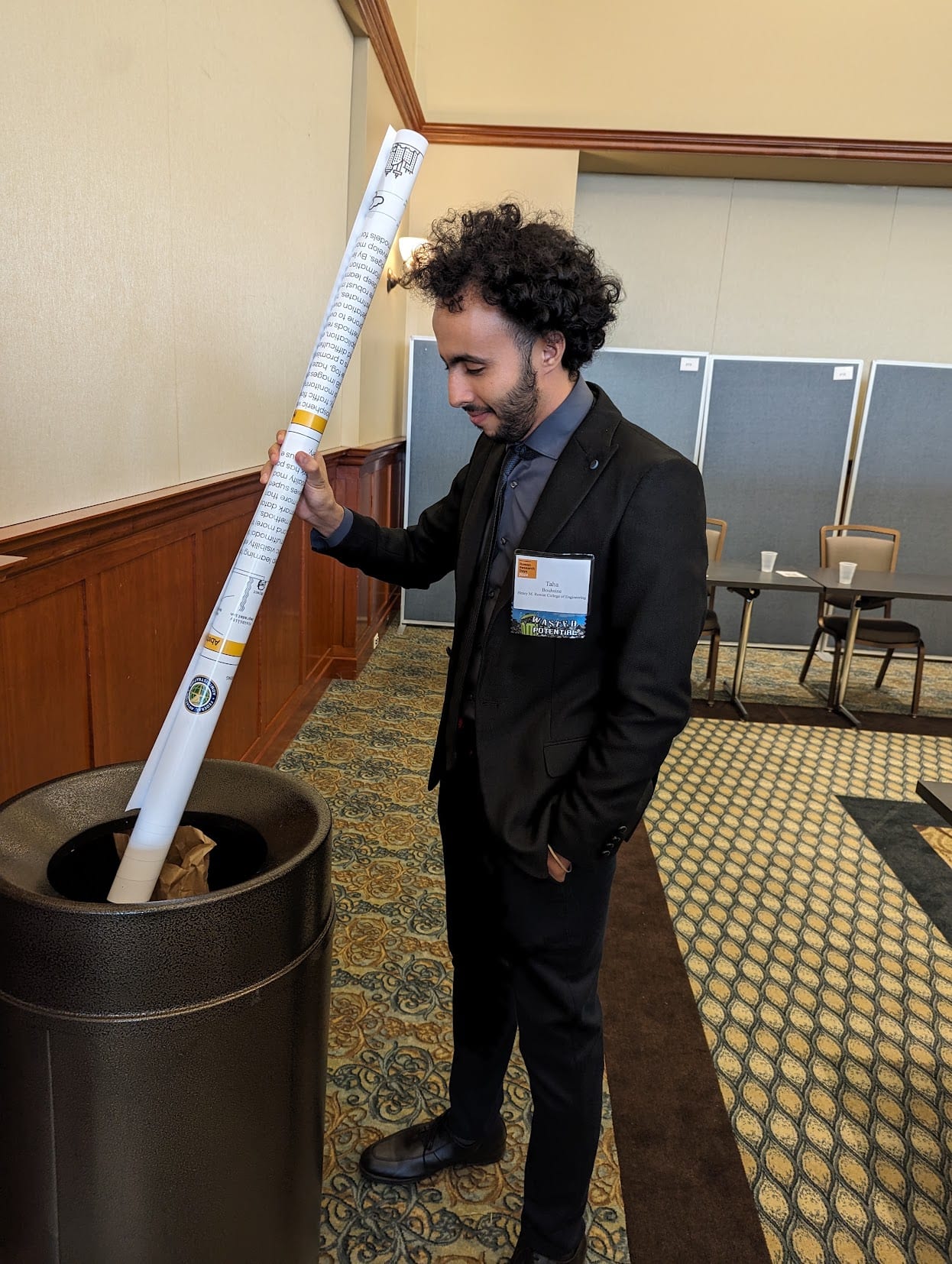
There was a bowl of stickers on the table, the kind conferences put out to make you feel like you belong. I looked through them and I picked this one on purpose. Wasted Potential. I clipped it under the badge with my college on it and I wore it all day, and it was not a joke, or it was the kind of joke you tell because saying the true thing plainly would be too much. I had been feeling it for a while: that I was spending my one supply of curiosity in the wrong place, in a room that did not reward it, an environment that did not feed the thing I was actually good at and only knew how to spend my time on politics and ego. So I labeled myself with the diagnosis. And at the end I rolled up the poster I had spent weeks on and fed it, slowly, into a trash can, and someone took a photo. A man in a good suit throwing away the thing he made, wearing the name of what the place was doing to him.
I keep coming back to it because it is not really about that poster. It is about a machine I walked into as a kid who liked knowing things, and only noticed years later that the machine does not run on knowing things. It runs on something adjacent, something that looks like knowing from a distance, and the whole trick of a career in it is to never look too closely at the gap. Picking that sticker was the first time I looked at the gap on purpose and refused to pretend I did not see it.
What actually moves a scientist
Before I say anything about the machine, I want to be honest about the animal it is supposed to feed, because the machine only hurts if you understand what it is starving.
The thing that makes someone a researcher is not intelligence. There are plenty of brilliant people who never once felt it. It is closer to an itch that does not turn off. You see something that does not fit, a number that is a little too round, a result that everybody accepts and nobody can quite explain, a plot with a bump in it that the paper waved away in one sentence, and instead of moving on you feel a small physical discomfort, and the only thing that relieves it is finding out why. Curiosity, when it is real, is not a pleasant hobby. It is a compulsion with a deadline you set yourself, and it will keep you up at 2am running one more version of the thing while the rational part of you begs you to sleep.
And there is a specific joy on the other side of it that I do not know how to describe to people who have not felt it. It is the moment the code finally runs and the curve bends the way the theory said it would. The moment a proof closes and you can feel, physically, that a thing which was cloudy an hour ago is now solid and will stay solid forever. It is quiet. It usually happens alone. There is no applause, because nobody else is in the room and nobody else would understand what just happened anyway. For about a minute you are the only human alive who knows this one small true thing, and it is enough. That minute is the entire reason. Everything else, the papers, the talks, the titles, is supposed to be scaffolding around protecting that minute.
That is the mind the system inherits. Someone who will work harder than any incentive could ever justify, for free, forever, as long as you let them chase the itch and, crucially, as long as somebody occasionally tells them the thing they found is real. Hold onto that second condition. It is where most of the damage happens.
The machine does not reward the work, it rewards the shape of the work
I came in believing science was a search. You do not know something, the world does, and you spend yourself trying to close the distance. That belief is not wrong. It is just not what gets funded.
What gets funded is the shape of a search. A proposal that reads like inevitable progress. A poster with the right density of arrows. A paper that lands in the right venue, cites the right names, gestures at the right open problems, and above all does not embarrass anyone on the committee that has to approve it. The content can be thin. It often is. The content is allowed to be thin as long as the shape is immaculate, because the shape is what other people can evaluate in the ninety seconds they will ever give it, and everyone in the system is drowning in things to evaluate in ninety seconds.
Here is what that looks like from the inside. You have a result you actually believe in, a small one, but real, the kind that gave you your minute at 2am. You bring it to the meeting and the first question is not “is it true,” it is “where can we put it.” Someone senior explains, kindly, that this venue wants a bigger story, so can you frame it as part of a bigger story. Someone else notes that the reviewers at that venue historically dislike this framing, so maybe soften the claim. A third person suggests the result would be stronger with a comparison against a method everyone knows is worse, purely so the table has more rows. By the end, the thing you were proud of is still in there somewhere, load-bearing, but it is now wearing a costume, and the meeting was not about whether it is true. Nobody in the meeting was lying. Every suggestion was correct, given the game. That is the horror of it. The game is coherent and the game is not science.
So a second discipline grows on top of the first one, and the second discipline is about producing the shape. Learning which problems are fashionable this season and which are radioactive. Learning whose lab you do not contradict. Learning to slice one honest result into three publishable units because the count is what gets read off a spreadsheet at promotion time. Learning to add the seventh author who did nothing because you will need the same favor next quarter. None of this is science. All of it is required to survive as a scientist. That is what the sticker means. The potential is not wasted by laziness. It is wasted, very efficiently, by a system that asks a curious person to spend most of their energy on everything except being curious.
You send it out, and nothing comes back
This is the part I actually needed to write, and it is the part that took me longest to admit hurt.
A researcher cannot verify their own work alone. Not really. You can check the math, rerun the experiment, stare at it until your eyes cross, but there is a kind of certainty you can only get from another mind engaging with the thing and telling you what they see. Feedback is not about praise, or it should not be. Feedback is verification. It is the thing that tells you whether you found something real or whether you spent three months elegantly fooling yourself. To ask for feedback is not weakness and it is not fishing for a compliment. It is the most fundamental act of the job. Science is other people checking your work. A result nobody has engaged with is not yet a result. It is a hope with equations attached.
So you send it out. You email the draft to your advisor with a line you rewrote four times to sound casual, “would love any thoughts when you get a chance.” You post it in the lab channel. You send it to the one person in the world whose paper you built on, because if anyone will understand what you did it is them. And then you wait, and here is the emotional physics of that waiting, which nobody warns you about.
First there is the hope, which is embarrassing in retrospect because of how large it is. You imagine the reply. You imagine them seeing the thing you saw. Then there is the checking, the refreshing, the way your chest does a small thing every time the inbox loads. Then the story-telling, because they are busy, of course they are busy, everyone is busy, you tell yourself this generously for a day, then less generously for a week. Then the deflation, slow, like air leaving a room. And then the worst part, which is the shame. Not shame at the work. Shame at having wanted a response at all. You start to feel foolish for having sent it, for having believed it was worth someone’s attention, and the next time you make something you sit on it a little longer before you dare to send it, and you rewrite the casual line five times instead of four.
Silence is the cruelest response because it is unfalsifiable. A harsh critique is a gift by comparison. If someone tears the work apart, at least they read it, at least it registered, at least you existed in their attention for the length of an argument. Silence gives you nothing to hold. You cannot tell if the work was bad, or fine, or if they simply never opened it, or if you do not matter enough to warrant the two minutes. You fill the vacuum yourself, and human beings fill vacuums with the worst available explanation. The poster session is the same wound in physical form. You stand next to the thing you made for three hours and watch people read your title from four feet away and keep walking, and the only person who stops stops to tell you about their own work. You learn to read the little “looks great!” that lands twenty seconds after you send a forty-page draft, and you learn exactly what it means, which is that they did not read past the first line and needed you to stop needing anything from them.
And here is the quiet catastrophe. The researcher I described earlier, the one who will work for free forever on one condition, has that one condition violated, over and over, until they stop asking. That is how a scientist dies inside an institution. Not in a dramatic collapse. They just slowly stop sending the thing out. They stop asking the question in the group meeting because they have watched too many of their questions die in the air while everyone waits for the senior person to speak. They stop bringing the weird idea because the weird idea got a raised eyebrow and a change of subject last time. The itch is still there, but they have learned that scratching it in public costs more than it pays, so they scratch it quietly, or they stop, and either way the institution records this as a productivity problem and never once suspects it built the thing it is now complaining about.
Politics is just what a scarce resource does to a room
I used to think the politics was a corruption, a thing you could route around by being good enough. Now I think it is closer to physics. Put a hundred smart, proud, underpaid people in a room, give them one grant, three good slots, and a metric that everyone knows is fake but nobody can afford to ignore, and you do not get a search for truth. You get a status economy. It would be strange if you got anything else.
You feel it in small things. Whose idea gets called “interesting” and whose identical idea gets called “interesting” in a tone that means drop it. Who gets introduced to the visiting speaker and who is left standing near the coffee. Which student’s result becomes “our” result the moment it works and stays “their” result while it is still risky. The seminar question that is not really a question, it is a small flag planted to remind the room who is senior. None of this is written down. All of it is legible to everyone, instantly, and it teaches you faster than any advice where the actual rewards live, and they do not live near the truth. They live near the people who control the slots.
And status economies have their own weather. The safe move is always to work near the crowd, because near the crowd your result is legible, your citations are guaranteed, your reviewers already believe the premise. The dangerous move is to go somewhere the crowd is not, where you might be wrong for years with nothing to show and no one to vouch for you. The system loudly celebrates the second kind of person in retrospect, in obituaries and prize speeches, and quietly punishes them the entire time they are alive and unproven. Everybody knows this. Nobody built it on purpose. It is just what the incentives do when you leave them running for a few decades.
Bending the knee, because logic is not what wins
I want to name the thing that broke something in me, specifically, because it is the part I was least prepared for.
I came in believing that math settles arguments. That is the whole promise, the reason a person like me falls in love with it in the first place. It does not care who you are. A derivation is right or it is wrong, and if it is right, it is right when a first-year says it and right when nobody says it, and the beautiful thing, the thing I would have called sacred if I used that word, is that it gives you a way to be right that does not require anyone’s permission. You can win an argument against someone more powerful than you with nothing but a correct line of reasoning, because reality is the referee and reality does not check your title.
Except in the room, it does. You present the clean argument, the one you checked five times, the one that actually follows, and the response is not a counter-argument. There is no flaw pointed to, no step disputed, no line where the logic breaks, because there isn’t one, and everyone can see there isn’t one. The response is a tone. A “well, in my experience.” A “that’s not quite how we think about it here.” A pause, and then the senior person says the opposite of what you just proved, and the room moves on as if a decision has been made, because a decision has been made, it just was not made on the logic. You stand there holding a correct thing that lost to a chair. And the second time it happens you understand the actual rule of the place, which is that being right is not a move. Being deferred to is the move, and deference flows toward seniority, not toward truth.
So you learn to bend the knee. Not because you were convinced, but because you watched what happens to people who keep insisting on the argument after the room has decided the argument is over. You start prefacing your correct statements with softeners that concede the frame before you have said anything. You start routing your idea through the senior person so it can come back down as theirs and therefore be allowed to be true. You learn that the fastest way to get a correct thing accepted is to make a powerful person feel it was their correct thing, and this works, and every time it works it takes something from you, because you got the result by pretending the logic needed a sponsor. Math does not need a sponsor. That was the entire point of math. And a place that makes you forget that is not teaching you to be a scientist, it is teaching you to be a courtier who does arithmetic.
And around that dynamic, predictably, a particular kind of person thrives. The one who never had a real question in their life but has an exquisite instinct for proximity. They cannot generate the work, so they attach to someone who can. They appear in the meeting where the idea is going well and are absent from the midnight where it was hard. They are generous with “we” over your result and precise with “you” over your risk. They know which author slot to ask for and exactly how to ask so that refusing would look petty. They contribute a suggestion you did not use and a logo on a slide and their name is on the paper, and years later they will describe your work in the first person to a room that does not know better, and it will help their career and it will help yours not at all. They are not evil. They are hungry, and the system has taught them that the efficient meal is a researcher, because researchers make the thing and the system does not check who actually made it. It checks whose name is listed, and listing is cheap, and making is not.
The two dynamics feed each other. The courtier learns to flatter the senior. The leech learns to attach to the maker. And the person who just wanted to find out whether the thing was true, who thought a correct argument would be enough, is the raw material both of them run on.
Fame, clout, and quality are three different currencies, and only one of them is real
Here is the distinction that took me the longest to feel instead of merely understand.
Fame is being known. People have heard the name. It compounds slowly, it is sticky, and it is only loosely coupled to whether you were ever right, because by the time you are famous the people repeating your name are mostly repeating other people repeating it.
Clout is being talked about right now. It is fame’s fast, cheap cousin. It spikes and decays. It rewards the take, the thread, the demo that photographs well, the number in the abstract rounded up to the friendliest version of true, the claim tuned for the size of the reaction rather than the size of the truth. Clout is intoxicating precisely because it arrives before the work is verified, sometimes before the work exists, and the feedback is instant. And notice the cruelty of the timing. The honest researcher, who sends the real draft and gets silence, is being taught that quality earns nothing, at the exact same moment that the person who posted the flashy half-true thread is being flooded with the engagement the researcher was starving for. The system is not neutral. It is actively training you to prefer clout over quality by controlling which one comes with a reply.
Quality is whether the thing is actually true, actually holds, actually moves the distance between what we know and what is. Quality is the only one of the three that does not care whether anyone is watching. It is also the only one with no built-in reward. You can produce something genuinely correct and genuinely hard and receive, in the moment, nothing. A package that showed up on time. Noted. Logged. Next.
The tragedy is that the machine pays out in the first two currencies and asks you to believe it is paying in the third. You optimize for the shape, you get clout, the clout feels like validation, and somewhere in there the actual question you started with, the not-knowing that made you curious in the first place, gets quietly deprioritized because it does not photograph well and it does not have a deadline and no committee is asking for it. Ego does the rest. Ego is what convinces you the currency you are actually collecting is the one you told yourself you came for. And ego is downstream of the silence too, because a person who is never told their real work is good will eventually go looking for the feeling somewhere, and clout is standing right there, always open, always ready to reply.
Shallow quality is the most dangerous thing in the building
There is a failure mode worse than obvious garbage, and it is the thing that looks exactly like quality from every angle that matters to a reviewer.
Clean plots. Confident prose. A method that is technically novel and practically pointless. A benchmark chosen because you win it. Ablations that ablate everything except the assumption the whole thing rests on. A related-work section engineered to make the contribution look larger by describing everyone else’s a little smaller. It passes review because it was engineered to pass review. It gets cited because it is citable. It moves the field precisely zero distance, and it costs a real amount of the one resource that is actually scarce, which is the attention of the people who might otherwise have worked on something true.
Shallow quality is dangerous because it is defensible. You cannot point at any one lie. Every sentence is careful. The whole is empty and every part is armored. And a system that evaluates in ninety seconds cannot tell shallow quality from the real thing, which means the rational strategy, if you want to survive, is to manufacture shallow quality on purpose. Most people do not decide to do this. They drift into it, one reasonable compromise at a time, and one day they are very successful and cannot remember the last time they were curious. The saddest version is the person who was, once, exactly the animal I described at the top, the one who felt the itch and lived for the 2am minute, and who is now extremely good at producing the shape and feels nothing when the code runs.
Why bother, then
I threw the poster away and I am going to keep doing the work anyway, and the two facts are not in tension, they are the whole point.
If the reward were real, quitting when the reward stops would be rational. But the reward was never the thing. The reward is downstream of a machine I did not build and cannot fix from the inside, and the machine is going to keep printing its stickers whether I feed it or not. What it cannot touch is the part that made me want in as a kid, the part that finds a real question and cannot let it go. That part does not need a venue. It does not need a committee. It genuinely does not care whether anyone is watching, which is exactly what makes it the only thing in the building worth protecting.
But I want to be careful not to romanticize the going-it-alone, because the silence is real and it does real damage and “just be strong enough to not need feedback” is a lie. And I have stopped believing the other lie too, the patient one, the one that says stay and fix it from the inside, endure the room, out-work the politics, and eventually the place will change. It will not change. I am not strong enough to reform a machine that has been running longer than I have been alive, and more to the point, I do not want to spend the fire on trying. Because that is the real cost that finally made the decision for me. It is not the silence, or the courtiers, or the leeches, taken one at a time. It is what all of them together were doing to the one thing I actually need to protect.
There is a fire underneath the curiosity, and it is not infinite, and it is not guaranteed to relight if it goes out. I have watched it go out in other people. I described one of them earlier, the person who was once exactly the animal I started this with and now feels nothing when the code runs. That is not a risk I am willing to run to keep a badge and a hallway. The environment was not neutral toward the fire. It was slowly, politely, and without any single villain, putting it out, one unanswered draft and one bent knee at a time, and I could feel the temperature dropping.
So I would rather leave. Not as a defeat, and not as a tantrum, but as the one move that actually protects the thing worth protecting. You cannot make the institution answer you and you cannot make it respect the argument over the chair, but you can take the fire and walk it somewhere it is allowed to burn. You go and find the few people who answer. The one collaborator who reads the whole draft and comes back with three pages of objections, which is love, actual love, in the only dialect that matters here. The stranger who engages with the real thing because they, too, felt the itch. You build a smaller room, on purpose, out of the people who still believe the question is the point, and you keep the fire in that room instead of feeding it to a furnace that gives nothing back. That room is not the machine. It is the thing the machine was supposed to be and forgot how to be.
So the sticker is right and also completely wrong. Yes, the potential the place wanted from me is being wasted, because I am increasingly unwilling to spend it on the shape. But potential is not wasted when you refuse to sell it cheap, and it is not wasted when you carry it out the door of a place that was burning it for warmth. It is only wasted when you convince yourself the clout was the point, stay because leaving is frightening, wear that belief for thirty years, and call the emptiness a career.
I would rather throw the poster away and keep the question. I would rather leave the room and keep the fire. And keep asking, out loud, of the people who answer.