# Stage and launch checkpointed TPU jobs

Phase 20: TPU Workflows: Launching Jobs & Checkpointed Experiments · about 25 minutes · CPU

## What you will be able to do

- Stage the TPU launcher (`resources/tpu-gcp/launch.py`) to a Cloud TPU VM with `gcloud compute tpus tpu-vm scp`.
- Separate XLA compile warmup time from steady-state step time in structured `events.jsonl` logs.
- Write atomic checkpoints using `temp` + `os.fsync` + `os.replace` so preemption never corrupts the latest checkpoint.
- Interrupt, resume from an atomic checkpoint, and verify zero drift against an uninterrupted control run.

## The problem

Once a Cloud TPU VM is running, typing ad-hoc interactive commands in an SSH shell is fragile: if the connection drops or a Spot TPU is preempted, you lose progress and cannot tell compilation time from step time. You need a repeatable way to stage code, launch TPU jobs, log structured JSONL events, and checkpoint atomically.

## The idea

The launcher records warmup and synchronized updates separately, then checkpoints the complete deterministic state with an integrity hash and a run-configuration identity. A requested resume must find a checkpoint, validate its contents and configuration, and define completed-run behavior explicitly.

## Why launching a TPU experiment is different from running a notebook cell

When you launch a JAX script on a TPU VM, the first call to a `@jax.jit` step traces Python and compiles an XLA HLO program for the attached TPU chips. If you time step $1$ together with steps $2\dots N$, your step-time measurement is dominated by XLA compilation rather than TPU execution.

A production-grade TPU launcher runs one synchronized warmup call before the training loop and logs `compile_warmup_s` in a dedicated `warmup` event. Subsequent `step` events measure synchronized steady-state updates (`jax.block_until_ready`).

Whenever a checkpoint step arrives, writing directly to `checkpoint-latest.json` risks leaving a half-written file if a Spot TPU VM is preempted mid-write. Writing to a temporary sibling file (`checkpoint-latest.json.tmp`), flushing with `os.fsync`, and atomically renaming with `os.replace` makes the visible checkpoint path switch atomically on supported local filesystems. This does not by itself promise survival across power loss or distributed publication. A checkpoint hash detects changed serialized state; a separately hashed configuration binds data identity, seed, learning rate, batch schedule, and optimizer rule.

$$
T_{\text{step}} = \frac{T_{\text{total}}(S) - T_{\text{compile}}(1)}{S - 1}
$$

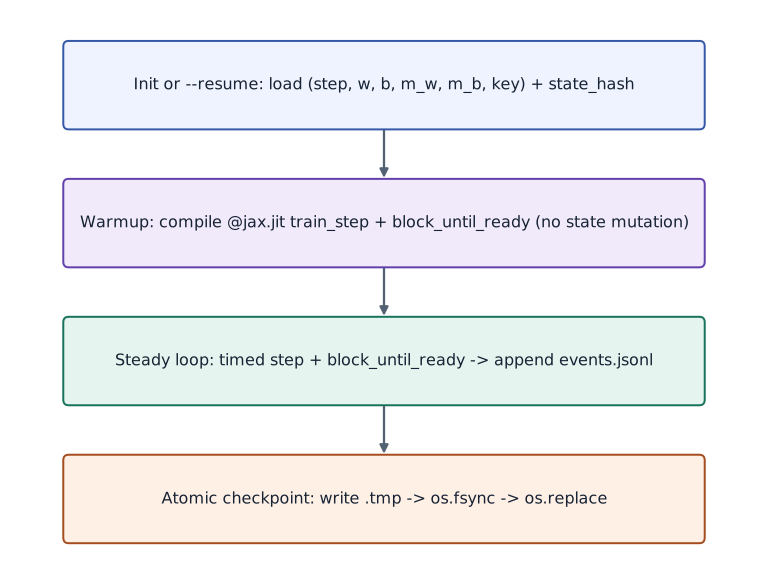
### Checkpointed TPU job launcher lifecycle from warmup to zero-drift resume

**Predict:** Why must the warmup compilation step run before the timed step loop without overwriting the restored checkpoint state?
![Checkpointed TPU job launcher lifecycle from warmup to zero-drift resume](../figures/tpu-02-mechanism.svg)

*Architecture and dataflow mechanism diagram.*

Read top to bottom: the launcher loads either the initial state or `checkpoint-latest.json`, runs one synchronized `@jax.jit` warmup call to compile XLA HLO without mutating state, executes timed steady-state steps while appending to `events.jsonl`, and writes `checkpoint-latest.json` atomically via `.tmp` + `fsync` + `os.replace`.

### Pause and reason

Why does restoring model weights alone after a Spot TPU preemption cause the resumed training curve to diverge from an uninterrupted run?

<details><summary>Compare your reasoning</summary>

Without restoring the optimizer momentum/variance buffers (`m_w`, `m_b`) and the PRNG key (`key`) alongside the step counter and weights, the next update uses zeroed momentum and a repeated or mismatched random batch.

</details>

## 1. Stage the launcher and run a checkpoint-resumed TPU experiment

Use the local CPU exercise first to test the resume contract: a missing requested checkpoint raises an error; modified state or changed configuration is rejected; resuming an already completed run returns its saved final state without executing another update. Only after these checks should you run the same launcher on a TPU VM.

**Stage launch.py and verify checkpoint resume on the Cloud TPU VM**

```bash
# Stage launch.py and verify checkpoint resume on the Cloud TPU VM
gcloud compute tpus tpu-vm scp resources/tpu-gcp/launch.py "$TPU_NAME":~/jax-tpu-lab/ --zone="$ZONE"

gcloud compute tpus tpu-vm ssh "$TPU_NAME" --zone="$ZONE" --command="
  set -euo pipefail
  source ~/jax-tpu-lab/.venv/bin/activate
  python ~/jax-tpu-lab/launch.py --platform tpu --run-dir ~/jax-tpu-lab/run-resumed --steps 4 --save-every 2
  python ~/jax-tpu-lab/launch.py --platform tpu --run-dir ~/jax-tpu-lab/run-resumed --steps 8 --save-every 2 --resume
  python ~/jax-tpu-lab/launch.py --platform tpu --run-dir ~/jax-tpu-lab/run-control --steps 8 --save-every 2
"
```

**Expected:** Both runs emit started, warmup, step, checkpoint, and completed JSONL events with backend: tpu, and their step-8 state hashes match.

## Define deterministic hashing and atomic checkpoint writes

Create main.py with digest_obj and atomic_write_json so interrupted writes never corrupt the latest checkpoint.

```python
# Step 1 — Define deterministic hashing and atomic checkpoint writes: Writing to a temporary sibling file, flushing with fsync, and...
# Import hashlib for this computation.
import hashlib
import json
import os
from pathlib import Path
import tempfile
import time
import jax
import jax.numpy as jnp
import numpy as np


# Function `digest_obj(value)` implementing this stage's computation:
def digest_obj(value):
    # Return `hashlib.sha256(json.dumps(value, sort_keys=True, separators=(',', ':')).encode()).hexdigest()[:16]` to the caller.
    return hashlib.sha256(
        json.dumps(value, sort_keys=True, separators=(",", ":")).encode()
    ).hexdigest()


# Function `atomic_write_json(path, payload)` implementing this stage's computation:
def atomic_write_json(path, payload):
    # Read or serialize artifact data on disk (`path`).
    path = Path(path)
    # Run `path.parent.mkdir` to perform the next check or state transition.
    path.parent.mkdir(parents=True, exist_ok=True)
    # Run `path.with_suffix` to compute `tmp`.
    tmp = path.with_suffix(path.suffix + ".tmp")
    # Enter managed runtime/context scope for this block:
    with tmp.open("w", encoding="utf-8") as f:
        # Run `json.dump` to perform the next check or state transition.
        json.dump(payload, f, sort_keys=True)
        # Run `f.flush` to perform the next check or state transition.
        f.flush()
        # Run `os.fsync` to perform the next check or state transition.
        os.fsync(f.fileno())
    # Run `os.replace` to perform the next check or state transition.
    os.replace(tmp, path)
```

Writing to a temporary sibling file, flushing with fsync, and calling os.replace guarantees that checkpoint-latest.json is always complete.

## Implement the TPU-ready job runner with warmup separation and resume

Append run_tpu_ready_job to main.py.

```python
# Step 2 — Implement the TPU-ready job runner with warmup separation and resume: Warmup compiles the JIT function without mutating w, b, m_w, m_b,...
# Define `run_tpu_ready_job(run_dir, steps, save_every, resume...)` to evaluate the objective and its automatic derivatives:
def run_tpu_ready_job(run_dir, steps=6, save_every=2, resume=False, seed=0, lr=0.05):
    # Read or serialize artifact data on disk (`run_dir`).
    run_dir = Path(run_dir)
    # Run `run_dir.mkdir` to perform the next check or state transition.
    run_dir.mkdir(parents=True, exist_ok=True)
    # Compute `events_path` from `run_dir / "events.jsonl"`
    events_path = run_dir / "events.jsonl"
    # Compute `ckpt_path` from `run_dir / "checkpoint-latest.json"`
    ckpt_path = run_dir / "checkpoint-latest.json"

    # Function `emit(event)` implementing this stage's computation:
    def emit(event, **fields):
        # Check which hardware backend (`cpu`, `gpu`, or `tpu`) JAX selected for `record`.
        record = {"event": event, "backend": jax.default_backend(), "devices": jax.device_count(), **fields}
        # Enter managed runtime/context scope for this block:
        with events_path.open("a", encoding="utf-8") as f:
            # Compute `f.write(json.dumps(record, sort_keys` as `True) + "\n")`.
            f.write(json.dumps(record, sort_keys=True) + "\n")
        # Return `record` to the caller.
        return record

    # Generate a uniform grid of points in `x`.
    x = jnp.linspace(-1.0, 1.0, 64, dtype=jnp.float32).reshape(64, 1)
    # Compute `target_y` from `3.0 * x - 0.5`
    target_y = 3.0 * x - 0.5

    config = {"schema": 1, "seed": int(seed), "lr": float(lr), "data": "linspace64-target-3x-minus-0.5-v1", "batch_size": 16, "optimizer": "momentum-0.8-noise-key-v1"}
    config_hash = digest_obj(config)
    # A requested resume requires an existing, compatible, intact checkpoint.
    if resume:
        if not ckpt_path.exists():
            raise FileNotFoundError(f"resume requested but checkpoint is missing: {ckpt_path}")
        saved = json.loads(ckpt_path.read_text(encoding="utf-8"))
        supplied_hash = saved.pop("state_hash", None)
        if supplied_hash != digest_obj(saved):
            raise ValueError("checkpoint state hash mismatch")
        if saved.get("config_hash") != config_hash or saved.get("config") != config:
            raise ValueError("checkpoint run configuration mismatch")
        step = int(saved["step"])
        w = jnp.array(saved["w"], dtype=jnp.float32)
        b = jnp.array(saved["b"], dtype=jnp.float32)
        m_w = jnp.array(saved["m_w"], dtype=jnp.float32)
        m_b = jnp.array(saved["m_b"], dtype=jnp.float32)
        key = jnp.array(saved["key"], dtype=jnp.uint32)
        state_payload = dict(saved)
        state_payload["state_hash"] = supplied_hash
        emit("restored", step=step, state_hash=supplied_hash)
    else:
        step = 0
        w = jnp.zeros((1, 1), dtype=jnp.float32)
        b = jnp.zeros((1,), dtype=jnp.float32)
        m_w = jnp.zeros_like(w)
        m_b = jnp.zeros_like(b)
        key = jax.random.PRNGKey(seed)
        emit("started", step=step)
        state_payload = {"step": 0, "w": np.asarray(w).tolist(), "b": np.asarray(b).tolist(), "m_w": np.asarray(m_w).tolist(), "m_b": np.asarray(m_b).tolist(), "key": np.asarray(key).tolist(), "config": config, "config_hash": config_hash}
        state_payload["state_hash"] = digest_obj(state_payload)
        atomic_write_json(ckpt_path, state_payload)
    if step > steps:
        raise ValueError(f"checkpoint step {step} exceeds requested final step {steps}")

    @jax.jit
    # Function `train_step(w, b, m_w, m_b, ...)` implementing this stage's computation:
    def train_step(w, b, m_w, m_b, key):
        # Split the PRNG key deterministically into independent subkeys (`(key, subkey)`).
        key, subkey = jax.random.split(key)
        # Draw pseudorandom samples for `idx` using the explicit RNG state.
        idx = jax.random.choice(subkey, 64, shape=(16,), replace=False)
        # Compute `xb, yb` from `x[idx], target_y[idx]`
        xb, yb = x[idx], target_y[idx]

        # Function `loss_fn(w_in, b_in)` implementing this stage's computation:
        def loss_fn(w_in, b_in):
            # Perform matrix contraction / projection to compute `pred`.
            pred = xb @ w_in + b_in
            # Return `jnp.mean((pred - yb) ** 2)` to the caller.
            return jnp.mean((pred - yb) ** 2)

        # Evaluate both scalar loss and parameter gradients in one pass (`(loss, (gw, gb))`).
        loss, (gw, gb) = jax.value_and_grad(loss_fn, argnums=(0, 1))(w, b)
        # Compute `m_w` from `0.8 * m_w + gw`
        m_w = 0.8 * m_w + gw
        # Compute `m_b` from `0.8 * m_b + gb`
        m_b = 0.8 * m_b + gb
        # Compute `w` from `w - lr * m_w`
        w = w - lr * m_w
        # Compute `b` from `b - lr * m_b`
        b = b - lr * m_b
        # Return `(w, b, m_w, m_b, key, loss)` to the caller.
        return w, b, m_w, m_b, key, loss

    if step == steps:
        emit("completed", step=step, state_hash=state_payload["state_hash"])
        return {"final_step": step, "state_hash": state_payload["state_hash"], "w": float(np.asarray(w).squeeze()), "b": float(np.asarray(b).squeeze()), "warmup_ms": 0.0, "step_losses": [], "step_times_ms": []}

    # Record execution timing or profiler trace in `t0`.
    t0 = time.perf_counter()
    # Run `train_step` to compute `warm`.
    warm = train_step(w, b, m_w, m_b, key)
    # Synchronize host execution until asynchronous device computation completes.
    jax.block_until_ready(warm)
    # Record execution timing or profiler trace in `warmup_ms`.
    warmup_ms = (time.perf_counter() - t0) * 1000.0
    # Run `emit` to perform the next check or state transition.
    emit("warmup", warmup_ms=warmup_ms, step=step)

    # Compute `step_losses` from `[]`
    step_losses = []
    # Compute `step_times_ms` from `[]`
    step_times_ms = []
    while step < steps:
        t_step = time.perf_counter()
        w, b, m_w, m_b, key, loss = train_step(w, b, m_w, m_b, key)
        jax.block_until_ready((w, b, m_w, m_b, key, loss))
        elapsed_ms = (time.perf_counter() - t_step) * 1000.0
        step += 1
        state_payload = {
            "step": step,
            "w": np.asarray(w).tolist(),
            "b": np.asarray(b).tolist(),
            "m_w": np.asarray(m_w).tolist(),
            "m_b": np.asarray(m_b).tolist(),
            "key": np.asarray(key).tolist(),
            "config": config,
            "config_hash": config_hash,
        }
        state_payload["state_hash"] = digest_obj(state_payload)
        step_losses.append(float(loss))
        step_times_ms.append(float(elapsed_ms))
        emit("step", step=step, loss=float(loss), step_ms=elapsed_ms, state_hash=state_payload["state_hash"])
        if step % save_every == 0 or step == steps:
            atomic_write_json(ckpt_path, state_payload)
            emit("checkpoint", step=step, state_hash=state_payload["state_hash"])

    # Run `emit` to perform the next check or state transition.
    emit("completed", step=step, state_hash=state_payload["state_hash"])
    # Return `{'final_step': step, 'state_hash': state_payload['state_hash'], 'w': float(np.asarray(w).squeeze()), 'b': float(np.asarray(b).squeeze()), 'warmup_ms': warmup_ms, 'step_losses': step_losses, 'step_times_ms': step_times_ms}` to the caller.
    return {
        "final_step": step,
        "state_hash": state_payload["state_hash"],
        "w": float(np.asarray(w).squeeze()),
        "b": float(np.asarray(b).squeeze()),
        "warmup_ms": warmup_ms,
        "step_losses": step_losses,
        "step_times_ms": step_times_ms,
    }


```

Warmup compiles the JIT function without mutating w, b, m_w, m_b, or key, so step 1 starts from the exact initial or restored state.

## Compare a checkpoint-resumed run against an uninterrupted control run

Append the 3-step + 3-step resumed run and 6-step uninterrupted control comparison to main.py.

```python
# Step 3 — Compare a checkpoint-resumed run against an uninterrupted control run: Because parameters, momentum buffers, and PRNG keys are all...
# Create an isolated temporary directory to run and inspect artifacts safely:
with tempfile.TemporaryDirectory(prefix="tpu-launch-") as tmp:
    # Read or serialize artifact data on disk (`root`).
    root = Path(tmp)
    # Run `run_tpu_ready_job` to compute `part1`.
    part1 = run_tpu_ready_job(root / "resumed", steps=3, save_every=3, resume=False)
    # Run `run_tpu_ready_job` to compute `part2`.
    part2 = run_tpu_ready_job(root / "resumed", steps=6, save_every=3, resume=True)
    # Run `run_tpu_ready_job` to compute `control`.
    control = run_tpu_ready_job(root / "control", steps=6, save_every=3, resume=False)
    # Compute `resumed_losses` from `part1["step_losses"] + part2["step_losses"]`
    resumed_losses = part1["step_losses"] + part2["step_losses"]

# Assert invariant `part2["state_hash"] == control["state_hash"]` holds
assert part2["state_hash"] == control["state_hash"]
# Assert that `np.allclose(resumed_losses, control["step_losses"])`.
assert np.allclose(resumed_losses, control["step_losses"])
# Print the observed values to compare against the expected result.
print("Resumed state_hash matches uninterrupted control:", part2["state_hash"])
# Print diagnostic summary of the computed outputs.
print("Losses across 6 steps:", [round(v, 5) for v in control["step_losses"]])
```

Because parameters, momentum buffers, and PRNG keys are all restored, the resumed trajectory matches the uninterrupted trajectory bit-for-bit.

## Run the example

```python
# Step 1 — Define deterministic hashing and atomic checkpoint writes: Writing to a temporary sibling file, flushing with fsync, and...
# Import hashlib for this computation.
import hashlib
import json
import os
from pathlib import Path
import tempfile
import time
import jax
import jax.numpy as jnp
import numpy as np


# Function `digest_obj(value)` implementing this stage's computation:
def digest_obj(value):
    # Return `hashlib.sha256(json.dumps(value, sort_keys=True, separators=(',', ':')).encode()).hexdigest()[:16]` to the caller.
    return hashlib.sha256(
        json.dumps(value, sort_keys=True, separators=(",", ":")).encode()
    ).hexdigest()


# Function `atomic_write_json(path, payload)` implementing this stage's computation:
def atomic_write_json(path, payload):
    # Read or serialize artifact data on disk (`path`).
    path = Path(path)
    # Run `path.parent.mkdir` to perform the next check or state transition.
    path.parent.mkdir(parents=True, exist_ok=True)
    # Run `path.with_suffix` to compute `tmp`.
    tmp = path.with_suffix(path.suffix + ".tmp")
    # Enter managed runtime/context scope for this block:
    with tmp.open("w", encoding="utf-8") as f:
        # Run `json.dump` to perform the next check or state transition.
        json.dump(payload, f, sort_keys=True)
        # Run `f.flush` to perform the next check or state transition.
        f.flush()
        # Run `os.fsync` to perform the next check or state transition.
        os.fsync(f.fileno())
    # Run `os.replace` to perform the next check or state transition.
    os.replace(tmp, path)


# Step 2 — Implement the TPU-ready job runner with warmup separation and resume: Warmup compiles the JIT function without mutating w, b, m_w, m_b,...
# Define `run_tpu_ready_job(run_dir, steps, save_every, resume...)` to evaluate the objective and its automatic derivatives:
def run_tpu_ready_job(run_dir, steps=6, save_every=2, resume=False, seed=0, lr=0.05):
    # Read or serialize artifact data on disk (`run_dir`).
    run_dir = Path(run_dir)
    # Run `run_dir.mkdir` to perform the next check or state transition.
    run_dir.mkdir(parents=True, exist_ok=True)
    # Compute `events_path` from `run_dir / "events.jsonl"`
    events_path = run_dir / "events.jsonl"
    # Compute `ckpt_path` from `run_dir / "checkpoint-latest.json"`
    ckpt_path = run_dir / "checkpoint-latest.json"

    # Function `emit(event)` implementing this stage's computation:
    def emit(event, **fields):
        # Check which hardware backend (`cpu`, `gpu`, or `tpu`) JAX selected for `record`.
        record = {"event": event, "backend": jax.default_backend(), "devices": jax.device_count(), **fields}
        # Enter managed runtime/context scope for this block:
        with events_path.open("a", encoding="utf-8") as f:
            # Compute `f.write(json.dumps(record, sort_keys` as `True) + "\n")`.
            f.write(json.dumps(record, sort_keys=True) + "\n")
        # Return `record` to the caller.
        return record

    # Generate a uniform grid of points in `x`.
    x = jnp.linspace(-1.0, 1.0, 64, dtype=jnp.float32).reshape(64, 1)
    # Compute `target_y` from `3.0 * x - 0.5`
    target_y = 3.0 * x - 0.5

    config = {"schema": 1, "seed": int(seed), "lr": float(lr), "data": "linspace64-target-3x-minus-0.5-v1", "batch_size": 16, "optimizer": "momentum-0.8-noise-key-v1"}
    config_hash = digest_obj(config)
    # A requested resume requires an existing, compatible, intact checkpoint.
    if resume:
        if not ckpt_path.exists():
            raise FileNotFoundError(f"resume requested but checkpoint is missing: {ckpt_path}")
        saved = json.loads(ckpt_path.read_text(encoding="utf-8"))
        supplied_hash = saved.pop("state_hash", None)
        if supplied_hash != digest_obj(saved):
            raise ValueError("checkpoint state hash mismatch")
        if saved.get("config_hash") != config_hash or saved.get("config") != config:
            raise ValueError("checkpoint run configuration mismatch")
        step = int(saved["step"])
        w = jnp.array(saved["w"], dtype=jnp.float32)
        b = jnp.array(saved["b"], dtype=jnp.float32)
        m_w = jnp.array(saved["m_w"], dtype=jnp.float32)
        m_b = jnp.array(saved["m_b"], dtype=jnp.float32)
        key = jnp.array(saved["key"], dtype=jnp.uint32)
        state_payload = dict(saved)
        state_payload["state_hash"] = supplied_hash
        emit("restored", step=step, state_hash=supplied_hash)
    else:
        step = 0
        w = jnp.zeros((1, 1), dtype=jnp.float32)
        b = jnp.zeros((1,), dtype=jnp.float32)
        m_w = jnp.zeros_like(w)
        m_b = jnp.zeros_like(b)
        key = jax.random.PRNGKey(seed)
        emit("started", step=step)
        state_payload = {"step": 0, "w": np.asarray(w).tolist(), "b": np.asarray(b).tolist(), "m_w": np.asarray(m_w).tolist(), "m_b": np.asarray(m_b).tolist(), "key": np.asarray(key).tolist(), "config": config, "config_hash": config_hash}
        state_payload["state_hash"] = digest_obj(state_payload)
        atomic_write_json(ckpt_path, state_payload)
    if step > steps:
        raise ValueError(f"checkpoint step {step} exceeds requested final step {steps}")

    @jax.jit
    # Function `train_step(w, b, m_w, m_b, ...)` implementing this stage's computation:
    def train_step(w, b, m_w, m_b, key):
        # Split the PRNG key deterministically into independent subkeys (`(key, subkey)`).
        key, subkey = jax.random.split(key)
        # Draw pseudorandom samples for `idx` using the explicit RNG state.
        idx = jax.random.choice(subkey, 64, shape=(16,), replace=False)
        # Compute `xb, yb` from `x[idx], target_y[idx]`
        xb, yb = x[idx], target_y[idx]

        # Function `loss_fn(w_in, b_in)` implementing this stage's computation:
        def loss_fn(w_in, b_in):
            # Perform matrix contraction / projection to compute `pred`.
            pred = xb @ w_in + b_in
            # Return `jnp.mean((pred - yb) ** 2)` to the caller.
            return jnp.mean((pred - yb) ** 2)

        # Evaluate both scalar loss and parameter gradients in one pass (`(loss, (gw, gb))`).
        loss, (gw, gb) = jax.value_and_grad(loss_fn, argnums=(0, 1))(w, b)
        # Compute `m_w` from `0.8 * m_w + gw`
        m_w = 0.8 * m_w + gw
        # Compute `m_b` from `0.8 * m_b + gb`
        m_b = 0.8 * m_b + gb
        # Compute `w` from `w - lr * m_w`
        w = w - lr * m_w
        # Compute `b` from `b - lr * m_b`
        b = b - lr * m_b
        # Return `(w, b, m_w, m_b, key, loss)` to the caller.
        return w, b, m_w, m_b, key, loss

    if step == steps:
        emit("completed", step=step, state_hash=state_payload["state_hash"])
        return {"final_step": step, "state_hash": state_payload["state_hash"], "w": float(np.asarray(w).squeeze()), "b": float(np.asarray(b).squeeze()), "warmup_ms": 0.0, "step_losses": [], "step_times_ms": []}

    # Record execution timing or profiler trace in `t0`.
    t0 = time.perf_counter()
    # Run `train_step` to compute `warm`.
    warm = train_step(w, b, m_w, m_b, key)
    # Synchronize host execution until asynchronous device computation completes.
    jax.block_until_ready(warm)
    # Record execution timing or profiler trace in `warmup_ms`.
    warmup_ms = (time.perf_counter() - t0) * 1000.0
    # Run `emit` to perform the next check or state transition.
    emit("warmup", warmup_ms=warmup_ms, step=step)

    # Compute `step_losses` from `[]`
    step_losses = []
    # Compute `step_times_ms` from `[]`
    step_times_ms = []
    while step < steps:
        t_step = time.perf_counter()
        w, b, m_w, m_b, key, loss = train_step(w, b, m_w, m_b, key)
        jax.block_until_ready((w, b, m_w, m_b, key, loss))
        elapsed_ms = (time.perf_counter() - t_step) * 1000.0
        step += 1
        state_payload = {
            "step": step,
            "w": np.asarray(w).tolist(),
            "b": np.asarray(b).tolist(),
            "m_w": np.asarray(m_w).tolist(),
            "m_b": np.asarray(m_b).tolist(),
            "key": np.asarray(key).tolist(),
            "config": config,
            "config_hash": config_hash,
        }
        state_payload["state_hash"] = digest_obj(state_payload)
        step_losses.append(float(loss))
        step_times_ms.append(float(elapsed_ms))
        emit("step", step=step, loss=float(loss), step_ms=elapsed_ms, state_hash=state_payload["state_hash"])
        if step % save_every == 0 or step == steps:
            atomic_write_json(ckpt_path, state_payload)
            emit("checkpoint", step=step, state_hash=state_payload["state_hash"])

    # Run `emit` to perform the next check or state transition.
    emit("completed", step=step, state_hash=state_payload["state_hash"])
    # Return `{'final_step': step, 'state_hash': state_payload['state_hash'], 'w': float(np.asarray(w).squeeze()), 'b': float(np.asarray(b).squeeze()), 'warmup_ms': warmup_ms, 'step_losses': step_losses, 'step_times_ms': step_times_ms}` to the caller.
    return {
        "final_step": step,
        "state_hash": state_payload["state_hash"],
        "w": float(np.asarray(w).squeeze()),
        "b": float(np.asarray(b).squeeze()),
        "warmup_ms": warmup_ms,
        "step_losses": step_losses,
        "step_times_ms": step_times_ms,
    }


# Step 3 — Compare a checkpoint-resumed run against an uninterrupted control run: Because parameters, momentum buffers, and PRNG keys are all...
# Create an isolated temporary directory to run and inspect artifacts safely:
with tempfile.TemporaryDirectory(prefix="tpu-launch-") as tmp:
    # Read or serialize artifact data on disk (`root`).
    root = Path(tmp)
    # Run `run_tpu_ready_job` to compute `part1`.
    part1 = run_tpu_ready_job(root / "resumed", steps=3, save_every=3, resume=False)
    # Run `run_tpu_ready_job` to compute `part2`.
    part2 = run_tpu_ready_job(root / "resumed", steps=6, save_every=3, resume=True)
    # Run `run_tpu_ready_job` to compute `control`.
    control = run_tpu_ready_job(root / "control", steps=6, save_every=3, resume=False)
    # Compute `resumed_losses` from `part1["step_losses"] + part2["step_losses"]`
    resumed_losses = part1["step_losses"] + part2["step_losses"]

# Assert invariant `part2["state_hash"] == control["state_hash"]` holds
assert part2["state_hash"] == control["state_hash"]
# Assert that `np.allclose(resumed_losses, control["step_losses"])`.
assert np.allclose(resumed_losses, control["step_losses"])
# Print the observed values to compare against the expected result.
print("Resumed state_hash matches uninterrupted control:", part2["state_hash"])
# Print diagnostic summary of the computed outputs.
print("Losses across 6 steps:", [round(v, 5) for v in control["step_losses"]])
```

Expected: Prints the matching 64-character state_hash for the resumed and control runs and the monotonically decreasing 6-step loss trajectory.

## Interrupted-and-resumed trajectory vs uninterrupted 6-step control run

**Predict:** Does stopping after step 3 and resuming in a fresh call change the loss trajectory on steps 4 through 6?

![Interrupted-and-resumed trajectory vs uninterrupted 6-step control run](../figures/tpu-02.svg)

**Recorded CPU computation**

### Read the figure

The horizontal axis shows training steps 1 through 6, with a vertical dotted boundary at step 3 where the first run stopped and wrote its checkpoint. The solid line is the uninterrupted 6-step control run; the dashed line is the run that stopped at step 3 and resumed for steps 4–6.

### Connect it to the computation

Because the checkpoint at step 3 saved `(w, b, m_w, m_b, key)` atomically and the warmup call did not consume the restored state, the two loss trajectories lie directly on top of each other (`max_abs_diff == 0`).

```python
# Compute figure data for: Interrupted-and-resumed trajectory vs uninterrupted 6-step control run
# Construct dictionary `visual_data` with the structured fields for this stage.
visual_data = {
    'kind': 'line',
    'x': [1, 2, 3, 4, 5, 6],
    'xlabel': 'training step',
    'ylabel': 'minibatch mean-squared loss',
    'boundaries': [3],
    'series': [
        {'label': 'uninterrupted 6-step control', 'y': [float(v) for v in control['step_losses']]},
        {'label': 'stopped at step 3 + resumed (steps 4-6)', 'y': [float(v) for v in resumed_losses]},
    ],
}
```

## Recorded reference execution

CPU run: 2026-10-20T10:58:53.178365+00:00. JAX 0.9.2.

```text
Resumed state_hash matches uninterrupted control: ecba6a13e41beb0003af0371f8422efa3b08538c4420efb07a9bc61b0a10cdc1
Losses across 6 steps: [3.6712, 3.78913, 1.91372, 2.09553, 1.81174, 1.16636]
Resumed state_hash matches uninterrupted control: ecba6a13e41beb0003af0371f8422efa3b08538c4420efb07a9bc61b0a10cdc1
Losses across 6 steps: [3.6712, 3.78913, 1.91372, 2.09553, 1.81174, 1.16636]
Warmup ms: 79.34 Median steady step ms: 0.0432
Resume rejection: checkpoint state hash mismatch
Step 8 resumed vs control hash: eba1c0bcfb80184d9f5108c1d6539369e21f95276e5d6806234237f41eccbed9 eba1c0bcfb80184d9f5108c1d6539369e21f95276e5d6806234237f41eccbed9
Recorded event sequence: ['started', 'warmup', 'step', 'step', 'checkpoint', 'completed', 'restored', 'warmup', 'step', 'step', 'checkpoint', 'completed']
Loaded step: 4 Leftover tmp files: []
PASS: tpu-02

```

## Compare JIT warmup latency against steady-state step latency

**Predict before running:** How does the warmup call duration compare to the median steady-state step duration?

```python
# Experiment — Compare JIT warmup latency against steady-state step latency: Logging warmup separately in events.jsonl prevents compilation...
median_step_ms = float(np.median(control["step_times_ms"]))
# Print the observed values to compare against the expected result.
print("Warmup ms:", round(control["warmup_ms"], 3), "Median steady step ms:", round(median_step_ms, 4))
# Assert invariant `control["warmup_ms"] > median_step_ms` holds
assert control["warmup_ms"] > median_step_ms
```

**Expected:** Warmup takes significantly longer than a steady-state compiled step because it includes tracing and XLA compilation.

Logging warmup separately in events.jsonl prevents compilation overhead from distorting per-step throughput numbers on CPU or TPU.

## Verify checkpoint integrity rejects omitted momentum

**Predict before running:** If the momentum buffers are changed in a saved checkpoint without updating its state hash, will resume continue with the altered state?

```python
# Verify checkpoint integrity rejects a modified momentum buffer
with tempfile.TemporaryDirectory(prefix="tpu-bad-resume-") as tmp:
    bad_dir = Path(tmp) / "bad"
    run_tpu_ready_job(bad_dir, steps=3, save_every=3, resume=False)
    ckpt_path = bad_dir / "checkpoint-latest.json"
    ckpt = json.loads(ckpt_path.read_text(encoding="utf-8"))
    ckpt["m_w"] = [[0.0]]
    ckpt["m_b"] = [0.0]
    ckpt_path.write_text(json.dumps(ckpt), encoding="utf-8")
    try:
        run_tpu_ready_job(bad_dir, steps=6, save_every=3, resume=True)
    except ValueError as exc:
        message = str(exc)
    else:
        raise AssertionError("modified checkpoint was accepted")
print("Resume rejection:", message)
assert message == "checkpoint state hash mismatch"
```

**Expected:** Resume raises ValueError with checkpoint state hash mismatch before loading or training from the modified state.

The state hash covers the serialized step, parameters, optimizer moments, PRNG key, and run configuration. A changed momentum buffer is corruption and must be rejected. To study the trajectory of a buggy weight-only resume, use a separate intentionally weakened loader that recomputes a valid hash after omitting momentum; that demonstrates the modeling error but is not an acceptable checkpoint path.

## Make it yours

Run `run_tpu_ready_job` for $4$ steps (`save_every=2`), resume to $8$ steps, and verify that the final `state_hash` at step $8$ equals an uninterrupted $8$-step run.

### How to write this exercise — Step-by-step recipe & starter scaffold

**Key functions & syntax to use:**
- `steps(...)` — Call `steps` with your updated parameters or inputs from this lesson's workspace.
- `tempfile.TemporaryDirectory(...)` — Call `tempfile.TemporaryDirectory` with your updated parameters or inputs from this lesson's workspace.
- `assert condition` — Verify that the observed output shape, status, or numerical value satisfies the contract.

**Step-by-step implementation plan:**
1. Create an isolated temporary directory to run and inspect artifacts safely:
2. Read or serialize artifact data on disk (`ex_root`).
3. Run `run_tpu_ready_job` to compute `r1`.
4. Run `run_tpu_ready_job` to compute `r2`.
5. Run `run_tpu_ready_job` to compute `ctrl8`.

**Starter code scaffold (fill in the TODOs):**

```python
# Exercise solution: Run run_tpu_ready_job for 4 steps (save_every=2), resume to 8 steps,...
# Create an isolated temporary directory to run and inspect artifacts safely:
with tempfile.TemporaryDirectory(prefix="tpu-ex-") as tmp:
    # Read or serialize artifact data on disk (`ex_root`).
    ex_root = Path(...)  # TODO: compute ex_root
    # Run `run_tpu_ready_job` to compute `r1`.
    r1 = run_tpu_ready_job(...)  # TODO: compute r1
    # Run `run_tpu_ready_job` to compute `r2`.
    r2 = run_tpu_ready_job(...)  # TODO: compute r2
    # Run `run_tpu_ready_job` to compute `ctrl8`.
    ctrl8 = run_tpu_ready_job(...)  # TODO: compute ctrl8
# Print the observed values to compare against the expected result.
print("Step 8 resumed vs control hash:", r2["state_hash"], ctrl8["state_hash"])
# Assert that `r2["state_hash"] == ctrl8["state_hash"] and len(r1["step_losses"] + r2["step_losses"]) == 8`.
assert r2["state_hash"]  # TODO: complete assertion check
```

<details><summary>Reference solution</summary>

```python
# Exercise solution: Run run_tpu_ready_job for 4 steps (save_every=2), resume to 8 steps,...
# Create an isolated temporary directory to run and inspect artifacts safely:
with tempfile.TemporaryDirectory(prefix="tpu-ex-") as tmp:
    # Read or serialize artifact data on disk (`ex_root`).
    ex_root = Path(tmp)
    # Run `run_tpu_ready_job` to compute `r1`.
    r1 = run_tpu_ready_job(ex_root / "resumed", steps=4, save_every=2, resume=False)
    # Run `run_tpu_ready_job` to compute `r2`.
    r2 = run_tpu_ready_job(ex_root / "resumed", steps=8, save_every=2, resume=True)
    # Run `run_tpu_ready_job` to compute `ctrl8`.
    ctrl8 = run_tpu_ready_job(ex_root / "control", steps=8, save_every=2, resume=False)
# Print the observed values to compare against the expected result.
print("Step 8 resumed vs control hash:", r2["state_hash"], ctrl8["state_hash"])
# Assert that `r2["state_hash"] == ctrl8["state_hash"] and len(r1["step_losses"] + r2["step_losses"]) == 8`.
assert r2["state_hash"] == ctrl8["state_hash"] and len(r1["step_losses"] + r2["step_losses"]) == 8
```

</details>

## Inspect the JSONL event sequence from a resumed run

**Foundations**

Run a $2$-step job followed by a `--resume` to step $4$ and list the ordered `event` names recorded in `events.jsonl`.

<details><summary>Hint</summary>

Read `events.jsonl` line by line with `json.loads`.

</details>

### How to write: Inspect the JSONL event sequence from a resumed run — Step-by-step recipe & starter scaffold

**Key functions & syntax to use:**
- `run(...)` — Call `run` with your updated parameters or inputs from this lesson's workspace.
- `tempfile.TemporaryDirectory(...)` — Call `tempfile.TemporaryDirectory` with your updated parameters or inputs from this lesson's workspace.
- `assert condition` — Verify that the observed output shape, status, or numerical value satisfies the contract.

**Step-by-step implementation plan:**
1. Inspect the JSONL event sequence from a resumed run (Foundations): The single append-only events.jsonl log captures both the...
2. Create an isolated temporary directory to run and inspect artifacts safely:
3. Read or serialize artifact data on disk (`ev_dir`).
4. Run `run_tpu_ready_job` to perform the next check or state transition.
5. Run `run_tpu_ready_job` to perform the next check or state transition.

**Starter code scaffold (fill in the TODOs):**

```python
# Inspect the JSONL event sequence from a resumed run (Foundations): The single append-only events.jsonl log captures both the...
# Create an isolated temporary directory to run and inspect artifacts safely:
with tempfile.TemporaryDirectory(prefix="tpu-events-") as tmp:
    # Read or serialize artifact data on disk (`ev_dir`).
    ev_dir = Path(...)  # TODO: compute ev_dir
    # Run `run_tpu_ready_job` to perform the next check or state transition.
    run_tpu_ready_job(ev_dir, steps = ...  # TODO: compute run_tpu_ready_job(ev_dir, steps
    # Run `run_tpu_ready_job` to perform the next check or state transition.
    run_tpu_ready_job(ev_dir, steps = ...  # TODO: compute run_tpu_ready_job(ev_dir, steps
    # Read or serialize artifact data on disk (`event_names`).
    event_names = ...  # TODO: compute event_names
# Print the observed values to compare against the expected result.
print("Recorded event sequence:", event_names)
# Assert that `"started" in event_names and "restored" in event_names and event_names[-1] == "completed"`.
assert "started"  # TODO: complete assertion check
```

<details><summary>Reference solution and reasoning</summary>

```python
# Inspect the JSONL event sequence from a resumed run (Foundations): The single append-only events.jsonl log captures both the...
# Create an isolated temporary directory to run and inspect artifacts safely:
with tempfile.TemporaryDirectory(prefix="tpu-events-") as tmp:
    # Read or serialize artifact data on disk (`ev_dir`).
    ev_dir = Path(tmp) / "job"
    # Run `run_tpu_ready_job` to perform the next check or state transition.
    run_tpu_ready_job(ev_dir, steps=2, save_every=2, resume=False)
    # Run `run_tpu_ready_job` to perform the next check or state transition.
    run_tpu_ready_job(ev_dir, steps=4, save_every=2, resume=True)
    # Read or serialize artifact data on disk (`event_names`).
    event_names = [json.loads(line)["event"] for line in (ev_dir / "events.jsonl").read_text().splitlines()]
# Print the observed values to compare against the expected result.
print("Recorded event sequence:", event_names)
# Assert that `"started" in event_names and "restored" in event_names and event_names[-1] == "completed"`.
assert "started" in event_names and "restored" in event_names and event_names[-1] == "completed"
```

The single append-only events.jsonl log captures both the initial run (`started` -> `warmup` -> `step` -> `checkpoint` -> `completed`) and the resumed run (`restored` -> `warmup` -> `step` -> `checkpoint` -> `completed`).

</details>

## Verify atomic checkpoint file replacement

**Transfer / diagnosis**

Write a small test that calls `atomic_write_json` twice on the same path and confirms that no `.tmp` file remains alongside the final JSON file.

<details><summary>Hint</summary>

Check `list(Path(tmp).glob('*.tmp')) == []`.

</details>

### How to write: Verify atomic checkpoint file replacement — Step-by-step recipe & starter scaffold

**Key functions & syntax to use:**
- `replacement(...)` — Call `replacement` with your updated parameters or inputs from this lesson's workspace.
- `tempfile.TemporaryDirectory(...)` — Call `tempfile.TemporaryDirectory` with your updated parameters or inputs from this lesson's workspace.
- `assert condition` — Verify that the observed output shape, status, or numerical value satisfies the contract.

**Step-by-step implementation plan:**
1. Create an isolated temporary directory to run and inspect artifacts safely:
2. Read or serialize artifact data on disk (`target`).
3. Run `atomic_write_json` to perform the next check or state transition.
4. Run `atomic_write_json` to perform the next check or state transition.
5. Read or serialize artifact data on disk (`leftovers`).

**Starter code scaffold (fill in the TODOs):**

```python
# Verify atomic checkpoint file replacement (Transfer / diagnosis): os.replace atomically swaps the flushed .tmp file into...
# Create an isolated temporary directory to run and inspect artifacts safely:
with tempfile.TemporaryDirectory(prefix="tpu-atomic-") as tmp:
    # Read or serialize artifact data on disk (`target`).
    target = Path(...)  # TODO: compute target
    # Run `atomic_write_json` to perform the next check or state transition.
    atomic_write_json(target, {"step": 2})
    # Run `atomic_write_json` to perform the next check or state transition.
    atomic_write_json(target, {"step": 4})
    # Read or serialize artifact data on disk (`leftovers`).
    leftovers = list(...)  # TODO: compute leftovers
    # Read or serialize artifact data on disk (`loaded`).
    loaded = json.loads(...)  # TODO: compute loaded
# Print the observed values to compare against the expected result.
print("Loaded step:", loaded["step"], "Leftover tmp files:", leftovers)
# Assert invariant `loaded["step"] == 4 and leftovers == []` holds
assert loaded["step"]  # TODO: complete assertion check
```

<details><summary>Reference solution and reasoning</summary>

```python
# Verify atomic checkpoint file replacement (Transfer / diagnosis): os.replace atomically swaps the flushed .tmp file into...
# Create an isolated temporary directory to run and inspect artifacts safely:
with tempfile.TemporaryDirectory(prefix="tpu-atomic-") as tmp:
    # Read or serialize artifact data on disk (`target`).
    target = Path(tmp) / "checkpoint-latest.json"
    # Run `atomic_write_json` to perform the next check or state transition.
    atomic_write_json(target, {"step": 2})
    # Run `atomic_write_json` to perform the next check or state transition.
    atomic_write_json(target, {"step": 4})
    # Read or serialize artifact data on disk (`leftovers`).
    leftovers = list(Path(tmp).glob("*.tmp"))
    # Read or serialize artifact data on disk (`loaded`).
    loaded = json.loads(target.read_text(encoding="utf-8"))
# Print the observed values to compare against the expected result.
print("Loaded step:", loaded["step"], "Leftover tmp files:", leftovers)
# Assert invariant `loaded["step"] == 4 and leftovers == []` holds
assert loaded["step"] == 4 and leftovers == []
```

`os.replace` atomically swaps the flushed `.tmp` file into `checkpoint-latest.json`, leaving zero partial files behind.

</details>

## Check your understanding

Why does `run_tpu_ready_job` execute `train_step` once and discard its outputs before starting the timed `while step < steps` loop?

1. To mutate the parameters one extra time before step 1
2. To trigger XLA compilation and synchronize the warmup result without altering the initial or restored training state, keeping compilation latency out of steady-state step measurements
3. Because JAX cannot save checkpoints without a warmup call

<details><summary>Answer and explanation</summary>

To trigger XLA compilation and synchronize the warmup result without altering the initial or restored training state, keeping compilation latency out of steady-state step measurements

JAX compiles `@jax.jit` functions on their first call for a given input shape and dtype; warming up on the initial state without overwriting `(w, b, m_w, m_b, key)` isolates compile time from step time while preserving exact state trajectories.

</details>

## Diagnose the result

If a resumed TPU run diverges from an uninterrupted run, check whether optimizer moments (`m_w`, `m_b`), PRNG `key`, or dataset position were omitted from the checkpoint.

## Carry forward

- Always separate `@jax.jit` warmup compilation from steady-state step timing and call `jax.block_until_ready`.
- Atomic checkpoints (`temp` + `fsync` + `os.replace`) containing parameters, optimizer state, and PRNG keys allow interrupted or Spot TPU runs to resume without numerical drift.

## Keep your evidence

Keep events.jsonl (started, warmup, step, checkpoint, restored, completed), checkpoint-latest.json, and matching resumed vs control state hashes.

Save your predictions, modified code, terminal outputs, and reasoning in your engineering portfolio.

## Primary references

- [Run JAX code on Cloud TPU VMs](https://cloud.google.com/tpu/docs/run-calculation-jax)
- [Orbax checkpointing guide](https://orbax.readthedocs.io/en/latest/)

