Wasted Potential
There was a bowl of stickers on the table, the kind conferences put out to make you feel like you belong. I looked through them and picked this one on purpose. Wasted Potential. I clipped it under the badge with my college on it and wore it all day. It was the kind of joke you tell because saying the true thing plainly would be too much. I had been feeling it for a while, spending my curiosity in a place that seemed to have endless uses for my time and very little use for the thing I wanted to do with it. Politics. Ego. The management of people who somehow always needed managing before the work could happen.
At the end I rolled up the poster I had spent weeks on and fed it, slowly, into a trash can. Someone took a photo. A man in a good suit throwing away the thing he made, wearing the name of what the place was doing to him.
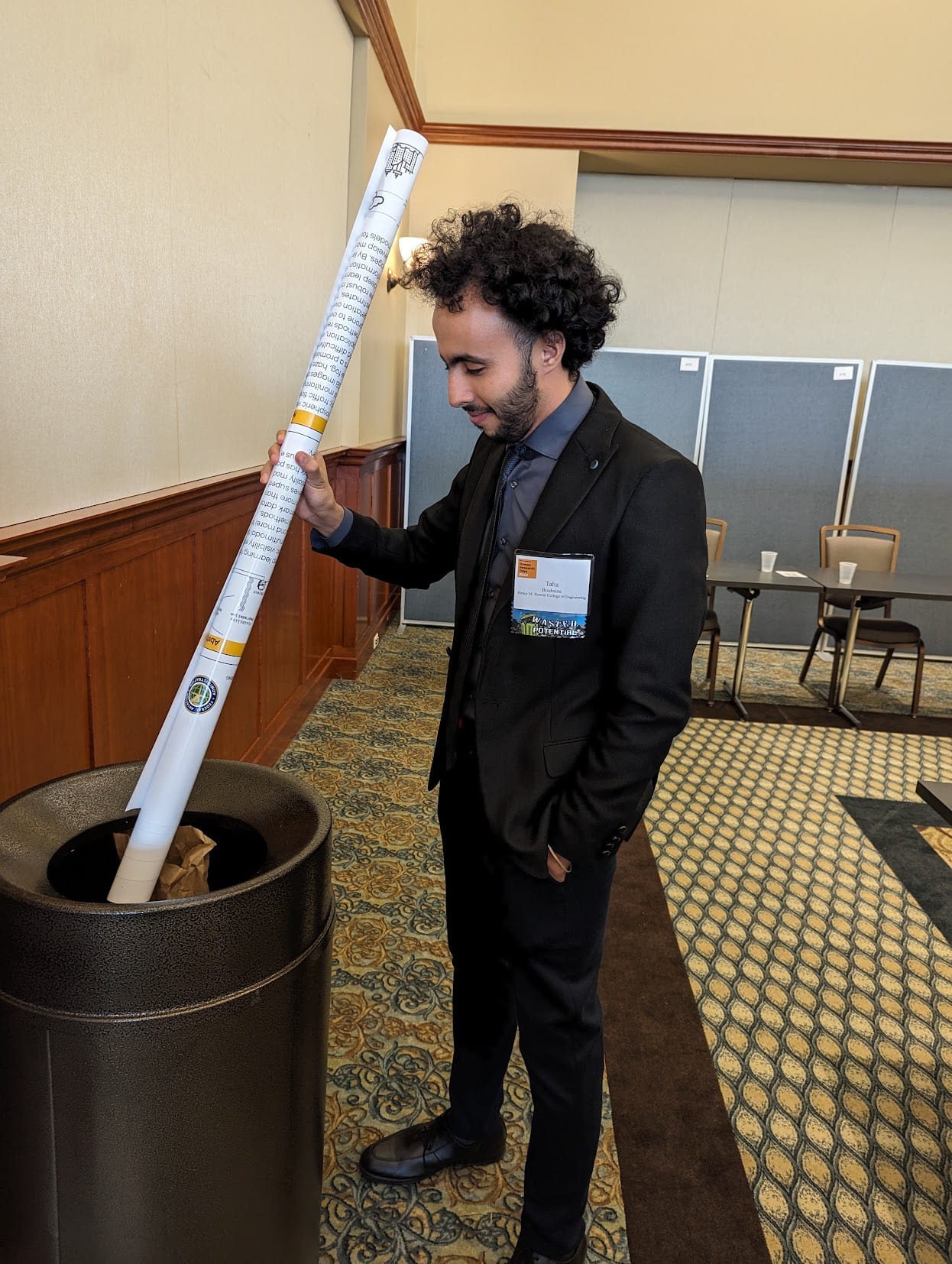
I keep coming back to that photograph. I was angry enough to put the poster in the bin, and I still cared enough for the gesture to hurt. If I had stopped caring about the work, there would have been much less to be angry about.
I like finding things out. That sounds too small for the amount of trouble it has caused me. A result does not quite make sense. A curve has a bump the paper moves past. Something everyone seems happy to use has a step I cannot explain. I can leave it alone for an evening and find myself back at it, trying another version, because I want to know why.
And sometimes it works. The code runs, the curve does what the argument said it should, or a proof I have been struggling with finally closes. Something I could not see an hour ago becomes clear. Usually there is nobody there to tell. For a little while, that does not matter. I have the thing I wanted.
Then I want somebody else to look at it.
This is the part I needed to write, and the part that took me longest to admit hurt. I can check the mathematics, rerun the experiment, stare at the result until I no longer trust my ability to see anything new in it. I want another mind to engage. Find the error. Tell me which assumption I have smuggled in. Ask the question I have spent three months getting too close to the work to ask.
So you send the draft. You rewrite the line asking for thoughts until it sounds casual enough to hide how much you want them. You imagine the reply, then check for it. They are busy, of course. Everybody is busy. You can be generous about that for a day. After a week, the generosity starts requiring more effort.
Eventually you feel embarrassed for having sent it. The next thing stays with you a little longer before you dare to ask again.
Silence gives you nothing to work with. You cannot tell whether the argument was weak, whether it was fine, whether the attachment was opened. You can spend a ridiculous amount of time trying to extract a verdict from the absence of one. At least an objection has something inside it. You can return to a definition, rerun something, disagree. An empty inbox leaves you doing all sides of the conversation yourself.
The little “looks great!” can be worse. Twenty seconds after a long draft arrives, apparently the work has been assessed. I do not know what was read. I know there is nothing in the reply I can use.
At a poster session, the waiting has a place to stand. People read the title and keep moving. Someone stops and begins telling you about their own work. You listen, because perhaps a conversation will happen somewhere inside it. You go home having explained less than you hoped and wondering why wanting that exchange now feels needy.
What frightens me is how easily I could learn to stop asking. Keep the next question to myself. Leave the strange idea out of the meeting. Produce something easy to recognize and stop bringing the part that needs another person to sit with it.
That is a miserable thing to learn in a place supposedly built for inquiry.
I also grew tired of how much effort went into making work resemble the work a venue was ready to receive. The bigger story. The fashionable problem. The comparison that makes the table look more complete without making the result more convincing. A poster with the right density of arrows.
There are real decisions to make about explaining a result. I care about those decisions. What wears me down is watching the question of where something will go take over the question of what has actually been found. By the end, the small result you were pleased with is still somewhere in the presentation. You have spent the meeting finding it a costume.
And I know how tempting that becomes. A confident description gets a response. The careful draft waits. You can learn to make the description more impressive long before you learn anything new about the thing it describes. After enough silence, even knowing what you are doing may not stop you wanting the reply.
The disappointment has made me suspicious of work that arrives perfectly dressed. Clean plots, confident prose, an impressive table. I want to know what was actually tested. Which assumption survived because the experiment never touched it? What would make the claim fail? What got smaller in the description of somebody else’s work so this contribution could look bigger?
Then there is the authority in the room.
I came to mathematics partly because an argument could be checked without first asking who had made it. A first-year could find the error. A senior person could be wrong. I loved that possibility. It gave me something to stand on when I had very little else.
So the response that hurts is the tone in place of an argument. “Well, in my experience.” “That’s not quite how we think about it here.” No step to examine, no assumption to dispute. The discussion ends anyway. You stand there holding a correct thing that lost to a chair.
Perhaps you try again, more carefully. You soften the sentence before you say it. You find a way to let the idea return through someone whose standing will make it easier to hear. And when that works, it is hard to be grateful for having learned the technique. You got the argument accepted by making it appear to need a sponsor.
I do not want to become a courtier who does arithmetic.
I am angry about credit too. About the ease with which someone can be generous with “we” over a result and precise with “you” over the risk. About the suggestion that did not enter the work somehow becoming a claim on it. About how refusing can require more explanation than asking did.
There is so much language available for making this sound collegial. I have much less patience for it when I think about the hours the work took, who was there for them, and how quickly those hours disappear beneath a list of names.
I wanted to do research. I was spending too much of myself learning how to get through the people around it.
The answer cannot be to become so independent that I no longer need anyone to read it. I do need that. Pretending otherwise would leave the most painful part of this whole experience untouched.
But I am tired of the advice to stay, endure it, outwork the politics, and eventually change the place. I do not want to spend the part of me that still cares on proving I can survive the surroundings. I have watched curiosity go quiet in people. I do not trust that I could let that happen to myself for years and simply decide to switch it back on.
So I would rather leave. I would rather look for the people who answer, who can read the draft and come back with objections that show they have actually been inside it. The collaborator who returns three pages of problems is offering something I know how to receive. There is love in that, in taking another person’s question seriously enough to spend an afternoon finding what is wrong with the answer.
The sticker was the name I gave to what staying was beginning to feel like. Throwing the poster away did not settle any of this. I still wanted the work to be read. I still wanted the question answered. I was angry because those things mattered, and because I could feel myself becoming less willing to ask.
I would rather throw the poster away and keep the question. I would rather leave the room and keep the fire. And keep asking, out loud, of the people who answer.