flaxchat
flaxchat
A minimal, end-to-end LLM training harness for Google Cloud TPU pods, built on JAX/Flax NNX.
Port of nanochat to the JAX ecosystem with full feature parity plus speculative decoding.
Part of the 2026 Q1 TPU Research Sprint, supported by the Google AI Developer Programs team.
Quick Start
pixi install
pixi run test          # 148 tests
pixi run -- python -m scripts.run_tinystories --depth=8 --steps=5000
Core Features
GPT Architecture (all nanochat features)
- Rotary Embeddings (RoPE), Group-Query Attention (GQA), QK Normalization
- ReLU^2 MLP, Value Embeddings (ResFormer), Sliding Window (SSSL pattern)
- Per-layer Residual Scaling, Smear, Backout, Logit Soft-capping
- Gradient Checkpointing (
nnx.remat,dots_saveable)
Optimizer
- Mixed Muon + AdamW via
optax.multi_transform - Muon: Polar Express orthogonalization + NorMuon variance reduction
- Per-group LR, betas, weight decay. Warmup -> constant -> warmdown schedule
Inference Engine (4 modes)
| Mode | Function | Speed | Description |
|---|---|---|---|
| Padded | generate() |
~1-2 tok/s | Simple, for debugging |
| KV-cached | generate_with_cache() |
~10-50 tok/s | Python loop with KV cache |
| Fully JIT | generate_fast() |
~200+ tok/s | jax.lax.while_loop, no Python overhead |
| Speculative | generate_speculative() |
~2-4x cached | Draft model proposes, main model verifies |
Tool Use (streaming)
engine = Engine(model, tokenizer)
for tokens, masks in engine.generate(prompt_ids, num_samples=3):
    # Automatic: calculator for math, sandboxed Python for code
    pass
Sandboxed Code Execution
from flaxchat.execution import execute_code
result = execute_code("print(sum(range(10)))", timeout=5.0)
# ExecutionResult(success=True, stdout="45\n")
Parallelism (default, not optional)
mesh = compute_init()  # auto mesh over ALL devices
# Data parallel, FSDP, multi-host — all automatic via JAX SPMD
Depth-Based Config
config = FlaxChatConfig.from_depth(depth=12)
# -> 12 layers, 768 dims, 6 heads, ~79M params
Pipeline
| Stage | Script | Description |
|---|---|---|
| Tokenizer | scripts/tok_train.py |
Train BPE tokenizer |
| Pretrain | scripts/pretrain.py |
Pretrain on ClimbMix-400B / TinyStories |
| SFT | scripts/sft.py |
Supervised fine-tuning |
| RL | scripts/rl.py |
GRPO/REINFORCE on GSM8K |
| Eval | scripts/eval.py |
MMLU, ARC, GSM8K, HumanEval, CORE |
| Chat | scripts/chat_web.py |
FastAPI WebSocket UI |
| Export | scripts/convert_to_tflite.py |
LiteRT/TFLite for edge |
Evaluation Tasks
| Task | Type | Source |
|---|---|---|
| MMLU | 4-choice | cais/mmlu |
| ARC-Challenge | Categorical | allenai/ai2_arc |
| GSM8K | Math + calculator | openai/gsm8k |
| HumanEval | Code + sandbox | openai/humaneval |
| SpellingBee | Tool use | Built-in templates |
| SmolTalk | Conversation | HuggingFaceTB/smol-smoltalk |
| CORE | ICL (DCLM) | Hellaswag, ARC, PIQA, Winogrande |
Test Suite
148 tests across 10 files covering model, engine (all 4 gen modes + speculative + tool use), optimizer, config, evaluation, execution sandbox, checkpoints, tokenizer, dataloader, and distributed utilities.
pixi run test # all tests pass on CPU, GPU, and TPU
Remote Execution
Kaggle GPU (via kgz)
from flaxchat.remote import KaggleRunner
runner = KaggleRunner("https://...")
runner.run_pipeline(depth=8, steps=5000)
GCP TPU (via tpuz)
from tpuz import TPU
tpu = TPU("my-tpu", accelerator="v6e-8")
tpu.up()
tpu.setup(extra_pip="flaxchat")
tpu.run("python -m scripts.pretrain --depth=12", sync=".")
Verified Results
Full Pipeline: Pretrain -> SFT -> RL (Kaggle TPU v5e-8)
| Stage | Dataset | Steps | Loss | Throughput | Time |
|---|---|---|---|---|---|
| Pretrain | FineWeb-Edu (2B tokens) | 15,258 | 10.4 -> 2.94 | 379K tok/s | ~1.5h |
| SFT | SmolTalk (50K conversations) | 2,000 | 2.94 -> 1.82 | — | ~7 min |
| GRPO | GSM8K (math + calculator) | 500 | RL training | — | — |
Model: 12L/768d/6h (GQA: 3kv) = 203.7M params
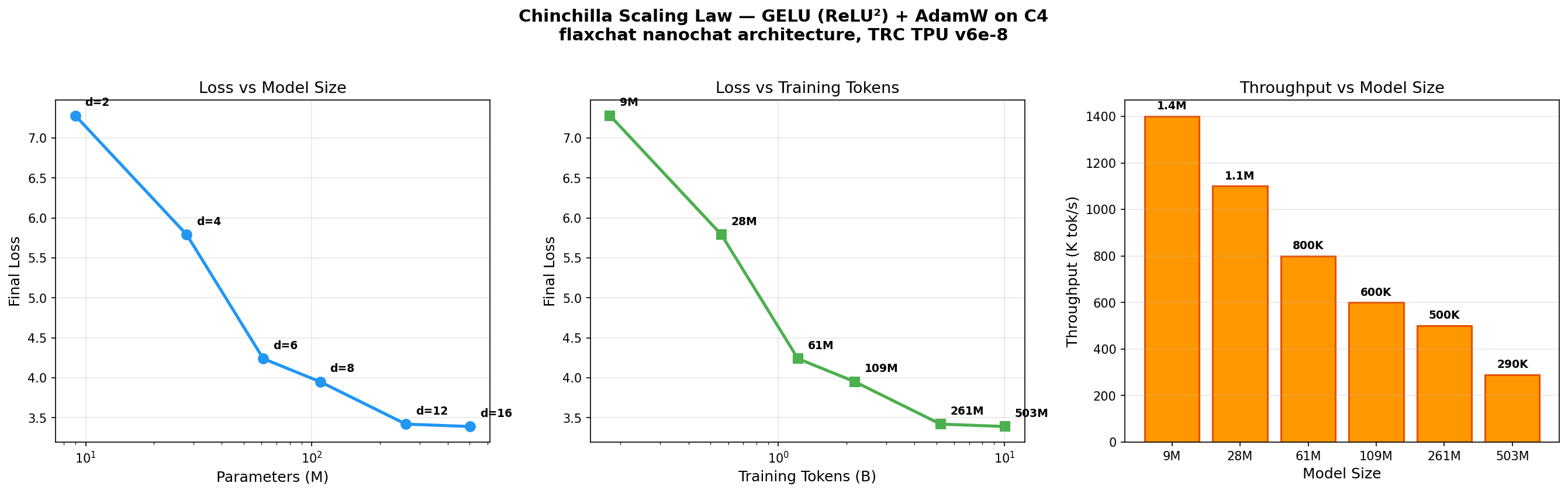
Chinchilla Scaling Law (TRC TPU v6e-8)
Nanochat architecture trained at Chinchilla-optimal budgets (20x params) on C4:
| Depth | Params | Tokens | Final Loss | Throughput |
|---|---|---|---|---|
| 2 | 9M | 0.18B | 7.28 | 1.4M tok/s |
| 4 | 28M | 0.56B | 5.79 | 1.1M tok/s |
| 6 | 61M | 1.22B | 4.24 | 800K tok/s |
| 8 | 109M | 2.18B | 3.95 | 600K tok/s |
| 12 | 261M | 5.22B | 3.42 | 500K tok/s |
| 16 | 503M | 10.06B | 3.39 | 290K tok/s |
Baselines
| Hardware | Model | Throughput | Loss | Time |
|---|---|---|---|---|
| Kaggle 2xT4 | 8L/256d (18.9M) | 55K tok/s | 2.20 | 50 min |
| Kaggle TPU v5e-8 | 8L/512d (90.2M) | 149K tok/s | 2.79 | 109s |
W&B: irf-sic/flaxchat
Acknowledgments
This project is part of the 2026 Q1 TPU Sprint, supported by the Google AI Developer Programs team.
- Google AI Developer Programs for issuing GCP credits
- TPU Research Cloud (TRC) for providing free access to Cloud TPU v4, v5e, and v6e
- Kaggle for free TPU v5e access for prototyping
Built on nanochat, JAX, Flax, Optax, Orbax, tpuz, kgz.
| View on GitHub | Documentation |
Blog Posts
- Training a 19M Parameter Story Generator from Scratch on 2xT4 GPUs — April 01, 2026 We trained a GPT language model from scratch on the TinyStories dataset using flaxchat, our JAX/Flax NNX port of nanochat. The entire pipeline ran end-to-end on 2x NVIDIA T4 GPUs…
Posts
subscribe via RSS