 JAX Pathways
This optional continuation of the NumPy ownership example asks whether two separately launched JAX processes compute one weighted update and whether a whole job can recover after a worker dies. It is a local CPU protocol exercise. Two local processes are not two machines, and this result does not establish network, accelerator, speed, TPU, or production durability claims.
Start here
Complete the two APIs in starter/model.py, then run the stages below. local_numerator_and_gradient returns the masked sum of squared-error loss and gradient plus the valid count. global_transition divides the gathered gradient sums by the one global valid count, then applies momentum and updates the weights. The reference checker computes expected math independently from the ordered sample IDs.
Run commands from the repository root. Python 3.14.3, JAX/JAXlib 0.9.2, and NumPy 2.4.4 are the versions recorded in the current receipt. Use an activated course environment's python3, or set JAXPATHWAYS_PYTHON to the exact Python executable that should launch worker processes. The report records the interpreter and library versions used. Source and runtime identities are frozen with an approved experiment; changing them under an old checkpoint approval must fail before JAX initialization or restore.
python3 projects/sharded-training/multiprocess/check.py \
  --stage math --candidate projects/sharded-training/multiprocess/solution/model.py

JAXPATHWAYS_PYTHON=python3 \
python3 projects/sharded-training/multiprocess/check.py \
  --stage all --candidate projects/sharded-training/multiprocess/solution/model.py
The checker writes a report and scratch work to an OS temporary directory when --output and --work are omitted. To keep evidence at a chosen location, pass both options, for example --work "$PWD/.l10b-run" --output "$PWD/.l10b-run/report.json"; use a new directory for each run.
math checks the two APIs and semantic controls without starting worker processes. checkpoint compares uninterrupted training with a fresh-process restore and checks the first post-restore IDs and complete optimizer/sampler state. worker-loss checks worker termination at a committed boundary and during an incomplete write, then restarts the whole cluster from CURRENT. all runs all three stages and the process-level negative controls. A failed stage means its named contract did not pass; a generic process error is not evidence that a particular negative control worked. If the host denies binding to 127.0.0.1, a process stage is blocked and must not be reported as passing; rerun on a local terminal that permits loopback sockets. math can still run on a host that blocks loopback.
Individual process stages use separate scratch directories and reports:
python3 projects/sharded-training/multiprocess/check.py \
  --stage checkpoint --candidate projects/sharded-training/multiprocess/solution/model.py
python3 projects/sharded-training/multiprocess/check.py \
  --stage worker-loss --candidate projects/sharded-training/multiprocess/solution/model.py
Worked update: uneven shards and an empty rank
The source-bound local CPU run in /private/tmp/l10b-final-preflight-all-20261021/report.json has SHA-256 ba21af2c1e37d1862a53b119fc4ed56ac0a5f1172d6c13d78b73df16f30856d5. Its step-1 transition records ordered IDs [2, 3, 0]: rank 0 owns [2, 3] and rank 1 owns [0], so their valid counts are [2, 1]. The pre-update loss is about 1.0208334. After the update, the local float32 fixture has w ≈ [0.13686667, -0.0222], v ≈ [-2.7373333, 0.444], key 17, epoch 0, cursor 3, and step 1.
At the epoch tail, IDs [1, 4] both belong to rank 0; counts are [2, 0]. Rank 1 contributes zero numerator and zero count. From the recorded step-1 state, the global gradient is approximately [-0.8187333, 1.8652667]. Divide the summed gradient numerator once by the global count 2, then apply momentum:
v2 = 0.8 * [-2.7373333, 0.444] + [-0.8187333, 1.8652667]
   ≈ [-3.0086, 2.2204667]
w2 = [0.13686667, -0.0222] - 0.05 * v2
   ≈ [0.28729668, -0.13322334]
The resulting state has key 17, epoch 0, cursor 5, and step 2. Do not average rank means: that would give the one-example shard the same weight as the two-example shard. Do not divide the empty shard by zero. These rounded values describe this local float32 fixture, not a general performance result.
The receipt binds the computation to these source hashes: check.py f9ffbef4d9f38de45c0bff63f25119aec6e1cbcc5beaca635118f79f8c7e72ad; solution/model.py a7a7c1aca9009d284c41014ea1c6d1f5b7a9b4b1b60991491f5073f1a46ea8a5; starter/model.py 166311a5dd9f47b77e0fdbed1cc4e116c4d0a96932fede3c7463f6af4770272d; supervisor.py 30c0e9724565089e9796b8be39e6c763a3f874ad3fd8c9b8c8de0a877d1db330; and worker.py f9838429d447308e54588c82523de0370e0525d92c748367e2a6fdccb94bbb03.
What the recovery run observed
The figure below distinguishes two events from the same named run. After a complete generation-1 commit, rank 1 was killed with return code -9; rank 0 was observed alive and later returned -6 during JAX shutdown. In a separate incomplete-write event, rank 0 had only rank-0.json.tmp, rank 1 had no final shard, and no generation-2 manifest existed when rank 1 was killed with -9. Rank 0 was alive when observed and later exited with return code 0 after the checker stopped it. CURRENT still named step 1. Both recovery checks started a new two-process attempt and restored the whole cluster; neither demonstrates survivor continuity.
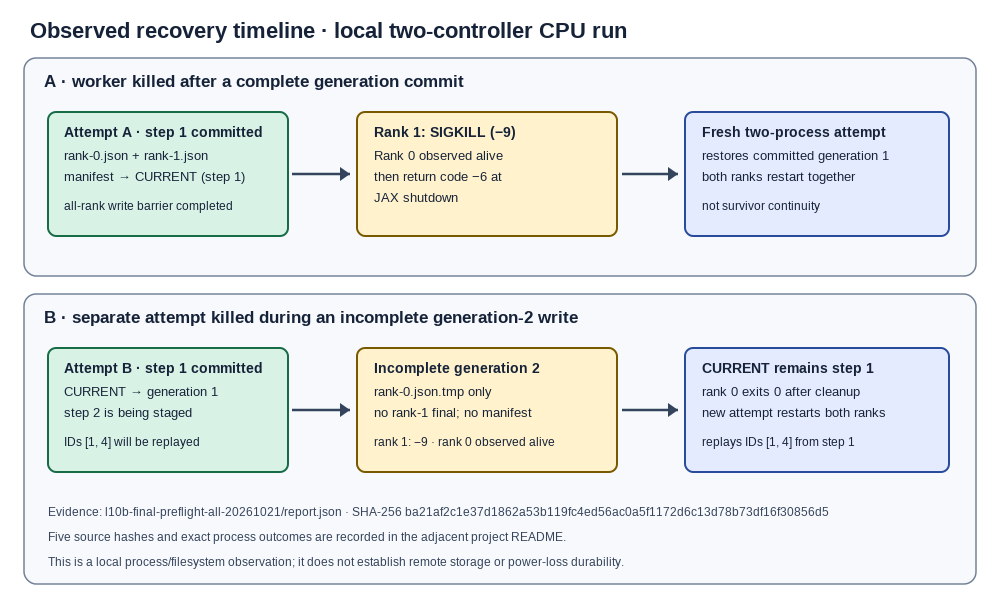
The standalone worker-loss report is /private/tmp/l10b-final-preflight-worker-loss-20261021/report.json, SHA-256 fbf1a2838ac55497377c406aa64de443655d584c0569b7eba4b4ac855cccec0f. It covers the same source hashes listed above and records the actual PIDs, per-rank return codes, checkpoint files, and restart comparisons. The recovery protocol synchronizes rank writes before publishing CURRENT.json; its local filesystem observation does not qualify remote storage or power-loss durability.
The checker also rejects changed source/configuration under an old approval, missing approval beside existing checkpoint artifacts, changed world or rank ownership, duplicate sample ownership, local-mean averaging, stale sampler state, early commit without every rank, stale checkpoint lineage, and a rechecksummed malformed state schema. A copy with only a trailing comment still passes the candidate math check; formatting is not used as a behavioral proxy.
The single-controller sharded project and the physical multi-host target retain their separate scopes and evidence. This extension establishes only the bounded two-controller CPU exercise described here.