Training
Build training loops, neural networks and small Transformers.
19 available · 0 plannedLessons in the focus phases. Shared preparation is listed in the path.
 JAX Pathways
103 available lessons22 phases30 hands-on projects
From arrays and gradients to training, evaluation, and deployment. Learn the ideas, run the experiments, and build with an AI tutor alongside you.
Start with basic Python and a laptop CPU. The course is in active development.
Start with a placement check, choose a learning path, and work through explanations and exercises with your agent.
1. Download the course workspace, unzip it, and open the jaxpathways folder in your agent. 2. Run this in that folder’s terminal (requires Node.js/npm):
npx skills add . --skill start-learning learn-jax jax-course-guide check-jax3. Ask your agent: Use start-learning to help me learn JAX from this workspace.
Codex · Claude Code · Cursor · other skill-enabled agents
For ChatGPT or another browser chatbot, download the first lesson, attach it to your chat, and ask for a guided walkthrough. The command above installs skills for coding agents that can read local files. Read the setup guide.

Start with the same foundations. Then follow the work that interests you.
Build training loops, neural networks and small Transformers.
19 available · 0 plannedLessons in the focus phases. Shared preparation is listed in the path.
Take a trained model toward export, serving and deployment.
8 available · 0 plannedLessons in the focus phases. Shared preparation is listed in the path.
Use differentiation for scientific models and numerical experiments.
4 available · 0 plannedLessons in the focus phases. Shared preparation is listed in the path.
Explore profiling, distributed computation and accelerator operations.
31 available · 0 plannedLessons in the focus phases. Shared preparation is listed in the path.
Read an explanation, make a prediction, then run and change the code. A few lessons from the journey:
All 103 lesson exercises run on CPU; planned capstones and accelerator validation are labeled in each path.
Start with these two projects, then explore the specialist projects as you progress.
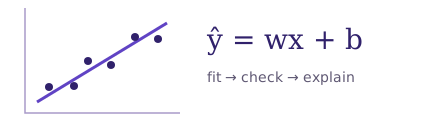
Fit a small model, check its gradients, and make the experiment reproducible.
Open the regression project ↗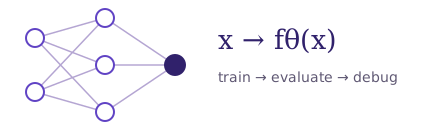
Connect a network, an optimizer, and an evaluation step. Investigate what happens when training goes wrong.
Open the classifier project ↗Staged CPU practice with exercises and checks. Each project states its prerequisites.
Read away from the browser. Keep the explanations beside your editor, or start with the first lesson online.
Book contents, author and edition details. The printable reader can be saved as a PDF from your browser. Read the first lesson online ↗