 JAX Pathways
Phase 05 / Neural network training
A compiled train and evaluation step
Revision v0.7.0 · Updated since your last visit. Review the changes; your progress is saved.
Lesson · about 95 minutes · CPU practice
Build train and eval steps and check that evaluation does not update weights.
Phase study guide: preparation, milestones and project evidence
Before you start
Before this: Model and state with Flax NNX
Hardware: CPU
Setup help: Python, notebook, or Cloud TPU VM
Use the tested CPU packages (the recorded environment uses Python 3.14.3). Other Python versions and accelerator environments require separate checks. The optional Cloud TPU specialization explains the target-specific execution boundaries. Logical CPU devices practice partitioning; they do not simulate TPU performance.
Download the repository ZIP or use your existing checkout. Extract it and open a terminal in the folder containing requirements-cpu.txt. The beginner ZIP is separate; these lessons use the full repository folder.
python3 -m venv .venv
source .venv/bin/activate
python -m pip install -r requirements-cpu.txtpy -3 -m venv .venv
.\.venv\Scripts\python.exe -m pip install -r requirements-cpu.txtAfter activation, run the complete worked example from that same folder:
python phases/05-networks/03-a-compiled-train-and-evaluation-step/code/main.py.\.venv\Scripts\python.exe phases/05-networks/03-a-compiled-train-and-evaluation-step/code/main.pyFor an incremental build, create main.py in your own practice folder, append each build block in order, and run python main.py with this environment active. Keep that file separate from the downloaded reference solution.
Download this lesson’s notebook. Open it with a Python kernel using the course environment. Run cells from the top after restarting the kernel; experiments depend on earlier definitions.
For local Jupyter, first install the course requirements using the Local Python steps, then use your environment’s Python to start Jupyter:
python -m pip install jupyterlab
python -m jupyter lab.\.venv\Scripts\python.exe -m pip install jupyterlab
.\.venv\Scripts\python.exe -m jupyter labSelect the downloaded networks-03.ipynb file in JupyterLab. The notebook contains reference solutions; make your prediction and attempt each practice task before opening them. Restart the kernel before changing logical device setup.
The worked reference for this lesson is CPU-validated. Some references explicitly configure logical CPU devices; setting JAX_PLATFORMS does not adapt them to a TPU. Follow the execution matrix and reviewed multi-host example before attempting a target run.
For accelerator preparation, study TPU setup, observed runtime receipts, checkpointed jobs and precision and retained traces. These target paths remain unqualified on physical TPU hardware until an actual receipt is recorded. Cloud provisioning is optional for CPU learning.
Check: optimizer updates; held-out accuracy above ; evaluation snapshots unchanged. Exact scalar metrics are printed by your run.
Revisit the guided CPU setup · Open 19: TPU Setup. Package instructions are CPU instructions; Windows and accelerator environments need their own validation.
What you will be able to do
- Choose a transparent train and held-out split
- Read the state transition in execution order
- Compute useful metrics without changing the model
- Make replay a controlled experiment
The problem
Training changes a model; evaluation should measure it without changing it. We’ll write those two steps separately and compile them with Flax NNX. Then we’ll check the parameters and optimizer counter before and after evaluation, so this important promise is something we test rather than assume.
The idea
Training computes gradients and changes the model. Evaluation measures a fixed model under a declared input and scoring contract. Keeping those roles separate prevents held-out data from quietly participating in fitting.
Evaluation observes a frozen model
Suppose validation loss improves after an accidental optimizer step on validation examples. The number is real, but it no longer evaluates the unchanged training result. The evaluation has influenced fitting.
Capture parameter and relevant state values before evaluation and compare afterward. If the model has training-only randomness or running statistics, verify its evaluation convention too. Depict only the mechanisms the actual model uses.
Aggregate evaluation contributions with their counts. Unequal batch sizes make an average of batch means different from an example mean. Finally, inspect actual errors in the held-out prediction field: a visually attractive boundary cannot rule out leakage or a denominator mistake.
Choose a transparent train and held-out split
Generate separate arrays from fixed independent seeds. Labels follow the known line x0 + x1 > , so there is no label ambiguity and no external dataset download. Forty-eight training rows and forty-eight held-out rows are intentionally tiny. The held-out distribution matches the training distribution; this measures interpolation on a controlled problem, not robustness under distribution shift. Keep held-out rows out of optimizer calls. Real projects also need validation for model selection and a final test set; this example fixes hyperparameters in advance and does not supply a production evaluation protocol.
Read the state transition in execution order
nnx.value_and_grad computes loss and gradients for the current parameters. optimizer.update(model, grads) then changes the model and optimizer state. The returned loss is pre-update loss, not the loss at the new weights. nnx.Optimizer is configured with wrt=nnx.Param, and optax.adam maintains first and second moments plus an update counter. A model snapshot alone cannot exactly resume Adam training. Conversely, a metrics call should not increment optimizer.step. Counting requested updates checks loop behavior, while comparing full snapshots checks evaluation isolation.
(model parameters, optimizer state, training batch) → loss/gradients → updated model and optimizer
(fixed model, held-out batch) → loss and accuracy only
Compute useful metrics without changing the model
Binary cross-entropy uses scores directly. Accuracy thresholds scores at zero; sigmoid is unnecessary for this decision. Return both because confidence and hard decisions measure different behavior. A wrong but extremely confident prediction can dominate loss while changing accuracy by only one observation. We calculate held-out loss independently with NumPy logaddexp and held-out accuracy with NumPy comparisons. Capture every parameter array before evaluation and compare bytes afterward. This model has no dropout or batch normalization; later stateful models require explicit evaluation mode and nonparameter-state checks too.
Make replay a controlled experiment
Repeat the full initialization and training routine from the same seed and batches. Compare final parameter arrays within tolerance and compare held-out metrics. This is stronger than checking that one seeded initialization looks similar. It verifies the sequence of updates, but only in the tested CPU environment. Floating-point reductions, package versions, and backend changes may affect results. Store model seed, data seeds, batch policy, learning rate, iteration count, dependency versions, and metrics. Do not use a different initialization as a supposed resume of an existing optimizer state.
Inspect predictions on held-out inputs
Predict before looking: Where would a mistake appear relative to the decision boundary?
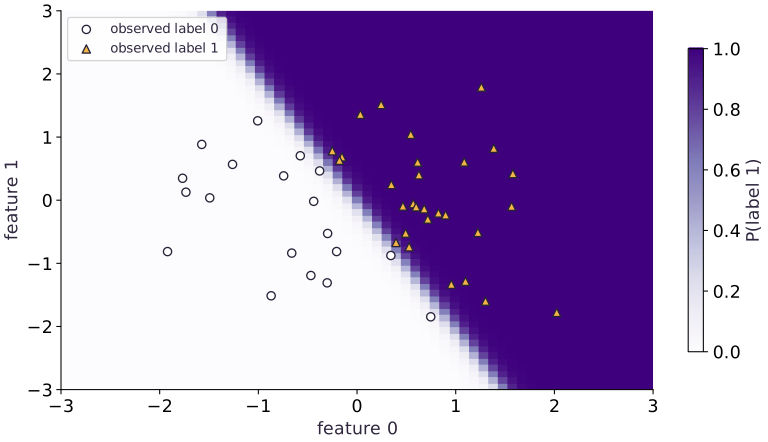
Read the figure
The horizontal and vertical axes are input features. The background is the trained model’s probability of label , from pale near to dark purple near . Circles mark held-out examples with label , and triangles mark held-out examples with label .
A slanted transition separates a mostly pale left side from a dark right side. The circles lie on the low-probability side and the triangles on the high-probability side. The example’s direct evaluation reports accuracy on this fixed held-out set; the figure shows where those correct decisions occur.
Connect it to the computation
The data rule assigns label when , whose boundary is . That explains the overall downward slant. The network approximates this separation; its transition need not be perfectly straight everywhere.
To inspect a mistake in a changed run, look for a triangle where the probability is below , or a circle where it is above , and check the model at that exact point. Grid colors are sampled approximations. Perfect accuracy on this small synthetic set is separate from accuracy outside it, and extreme probabilities do not by themselves establish calibration.
Open full-size figureDownload data and provenance
The notebook contains the data experiment, plotting code, and recorded figure output. Rerun it to test your changes.
Where to put & run this code: Work in phases/05-networks/03-a-compiled-train-and-evaluation-step/code/main.py (or downloaded exercises/networks-03.py / exercises/networks-03.ipynb) and execute from the repository root with python3 phases/05-networks/03-a-compiled-train-and-evaluation-step/code/main.py.
1 Construct data, model, and optimizer
Create main.py in the training dependency environment. The generator returns separate train and held-out arrays.
# Step 1 — 1. Construct data, model, and optimizer: The held-out seed is 11; every optimizer call below uses seed-10...
from flax import nnx
import jax
import jax.numpy as jnp
import numpy as np
import optax
def dataset(seed,n=48):
    a=np.random.default_rng(seed).normal(size=(n,2)).astype(np.float32)
    b=(a[:,0]+.5*a[:,1]>0).astype(np.float32)
    return jnp.array(a),jnp.array(b)
train_x,train_y=dataset(10)
test_x,test_y=dataset(11)
# Define `Classifier` module / container with explicit state and forward pass:
class Classifier(nnx.Module):
    def __init__(self,seed=0):
        rngs=nnx.Rngs(seed)
        self.hidden=nnx.Linear(2,8,rngs=rngs)
        self.out=nnx.Linear(8,1,rngs=rngs)
    def __call__(self,x):return self.out(nnx.tanh(self.hidden(x))).squeeze(-1)
def objective(m,x,y):return jnp.mean(optax.sigmoid_binary_cross_entropy(m(x),y))
def initialize():
    m=Classifier(0)
    return m,nnx.Optimizer(m,optax.adam(.03),wrt=nnx.Param)
model,optimizer=initialize()
Code building blocks in this step
jnp.array(values, dtype=...)— Constructs an immutable device-backed JAX array from Python/NumPy values.x.sum(axis=...) / x.mean(axis=..., keepdims=...)— Reduces values along the namedaxis(the axis you name is collapsed unlesskeepdims=True).nnx.Module / nnx.Linear / nnx.Optimizer— Flax NNX stateful module and optimizer containers with explicit RNG streams (nnx.Rngs) and traced graph updates.optax.adam(lr) / optax.apply_updates(params, updates)— Optax gradient transformations and numerically stable loss functions over parameter PyTrees.
The held-out seed is ; every optimizer call below uses seed-10 data only.
2 Define the two compiled functions
Append train and evaluation functions. Notice that only train_step receives an optimizer.
# Step 2 — 2. Define the two compiled functions: The 80-update counter is an optimizer invariant.
# Define and JIT-compile `train_step(m, o, x, y)` so XLA traces and fuses the operations:
@nnx.jit
def train_step(m,o,x,y):
    # Differentiate the objective to obtain `(value, grads)` via automatic differentiation.
    value,grads=nnx.value_and_grad(objective)(m,x,y)
    # Update state in place with the new values.
    o.update(m,grads)
    return value
# Define and JIT-compile `evaluate(m, x, y)` so XLA traces and fuses the operations:
@nnx.jit
def evaluate(m,x,y):
    scores=m(x)
    return jnp.mean(optax.sigmoid_binary_cross_entropy(scores,y)),jnp.mean((scores>0)==y)
def snapshot(m):return [np.array(a,copy=True) for a in jax.tree.leaves(nnx.state(m))]
before_loss=float(objective(model,train_x,train_y))
# Execute `for _ in range(80):train_step(model,optimizer,train_x,train_y)`.
for _ in range(80):train_step(model,optimizer,train_x,train_y)
assert int(optimizer.step[...])==80
Code building blocks in this step
x.sum(axis=...) / x.mean(axis=..., keepdims=...)— Reduces values along the namedaxis(the axis you name is collapsed unlesskeepdims=True).jax.value_and_grad(loss_fn)(params, ...)— Evaluates both the scalar loss and its gradient PyTree(loss_val, grads)in a single forward+backward pass.jax.jit(fn) / @jax.jit— Tracesfnwith abstract shapes and compiles a fused XLA executable cached by input shape and dtype.optax.adam(lr) / optax.apply_updates(params, updates)— Optax gradient transformations and numerically stable loss functions over parameter PyTrees.
The 80-update counter is an optimizer invariant. Pre-update losses returned during the loop are not the final held-out metric.
3 Verify held-out metrics and state isolation
Append snapshot and reference comparisons. Print both training and held-out results instead of a single success number.
# Step 3 — 3. Verify held-out metrics and state isolation: The synthetic fixture normally exceeds 0.85 held-out accuracy.
frozen=snapshot(model)
step_count=int(optimizer.step[...])
test_loss,test_accuracy=evaluate(model,test_x,test_y)
for a,b in zip(frozen,snapshot(model)):np.testing.assert_array_equal(a,b)
assert int(optimizer.step[...])==step_count
# Convert `scores` to a host NumPy array for inspection or verification.
# Convert `labels` to a host NumPy array for inspection or verification.
scores=np.asarray(model(test_x))
labels=np.asarray(test_y)
np.testing.assert_allclose(test_loss,np.mean(np.logaddexp(0.,scores)-labels*scores),rtol=1e-5,atol=1e-6)
np.testing.assert_allclose(test_accuracy,np.mean((scores>0)==labels),atol=1e-6)
assert float(test_accuracy)>.85 and float(objective(model,train_x,train_y))<before_loss*.3
print('Updates:',step_count,'held-out loss:',float(test_loss),'accuracy:',float(test_accuracy))
Code building blocks in this step
x.sum(axis=...) / x.mean(axis=..., keepdims=...)— Reduces values along the namedaxis(the axis you name is collapsed unlesskeepdims=True).jnp.allclose(actual, expected, rtol=..., atol=...)— Checks that two arrays match elementwise within floating-point tolerance.
The synthetic fixture normally exceeds held-out accuracy. Parameter bytes and optimizer count remain unchanged during evaluation.
View the cumulative build in main.py
These blocks append in order to the same file.
# Step 1 — 1. Construct data, model, and optimizer: The held-out seed is 11; every optimizer call below uses seed-10...
from flax import nnx
import jax
import jax.numpy as jnp
import numpy as np
import optax
def dataset(seed,n=48):
    a=np.random.default_rng(seed).normal(size=(n,2)).astype(np.float32)
    b=(a[:,0]+.5*a[:,1]>0).astype(np.float32)
    return jnp.array(a),jnp.array(b)
train_x,train_y=dataset(10)
test_x,test_y=dataset(11)
# Define `Classifier` module / container with explicit state and forward pass:
class Classifier(nnx.Module):
    def __init__(self,seed=0):
        rngs=nnx.Rngs(seed)
        self.hidden=nnx.Linear(2,8,rngs=rngs)
        self.out=nnx.Linear(8,1,rngs=rngs)
    def __call__(self,x):return self.out(nnx.tanh(self.hidden(x))).squeeze(-1)
def objective(m,x,y):return jnp.mean(optax.sigmoid_binary_cross_entropy(m(x),y))
def initialize():
    m=Classifier(0)
    return m,nnx.Optimizer(m,optax.adam(.03),wrt=nnx.Param)
model,optimizer=initialize()

# Step 2 — 2. Define the two compiled functions: The 80-update counter is an optimizer invariant.
# Define and JIT-compile `train_step(m, o, x, y)` so XLA traces and fuses the operations:
@nnx.jit
def train_step(m,o,x,y):
    # Differentiate the objective to obtain `(value, grads)` via automatic differentiation.
    value,grads=nnx.value_and_grad(objective)(m,x,y)
    # Update state in place with the new values.
    o.update(m,grads)
    return value
# Define and JIT-compile `evaluate(m, x, y)` so XLA traces and fuses the operations:
@nnx.jit
def evaluate(m,x,y):
    scores=m(x)
    return jnp.mean(optax.sigmoid_binary_cross_entropy(scores,y)),jnp.mean((scores>0)==y)
def snapshot(m):return [np.array(a,copy=True) for a in jax.tree.leaves(nnx.state(m))]
before_loss=float(objective(model,train_x,train_y))
# Execute `for _ in range(80):train_step(model,optimizer,train_x,train_y)`.
for _ in range(80):train_step(model,optimizer,train_x,train_y)
assert int(optimizer.step[...])==80

# Step 3 — 3. Verify held-out metrics and state isolation: The synthetic fixture normally exceeds 0.85 held-out accuracy.
frozen=snapshot(model)
step_count=int(optimizer.step[...])
test_loss,test_accuracy=evaluate(model,test_x,test_y)
for a,b in zip(frozen,snapshot(model)):np.testing.assert_array_equal(a,b)
assert int(optimizer.step[...])==step_count
# Convert `scores` to a host NumPy array for inspection or verification.
# Convert `labels` to a host NumPy array for inspection or verification.
scores=np.asarray(model(test_x))
labels=np.asarray(test_y)
np.testing.assert_allclose(test_loss,np.mean(np.logaddexp(0.,scores)-labels*scores),rtol=1e-5,atol=1e-6)
np.testing.assert_allclose(test_accuracy,np.mean((scores>0)==labels),atol=1e-6)
assert float(test_accuracy)>.85 and float(objective(model,train_x,train_y))<before_loss*.3
print('Updates:',step_count,'held-out loss:',float(test_loss),'accuracy:',float(test_accuracy))
Run the example
python3 phases/05-networks/03-a-compiled-train-and-evaluation-step/code/main.pyAbout this command
This shortcut uses an activated macOS/Linux course environment in the repository folder. For Windows, use the explicit interpreter command in “Setup help” above. The script includes worked examples and reference solutions.
Inspect the complete assembled example
# Step 1 — 1. Construct data, model, and optimizer: The held-out seed is 11; every optimizer call below uses seed-10...
from flax import nnx
import jax
import jax.numpy as jnp
import numpy as np
import optax
def dataset(seed,n=48):
    a=np.random.default_rng(seed).normal(size=(n,2)).astype(np.float32)
    b=(a[:,0]+.5*a[:,1]>0).astype(np.float32)
    return jnp.array(a),jnp.array(b)
train_x,train_y=dataset(10)
test_x,test_y=dataset(11)
# Define `Classifier` module / container with explicit state and forward pass:
class Classifier(nnx.Module):
    def __init__(self,seed=0):
        rngs=nnx.Rngs(seed)
        self.hidden=nnx.Linear(2,8,rngs=rngs)
        self.out=nnx.Linear(8,1,rngs=rngs)
    def __call__(self,x):return self.out(nnx.tanh(self.hidden(x))).squeeze(-1)
def objective(m,x,y):return jnp.mean(optax.sigmoid_binary_cross_entropy(m(x),y))
def initialize():
    m=Classifier(0)
    return m,nnx.Optimizer(m,optax.adam(.03),wrt=nnx.Param)
model,optimizer=initialize()

# Step 2 — 2. Define the two compiled functions: The 80-update counter is an optimizer invariant.
# Define and JIT-compile `train_step(m, o, x, y)` so XLA traces and fuses the operations:
@nnx.jit
def train_step(m,o,x,y):
    # Differentiate the objective to obtain `(value, grads)` via automatic differentiation.
    value,grads=nnx.value_and_grad(objective)(m,x,y)
    # Update state in place with the new values.
    o.update(m,grads)
    return value
# Define and JIT-compile `evaluate(m, x, y)` so XLA traces and fuses the operations:
@nnx.jit
def evaluate(m,x,y):
    scores=m(x)
    return jnp.mean(optax.sigmoid_binary_cross_entropy(scores,y)),jnp.mean((scores>0)==y)
def snapshot(m):return [np.array(a,copy=True) for a in jax.tree.leaves(nnx.state(m))]
before_loss=float(objective(model,train_x,train_y))
# Execute `for _ in range(80):train_step(model,optimizer,train_x,train_y)`.
for _ in range(80):train_step(model,optimizer,train_x,train_y)
assert int(optimizer.step[...])==80

# Step 3 — 3. Verify held-out metrics and state isolation: The synthetic fixture normally exceeds 0.85 held-out accuracy.
frozen=snapshot(model)
step_count=int(optimizer.step[...])
test_loss,test_accuracy=evaluate(model,test_x,test_y)
for a,b in zip(frozen,snapshot(model)):np.testing.assert_array_equal(a,b)
assert int(optimizer.step[...])==step_count
# Convert `scores` to a host NumPy array for inspection or verification.
# Convert `labels` to a host NumPy array for inspection or verification.
scores=np.asarray(model(test_x))
labels=np.asarray(test_y)
np.testing.assert_allclose(test_loss,np.mean(np.logaddexp(0.,scores)-labels*scores),rtol=1e-5,atol=1e-6)
np.testing.assert_allclose(test_accuracy,np.mean((scores>0)==labels),atol=1e-6)
assert float(test_accuracy)>.85 and float(objective(model,train_x,train_y))<before_loss*.3
print('Updates:',step_count,'held-out loss:',float(test_loss),'accuracy:',float(test_accuracy))
Expected result: optimizer updates; held-out accuracy above ; evaluation snapshots unchanged. Exact scalar metrics are printed by your run.
Recorded reference execution
Reference output captured from executing the complete lesson script (code/main.py) and its assertions in the course CPU environment.
Updates: 80 held-out loss: 0.018426384776830673 accuracy: 1.0
Updates: 80 held-out loss: 0.018426384776830673 accuracy: 1.0
Count-weighted held-out metrics: [0.01842638 0.99999995] constructed accuracy: 0.5416666666666666
PASS: networks-03
Download execution record · The notebook includes executed cells and figure outputs. Compare your run with these values; timings depend on the machine.
Replay the complete update sequence
# Experiment — Replay the complete update sequence: Replay reconstructs optimizer state from the start.
replay,replay_optimizer=initialize()
# Execute `for _ in range(80):train_step(replay,replay_optimizer,train_x,train_y)`.
for _ in range(80):train_step(replay,replay_optimizer,train_x,train_y)
for a,b in zip(snapshot(model),snapshot(replay)):np.testing.assert_allclose(a,b,rtol=1e-6,atol=1e-6)
np.testing.assert_allclose(evaluate(replay,test_x,test_y),evaluate(model,test_x,test_y),rtol=1e-6)
Expected: Final parameters and held-out metrics agree within CPU tolerances.
Replay reconstructs optimizer state from the start. It is not a checkpoint-resume implementation.
Duplicating evaluation data
# Experiment — Duplicating evaluation data: Means normalize the observation count.
doubled=evaluate(model,jnp.concatenate([test_x,test_x]),jnp.concatenate([test_y,test_y]))
np.testing.assert_allclose(doubled,evaluate(model,test_x,test_y),rtol=1e-5,atol=1e-6)
Expected: Both metrics stay the same.
Means normalize the observation count. Duplicating data does not create independent evaluation evidence.
Make it yours
Where to put your code: Append your solution at the bottom of phases/05-networks/03-a-compiled-train-and-evaluation-step/code/main.py (or inside the Make it yours cell of exercises/networks-03.ipynb) and run python3 phases/05-networks/03-a-compiled-train-and-evaluation-step/code/main.py to verify your prediction before opening the reference solution.
Compute held-out metrics in three equal chunks and reconstruct the overall means. Then confirm no state changed.
Show a writing guide and starter scaffold
How to write this exercise code: step-by-step recipe & starter scaffold
1. Key functions & syntax to use:
x.sum(axis=...) / x.mean(axis=..., keepdims=...)— Reduces values along the namedaxis(the axis you name is collapsed unlesskeepdims=True).jnp.allclose(actual, expected, rtol=..., atol=...)— Checks that two arrays match elementwise within floating-point tolerance.
2. Step-by-step implementation plan:
- Reduce along axis=0 to compute
aggregate. - Convert
to a host NumPy array for inspection or verification.
# Exercise solution: Compute held-out metrics in three equal chunks and reconstruct the...
old = snapshot(...)  # TODO: compute old
pieces = ...  # TODO: compute pieces
# Reduce along axis=0 to compute `aggregate`.
aggregate = np.mean(...)  # TODO: compute aggregate
# Convert `` to a host NumPy array for inspection or verification.
np.testing.assert_allclose(aggregate,np.asarray(evaluate(model,test_x,test_y)),rtol = ...  # TODO: compute np.testing.assert_allclose(aggregate,np.asarray(evaluate(model,test_x,test_y)),rtol
for a,b in zip(old,snapshot(model)):np.testing.assert_array_equal(a,b)
Reveal the reference solution
# Exercise solution: Compute held-out metrics in three equal chunks and reconstruct the...
old=snapshot(model)
pieces=[evaluate(model,test_x[i:i+16],test_y[i:i+16]) for i in range(0,48,16)]
# Reduce along axis=0 to compute `aggregate`.
aggregate=np.mean(np.asarray(pieces),axis=0)
# Convert `` to a host NumPy array for inspection or verification.
np.testing.assert_allclose(aggregate,np.asarray(evaluate(model,test_x,test_y)),rtol=1e-5,atol=1e-6)
for a,b in zip(old,snapshot(model)):np.testing.assert_array_equal(a,b)
Aggregate unequal batches
Transfer
Evaluate the held-out set in batches of seven and forty-one observations. Reconstruct both metrics from sums and counts. Use a separate constructed count example to demonstrate why averaging batch accuracies can be wrong.
Show a writing guide and starter scaffold
How to write this practice solution: step-by-step recipe & starter scaffold
1. Key functions & syntax to use:
x.sum(axis=...) / x.mean(axis=..., keepdims=...)— Reduces values along the namedaxis(the axis you name is collapsed unlesskeepdims=True).jnp.allclose(actual, expected, rtol=..., atol=...)— Checks that two arrays match elementwise within floating-point tolerance.
2. Step-by-step implementation plan:
- Convert
metricsto a host NumPy array for inspection or verification. - Reduce along axis=0 to compute
weighted. - Convert
to a host NumPy array for inspection or verification. - Execute
np.testing.assert_allclose(correct.sum()/counts.sum(),expected).
# Aggregate unequal batches (Transfer): A batch is a packaging choice, not a unit of evidence.
sizes = np.array(...)  # TODO: compute sizes
# Convert `metrics` to a host NumPy array for inspection or verification.
metrics = np.asarray(...)  # TODO: compute metrics
# Reduce along axis=0 to compute `weighted`.
weighted = ...  # TODO: compute weighted
# Convert `` to a host NumPy array for inspection or verification.
np.testing.assert_allclose(weighted,np.asarray(evaluate(model,test_x,test_y)),rtol = ...  # TODO: compute np.testing.assert_allclose(weighted,np.asarray(evaluate(model,test_x,test_y)),rtol
correct = np.array(...)  # TODO: compute correct
counts = np.array(...)  # TODO: compute counts
expected = ...  # TODO: compute expected
# Execute `np.testing.assert_allclose(correct.sum()/counts.sum(),expected)`.
np.testing.assert_allclose(correct.sum()/counts.sum(),expected)
assert not np.isclose(np.mean(correct/counts),expected)  # TODO: complete assertion check
print('Count-weighted held-out metrics:',weighted,'constructed accuracy:',expected)
Show a hint
Weight each batch mean by its number of observations.
Reveal reference solution and reasoning
# Aggregate unequal batches (Transfer): A batch is a packaging choice, not a unit of evidence.
sizes=np.array([7,41])
# Convert `metrics` to a host NumPy array for inspection or verification.
metrics=np.asarray([evaluate(model,test_x[:7],test_y[:7]),evaluate(model,test_x[7:],test_y[7:])])
# Reduce along axis=0 to compute `weighted`.
weighted=(metrics*sizes[:,None]).sum(axis=0)/sizes.sum()
# Convert `` to a host NumPy array for inspection or verification.
np.testing.assert_allclose(weighted,np.asarray(evaluate(model,test_x,test_y)),rtol=1e-5,atol=1e-6)
correct=np.array([6,20])
counts=np.array([7,41])
expected=26/48
# Execute `np.testing.assert_allclose(correct.sum()/counts.sum(),expected)`.
np.testing.assert_allclose(correct.sum()/counts.sum(),expected)
assert not np.isclose(np.mean(correct/counts),expected)
print('Count-weighted held-out metrics:',weighted,'constructed accuracy:',expected)
A batch is a packaging choice, not a unit of evidence. The constructed counts expose the bias even if a particular model happens to obtain equal accuracy on both actual batches.
Catch an evaluation function that trains
Intermediate
On an independent clone, deliberately call train_step with held-out data and show the isolation checks fail. Keep the real model untouched.
Show a writing guide and starter scaffold
How to write this practice solution: step-by-step recipe & starter scaffold
1. Key functions & syntax to use:
jnp.array(values, dtype=...)— Constructs an immutable device-backed JAX array from Python/NumPy values.jax.tree.map(lambda p, g: ..., params, grads)— Applies a function leaf-by-leaf across matching PyTrees (such as updating every parameter tensor with its gradient).nnx.Module / nnx.Linear / nnx.Optimizer— Flax NNX stateful module and optimizer containers with explicit RNG streams (nnx.Rngs) and traced graph updates.optax.adam(lr) / optax.apply_updates(params, updates)— Optax gradient transformations and numerically stable loss functions over parameter PyTrees.
2. Step-by-step implementation plan:
- Catch an evaluation function that trains (Intermediate): A plausible returned loss is separate from evaluation.
- Transform every leaf of the parameter PyTree (
bad_model). - Configure or step the Optax optimizer state (
bad_optimizer).
# Catch an evaluation function that trains (Intermediate): A plausible returned loss is separate from evaluation.
graph,state = nnx.split(...)  # TODO: compute graph,state
# Transform every leaf of the parameter PyTree (`bad_model`).
bad_model = nnx.merge(...)  # TODO: compute bad_model
# Configure or step the Optax optimizer state (`bad_optimizer`).
bad_optimizer = nnx.Optimizer(...)  # TODO: compute bad_optimizer
prior = snapshot(...)  # TODO: compute prior
train_step(bad_model,bad_optimizer,test_x,test_y)
assert int(bad_optimizer.step[...])  # TODO: complete assertion check
assert any(not np.array_equal(a,b) for a,b  # TODO: complete assertion check
assert int(optimizer.step[...])  # TODO: complete assertion check
Show a hint
Compare both optimizer.step and model parameters around the bad call.
Reveal reference solution and reasoning
# Catch an evaluation function that trains (Intermediate): A plausible returned loss is separate from evaluation.
graph,state=nnx.split(model)
# Transform every leaf of the parameter PyTree (`bad_model`).
bad_model=nnx.merge(graph,jax.tree.map(lambda a:jnp.array(a,copy=True),state))
# Configure or step the Optax optimizer state (`bad_optimizer`).
bad_optimizer=nnx.Optimizer(bad_model,optax.adam(.03),wrt=nnx.Param)
prior=snapshot(bad_model)
train_step(bad_model,bad_optimizer,test_x,test_y)
assert int(bad_optimizer.step[...])==1
assert any(not np.array_equal(a,b) for a,b in zip(prior,snapshot(bad_model)))
assert int(optimizer.step[...])==80
A plausible returned loss is separate from evaluation. Passing held-out data through the update function leaks it into learned state.
Diagnose the result
If metrics look suspiciously good, trace which arrays reach train_step. If evaluation modifies the model, compare snapshots and optimizer counts. If replay fails, compare data seeds, iteration counts, optimizer initialization, and versions before guessing that compilation is nondeterministic.
Carry forward
- Choose a transparent train and held-out split
- Read the state transition in execution order
- Compute useful metrics without changing the model
- Make replay a controlled experiment
Keep your evidence
Keep pre/post parameter snapshots around evaluation, optimizer step count 80, independent held-out loss and accuracy, complete replay comparison, and a deliberately bad held-out update on an isolated clone.
Save your modified code, its output, and an explanation of your prediction. Checkpoint answers and exercise evidence are tracked separately.
Saved in this browser. Export or back up your portfolio anytime in My learning.
Verified on local CPU. Stage to a Cloud TPU VM via Cloud TPU setup to record accelerator execution receipts (TODO: add automated Cloud TPU CI execution receipts).