 JAX Pathways
Phase 20 / TPU Workflows: Launching Jobs & Checkpointed Experiments
Run course scripts and multi-host TPU Pod slices
Revision v0.7.0 · Updated since your last visit. Review the changes; your progress is saved.
Lesson · about 20 minutes · CPU practice
Stage any course script in public/exercises/ to a TPU VM, construct single-host and --worker=all multi-host SSH launch commands, and verify jax.distributed.initialize() requirements.
Phase study guide: preparation, milestones and project evidence
Before you start
Before this: Stage and launch checkpointed TPU jobs
Hardware: CPU workflow planner; Cloud TPU VM or Pod slice for target runs
Setup help: Python, notebook, or Cloud TPU VM
Use the tested CPU packages (the recorded environment uses Python 3.14.3). Other Python versions and accelerator environments require separate checks. The optional Cloud TPU specialization explains the target-specific execution boundaries. Logical CPU devices practice partitioning; they do not simulate TPU performance.
Download the repository ZIP or use your existing checkout. Extract it and open a terminal in the folder containing requirements-cpu.txt. The beginner ZIP is separate; these lessons use the full repository folder.
python3 -m venv .venv
source .venv/bin/activate
python -m pip install -r requirements-cpu.txtpy -3 -m venv .venv
.\.venv\Scripts\python.exe -m pip install -r requirements-cpu.txtAfter activation, run the complete worked example from that same folder:
python phases/20-tpu-workflows/02-run-course-scripts-and-multihost-tpu-slices/code/main.py.\.venv\Scripts\python.exe phases/20-tpu-workflows/02-run-course-scripts-and-multihost-tpu-slices/code/main.pyFor an incremental build, create main.py in your own practice folder, append each build block in order, and run python main.py with this environment active. Keep that file separate from the downloaded reference solution.
Download this lesson’s notebook. Open it with a Python kernel using the course environment. Run cells from the top after restarting the kernel; experiments depend on earlier definitions.
For local Jupyter, first install the course requirements using the Local Python steps, then use your environment’s Python to start Jupyter:
python -m pip install jupyterlab
python -m jupyter lab.\.venv\Scripts\python.exe -m pip install jupyterlab
.\.venv\Scripts\python.exe -m jupyter labSelect the downloaded tpu-05.ipynb file in JupyterLab. The notebook contains reference solutions; make your prediction and attempt each practice task before opening them. Restart the kernel before changing logical device setup.
The worked reference for this lesson is CPU-validated. Some references explicitly configure logical CPU devices; setting JAX_PLATFORMS does not adapt them to a TPU. Follow the execution matrix and reviewed multi-host example before attempting a target run.
For accelerator preparation, study TPU setup, observed runtime receipts, checkpointed jobs and precision and retained traces. These target paths remain unqualified on physical TPU hardware until an actual receipt is recorded. Cloud provisioning is optional for CPU learning.
Check: Prints the global chip counts across v5litepod-4 (4), v5litepod-8 (8), v5litepod-16 (16), and v6e-16 (16) and the verified multi-host Pod SSH command.
Revisit the guided CPU setup · Open 19: TPU Setup. Package instructions are CPU instructions; Windows and accelerator environments need their own validation.
What you will be able to do
- Classify course scripts using a CPU-only / single-host-compatible / multi-host-qualified execution matrix before staging.
- Distinguish single-host TPU slices (
1host,1–8chips) from multi-host TPU Pod slices (2+hosts,--worker=all). - Generate exact
gcloud compute tpus tpu-vm scpandsshcommand pipelines for single-host and multi-host runs. - Retrieve
events.jsonl, stdout logs, and checkpoints viascp --recursebefore deleting the TPU VM.
The problem
A course script may contain CPU-specific device selection or assumptions that do not transfer to TPU. Before staging, classify the exact script as CPU-only, single-host accelerator-compatible, multi-host-qualified, or not yet reviewed. Multi-host discovery is a topology receipt; it is not evidence of distributed training.
The idea
Use a per-script execution matrix. distributed-02 is CPU-only because it explicitly selects CPU devices; route it to CPU. Treat other scripts as unreviewed until their source is checked. A TPU-compatible single-host script may run on one TPU VM after its backend contract is verified. Multi-host requires simultaneous worker launch and distributed initialization, followed by a program that assigns each process data and uses the intended collective. Keep discovery receipts separate from training receipts.
Why multi-host TPU Pod slices require --worker=all and jax.distributed.initialize()
--worker=all starts a process on each host, and jax.distributed.initialize() lets those processes discover the global topology. These steps establish process and device discovery only. They do not create a training mesh, distribute data, perform a collective update, or prove checkpoint recovery. A multi-host training receipt must separately record each process identity, its owned input range, collective result, synchronized update, and per-process logs.
Execution matrix: distributed-02 → CPU-only (its source requests jax.devices("cpu")); do not set JAX_PLATFORMS=tpu. Other lesson scripts → inspect-required until a source review identifies device selection and assumptions. Single-host TPU-compatible → allowed only after that review and a backend assertion. Multi-host-qualified → allowed only after the program explicitly initializes all hosts, assigns distinct process-local inputs, and checks a global result. No generic “run any script” command is valid.
1. Route a script using the execution matrix
For distributed-02, use its CPU mode and retain its CPU receipt. For a script reviewed as single-host TPU-compatible, set LESSON_ID to that reviewed ID and run on one TPU VM. Use set -o pipefail so tee cannot hide a failed Python process. Do not infer TPU compatibility from a successful import or from JAX_PLATFORMS=tpu.
Run the known CPU-only distributed lesson in CPU mode
LESSON_ID="distributed-02"
set -o pipefail
python "public/exercises/${LESSON_ID}.py" | tee "${LESSON_ID}-cpu.txt"
Expected:
Executes the source-selected CPU path and saves its output. pipefail preserves a failed lesson exit status through tee; this receipt makes no TPU execution claim.
2. Separate multi-host discovery from a qualified training run
Launching with --worker=all and calling jax.distributed.initialize() verifies that processes can discover the global device topology. The command below is a discovery check only. A training claim additionally requires distinct per-process data, an explicit global reduction/update, and synchronized output/checkpoint evidence; no TPU training has been qualified by this lesson.
The following one-step example performs an actual global reduction and parameter update: every process contributes a distinct scalar input, lax.psum computes a global mean gradient, each replica applies the same update, and process 0 publishes a checkpoint after a global barrier. It is executable code, not a claimed result. Qualify it on a named TPU slice and retain all per-worker receipts before describing it as verified.
Record multi-host process and device discovery only
gcloud compute tpus tpu-vm ssh "$TPU_NAME" --zone="$ZONE" --worker=all --command="set -euo pipefail; JAX_PLATFORMS=tpu ~/jax-tpu-lab/.venv/bin/python -c 'import jax; jax.distributed.initialize(); print(dict(process=jax.process_index(), process_count=jax.process_count(), global_devices=jax.device_count(), local_devices=jax.local_device_count()))'"Expected:
Each worker reports process and device counts. This verifies topology discovery only; it does not establish data ownership, a collective training update, or checkpoint recovery.
Run a one-step multi-host collective update after discovery
cat > ./multihost_collective.py <<'PY'
import json
import os
from pathlib import Path
from functools import partial
import jax
import jax.numpy as jnp
import numpy as np
from jax.experimental import multihost_utils

jax.distributed.initialize()
process_index = jax.process_index()
process_count = jax.process_count()
local_devices = jax.local_device_count()
# Each process owns a distinct local batch value. pmap distributes each local value to one local device.
x_local = jnp.full((local_devices,), float(process_index + 1), dtype=jnp.float32)
@partial(jax.pmap, axis_name="devices")
def update(theta, x):
    local_grad = 2.0 * (theta - x)
    global_mean_grad = jax.lax.psum(local_grad, "devices") / jax.device_count()
    return theta - 0.1 * global_mean_grad, global_mean_grad

theta0 = jnp.zeros((local_devices,), dtype=jnp.float32)
theta1, grad = update(theta0, x_local)
jax.block_until_ready((theta1, grad))
expected_mean_gradient = -float(process_count + 1)
expected_theta = 0.1 * float(process_count + 1)
if not np.allclose(np.asarray(grad), expected_mean_gradient):
    raise RuntimeError("global reduction does not match the independently derived mean gradient")
if not np.allclose(np.asarray(theta1), expected_theta):
    raise RuntimeError("updated parameter does not match the expected global update")
if not np.allclose(np.asarray(theta1), np.asarray(theta1)[0]):
    raise RuntimeError("replicas produced different parameter updates")

out_dir = Path(os.environ.get("TPU_RUN_DIR", "~/jax-tpu-lab/multihost-run")).expanduser()
out_dir.mkdir(parents=True, exist_ok=True)
receipt = {"process_index": process_index, "process_count": process_count,
           "local_devices": local_devices, "global_devices": jax.device_count(),
           "owned_input": float(process_index + 1),
           "global_mean_gradient": float(np.asarray(grad)[0]),
           "updated_theta": float(np.asarray(theta1)[0]),
           "backend": jax.default_backend()}
(out_dir / f"worker-{process_index}.json").write_text(json.dumps(receipt, sort_keys=True) + "\n")
# Publish a single checkpoint only after all workers finish the same collective update.
multihost_utils.sync_global_devices("after-global-update")
if process_index == 0:
    tmp = out_dir / "checkpoint.json.tmp"
    tmp.write_text(json.dumps({"theta": receipt["updated_theta"], "global_devices": jax.device_count()}, sort_keys=True) + "\n")
    os.replace(tmp, out_dir / "checkpoint.json")
print(json.dumps(receipt, sort_keys=True))
PY
gcloud compute tpus tpu-vm scp ./multihost_collective.py "$TPU_NAME":~/jax-tpu-lab/ --zone="$ZONE" --worker=all
gcloud compute tpus tpu-vm ssh "$TPU_NAME" --zone="$ZONE" --worker=all --command="set -euo pipefail; mkdir -p ~/jax-tpu-lab/multihost-run; export TPU_RUN_DIR=~/jax-tpu-lab/multihost-run; JAX_PLATFORMS=tpu ~/jax-tpu-lab/.venv/bin/python ~/jax-tpu-lab/multihost_collective.py | tee ~/jax-tpu-lab/multihost-run/stdout-\$(hostname).jsonl"
Expected:
Each process writes a worker-indexed receipt with its distinct input, global gradient, updated parameter, and observed backend. The independent expected values are mean gradient = -(process_count + 1) and updated theta = 0.1 * (process_count + 1); these checks reject a local-only reduction. Process 0 publishes checkpoint.json after the global barrier. Treat these as TPU results only after running on and naming a multi-host slice.
Copy each worker receipt and the process-0 checkpoint back before teardown
mkdir -p ./tpu-runs
gcloud compute tpus tpu-vm scp --recurse "$TPU_NAME":~/jax-tpu-lab/multihost-run ./tpu-runs/ --zone="$ZONE" --worker=all
Expected:
Copies each host-local multihost-run directory before TPU deletion. Verify one worker-N.json receipt per process, process-0 checkpoint.json, and one stdout log per host.
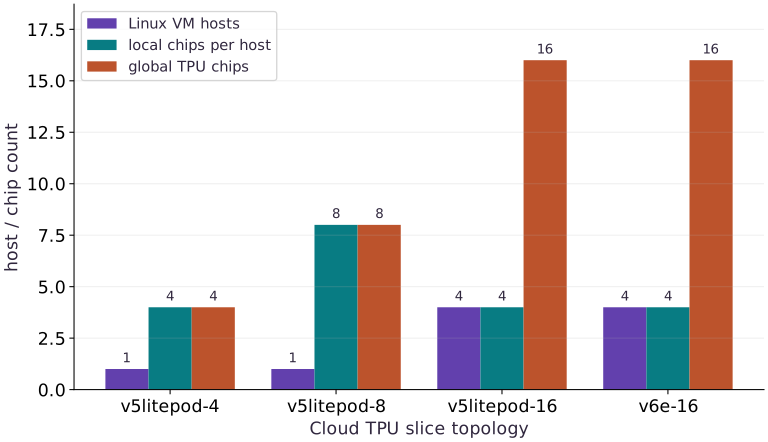
Host count, per-host local chips, and global TPU chips across single-host and Pod slices
Predict before looking: How do hosts, chips_per_host, and global_chips change when moving from v5litepod-4 and v5litepod-8 to v5litepod-16 and v6e-16?
Read the figure
The horizontal axis compares four Cloud TPU slices (v5litepod-4, v5litepod-8, v5litepod-16, v6e-16). For each slice, the three bars show the number of Linux VM hosts, the number of local TPU chips per host, and the total global TPU chips.
Connect it to the computation
v5litepod-4 and v5litepod-8 keep hosts = 1, whereas v5litepod-16 and v6e-16 use 4 hosts with 4 local chips each (16 global chips), visually showing why --worker=all becomes mandatory at 16 chips.
Open full-size figureDownload data and provenance
The notebook contains the data experiment, plotting code, and recorded figure output. Rerun it to test your changes.
Where to put & run this code: Work in phases/20-tpu-workflows/02-run-course-scripts-and-multihost-tpu-slices/code/main.py (or downloaded exercises/tpu-05.py / exercises/tpu-05.ipynb) and execute from the repository root with python3 phases/20-tpu-workflows/02-run-course-scripts-and-multihost-tpu-slices/code/main.py.
1 Tabulate single-host and multi-host TPU slice topologies
Create main.py with SLICE_CATALOG and compute global_chips, total_hbm_gib, and multi_host.
# Step 1 — Tabulate single-host and multi-host TPU slice topologies: Separating hosts from chips_per_host shows immediately when a...
# Import json for this computation.
import json
import jax
import numpy as np

# Initialize list `SLICE_CATALOG` for the stage values.
SLICE_CATALOG = [
    {"slice": "v5litepod-4", "hosts": 1, "chips_per_host": 4, "hbm_per_chip_gib": 16},
    {"slice": "v5litepod-8", "hosts": 1, "chips_per_host": 8, "hbm_per_chip_gib": 16},
    {"slice": "v5litepod-16", "hosts": 4, "chips_per_host": 4, "hbm_per_chip_gib": 16},
    {"slice": "v6e-16", "hosts": 4, "chips_per_host": 4, "hbm_per_chip_gib": 32},
]
# Iterate over `entry` to step through the computation:
for entry in SLICE_CATALOG:
    # Compute `entry["global_chips"]` from `entry["hosts"] * entry["chips_per_host"]`
    entry["global_chips"] = entry["hosts"] * entry["chips_per_host"]
    # Compute `entry["total_hbm_gib"]` from `entry["global_chips"] * entry["hbm_per_chip_gib"]`
    entry["total_hbm_gib"] = entry["global_chips"] * entry["hbm_per_chip_gib"]
    # Compute `entry["multi_host"]` from `entry["hosts"] > 1`
    entry["multi_host"] = entry["hosts"] > 1
Separating hosts from chips_per_host shows immediately when a slice crosses the single-host boundary into multi-host execution.
2 Generate single-host and multi-host gcloud command pipelines
Use an explicit reviewed execution class; this fixture authorizes only the CPU route for distributed-02.
def build_tpu_experiment_commands(tpu_name, zone, lesson_id, hosts=1, execution_class="review-required"):
    if execution_class == "review-required":
        raise ValueError("classify and review the script before generating a TPU launch command")
    if execution_class == "cpu-only":
        if hosts != 1:
            raise ValueError("CPU-only scripts must use the CPU route")
        return {"run": f"python public/exercises/{lesson_id}.py", "multi_host": False}
    if execution_class not in {"single-host-compatible", "multi-host-qualified"}:
        raise ValueError("unknown execution class")
    if execution_class == "single-host-compatible" and hosts != 1:
        raise ValueError("single-host scripts cannot run across a TPU Pod")
    if hosts > 1 and execution_class != "multi-host-qualified":
        raise ValueError("multi-host launch requires a qualified training program")
    if hosts < 1:
        raise ValueError("hosts must be positive")
    worker_flag = " --worker=all" if hosts > 1 else ""
    scp_stage = f"gcloud compute tpus tpu-vm scp public/exercises/{lesson_id}.py {tpu_name}:~/jax-tpu-lab/ --zone={zone}{worker_flag}"
    ssh_run = f"gcloud compute tpus tpu-vm ssh {tpu_name} --zone={zone}{worker_flag} --command='set -o pipefail; JAX_PLATFORMS=tpu ~/jax-tpu-lab/.venv/bin/python ~/jax-tpu-lab/{lesson_id}.py | tee ~/jax-tpu-lab/{lesson_id}-tpu.txt'"
    scp_fetch = f"gcloud compute tpus tpu-vm scp {tpu_name}:~/jax-tpu-lab/{lesson_id}-tpu.txt ./ --zone={zone}"
    return {"scp_stage": scp_stage, "ssh_run": ssh_run, "scp_fetch": scp_fetch, "multi_host": hosts > 1}

single_cmds = build_tpu_experiment_commands("jax-tpu-course", "us-west1-c", "distributed-02", hosts=1, execution_class="cpu-only")
assert single_cmds["run"] == "python public/exercises/distributed-02.py"
for kwargs in ({}, {"hosts": 4, "execution_class": "cpu-only"}):
    try:
        build_tpu_experiment_commands("jax-tpu-pod", "us-west1-c", "distributed-02", **kwargs)
    except ValueError:
        pass
    else:
        raise AssertionError("unreviewed or CPU-only work must not be routed to a TPU Pod")
print("CPU route:", single_cmds["run"])
Code building blocks in this step
build_tpu_experiment_commands(...)— Callbuild_tpu_experiment_commandswith your updated parameters or inputs from this lesson's workspace.ValueError(...)— CallValueErrorwith your updated parameters or inputs from this lesson's workspace.assert condition— Verify that the observed output shape, status, or numerical value satisfies the contract.
The helper requires an explicit reviewed execution class. The only named course script in this example is CPU-only, so it has no TPU or Pod command.
3 Step 3: Verify invariants on the completed state
Verify that the CPU route is preserved and unsafe TPU or Pod routes remain rejected.
assert single_cmds["run"] == "python public/exercises/distributed-02.py"
assert single_cmds["multi_host"] is False
try:
    build_tpu_experiment_commands("jax-tpu-pod", "us-west1-c", "distributed-02", hosts=4, execution_class="cpu-only")
except ValueError:
    print("CPU-only route remains excluded from TPU Pod execution")
else:
    raise AssertionError("CPU-only work must not be routed to a TPU Pod")
Code building blocks in this step
build_tpu_experiment_commands(...)— Callbuild_tpu_experiment_commandswith your updated parameters or inputs from this lesson's workspace.AssertionError(...)— CallAssertionErrorwith your updated parameters or inputs from this lesson's workspace.assert condition— Verify that the observed output shape, status, or numerical value satisfies the contract.
The completed checks retain the CPU route and reject a Pod launch for this CPU-only source.
View the cumulative build in main.py
These blocks append in order to the same file.
# Step 1 — Tabulate single-host and multi-host TPU slice topologies: Separating hosts from chips_per_host shows immediately when a...
# Import json for this computation.
import json
import jax
import numpy as np

# Initialize list `SLICE_CATALOG` for the stage values.
SLICE_CATALOG = [
    {"slice": "v5litepod-4", "hosts": 1, "chips_per_host": 4, "hbm_per_chip_gib": 16},
    {"slice": "v5litepod-8", "hosts": 1, "chips_per_host": 8, "hbm_per_chip_gib": 16},
    {"slice": "v5litepod-16", "hosts": 4, "chips_per_host": 4, "hbm_per_chip_gib": 16},
    {"slice": "v6e-16", "hosts": 4, "chips_per_host": 4, "hbm_per_chip_gib": 32},
]
# Iterate over `entry` to step through the computation:
for entry in SLICE_CATALOG:
    # Compute `entry["global_chips"]` from `entry["hosts"] * entry["chips_per_host"]`
    entry["global_chips"] = entry["hosts"] * entry["chips_per_host"]
    # Compute `entry["total_hbm_gib"]` from `entry["global_chips"] * entry["hbm_per_chip_gib"]`
    entry["total_hbm_gib"] = entry["global_chips"] * entry["hbm_per_chip_gib"]
    # Compute `entry["multi_host"]` from `entry["hosts"] > 1`
    entry["multi_host"] = entry["hosts"] > 1

def build_tpu_experiment_commands(tpu_name, zone, lesson_id, hosts=1, execution_class="review-required"):
    if execution_class == "review-required":
        raise ValueError("classify and review the script before generating a TPU launch command")
    if execution_class == "cpu-only":
        if hosts != 1:
            raise ValueError("CPU-only scripts must use the CPU route")
        return {"run": f"python public/exercises/{lesson_id}.py", "multi_host": False}
    if execution_class not in {"single-host-compatible", "multi-host-qualified"}:
        raise ValueError("unknown execution class")
    if execution_class == "single-host-compatible" and hosts != 1:
        raise ValueError("single-host scripts cannot run across a TPU Pod")
    if hosts > 1 and execution_class != "multi-host-qualified":
        raise ValueError("multi-host launch requires a qualified training program")
    if hosts < 1:
        raise ValueError("hosts must be positive")
    worker_flag = " --worker=all" if hosts > 1 else ""
    scp_stage = f"gcloud compute tpus tpu-vm scp public/exercises/{lesson_id}.py {tpu_name}:~/jax-tpu-lab/ --zone={zone}{worker_flag}"
    ssh_run = f"gcloud compute tpus tpu-vm ssh {tpu_name} --zone={zone}{worker_flag} --command='set -o pipefail; JAX_PLATFORMS=tpu ~/jax-tpu-lab/.venv/bin/python ~/jax-tpu-lab/{lesson_id}.py | tee ~/jax-tpu-lab/{lesson_id}-tpu.txt'"
    scp_fetch = f"gcloud compute tpus tpu-vm scp {tpu_name}:~/jax-tpu-lab/{lesson_id}-tpu.txt ./ --zone={zone}"
    return {"scp_stage": scp_stage, "ssh_run": ssh_run, "scp_fetch": scp_fetch, "multi_host": hosts > 1}

single_cmds = build_tpu_experiment_commands("jax-tpu-course", "us-west1-c", "distributed-02", hosts=1, execution_class="cpu-only")
assert single_cmds["run"] == "python public/exercises/distributed-02.py"
for kwargs in ({}, {"hosts": 4, "execution_class": "cpu-only"}):
    try:
        build_tpu_experiment_commands("jax-tpu-pod", "us-west1-c", "distributed-02", **kwargs)
    except ValueError:
        pass
    else:
        raise AssertionError("unreviewed or CPU-only work must not be routed to a TPU Pod")
print("CPU route:", single_cmds["run"])

assert single_cmds["run"] == "python public/exercises/distributed-02.py"
assert single_cmds["multi_host"] is False
try:
    build_tpu_experiment_commands("jax-tpu-pod", "us-west1-c", "distributed-02", hosts=4, execution_class="cpu-only")
except ValueError:
    print("CPU-only route remains excluded from TPU Pod execution")
else:
    raise AssertionError("CPU-only work must not be routed to a TPU Pod")
Run the example
python3 phases/20-tpu-workflows/02-run-course-scripts-and-multihost-tpu-slices/code/main.pyAbout this command
This shortcut uses an activated macOS/Linux course environment in the repository folder. For Windows, use the explicit interpreter command in “Setup help” above. The script includes worked examples and reference solutions.
Inspect the complete assembled example
# Run course scripts and multi-host TPU Pod slices: Every lesson in this course generates a self-contained script in...
# Import json for this computation.
import json
import jax
import numpy as np

# Initialize list `SLICE_CATALOG` for the stage values.
SLICE_CATALOG = [
    {"slice": "v5litepod-4", "hosts": 1, "chips_per_host": 4, "hbm_per_chip_gib": 16},
    {"slice": "v5litepod-8", "hosts": 1, "chips_per_host": 8, "hbm_per_chip_gib": 16},
    {"slice": "v5litepod-16", "hosts": 4, "chips_per_host": 4, "hbm_per_chip_gib": 16},
    {"slice": "v6e-16", "hosts": 4, "chips_per_host": 4, "hbm_per_chip_gib": 32},
]
# Iterate over `entry` to step through the computation:
for entry in SLICE_CATALOG:
    # Compute `entry["global_chips"]` from `entry["hosts"] * entry["chips_per_host"]`
    entry["global_chips"] = entry["hosts"] * entry["chips_per_host"]
    # Compute `entry["total_hbm_gib"]` from `entry["global_chips"] * entry["hbm_per_chip_gib"]`
    entry["total_hbm_gib"] = entry["global_chips"] * entry["hbm_per_chip_gib"]
    # Compute `entry["multi_host"]` from `entry["hosts"] > 1`
    entry["multi_host"] = entry["hosts"] > 1


# Function `build_tpu_experiment_commands(tpu_name, zone, lesson_id, hosts)` implementing this stage's computation:
def build_tpu_experiment_commands(tpu_name, zone, lesson_id, hosts=1, execution_class="review-required"):
    if execution_class == "review-required":
        raise ValueError("classify and review the script before generating a TPU launch command")
    if execution_class == "cpu-only":
        if hosts != 1:
            raise ValueError("CPU-only scripts must use the CPU route")
        return {"run": f"python public/exercises/{lesson_id}.py", "multi_host": False}
    if execution_class == "single-host-compatible" and hosts != 1:
        raise ValueError("single-host scripts cannot run across a TPU Pod")
    if hosts > 1 and execution_class != "multi-host-qualified":
        raise ValueError("multi-host launch requires a qualified training program")
    worker_flag = " --worker=all" if hosts > 1 else ""
    scp_stage = f"gcloud compute tpus tpu-vm scp public/exercises/{lesson_id}.py {tpu_name}:~/jax-tpu-lab/ --zone={zone}{worker_flag}"
    ssh_run = f"gcloud compute tpus tpu-vm ssh {tpu_name} --zone={zone}{worker_flag} --command='set -o pipefail; JAX_PLATFORMS=tpu ~/jax-tpu-lab/.venv/bin/python ~/jax-tpu-lab/{lesson_id}.py | tee ~/jax-tpu-lab/{lesson_id}-tpu.txt'"
    scp_fetch = f"gcloud compute tpus tpu-vm scp {tpu_name}:~/jax-tpu-lab/{lesson_id}-tpu.txt ./ --zone={zone}"
    return {"scp_stage": scp_stage, "ssh_run": ssh_run, "scp_fetch": scp_fetch, "multi_host": hosts > 1}

# Run `build_tpu_experiment_commands` to compute `single_cmds`.
single_cmds = build_tpu_experiment_commands("jax-tpu-course", "us-west1-c", "distributed-02", hosts=1, execution_class="cpu-only")
# Run `build_tpu_experiment_commands` to compute `pod_cmds`.
pod_cmds = None  # This lesson has no multi-host-qualified training program.
# Assert the CPU route does not request TPU execution.
assert single_cmds["run"] == "python public/exercises/distributed-02.py"
# Assert that `"--worker=all" in pod_cmds["scp_stage"] and "--worker=all" in pod_cmds["ssh_run"]`.
try:
    build_tpu_experiment_commands("jax-tpu-pod", "us-west1-c", "distributed-02", hosts=4, execution_class="cpu-only")
except ValueError:
    print("Correctly rejected CPU-only lesson for TPU Pod execution")
else:
    raise AssertionError("CPU-only lesson must not be routed to TPU Pod")
# Print the observed values to compare against the expected result.
print("Slice catalog global chips:", {s["slice"]: s["global_chips"] for s in SLICE_CATALOG})
# Print diagnostic summary of the computed outputs.
print("CPU route:", single_cmds["run"])
Expected result: Prints the global chip counts across v5litepod-4 (4), v5litepod-8 (8), v5litepod-16 (16), and v6e-16 (16) and the verified multi-host Pod SSH command.
Recorded reference execution
Reference output captured from executing the complete lesson script (code/main.py) and its assertions in the course CPU environment.
CPU route: python public/exercises/distributed-02.py
CPU-only route remains excluded from TPU Pod execution
Correctly rejected CPU-only lesson for TPU Pod execution
Slice catalog global chips: {'v5litepod-4': 4, 'v5litepod-8': 8, 'v5litepod-16': 16, 'v6e-16': 16}
CPU route: python public/exercises/distributed-02.py
v5litepod-16 global chips: 16 Idle chips without --worker=all: 12
Total HBM GiB by slice: {'v5litepod-4': 64, 'v5litepod-8': 128, 'v5litepod-16': 256, 'v6e-16': 512}
CPU route: python public/exercises/distributed-02.py
Rejected unsafe route: {}
Rejected unsafe route: {'hosts': 4, 'execution_class': 'cpu-only'}
Multi-host Pod slices: ['v5litepod-16', 'v6e-16']
Per-host batch: 32 Global batch: 128
PASS: tpu-05
Download execution record · The notebook includes executed cells and figure outputs. Compare your run with these values; timings depend on the machine.
Compare local vs global device counts across slices
# Experiment — Compare local vs global device counts across slices: Worker 0 only controls its own 4 local chips; the other 3 hosts...
v5e16 = next(s for s in SLICE_CATALOG if s["slice"] == "v5litepod-16")
# Compute `idle_without_worker_all` from `v5e16["global_chips"] - v5e16["chips_per_host"]`
idle_without_worker_all = v5e16["global_chips"] - v5e16["chips_per_host"]
# Print the observed values to compare against the expected result.
print("v5litepod-16 global chips:", v5e16["global_chips"], "Idle chips without --worker=all:", idle_without_worker_all)
# Assert invariant `idle_without_worker_all == 12` holds
assert idle_without_worker_all == 12
Expected: Without --worker=all, 12 of the 16 TPU chips on v5litepod-16 never receive a process.
Worker 0 only controls its own 4 local chips; the other 3 hosts (3 * 4 = 12 chips) require --worker=all.
Verify total HBM scaling from v5litepod-16 to v6e-16
# Experiment — Verify total HBM scaling from v5litepod-16 to v6e-16: Doubling per-chip HBM on Trillium (v6e) doubles the total...
hbm_by_slice = {s["slice"]: s["total_hbm_gib"] for s in SLICE_CATALOG}
# Print the observed values to compare against the expected result.
print("Total HBM GiB by slice:", hbm_by_slice)
# Assert that `hbm_by_slice["v6e-16"] == 512 and hbm_by_slice["v5litepod-16"] == 256`.
assert hbm_by_slice["v6e-16"] == 512 and hbm_by_slice["v5litepod-16"] == 256
Expected: v6e-16 provides 512 GiB of total HBM across 4 hosts (32 GiB/chip), double v5litepod-16's 256 GiB (16 GiB/chip).
Doubling per-chip HBM on Trillium (v6e) doubles the total sharded model state capacity for the same 4-host Pod topology.
Make it yours
Where to put your code: Append your solution at the bottom of phases/20-tpu-workflows/02-run-course-scripts-and-multihost-tpu-slices/code/main.py (or inside the Make it yours cell of exercises/tpu-05.ipynb) and run python3 phases/20-tpu-workflows/02-run-course-scripts-and-multihost-tpu-slices/code/main.py to verify your prediction before opening the reference solution.
Use build_tpu_experiment_commands for the reviewed CPU-only distributed-02 route. Then verify that its default unreviewed class and a four-host CPU-only request both raise ValueError.
Show a writing guide and starter scaffold
How to write this exercise code: step-by-step recipe & starter scaffold
1. Key functions & syntax to use:
build_tpu_experiment_commands(...)— Callbuild_tpu_experiment_commandswith your updated parameters or inputs from this lesson's workspace.in(...)— Callinwith your updated parameters or inputs from this lesson's workspace.assert condition— Verify that the observed output shape, status, or numerical value satisfies the contract.
2. Step-by-step implementation plan:
- Set up the changed input or configuration parameters requested in the prompt.
- Run the target function or transformation and assert that the output matches your prediction.
cpu_cmds = build_tpu_experiment_commands(...)  # TODO: compute cpu_cmds
print("CPU route:", cpu_cmds["run"])
assert cpu_cmds["run"]  # TODO: complete assertion check
for kwargs in ({}, {"hosts": 4, "execution_class": "cpu-only"}):
    try:
        build_tpu_experiment_commands("jax-tpu-pod", "us-west1-c", "distributed-02", **kwargs)
    except ValueError:
        print("Rejected unsafe route:", kwargs)
    else:
        raise AssertionError("unreviewed or CPU-only work must not be routed to a TPU Pod")
Reveal the reference solution
cpu_cmds = build_tpu_experiment_commands("jax-tpu-course", "us-west1-c", "distributed-02", hosts=1, execution_class="cpu-only")
print("CPU route:", cpu_cmds["run"])
assert cpu_cmds["run"] == "python public/exercises/distributed-02.py"
for kwargs in ({}, {"hosts": 4, "execution_class": "cpu-only"}):
    try:
        build_tpu_experiment_commands("jax-tpu-pod", "us-west1-c", "distributed-02", **kwargs)
    except ValueError:
        print("Rejected unsafe route:", kwargs)
    else:
        raise AssertionError("unreviewed or CPU-only work must not be routed to a TPU Pod")
Filter multi-host slices from the catalog
Foundations
List the slice names in SLICE_CATALOG that require --worker=all (multi_host == True).
Show a writing guide and starter scaffold
How to write this practice solution: step-by-step recipe & starter scaffold
1. Key functions & syntax to use:
catalog(...)— Callcatalogwith your updated parameters or inputs from this lesson's workspace.hosts(...)— Callhostswith your updated parameters or inputs from this lesson's workspace.assert condition— Verify that the observed output shape, status, or numerical value satisfies the contract.
2. Step-by-step implementation plan:
- Filter multi-host slices from the catalog (Foundations): Both 16-chip slices span 4 hosts (4 chips per host) and...
- Print the observed values to compare against the expected result.
- Assert invariant
pod_slices == ["v5litepod-16"holds
# Filter multi-host slices from the catalog (Foundations): Both 16-chip slices span 4 hosts (4 chips per host) and...
pod_slices = ...  # TODO: compute pod_slices
# Print the observed values to compare against the expected result.
print("Multi-host Pod slices:", pod_slices)
# Assert invariant `pod_slices == ["v5litepod-16"` holds
assert pod_slices  # TODO: complete assertion check
Show a hint
Filter by s['multi_host'].
Reveal reference solution and reasoning
# Filter multi-host slices from the catalog (Foundations): Both 16-chip slices span 4 hosts (4 chips per host) and...
pod_slices = [s["slice"] for s in SLICE_CATALOG if s["multi_host"]]
# Print the observed values to compare against the expected result.
print("Multi-host Pod slices:", pod_slices)
# Assert invariant `pod_slices == ["v5litepod-16"` holds
assert pod_slices == ["v5litepod-16", "v6e-16"]
Both 16-chip slices span 4 hosts (4 chips per host) and therefore require multi-host coordination.
Compute per-host vs global batch size on a 4-host Pod slice
Transfer / diagnosis
If each TPU chip processes a microbatch of sequences on v5litepod-16 (4 hosts, 4 chips/host), compute the per-host batch size and the global batch size per step.
Show a writing guide and starter scaffold
How to write this practice solution: step-by-step recipe & starter scaffold
1. Key functions & syntax to use:
slice(...)— Callslicewith your updated parameters or inputs from this lesson's workspace.chips(...)— Callchipswith your updated parameters or inputs from this lesson's workspace.assert condition— Verify that the observed output shape, status, or numerical value satisfies the contract.
2. Step-by-step implementation plan:
- Compute
per_host_batchfrommicrobatch_per_chip * 4 - Compute
global_batchfrommicrobatch_per_chip * 16 - Print the observed values to compare against the expected result.
- Assert invariant
per_host_batch == 32 and global_batch == 128holds
# Compute per-host vs global batch size on a 4-host Pod slice (Transfer / diagnosis): Each host feeds its 4 local chips (32 sequences per host),...
microbatch_per_chip = ...  # TODO: compute microbatch_per_chip
# Compute `per_host_batch` from `microbatch_per_chip * 4`
per_host_batch = ...  # TODO: compute per_host_batch
# Compute `global_batch` from `microbatch_per_chip * 16`
global_batch = ...  # TODO: compute global_batch
# Print the observed values to compare against the expected result.
print("Per-host batch:", per_host_batch, "Global batch:", global_batch)
# Assert invariant `per_host_batch == 32 and global_batch == 128` holds
assert per_host_batch  # TODO: complete assertion check
Show a hint
Multiply 8 * chips_per_host and 8 * global_chips.
Reveal reference solution and reasoning
# Compute per-host vs global batch size on a 4-host Pod slice (Transfer / diagnosis): Each host feeds its 4 local chips (32 sequences per host),...
microbatch_per_chip = 8
# Compute `per_host_batch` from `microbatch_per_chip * 4`
per_host_batch = microbatch_per_chip * 4
# Compute `global_batch` from `microbatch_per_chip * 16`
global_batch = microbatch_per_chip * 16
# Print the observed values to compare against the expected result.
print("Per-host batch:", per_host_batch, "Global batch:", global_batch)
# Assert invariant `per_host_batch == 32 and global_batch == 128` holds
assert per_host_batch == 32 and global_batch == 128
Each host feeds its 4 local chips (32 sequences per host), yielding a synchronized global batch of 128 sequences across the 16-chip mesh.
Diagnose the result
If gcloud compute tpus tpu-vm ssh --worker=all fails on one worker because .venv is missing, run your .venv bootstrap command with --worker=all as well so every host has ~/jax-tpu-lab/.venv installed.
Carry forward
- Stage any
public/exercises/<lesson-id>.pyscript withgcloud compute tpus tpu-vm scpto run course experiments on TPU in parallel. - Use single-host commands for
1–8chip slices (v5litepod-4,v5litepod-8,v6e-4) and add--worker=all+jax.distributed.initialize()for multi-host slices (v5litepod-16,v6e-16).
Keep your evidence
Keep the generated scp_in_cmd, ssh_run_cmd, and scp_out_cmd workflow for single-host and multi-host slices plus the process-0 checkpoint writer check.
Save your modified code, its output, and an explanation of your prediction. Checkpoint answers and exercise evidence are tracked separately.
Saved in this browser. Export or back up your portfolio anytime in My learning.
Verified on local CPU. Stage to a Cloud TPU VM via Cloud TPU setup to record accelerator execution receipts (TODO: add automated Cloud TPU CI execution receipts).
Primary references
Phase 20 Integration Project
Bring this phase together: Gate simulated multi-worker checkpoint publication on complete receipts
Checkpoint to prove: Stage scripts with gcloud compute tpus tpu-vm scp, separate XLA warmup from timed step loops, verify zero-drift checkpoint resume, and build single-host and --worker=all Pod launch commands.
Work in projects/tpu-workflow-audit/starter/model.py. Complete stages 1 and 2 for independent calculations and changed-condition diagnosis, then retain the stage 3 evidence with --evidence-dir runs/tpu-workflow-audit. Stage 4 integrates the checks. Learner commands explicitly select the starter; --implementation solution is instructor reference execution. This bounded practice does not certify the entire phase or target hardware.