 JAX Pathways
Phase 20 / TPU Workflows: Launching Jobs & Checkpointed Experiments
Stage and launch checkpointed TPU jobs
Revision v0.7.0 · Updated since your last visit. Review the changes; your progress is saved.
Lesson · about 25 minutes · CPU practice
Stage launch.py to a TPU VM, separate first-step XLA compilation warmup from steady-state step timing, and verify that resuming from an atomic checkpoint matches an uninterrupted run.
Phase study guide: preparation, milestones and project evidence
Before you start
Before this: TPU Setup: Provisioning & Runtime Verification
Hardware: CPU launcher rehearsal; Cloud TPU VM for target checkpointed runs
Setup help: Python, notebook, or Cloud TPU VM
Use the tested CPU packages (the recorded environment uses Python 3.14.3). Other Python versions and accelerator environments require separate checks. The optional Cloud TPU specialization explains the target-specific execution boundaries. Logical CPU devices practice partitioning; they do not simulate TPU performance.
Download the repository ZIP or use your existing checkout. Extract it and open a terminal in the folder containing requirements-cpu.txt. The beginner ZIP is separate; these lessons use the full repository folder.
python3 -m venv .venv
source .venv/bin/activate
python -m pip install -r requirements-cpu.txtpy -3 -m venv .venv
.\.venv\Scripts\python.exe -m pip install -r requirements-cpu.txtAfter activation, run the complete worked example from that same folder:
python phases/20-tpu-workflows/01-stage-and-launch-checkpointed-tpu-jobs/code/main.py.\.venv\Scripts\python.exe phases/20-tpu-workflows/01-stage-and-launch-checkpointed-tpu-jobs/code/main.pyFor an incremental build, create main.py in your own practice folder, append each build block in order, and run python main.py with this environment active. Keep that file separate from the downloaded reference solution.
Download this lesson’s notebook. Open it with a Python kernel using the course environment. Run cells from the top after restarting the kernel; experiments depend on earlier definitions.
For local Jupyter, first install the course requirements using the Local Python steps, then use your environment’s Python to start Jupyter:
python -m pip install jupyterlab
python -m jupyter lab.\.venv\Scripts\python.exe -m pip install jupyterlab
.\.venv\Scripts\python.exe -m jupyter labSelect the downloaded tpu-02.ipynb file in JupyterLab. The notebook contains reference solutions; make your prediction and attempt each practice task before opening them. Restart the kernel before changing logical device setup.
The worked reference for this lesson is CPU-validated. Some references explicitly configure logical CPU devices; setting JAX_PLATFORMS does not adapt them to a TPU. Follow the execution matrix and reviewed multi-host example before attempting a target run.
For accelerator preparation, study TPU setup, observed runtime receipts, checkpointed jobs and precision and retained traces. These target paths remain unqualified on physical TPU hardware until an actual receipt is recorded. Cloud provisioning is optional for CPU learning.
Check: Prints the matching 64-character state_hash for the resumed and control runs and the monotonically decreasing 6-step loss trajectory.
Revisit the guided CPU setup · Open 19: TPU Setup. Package instructions are CPU instructions; Windows and accelerator environments need their own validation.
What you will be able to do
- Stage the TPU launcher (
resources/tpu-gcp/launch.py) to a Cloud TPU VM withgcloud compute tpus tpu-vm scp. - Separate XLA compile warmup time from steady-state step time in structured
events.jsonllogs. - Write atomic checkpoints using
temp+os.fsync+os.replaceso preemption never corrupts the latest checkpoint. - Interrupt, resume from an atomic checkpoint, and verify zero drift against an uninterrupted control run.
The problem
Once a Cloud TPU VM is running, typing ad-hoc interactive commands in an SSH shell is fragile: if the connection drops or a Spot TPU is preempted, you lose progress and cannot tell compilation time from step time. You need a repeatable way to stage code, launch TPU jobs, log structured JSONL events, and checkpoint atomically.
The idea
The launcher records warmup and synchronized updates separately, then checkpoints the complete deterministic state with an integrity hash and a run-configuration identity. A requested resume must find a checkpoint, validate its contents and configuration, and define completed-run behavior explicitly.
Why launching a TPU experiment is different from running a notebook cell
When you launch a JAX script on a TPU VM, the first call to a @jax.jit step traces Python and compiles an XLA HLO program for the attached TPU chips. If you time step together with steps , your step-time measurement is dominated by XLA compilation rather than TPU execution.
A production-grade TPU launcher runs one synchronized warmup call before the training loop and logs compile_warmup_s in a dedicated warmup event. Subsequent step events measure synchronized steady-state updates (jax.block_until_ready).
Whenever a checkpoint step arrives, writing directly to checkpoint-latest.json risks leaving a half-written file if a Spot TPU VM is preempted mid-write. Writing to a temporary sibling file (checkpoint-latest.json.tmp), flushing with os.fsync, and atomically renaming with os.replace makes the visible checkpoint path switch atomically on supported local filesystems. This does not by itself promise survival across power loss or distributed publication. A checkpoint hash detects changed serialized state; a separately hashed configuration binds data identity, seed, learning rate, batch schedule, and optimizer rule.
Checkpointed TPU job launcher lifecycle from warmup to zero-drift resume
Predict: Why must the warmup compilation step run before the timed step loop without overwriting the restored checkpoint state?
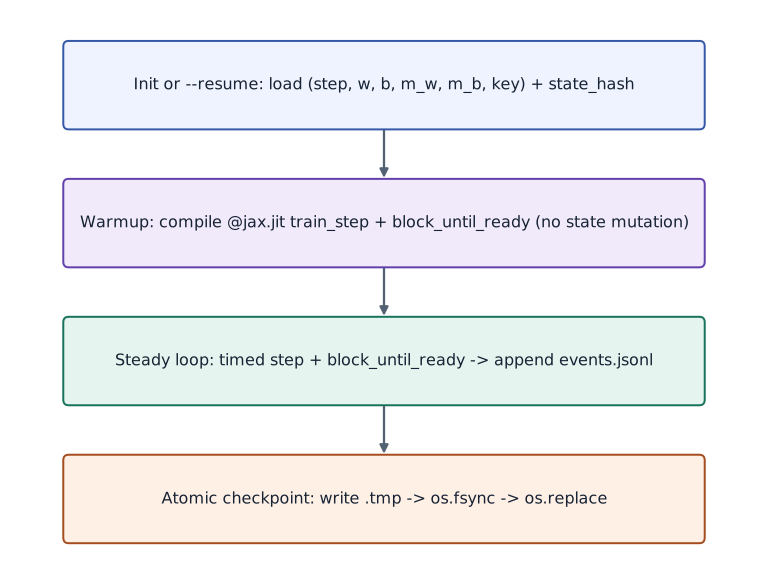
Read top to bottom: the launcher loads either the initial state or checkpoint-latest.json, runs one synchronized @jax.jit warmup call to compile XLA HLO without mutating state, executes timed steady-state steps while appending to events.jsonl, and writes checkpoint-latest.json atomically via .tmp + fsync + os.replace.
1. Stage the launcher and run a checkpoint-resumed TPU experiment
Use the local CPU exercise first to test the resume contract: a missing requested checkpoint raises an error; modified state or changed configuration is rejected; resuming an already completed run returns its saved final state without executing another update. Only after these checks should you run the same launcher on a TPU VM.
Stage launch.py and verify checkpoint resume on the Cloud TPU VM
# Stage launch.py and verify checkpoint resume on the Cloud TPU VM
gcloud compute tpus tpu-vm scp resources/tpu-gcp/launch.py "$TPU_NAME":~/jax-tpu-lab/ --zone="$ZONE"

gcloud compute tpus tpu-vm ssh "$TPU_NAME" --zone="$ZONE" --command="
  set -euo pipefail
  source ~/jax-tpu-lab/.venv/bin/activate
  python ~/jax-tpu-lab/launch.py --platform tpu --run-dir ~/jax-tpu-lab/run-resumed --steps 4 --save-every 2
  python ~/jax-tpu-lab/launch.py --platform tpu --run-dir ~/jax-tpu-lab/run-resumed --steps 8 --save-every 2 --resume
  python ~/jax-tpu-lab/launch.py --platform tpu --run-dir ~/jax-tpu-lab/run-control --steps 8 --save-every 2
"
Expected:
Both runs emit started, warmup, step, checkpoint, and completed JSONL events with backend: tpu, and their step-8 state hashes match.
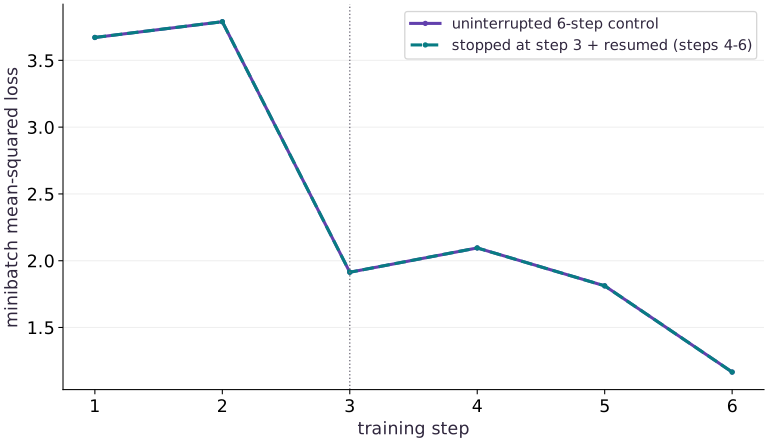
Interrupted-and-resumed trajectory vs uninterrupted 6-step control run
Predict before looking: Does stopping after step 3 and resuming in a fresh call change the loss trajectory on steps 4 through 6?
Read the figure
The horizontal axis shows training steps 1 through 6, with a vertical dotted boundary at step 3 where the first run stopped and wrote its checkpoint. The solid line is the uninterrupted 6-step control run; the dashed line is the run that stopped at step 3 and resumed for steps 4–6.
Connect it to the computation
Because the checkpoint at step 3 saved (w, b, m_w, m_b, key) atomically and the warmup call did not consume the restored state, the two loss trajectories lie directly on top of each other (max_abs_diff == 0).
Open full-size figureDownload data and provenance
The notebook contains the data experiment, plotting code, and recorded figure output. Rerun it to test your changes.
Where to put & run this code: Work in phases/20-tpu-workflows/01-stage-and-launch-checkpointed-tpu-jobs/code/main.py (or downloaded exercises/tpu-02.py / exercises/tpu-02.ipynb) and execute from the repository root with python3 phases/20-tpu-workflows/01-stage-and-launch-checkpointed-tpu-jobs/code/main.py.
1 Define deterministic hashing and atomic checkpoint writes
Create main.py with digest_obj and atomic_write_json so interrupted writes never corrupt the latest checkpoint.
# Step 1 — Define deterministic hashing and atomic checkpoint writes: Writing to a temporary sibling file, flushing with fsync, and...
# Import hashlib for this computation.
import hashlib
import json
import os
from pathlib import Path
import tempfile
import time
import jax
import jax.numpy as jnp
import numpy as np


# Function `digest_obj(value)` implementing this stage's computation:
def digest_obj(value):
    # Return `hashlib.sha256(json.dumps(value, sort_keys=True, separators=(',', ':')).encode()).hexdigest()[:16]` to the caller.
    return hashlib.sha256(
        json.dumps(value, sort_keys=True, separators=(",", ":")).encode()
    ).hexdigest()


# Function `atomic_write_json(path, payload)` implementing this stage's computation:
def atomic_write_json(path, payload):
    # Read or serialize artifact data on disk (`path`).
    path = Path(path)
    # Run `path.parent.mkdir` to perform the next check or state transition.
    path.parent.mkdir(parents=True, exist_ok=True)
    # Run `path.with_suffix` to compute `tmp`.
    tmp = path.with_suffix(path.suffix + ".tmp")
    # Enter managed runtime/context scope for this block:
    with tmp.open("w", encoding="utf-8") as f:
        # Run `json.dump` to perform the next check or state transition.
        json.dump(payload, f, sort_keys=True)
        # Run `f.flush` to perform the next check or state transition.
        f.flush()
        # Run `os.fsync` to perform the next check or state transition.
        os.fsync(f.fileno())
    # Run `os.replace` to perform the next check or state transition.
    os.replace(tmp, path)
Code building blocks in this step
digest_obj(...)— Calldigest_objwith your updated parameters or inputs from this lesson's workspace.hashlib.sha256(...)— Callhashlib.sha256with your updated parameters or inputs from this lesson's workspace.
Writing to a temporary sibling file, flushing with fsync, and calling os.replace guarantees that checkpoint-latest.json is always complete.
2 Implement the TPU-ready job runner with warmup separation and resume
Append run_tpu_ready_job to main.py.
# Step 2 — Implement the TPU-ready job runner with warmup separation and resume: Warmup compiles the JIT function without mutating w, b, m_w, m_b,...
# Define `run_tpu_ready_job(run_dir, steps, save_every, resume...)` to evaluate the objective and its automatic derivatives:
def run_tpu_ready_job(run_dir, steps=6, save_every=2, resume=False, seed=0, lr=0.05):
    # Read or serialize artifact data on disk (`run_dir`).
    run_dir = Path(run_dir)
    # Run `run_dir.mkdir` to perform the next check or state transition.
    run_dir.mkdir(parents=True, exist_ok=True)
    # Compute `events_path` from `run_dir / "events.jsonl"`
    events_path = run_dir / "events.jsonl"
    # Compute `ckpt_path` from `run_dir / "checkpoint-latest.json"`
    ckpt_path = run_dir / "checkpoint-latest.json"

    # Function `emit(event)` implementing this stage's computation:
    def emit(event, **fields):
        # Check which hardware backend (`cpu`, `gpu`, or `tpu`) JAX selected for `record`.
        record = {"event": event, "backend": jax.default_backend(), "devices": jax.device_count(), **fields}
        # Enter managed runtime/context scope for this block:
        with events_path.open("a", encoding="utf-8") as f:
            # Compute `f.write(json.dumps(record, sort_keys` as `True) + "\n")`.
            f.write(json.dumps(record, sort_keys=True) + "\n")
        # Return `record` to the caller.
        return record

    # Generate a uniform grid of points in `x`.
    x = jnp.linspace(-1.0, 1.0, 64, dtype=jnp.float32).reshape(64, 1)
    # Compute `target_y` from `3.0 * x - 0.5`
    target_y = 3.0 * x - 0.5

    config = {"schema": 1, "seed": int(seed), "lr": float(lr), "data": "linspace64-target-3x-minus-0.5-v1", "batch_size": 16, "optimizer": "momentum-0.8-noise-key-v1"}
    config_hash = digest_obj(config)
    # A requested resume requires an existing, compatible, intact checkpoint.
    if resume:
        if not ckpt_path.exists():
            raise FileNotFoundError(f"resume requested but checkpoint is missing: {ckpt_path}")
        saved = json.loads(ckpt_path.read_text(encoding="utf-8"))
        supplied_hash = saved.pop("state_hash", None)
        if supplied_hash != digest_obj(saved):
            raise ValueError("checkpoint state hash mismatch")
        if saved.get("config_hash") != config_hash or saved.get("config") != config:
            raise ValueError("checkpoint run configuration mismatch")
        step = int(saved["step"])
        w = jnp.array(saved["w"], dtype=jnp.float32)
        b = jnp.array(saved["b"], dtype=jnp.float32)
        m_w = jnp.array(saved["m_w"], dtype=jnp.float32)
        m_b = jnp.array(saved["m_b"], dtype=jnp.float32)
        key = jnp.array(saved["key"], dtype=jnp.uint32)
        state_payload = dict(saved)
        state_payload["state_hash"] = supplied_hash
        emit("restored", step=step, state_hash=supplied_hash)
    else:
        step = 0
        w = jnp.zeros((1, 1), dtype=jnp.float32)
        b = jnp.zeros((1,), dtype=jnp.float32)
        m_w = jnp.zeros_like(w)
        m_b = jnp.zeros_like(b)
        key = jax.random.PRNGKey(seed)
        emit("started", step=step)
        state_payload = {"step": 0, "w": np.asarray(w).tolist(), "b": np.asarray(b).tolist(), "m_w": np.asarray(m_w).tolist(), "m_b": np.asarray(m_b).tolist(), "key": np.asarray(key).tolist(), "config": config, "config_hash": config_hash}
        state_payload["state_hash"] = digest_obj(state_payload)
        atomic_write_json(ckpt_path, state_payload)
    if step > steps:
        raise ValueError(f"checkpoint step {step} exceeds requested final step {steps}")

    @jax.jit
    # Function `train_step(w, b, m_w, m_b, ...)` implementing this stage's computation:
    def train_step(w, b, m_w, m_b, key):
        # Split the PRNG key deterministically into independent subkeys (`(key, subkey)`).
        key, subkey = jax.random.split(key)
        # Draw pseudorandom samples for `idx` using the explicit RNG state.
        idx = jax.random.choice(subkey, 64, shape=(16,), replace=False)
        # Compute `xb, yb` from `x[idx], target_y[idx]`
        xb, yb = x[idx], target_y[idx]

        # Function `loss_fn(w_in, b_in)` implementing this stage's computation:
        def loss_fn(w_in, b_in):
            # Perform matrix contraction / projection to compute `pred`.
            pred = xb @ w_in + b_in
            # Return `jnp.mean((pred - yb) ** 2)` to the caller.
            return jnp.mean((pred - yb) ** 2)

        # Evaluate both scalar loss and parameter gradients in one pass (`(loss, (gw, gb))`).
        loss, (gw, gb) = jax.value_and_grad(loss_fn, argnums=(0, 1))(w, b)
        # Compute `m_w` from `0.8 * m_w + gw`
        m_w = 0.8 * m_w + gw
        # Compute `m_b` from `0.8 * m_b + gb`
        m_b = 0.8 * m_b + gb
        # Compute `w` from `w - lr * m_w`
        w = w - lr * m_w
        # Compute `b` from `b - lr * m_b`
        b = b - lr * m_b
        # Return `(w, b, m_w, m_b, key, loss)` to the caller.
        return w, b, m_w, m_b, key, loss

    if step == steps:
        emit("completed", step=step, state_hash=state_payload["state_hash"])
        return {"final_step": step, "state_hash": state_payload["state_hash"], "w": float(np.asarray(w).squeeze()), "b": float(np.asarray(b).squeeze()), "warmup_ms": 0.0, "step_losses": [], "step_times_ms": []}

    # Record execution timing or profiler trace in `t0`.
    t0 = time.perf_counter()
    # Run `train_step` to compute `warm`.
    warm = train_step(w, b, m_w, m_b, key)
    # Synchronize host execution until asynchronous device computation completes.
    jax.block_until_ready(warm)
    # Record execution timing or profiler trace in `warmup_ms`.
    warmup_ms = (time.perf_counter() - t0) * 1000.0
    # Run `emit` to perform the next check or state transition.
    emit("warmup", warmup_ms=warmup_ms, step=step)

    # Compute `step_losses` from `[]`
    step_losses = []
    # Compute `step_times_ms` from `[]`
    step_times_ms = []
    while step < steps:
        t_step = time.perf_counter()
        w, b, m_w, m_b, key, loss = train_step(w, b, m_w, m_b, key)
        jax.block_until_ready((w, b, m_w, m_b, key, loss))
        elapsed_ms = (time.perf_counter() - t_step) * 1000.0
        step += 1
        state_payload = {
            "step": step,
            "w": np.asarray(w).tolist(),
            "b": np.asarray(b).tolist(),
            "m_w": np.asarray(m_w).tolist(),
            "m_b": np.asarray(m_b).tolist(),
            "key": np.asarray(key).tolist(),
            "config": config,
            "config_hash": config_hash,
        }
        state_payload["state_hash"] = digest_obj(state_payload)
        step_losses.append(float(loss))
        step_times_ms.append(float(elapsed_ms))
        emit("step", step=step, loss=float(loss), step_ms=elapsed_ms, state_hash=state_payload["state_hash"])
        if step % save_every == 0 or step == steps:
            atomic_write_json(ckpt_path, state_payload)
            emit("checkpoint", step=step, state_hash=state_payload["state_hash"])

    # Run `emit` to perform the next check or state transition.
    emit("completed", step=step, state_hash=state_payload["state_hash"])
    # Return `{'final_step': step, 'state_hash': state_payload['state_hash'], 'w': float(np.asarray(w).squeeze()), 'b': float(np.asarray(b).squeeze()), 'warmup_ms': warmup_ms, 'step_losses': step_losses, 'step_times_ms': step_times_ms}` to the caller.
    return {
        "final_step": step,
        "state_hash": state_payload["state_hash"],
        "w": float(np.asarray(w).squeeze()),
        "b": float(np.asarray(b).squeeze()),
        "warmup_ms": warmup_ms,
        "step_losses": step_losses,
        "step_times_ms": step_times_ms,
    }
Code building blocks in this step
jnp.linspace(start, stop, num)— Createsnumevenly spaced float points across the closed interval[start, stop].jnp.array(values, dtype=...)— Constructs an immutable device-backed JAX array from Python/NumPy values.jnp.zeros / jnp.ones(shape, dtype=...)— Allocates a tensor of the givenshapeinitialized with constants.array.reshape(new_shape)— Reorganizes tensor axes without changing the total element count (array.size).
Warmup compiles the JIT function without mutating w, b, m_w, m_b, or key, so step 1 starts from the exact initial or restored state.
3 Compare a checkpoint-resumed run against an uninterrupted control run
Append the 3-step + 3-step resumed run and 6-step uninterrupted control comparison to main.py.
# Step 3 — Compare a checkpoint-resumed run against an uninterrupted control run: Because parameters, momentum buffers, and PRNG keys are all...
# Create an isolated temporary directory to run and inspect artifacts safely:
with tempfile.TemporaryDirectory(prefix="tpu-launch-") as tmp:
    # Read or serialize artifact data on disk (`root`).
    root = Path(tmp)
    # Run `run_tpu_ready_job` to compute `part1`.
    part1 = run_tpu_ready_job(root / "resumed", steps=3, save_every=3, resume=False)
    # Run `run_tpu_ready_job` to compute `part2`.
    part2 = run_tpu_ready_job(root / "resumed", steps=6, save_every=3, resume=True)
    # Run `run_tpu_ready_job` to compute `control`.
    control = run_tpu_ready_job(root / "control", steps=6, save_every=3, resume=False)
    # Compute `resumed_losses` from `part1["step_losses"] + part2["step_losses"]`
    resumed_losses = part1["step_losses"] + part2["step_losses"]

# Assert invariant `part2["state_hash"] == control["state_hash"]` holds
assert part2["state_hash"] == control["state_hash"]
# Assert that `np.allclose(resumed_losses, control["step_losses"])`.
assert np.allclose(resumed_losses, control["step_losses"])
# Print the observed values to compare against the expected result.
print("Resumed state_hash matches uninterrupted control:", part2["state_hash"])
# Print diagnostic summary of the computed outputs.
print("Losses across 6 steps:", [round(v, 5) for v in control["step_losses"]])
Code building blocks in this step
jnp.allclose(actual, expected, rtol=..., atol=...)— Checks that two arrays match elementwise within floating-point tolerance.
Because parameters, momentum buffers, and PRNG keys are all restored, the resumed trajectory matches the uninterrupted trajectory bit-for-bit.
View the cumulative build in main.py
These blocks append in order to the same file.
# Step 1 — Define deterministic hashing and atomic checkpoint writes: Writing to a temporary sibling file, flushing with fsync, and...
# Import hashlib for this computation.
import hashlib
import json
import os
from pathlib import Path
import tempfile
import time
import jax
import jax.numpy as jnp
import numpy as np


# Function `digest_obj(value)` implementing this stage's computation:
def digest_obj(value):
    # Return `hashlib.sha256(json.dumps(value, sort_keys=True, separators=(',', ':')).encode()).hexdigest()[:16]` to the caller.
    return hashlib.sha256(
        json.dumps(value, sort_keys=True, separators=(",", ":")).encode()
    ).hexdigest()


# Function `atomic_write_json(path, payload)` implementing this stage's computation:
def atomic_write_json(path, payload):
    # Read or serialize artifact data on disk (`path`).
    path = Path(path)
    # Run `path.parent.mkdir` to perform the next check or state transition.
    path.parent.mkdir(parents=True, exist_ok=True)
    # Run `path.with_suffix` to compute `tmp`.
    tmp = path.with_suffix(path.suffix + ".tmp")
    # Enter managed runtime/context scope for this block:
    with tmp.open("w", encoding="utf-8") as f:
        # Run `json.dump` to perform the next check or state transition.
        json.dump(payload, f, sort_keys=True)
        # Run `f.flush` to perform the next check or state transition.
        f.flush()
        # Run `os.fsync` to perform the next check or state transition.
        os.fsync(f.fileno())
    # Run `os.replace` to perform the next check or state transition.
    os.replace(tmp, path)

# Step 2 — Implement the TPU-ready job runner with warmup separation and resume: Warmup compiles the JIT function without mutating w, b, m_w, m_b,...
# Define `run_tpu_ready_job(run_dir, steps, save_every, resume...)` to evaluate the objective and its automatic derivatives:
def run_tpu_ready_job(run_dir, steps=6, save_every=2, resume=False, seed=0, lr=0.05):
    # Read or serialize artifact data on disk (`run_dir`).
    run_dir = Path(run_dir)
    # Run `run_dir.mkdir` to perform the next check or state transition.
    run_dir.mkdir(parents=True, exist_ok=True)
    # Compute `events_path` from `run_dir / "events.jsonl"`
    events_path = run_dir / "events.jsonl"
    # Compute `ckpt_path` from `run_dir / "checkpoint-latest.json"`
    ckpt_path = run_dir / "checkpoint-latest.json"

    # Function `emit(event)` implementing this stage's computation:
    def emit(event, **fields):
        # Check which hardware backend (`cpu`, `gpu`, or `tpu`) JAX selected for `record`.
        record = {"event": event, "backend": jax.default_backend(), "devices": jax.device_count(), **fields}
        # Enter managed runtime/context scope for this block:
        with events_path.open("a", encoding="utf-8") as f:
            # Compute `f.write(json.dumps(record, sort_keys` as `True) + "\n")`.
            f.write(json.dumps(record, sort_keys=True) + "\n")
        # Return `record` to the caller.
        return record

    # Generate a uniform grid of points in `x`.
    x = jnp.linspace(-1.0, 1.0, 64, dtype=jnp.float32).reshape(64, 1)
    # Compute `target_y` from `3.0 * x - 0.5`
    target_y = 3.0 * x - 0.5

    config = {"schema": 1, "seed": int(seed), "lr": float(lr), "data": "linspace64-target-3x-minus-0.5-v1", "batch_size": 16, "optimizer": "momentum-0.8-noise-key-v1"}
    config_hash = digest_obj(config)
    # A requested resume requires an existing, compatible, intact checkpoint.
    if resume:
        if not ckpt_path.exists():
            raise FileNotFoundError(f"resume requested but checkpoint is missing: {ckpt_path}")
        saved = json.loads(ckpt_path.read_text(encoding="utf-8"))
        supplied_hash = saved.pop("state_hash", None)
        if supplied_hash != digest_obj(saved):
            raise ValueError("checkpoint state hash mismatch")
        if saved.get("config_hash") != config_hash or saved.get("config") != config:
            raise ValueError("checkpoint run configuration mismatch")
        step = int(saved["step"])
        w = jnp.array(saved["w"], dtype=jnp.float32)
        b = jnp.array(saved["b"], dtype=jnp.float32)
        m_w = jnp.array(saved["m_w"], dtype=jnp.float32)
        m_b = jnp.array(saved["m_b"], dtype=jnp.float32)
        key = jnp.array(saved["key"], dtype=jnp.uint32)
        state_payload = dict(saved)
        state_payload["state_hash"] = supplied_hash
        emit("restored", step=step, state_hash=supplied_hash)
    else:
        step = 0
        w = jnp.zeros((1, 1), dtype=jnp.float32)
        b = jnp.zeros((1,), dtype=jnp.float32)
        m_w = jnp.zeros_like(w)
        m_b = jnp.zeros_like(b)
        key = jax.random.PRNGKey(seed)
        emit("started", step=step)
        state_payload = {"step": 0, "w": np.asarray(w).tolist(), "b": np.asarray(b).tolist(), "m_w": np.asarray(m_w).tolist(), "m_b": np.asarray(m_b).tolist(), "key": np.asarray(key).tolist(), "config": config, "config_hash": config_hash}
        state_payload["state_hash"] = digest_obj(state_payload)
        atomic_write_json(ckpt_path, state_payload)
    if step > steps:
        raise ValueError(f"checkpoint step {step} exceeds requested final step {steps}")

    @jax.jit
    # Function `train_step(w, b, m_w, m_b, ...)` implementing this stage's computation:
    def train_step(w, b, m_w, m_b, key):
        # Split the PRNG key deterministically into independent subkeys (`(key, subkey)`).
        key, subkey = jax.random.split(key)
        # Draw pseudorandom samples for `idx` using the explicit RNG state.
        idx = jax.random.choice(subkey, 64, shape=(16,), replace=False)
        # Compute `xb, yb` from `x[idx], target_y[idx]`
        xb, yb = x[idx], target_y[idx]

        # Function `loss_fn(w_in, b_in)` implementing this stage's computation:
        def loss_fn(w_in, b_in):
            # Perform matrix contraction / projection to compute `pred`.
            pred = xb @ w_in + b_in
            # Return `jnp.mean((pred - yb) ** 2)` to the caller.
            return jnp.mean((pred - yb) ** 2)

        # Evaluate both scalar loss and parameter gradients in one pass (`(loss, (gw, gb))`).
        loss, (gw, gb) = jax.value_and_grad(loss_fn, argnums=(0, 1))(w, b)
        # Compute `m_w` from `0.8 * m_w + gw`
        m_w = 0.8 * m_w + gw
        # Compute `m_b` from `0.8 * m_b + gb`
        m_b = 0.8 * m_b + gb
        # Compute `w` from `w - lr * m_w`
        w = w - lr * m_w
        # Compute `b` from `b - lr * m_b`
        b = b - lr * m_b
        # Return `(w, b, m_w, m_b, key, loss)` to the caller.
        return w, b, m_w, m_b, key, loss

    if step == steps:
        emit("completed", step=step, state_hash=state_payload["state_hash"])
        return {"final_step": step, "state_hash": state_payload["state_hash"], "w": float(np.asarray(w).squeeze()), "b": float(np.asarray(b).squeeze()), "warmup_ms": 0.0, "step_losses": [], "step_times_ms": []}

    # Record execution timing or profiler trace in `t0`.
    t0 = time.perf_counter()
    # Run `train_step` to compute `warm`.
    warm = train_step(w, b, m_w, m_b, key)
    # Synchronize host execution until asynchronous device computation completes.
    jax.block_until_ready(warm)
    # Record execution timing or profiler trace in `warmup_ms`.
    warmup_ms = (time.perf_counter() - t0) * 1000.0
    # Run `emit` to perform the next check or state transition.
    emit("warmup", warmup_ms=warmup_ms, step=step)

    # Compute `step_losses` from `[]`
    step_losses = []
    # Compute `step_times_ms` from `[]`
    step_times_ms = []
    while step < steps:
        t_step = time.perf_counter()
        w, b, m_w, m_b, key, loss = train_step(w, b, m_w, m_b, key)
        jax.block_until_ready((w, b, m_w, m_b, key, loss))
        elapsed_ms = (time.perf_counter() - t_step) * 1000.0
        step += 1
        state_payload = {
            "step": step,
            "w": np.asarray(w).tolist(),
            "b": np.asarray(b).tolist(),
            "m_w": np.asarray(m_w).tolist(),
            "m_b": np.asarray(m_b).tolist(),
            "key": np.asarray(key).tolist(),
            "config": config,
            "config_hash": config_hash,
        }
        state_payload["state_hash"] = digest_obj(state_payload)
        step_losses.append(float(loss))
        step_times_ms.append(float(elapsed_ms))
        emit("step", step=step, loss=float(loss), step_ms=elapsed_ms, state_hash=state_payload["state_hash"])
        if step % save_every == 0 or step == steps:
            atomic_write_json(ckpt_path, state_payload)
            emit("checkpoint", step=step, state_hash=state_payload["state_hash"])

    # Run `emit` to perform the next check or state transition.
    emit("completed", step=step, state_hash=state_payload["state_hash"])
    # Return `{'final_step': step, 'state_hash': state_payload['state_hash'], 'w': float(np.asarray(w).squeeze()), 'b': float(np.asarray(b).squeeze()), 'warmup_ms': warmup_ms, 'step_losses': step_losses, 'step_times_ms': step_times_ms}` to the caller.
    return {
        "final_step": step,
        "state_hash": state_payload["state_hash"],
        "w": float(np.asarray(w).squeeze()),
        "b": float(np.asarray(b).squeeze()),
        "warmup_ms": warmup_ms,
        "step_losses": step_losses,
        "step_times_ms": step_times_ms,
    }


# Step 3 — Compare a checkpoint-resumed run against an uninterrupted control run: Because parameters, momentum buffers, and PRNG keys are all...
# Create an isolated temporary directory to run and inspect artifacts safely:
with tempfile.TemporaryDirectory(prefix="tpu-launch-") as tmp:
    # Read or serialize artifact data on disk (`root`).
    root = Path(tmp)
    # Run `run_tpu_ready_job` to compute `part1`.
    part1 = run_tpu_ready_job(root / "resumed", steps=3, save_every=3, resume=False)
    # Run `run_tpu_ready_job` to compute `part2`.
    part2 = run_tpu_ready_job(root / "resumed", steps=6, save_every=3, resume=True)
    # Run `run_tpu_ready_job` to compute `control`.
    control = run_tpu_ready_job(root / "control", steps=6, save_every=3, resume=False)
    # Compute `resumed_losses` from `part1["step_losses"] + part2["step_losses"]`
    resumed_losses = part1["step_losses"] + part2["step_losses"]

# Assert invariant `part2["state_hash"] == control["state_hash"]` holds
assert part2["state_hash"] == control["state_hash"]
# Assert that `np.allclose(resumed_losses, control["step_losses"])`.
assert np.allclose(resumed_losses, control["step_losses"])
# Print the observed values to compare against the expected result.
print("Resumed state_hash matches uninterrupted control:", part2["state_hash"])
# Print diagnostic summary of the computed outputs.
print("Losses across 6 steps:", [round(v, 5) for v in control["step_losses"]])
Run the example
python3 phases/20-tpu-workflows/01-stage-and-launch-checkpointed-tpu-jobs/code/main.pyAbout this command
This shortcut uses an activated macOS/Linux course environment in the repository folder. For Windows, use the explicit interpreter command in “Setup help” above. The script includes worked examples and reference solutions.
Inspect the complete assembled example
# Step 1 — Define deterministic hashing and atomic checkpoint writes: Writing to a temporary sibling file, flushing with fsync, and...
# Import hashlib for this computation.
import hashlib
import json
import os
from pathlib import Path
import tempfile
import time
import jax
import jax.numpy as jnp
import numpy as np


# Function `digest_obj(value)` implementing this stage's computation:
def digest_obj(value):
    # Return `hashlib.sha256(json.dumps(value, sort_keys=True, separators=(',', ':')).encode()).hexdigest()[:16]` to the caller.
    return hashlib.sha256(
        json.dumps(value, sort_keys=True, separators=(",", ":")).encode()
    ).hexdigest()


# Function `atomic_write_json(path, payload)` implementing this stage's computation:
def atomic_write_json(path, payload):
    # Read or serialize artifact data on disk (`path`).
    path = Path(path)
    # Run `path.parent.mkdir` to perform the next check or state transition.
    path.parent.mkdir(parents=True, exist_ok=True)
    # Run `path.with_suffix` to compute `tmp`.
    tmp = path.with_suffix(path.suffix + ".tmp")
    # Enter managed runtime/context scope for this block:
    with tmp.open("w", encoding="utf-8") as f:
        # Run `json.dump` to perform the next check or state transition.
        json.dump(payload, f, sort_keys=True)
        # Run `f.flush` to perform the next check or state transition.
        f.flush()
        # Run `os.fsync` to perform the next check or state transition.
        os.fsync(f.fileno())
    # Run `os.replace` to perform the next check or state transition.
    os.replace(tmp, path)


# Step 2 — Implement the TPU-ready job runner with warmup separation and resume: Warmup compiles the JIT function without mutating w, b, m_w, m_b,...
# Define `run_tpu_ready_job(run_dir, steps, save_every, resume...)` to evaluate the objective and its automatic derivatives:
def run_tpu_ready_job(run_dir, steps=6, save_every=2, resume=False, seed=0, lr=0.05):
    # Read or serialize artifact data on disk (`run_dir`).
    run_dir = Path(run_dir)
    # Run `run_dir.mkdir` to perform the next check or state transition.
    run_dir.mkdir(parents=True, exist_ok=True)
    # Compute `events_path` from `run_dir / "events.jsonl"`
    events_path = run_dir / "events.jsonl"
    # Compute `ckpt_path` from `run_dir / "checkpoint-latest.json"`
    ckpt_path = run_dir / "checkpoint-latest.json"

    # Function `emit(event)` implementing this stage's computation:
    def emit(event, **fields):
        # Check which hardware backend (`cpu`, `gpu`, or `tpu`) JAX selected for `record`.
        record = {"event": event, "backend": jax.default_backend(), "devices": jax.device_count(), **fields}
        # Enter managed runtime/context scope for this block:
        with events_path.open("a", encoding="utf-8") as f:
            # Compute `f.write(json.dumps(record, sort_keys` as `True) + "\n")`.
            f.write(json.dumps(record, sort_keys=True) + "\n")
        # Return `record` to the caller.
        return record

    # Generate a uniform grid of points in `x`.
    x = jnp.linspace(-1.0, 1.0, 64, dtype=jnp.float32).reshape(64, 1)
    # Compute `target_y` from `3.0 * x - 0.5`
    target_y = 3.0 * x - 0.5

    config = {"schema": 1, "seed": int(seed), "lr": float(lr), "data": "linspace64-target-3x-minus-0.5-v1", "batch_size": 16, "optimizer": "momentum-0.8-noise-key-v1"}
    config_hash = digest_obj(config)
    # A requested resume requires an existing, compatible, intact checkpoint.
    if resume:
        if not ckpt_path.exists():
            raise FileNotFoundError(f"resume requested but checkpoint is missing: {ckpt_path}")
        saved = json.loads(ckpt_path.read_text(encoding="utf-8"))
        supplied_hash = saved.pop("state_hash", None)
        if supplied_hash != digest_obj(saved):
            raise ValueError("checkpoint state hash mismatch")
        if saved.get("config_hash") != config_hash or saved.get("config") != config:
            raise ValueError("checkpoint run configuration mismatch")
        step = int(saved["step"])
        w = jnp.array(saved["w"], dtype=jnp.float32)
        b = jnp.array(saved["b"], dtype=jnp.float32)
        m_w = jnp.array(saved["m_w"], dtype=jnp.float32)
        m_b = jnp.array(saved["m_b"], dtype=jnp.float32)
        key = jnp.array(saved["key"], dtype=jnp.uint32)
        state_payload = dict(saved)
        state_payload["state_hash"] = supplied_hash
        emit("restored", step=step, state_hash=supplied_hash)
    else:
        step = 0
        w = jnp.zeros((1, 1), dtype=jnp.float32)
        b = jnp.zeros((1,), dtype=jnp.float32)
        m_w = jnp.zeros_like(w)
        m_b = jnp.zeros_like(b)
        key = jax.random.PRNGKey(seed)
        emit("started", step=step)
        state_payload = {"step": 0, "w": np.asarray(w).tolist(), "b": np.asarray(b).tolist(), "m_w": np.asarray(m_w).tolist(), "m_b": np.asarray(m_b).tolist(), "key": np.asarray(key).tolist(), "config": config, "config_hash": config_hash}
        state_payload["state_hash"] = digest_obj(state_payload)
        atomic_write_json(ckpt_path, state_payload)
    if step > steps:
        raise ValueError(f"checkpoint step {step} exceeds requested final step {steps}")

    @jax.jit
    # Function `train_step(w, b, m_w, m_b, ...)` implementing this stage's computation:
    def train_step(w, b, m_w, m_b, key):
        # Split the PRNG key deterministically into independent subkeys (`(key, subkey)`).
        key, subkey = jax.random.split(key)
        # Draw pseudorandom samples for `idx` using the explicit RNG state.
        idx = jax.random.choice(subkey, 64, shape=(16,), replace=False)
        # Compute `xb, yb` from `x[idx], target_y[idx]`
        xb, yb = x[idx], target_y[idx]

        # Function `loss_fn(w_in, b_in)` implementing this stage's computation:
        def loss_fn(w_in, b_in):
            # Perform matrix contraction / projection to compute `pred`.
            pred = xb @ w_in + b_in
            # Return `jnp.mean((pred - yb) ** 2)` to the caller.
            return jnp.mean((pred - yb) ** 2)

        # Evaluate both scalar loss and parameter gradients in one pass (`(loss, (gw, gb))`).
        loss, (gw, gb) = jax.value_and_grad(loss_fn, argnums=(0, 1))(w, b)
        # Compute `m_w` from `0.8 * m_w + gw`
        m_w = 0.8 * m_w + gw
        # Compute `m_b` from `0.8 * m_b + gb`
        m_b = 0.8 * m_b + gb
        # Compute `w` from `w - lr * m_w`
        w = w - lr * m_w
        # Compute `b` from `b - lr * m_b`
        b = b - lr * m_b
        # Return `(w, b, m_w, m_b, key, loss)` to the caller.
        return w, b, m_w, m_b, key, loss

    if step == steps:
        emit("completed", step=step, state_hash=state_payload["state_hash"])
        return {"final_step": step, "state_hash": state_payload["state_hash"], "w": float(np.asarray(w).squeeze()), "b": float(np.asarray(b).squeeze()), "warmup_ms": 0.0, "step_losses": [], "step_times_ms": []}

    # Record execution timing or profiler trace in `t0`.
    t0 = time.perf_counter()
    # Run `train_step` to compute `warm`.
    warm = train_step(w, b, m_w, m_b, key)
    # Synchronize host execution until asynchronous device computation completes.
    jax.block_until_ready(warm)
    # Record execution timing or profiler trace in `warmup_ms`.
    warmup_ms = (time.perf_counter() - t0) * 1000.0
    # Run `emit` to perform the next check or state transition.
    emit("warmup", warmup_ms=warmup_ms, step=step)

    # Compute `step_losses` from `[]`
    step_losses = []
    # Compute `step_times_ms` from `[]`
    step_times_ms = []
    while step < steps:
        t_step = time.perf_counter()
        w, b, m_w, m_b, key, loss = train_step(w, b, m_w, m_b, key)
        jax.block_until_ready((w, b, m_w, m_b, key, loss))
        elapsed_ms = (time.perf_counter() - t_step) * 1000.0
        step += 1
        state_payload = {
            "step": step,
            "w": np.asarray(w).tolist(),
            "b": np.asarray(b).tolist(),
            "m_w": np.asarray(m_w).tolist(),
            "m_b": np.asarray(m_b).tolist(),
            "key": np.asarray(key).tolist(),
            "config": config,
            "config_hash": config_hash,
        }
        state_payload["state_hash"] = digest_obj(state_payload)
        step_losses.append(float(loss))
        step_times_ms.append(float(elapsed_ms))
        emit("step", step=step, loss=float(loss), step_ms=elapsed_ms, state_hash=state_payload["state_hash"])
        if step % save_every == 0 or step == steps:
            atomic_write_json(ckpt_path, state_payload)
            emit("checkpoint", step=step, state_hash=state_payload["state_hash"])

    # Run `emit` to perform the next check or state transition.
    emit("completed", step=step, state_hash=state_payload["state_hash"])
    # Return `{'final_step': step, 'state_hash': state_payload['state_hash'], 'w': float(np.asarray(w).squeeze()), 'b': float(np.asarray(b).squeeze()), 'warmup_ms': warmup_ms, 'step_losses': step_losses, 'step_times_ms': step_times_ms}` to the caller.
    return {
        "final_step": step,
        "state_hash": state_payload["state_hash"],
        "w": float(np.asarray(w).squeeze()),
        "b": float(np.asarray(b).squeeze()),
        "warmup_ms": warmup_ms,
        "step_losses": step_losses,
        "step_times_ms": step_times_ms,
    }


# Step 3 — Compare a checkpoint-resumed run against an uninterrupted control run: Because parameters, momentum buffers, and PRNG keys are all...
# Create an isolated temporary directory to run and inspect artifacts safely:
with tempfile.TemporaryDirectory(prefix="tpu-launch-") as tmp:
    # Read or serialize artifact data on disk (`root`).
    root = Path(tmp)
    # Run `run_tpu_ready_job` to compute `part1`.
    part1 = run_tpu_ready_job(root / "resumed", steps=3, save_every=3, resume=False)
    # Run `run_tpu_ready_job` to compute `part2`.
    part2 = run_tpu_ready_job(root / "resumed", steps=6, save_every=3, resume=True)
    # Run `run_tpu_ready_job` to compute `control`.
    control = run_tpu_ready_job(root / "control", steps=6, save_every=3, resume=False)
    # Compute `resumed_losses` from `part1["step_losses"] + part2["step_losses"]`
    resumed_losses = part1["step_losses"] + part2["step_losses"]

# Assert invariant `part2["state_hash"] == control["state_hash"]` holds
assert part2["state_hash"] == control["state_hash"]
# Assert that `np.allclose(resumed_losses, control["step_losses"])`.
assert np.allclose(resumed_losses, control["step_losses"])
# Print the observed values to compare against the expected result.
print("Resumed state_hash matches uninterrupted control:", part2["state_hash"])
# Print diagnostic summary of the computed outputs.
print("Losses across 6 steps:", [round(v, 5) for v in control["step_losses"]])
Expected result: Prints the matching 64-character state_hash for the resumed and control runs and the monotonically decreasing 6-step loss trajectory.
Recorded reference execution
Reference output captured from executing the complete lesson script (code/main.py) and its assertions in the course CPU environment.
Resumed state_hash matches uninterrupted control: ecba6a13e41beb0003af0371f8422efa3b08538c4420efb07a9bc61b0a10cdc1
Losses across 6 steps: [3.6712, 3.78913, 1.91372, 2.09553, 1.81174, 1.16636]
Resumed state_hash matches uninterrupted control: ecba6a13e41beb0003af0371f8422efa3b08538c4420efb07a9bc61b0a10cdc1
Losses across 6 steps: [3.6712, 3.78913, 1.91372, 2.09553, 1.81174, 1.16636]
Warmup ms: 79.34 Median steady step ms: 0.0432
Resume rejection: checkpoint state hash mismatch
Step 8 resumed vs control hash: eba1c0bcfb80184d9f5108c1d6539369e21f95276e5d6806234237f41eccbed9 eba1c0bcfb80184d9f5108c1d6539369e21f95276e5d6806234237f41eccbed9
Recorded event sequence: ['started', 'warmup', 'step', 'step', 'checkpoint', 'completed', 'restored', 'warmup', 'step', 'step', 'checkpoint', 'completed']
Loaded step: 4 Leftover tmp files: []
PASS: tpu-02
Download execution record · The notebook includes executed cells and figure outputs. Compare your run with these values; timings depend on the machine.
Compare JIT warmup latency against steady-state step latency
# Experiment — Compare JIT warmup latency against steady-state step latency: Logging warmup separately in events.jsonl prevents compilation...
median_step_ms = float(np.median(control["step_times_ms"]))
# Print the observed values to compare against the expected result.
print("Warmup ms:", round(control["warmup_ms"], 3), "Median steady step ms:", round(median_step_ms, 4))
# Assert invariant `control["warmup_ms"] > median_step_ms` holds
assert control["warmup_ms"] > median_step_ms
Expected: Warmup takes significantly longer than a steady-state compiled step because it includes tracing and XLA compilation.
Logging warmup separately in events.jsonl prevents compilation overhead from distorting per-step throughput numbers on CPU or TPU.
Verify checkpoint integrity rejects omitted momentum
# Verify checkpoint integrity rejects a modified momentum buffer
with tempfile.TemporaryDirectory(prefix="tpu-bad-resume-") as tmp:
    bad_dir = Path(tmp) / "bad"
    run_tpu_ready_job(bad_dir, steps=3, save_every=3, resume=False)
    ckpt_path = bad_dir / "checkpoint-latest.json"
    ckpt = json.loads(ckpt_path.read_text(encoding="utf-8"))
    ckpt["m_w"] = [[0.0]]
    ckpt["m_b"] = [0.0]
    ckpt_path.write_text(json.dumps(ckpt), encoding="utf-8")
    try:
        run_tpu_ready_job(bad_dir, steps=6, save_every=3, resume=True)
    except ValueError as exc:
        message = str(exc)
    else:
        raise AssertionError("modified checkpoint was accepted")
print("Resume rejection:", message)
assert message == "checkpoint state hash mismatch"
Expected: Resume raises ValueError with checkpoint state hash mismatch before loading or training from the modified state.
The state hash covers the serialized step, parameters, optimizer moments, PRNG key, and run configuration. A changed momentum buffer is corruption and must be rejected. To study the trajectory of a buggy weight-only resume, use a separate intentionally weakened loader that recomputes a valid hash after omitting momentum; that demonstrates the modeling error but is not an acceptable checkpoint path.
Make it yours
Where to put your code: Append your solution at the bottom of phases/20-tpu-workflows/01-stage-and-launch-checkpointed-tpu-jobs/code/main.py (or inside the Make it yours cell of exercises/tpu-02.ipynb) and run python3 phases/20-tpu-workflows/01-stage-and-launch-checkpointed-tpu-jobs/code/main.py to verify your prediction before opening the reference solution.
Run run_tpu_ready_job for steps (save_every=2), resume to steps, and verify that the final state_hash at step equals an uninterrupted -step run.
Show a writing guide and starter scaffold
How to write this exercise code: step-by-step recipe & starter scaffold
1. Key functions & syntax to use:
steps(...)— Callstepswith your updated parameters or inputs from this lesson's workspace.tempfile.TemporaryDirectory(...)— Calltempfile.TemporaryDirectorywith your updated parameters or inputs from this lesson's workspace.assert condition— Verify that the observed output shape, status, or numerical value satisfies the contract.
2. Step-by-step implementation plan:
- Create an isolated temporary directory to run and inspect artifacts safely:
- Read or serialize artifact data on disk (
ex_root). - Run
run_tpu_ready_jobto computer1. - Run
run_tpu_ready_jobto computer2. - Run
run_tpu_ready_jobto computectrl8.
# Exercise solution: Run run_tpu_ready_job for 4 steps (save_every=2), resume to 8 steps,...
# Create an isolated temporary directory to run and inspect artifacts safely:
with tempfile.TemporaryDirectory(prefix="tpu-ex-") as tmp:
    # Read or serialize artifact data on disk (`ex_root`).
    ex_root = Path(...)  # TODO: compute ex_root
    # Run `run_tpu_ready_job` to compute `r1`.
    r1 = run_tpu_ready_job(...)  # TODO: compute r1
    # Run `run_tpu_ready_job` to compute `r2`.
    r2 = run_tpu_ready_job(...)  # TODO: compute r2
    # Run `run_tpu_ready_job` to compute `ctrl8`.
    ctrl8 = run_tpu_ready_job(...)  # TODO: compute ctrl8
# Print the observed values to compare against the expected result.
print("Step 8 resumed vs control hash:", r2["state_hash"], ctrl8["state_hash"])
# Assert that `r2["state_hash"] == ctrl8["state_hash"] and len(r1["step_losses"] + r2["step_losses"]) == 8`.
assert r2["state_hash"]  # TODO: complete assertion check
Reveal the reference solution
# Exercise solution: Run run_tpu_ready_job for 4 steps (save_every=2), resume to 8 steps,...
# Create an isolated temporary directory to run and inspect artifacts safely:
with tempfile.TemporaryDirectory(prefix="tpu-ex-") as tmp:
    # Read or serialize artifact data on disk (`ex_root`).
    ex_root = Path(tmp)
    # Run `run_tpu_ready_job` to compute `r1`.
    r1 = run_tpu_ready_job(ex_root / "resumed", steps=4, save_every=2, resume=False)
    # Run `run_tpu_ready_job` to compute `r2`.
    r2 = run_tpu_ready_job(ex_root / "resumed", steps=8, save_every=2, resume=True)
    # Run `run_tpu_ready_job` to compute `ctrl8`.
    ctrl8 = run_tpu_ready_job(ex_root / "control", steps=8, save_every=2, resume=False)
# Print the observed values to compare against the expected result.
print("Step 8 resumed vs control hash:", r2["state_hash"], ctrl8["state_hash"])
# Assert that `r2["state_hash"] == ctrl8["state_hash"] and len(r1["step_losses"] + r2["step_losses"]) == 8`.
assert r2["state_hash"] == ctrl8["state_hash"] and len(r1["step_losses"] + r2["step_losses"]) == 8
Inspect the JSONL event sequence from a resumed run
Foundations
Run a -step job followed by a --resume to step and list the ordered event names recorded in events.jsonl.
Show a writing guide and starter scaffold
How to write this practice solution: step-by-step recipe & starter scaffold
1. Key functions & syntax to use:
run(...)— Callrunwith your updated parameters or inputs from this lesson's workspace.tempfile.TemporaryDirectory(...)— Calltempfile.TemporaryDirectorywith your updated parameters or inputs from this lesson's workspace.assert condition— Verify that the observed output shape, status, or numerical value satisfies the contract.
2. Step-by-step implementation plan:
- Inspect the JSONL event sequence from a resumed run (Foundations): The single append-only events.jsonl log captures both the...
- Create an isolated temporary directory to run and inspect artifacts safely:
- Read or serialize artifact data on disk (
ev_dir). - Run
run_tpu_ready_jobto perform the next check or state transition. - Run
run_tpu_ready_jobto perform the next check or state transition.
# Inspect the JSONL event sequence from a resumed run (Foundations): The single append-only events.jsonl log captures both the...
# Create an isolated temporary directory to run and inspect artifacts safely:
with tempfile.TemporaryDirectory(prefix="tpu-events-") as tmp:
    # Read or serialize artifact data on disk (`ev_dir`).
    ev_dir = Path(...)  # TODO: compute ev_dir
    # Run `run_tpu_ready_job` to perform the next check or state transition.
    run_tpu_ready_job(ev_dir, steps = ...  # TODO: compute run_tpu_ready_job(ev_dir, steps
    # Run `run_tpu_ready_job` to perform the next check or state transition.
    run_tpu_ready_job(ev_dir, steps = ...  # TODO: compute run_tpu_ready_job(ev_dir, steps
    # Read or serialize artifact data on disk (`event_names`).
    event_names = ...  # TODO: compute event_names
# Print the observed values to compare against the expected result.
print("Recorded event sequence:", event_names)
# Assert that `"started" in event_names and "restored" in event_names and event_names[-1] == "completed"`.
assert "started"  # TODO: complete assertion check
Show a hint
Read events.jsonl line by line with json.loads.
Reveal reference solution and reasoning
# Inspect the JSONL event sequence from a resumed run (Foundations): The single append-only events.jsonl log captures both the...
# Create an isolated temporary directory to run and inspect artifacts safely:
with tempfile.TemporaryDirectory(prefix="tpu-events-") as tmp:
    # Read or serialize artifact data on disk (`ev_dir`).
    ev_dir = Path(tmp) / "job"
    # Run `run_tpu_ready_job` to perform the next check or state transition.
    run_tpu_ready_job(ev_dir, steps=2, save_every=2, resume=False)
    # Run `run_tpu_ready_job` to perform the next check or state transition.
    run_tpu_ready_job(ev_dir, steps=4, save_every=2, resume=True)
    # Read or serialize artifact data on disk (`event_names`).
    event_names = [json.loads(line)["event"] for line in (ev_dir / "events.jsonl").read_text().splitlines()]
# Print the observed values to compare against the expected result.
print("Recorded event sequence:", event_names)
# Assert that `"started" in event_names and "restored" in event_names and event_names[-1] == "completed"`.
assert "started" in event_names and "restored" in event_names and event_names[-1] == "completed"
The single append-only events.jsonl log captures both the initial run (started -> warmup -> step -> checkpoint -> completed) and the resumed run (restored -> warmup -> step -> checkpoint -> completed).
Verify atomic checkpoint file replacement
Transfer / diagnosis
Write a small test that calls atomic_write_json twice on the same path and confirms that no .tmp file remains alongside the final JSON file.
Show a writing guide and starter scaffold
How to write this practice solution: step-by-step recipe & starter scaffold
1. Key functions & syntax to use:
replacement(...)— Callreplacementwith your updated parameters or inputs from this lesson's workspace.tempfile.TemporaryDirectory(...)— Calltempfile.TemporaryDirectorywith your updated parameters or inputs from this lesson's workspace.assert condition— Verify that the observed output shape, status, or numerical value satisfies the contract.
2. Step-by-step implementation plan:
- Create an isolated temporary directory to run and inspect artifacts safely:
- Read or serialize artifact data on disk (
target). - Run
atomic_write_jsonto perform the next check or state transition. - Run
atomic_write_jsonto perform the next check or state transition. - Read or serialize artifact data on disk (
leftovers).
# Verify atomic checkpoint file replacement (Transfer / diagnosis): os.replace atomically swaps the flushed .tmp file into...
# Create an isolated temporary directory to run and inspect artifacts safely:
with tempfile.TemporaryDirectory(prefix="tpu-atomic-") as tmp:
    # Read or serialize artifact data on disk (`target`).
    target = Path(...)  # TODO: compute target
    # Run `atomic_write_json` to perform the next check or state transition.
    atomic_write_json(target, {"step": 2})
    # Run `atomic_write_json` to perform the next check or state transition.
    atomic_write_json(target, {"step": 4})
    # Read or serialize artifact data on disk (`leftovers`).
    leftovers = list(...)  # TODO: compute leftovers
    # Read or serialize artifact data on disk (`loaded`).
    loaded = json.loads(...)  # TODO: compute loaded
# Print the observed values to compare against the expected result.
print("Loaded step:", loaded["step"], "Leftover tmp files:", leftovers)
# Assert invariant `loaded["step"] == 4 and leftovers == []` holds
assert loaded["step"]  # TODO: complete assertion check
Show a hint
Check list(Path(tmp).glob('*.tmp')) == [].
Reveal reference solution and reasoning
# Verify atomic checkpoint file replacement (Transfer / diagnosis): os.replace atomically swaps the flushed .tmp file into...
# Create an isolated temporary directory to run and inspect artifacts safely:
with tempfile.TemporaryDirectory(prefix="tpu-atomic-") as tmp:
    # Read or serialize artifact data on disk (`target`).
    target = Path(tmp) / "checkpoint-latest.json"
    # Run `atomic_write_json` to perform the next check or state transition.
    atomic_write_json(target, {"step": 2})
    # Run `atomic_write_json` to perform the next check or state transition.
    atomic_write_json(target, {"step": 4})
    # Read or serialize artifact data on disk (`leftovers`).
    leftovers = list(Path(tmp).glob("*.tmp"))
    # Read or serialize artifact data on disk (`loaded`).
    loaded = json.loads(target.read_text(encoding="utf-8"))
# Print the observed values to compare against the expected result.
print("Loaded step:", loaded["step"], "Leftover tmp files:", leftovers)
# Assert invariant `loaded["step"] == 4 and leftovers == []` holds
assert loaded["step"] == 4 and leftovers == []
os.replace atomically swaps the flushed .tmp file into checkpoint-latest.json, leaving zero partial files behind.
Diagnose the result
If a resumed TPU run diverges from an uninterrupted run, check whether optimizer moments (m_w, m_b), PRNG key, or dataset position were omitted from the checkpoint.
Carry forward
- Always separate
@jax.jitwarmup compilation from steady-state step timing and calljax.block_until_ready. - Atomic checkpoints (
temp+fsync+os.replace) containing parameters, optimizer state, and PRNG keys allow interrupted or Spot TPU runs to resume without numerical drift.
Keep your evidence
Keep events.jsonl (started, warmup, step, checkpoint, restored, completed), checkpoint-latest.json, and matching resumed vs control state hashes.
Save your modified code, its output, and an explanation of your prediction. Checkpoint answers and exercise evidence are tracked separately.
Saved in this browser. Export or back up your portfolio anytime in My learning.
Verified on local CPU. Stage to a Cloud TPU VM via Cloud TPU setup to record accelerator execution receipts (TODO: add automated Cloud TPU CI execution receipts).