Softmax-Free Attention in JAX/Flax NNX
Part 5 of 6Attention Is a Kernel
One if statement is all that separates the two models here. On one side of it: a dot product, a mask of -inf, a softmax. On the other: a ratio of polynomials, a mask of 0.0, and a division by a row sum that stays a tensor instead of disappearing into a definition. Projections, heads, optimizer, batch order are all held fixed so the branch is the only thing under measurement. The explainer reports the verdict; below is the code that produced it, quoted from both Kaggle runs (quality bundle kgl_blog-yatattn-v1, telemetry bundle kgl_blog-yatattn-telem), including the telemetry that killed one of our claims.
One module, two compatibility functions
The entire experimental contrast lives inside Attention.__call__. Same projections, same heads, same causal mask, same value aggregation; the branch chooses only how a query and key become a score, and how scores become weights:
if s.variant == "softmax":
    logits = (q @ k.transpose(0, 1, 3, 2)) / math.sqrt(s.dh)
    logits = jnp.where(mask, logits, -jnp.inf)
    w = jax.nn.softmax(logits, axis=-1)
else:
    dots = q @ k.transpose(0, 1, 3, 2)                       # (B,h,T,T)
    d2 = (jnp.sum(q * q, -1, keepdims=True)
          + jnp.sum(k * k, -1, keepdims=True).swapaxes(-1, -2)
          - 2 * dots)
    b = jax.nn.softplus(s.b_raw.value)[None, :, None, None]    # per head
    eps = jax.nn.softplus(s.eps_raw.value)[None, :, None, None]
    kappa = ((dots + b) ** 2) / (jnp.maximum(d2, 0.0) + eps)   # >= 0, Mercer
    kappa = jnp.where(mask, kappa, 0.0)
    mass = kappa.sum(-1, keepdims=True)                        # (B,h,T,1)
    w = kappa / (mass + 1e-9)
The kernel scalars are stored raw and passed through a softplus, so admissibility () is structural rather than clipped, one pair per head, initialized at zero so the effective values start at :
if variant == "yat_b":
    s.b_raw = nnx.Param(jnp.zeros((heads,)))
    s.eps_raw = nnx.Param(jnp.zeros((heads,)))
Read the kernel branch against the softmax branch and notice what is missing. There is no exponential, so there is no max-subtraction trick and no shift gauge. The causal mask is 0.0, not -inf, because zero kernel mass is exclusion. And mass, the row sum that softmax divides away inside its own definition, is a first-class tensor here, kept for telemetry. The pairwise distance is assembled from the same dots the score already needed, so the kernel branch costs one extra elementwise pass over the attention matrix, not an extra matmul.
Everything around this branch is deliberately boring: the same projections, the same pre-norm GPT skeleton, the same AdamW, the same batches in the same order. Softmax counts 2,719,169 parameters and the kernel 2,719,217; the difference is exactly the forty-eight learned scalars.
The contest
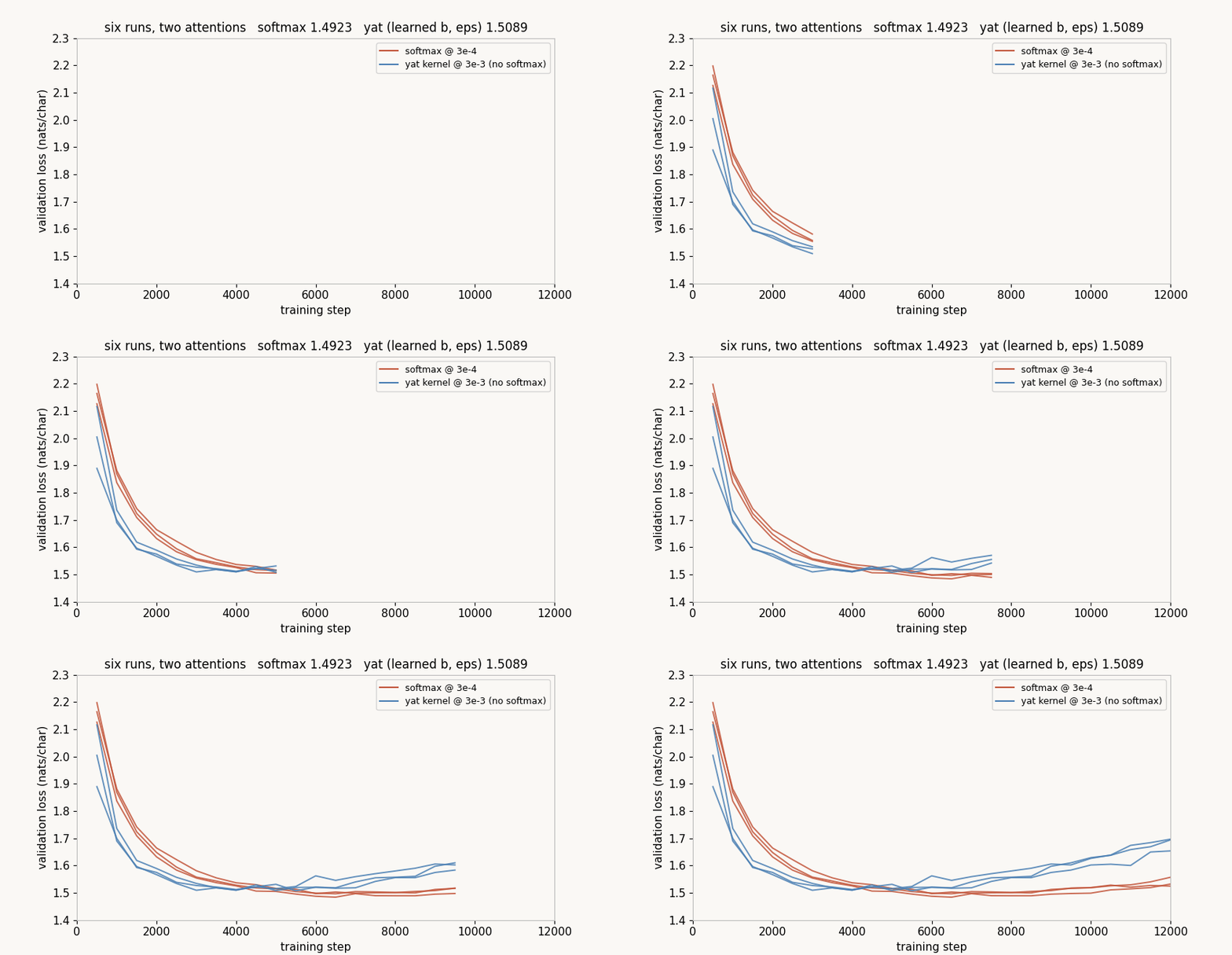
Three seeds per variant, 12,000 steps, each at its swept learning rate (3e-4 softmax, 3e-3 kernel), best validation loss on held-out Shakespeare:
| best-val (nats/char) | bits/char | |
|---|---|---|
| softmax | 1.4923 ± 0.0060 | 2.153 |
| yat kernel (learned per-head b, eps) | 1.5089 ± 0.0020 | 2.177 |
| ablation: b = 0, eps = 1 frozen | 1.5131 ± 0.0071 | 2.183 |
The telemetry that killed a claim
The run logs the maximum attention score each model produces on held-out batches. We expected to caption this “bounded kernel, roaming logits”. The data said otherwise, and the companion is where the numbers live:
| trained score, mean | trained score, max | |
|---|---|---|
| softmax logits | 15 to 18 | 34.5 |
| yat kernel | 17,000 to 68,000 | 443,508 |
The kernel’s scores are five orders of magnitude larger, because and training grows the projection norms. Boundedness-for-bounded-inputs turns out not to survive contact with training, and the property that does the work is a different one: a ratio of polynomials digests without a max trick, while does not exist in float32 at all.
The mass channel’s naive test is measured with a rank statistic, mass against next-token correctness:
order = np.argsort(m)
ranks = np.empty_like(order, dtype=float); ranks[order] = np.arange(len(m))
pos = ranks[c == 1]
auroc = (pos.sum() - len(pos) * (len(pos) - 1) / 2) / (len(pos) * (c == 0).sum() + 1e-9)
AUROC 0.509, 0.501, 0.508 across seeds. Null, reported as such.
The learning-rate audit
The Yat training recipe says kernel attention wants roughly three times the softmax learning rate, and the original contest ran both variants at softmax’s 3e-4. The audit sweep (bundle kgl_blog-yatattn-lrsweep, one seed per cell, full 12,000 steps each):
| LR | softmax | yat |
|---|---|---|
| 3e-4 | 1.4838 | 1.5166 |
| 1e-3 | 1.5066 | 1.5098 |
| 3e-3 | 1.5040 | 1.5007 |
| 1e-2 | 2.5849 | 1.5092 |
Three seeds re-run at the kernel’s best rate (bundle kgl_blog-yatattn-fair) give 1.5163 ± 0.0023, within run-to-run noise of the published 1.5131 ± 0.0071, so the quality table stands.
The b = 0 ablation row is not just a smaller kernel, it is a different mathematical object: the explainer walks through why the universality theorem needs the bias. Empirically the ablation costs a run-noise-sized amount of quality and, more decisively, un-tames the score scale: 443,508 maximum trained score against the full kernel’s 61,221.
The learned scalars themselves are exported by the telemetry run (bundle kgl_blog-yatattn-b-telem), and they tell a per-head specialization story: b wanders from its log 2 init across [0.22, 3.40], and eps splits, most heads driving it toward zero (sharp, local kernels) while two late-layer heads grow it to 6.4 and 12.7 (smooth, near-global ones). The entropy statistics on the trained maps barely move against the ablation (mean 0.73 vs softmax’s 0.48), so the diffuseness mechanism the explainer describes is a property of the polynomial ratio, not of the frozen scalars. Read the sweep table by column rather than by cell: softmax needs its rate found and dies at 1e-2, while the kernel’s entire column sits inside a 1 percent band. Per-variant LR overrides and the sweep mode are set by the SWEEP_LRS, LR_YAT, and LR_SOFTMAX env knobs.
The normalizer as a swappable part
Both normalizers consume the same nonnegative kappa, so the choice is one branch:
if s.variant.endswith("_exp"):
    w = jax.nn.softmax(jnp.where(mask, kappa, -jnp.inf), axis=-1)   # sharpener
    w = jnp.where(mask.any(-1)[None, None, :, None], w, 0.0)        # keyless rows -> 0
else:
    w = kappa / (mass + 1e-9)                                       # Nadaraya-Watson
Trained under softmax(kappa) instead of the ℓ1 sum, the kernel recovers softmax-grade quality on the full-QK tier (1.4968 ± 0.0054, three seeds, vs the ℓ1 kernel’s 1.5089 and standard softmax’s 1.4923) and on the no-V tier (1.5158 vs 1.5343); on the keep-V tier it is worse and high-variance (1.5559 ± 0.043). The explainer reads the mechanism off the learned scalars.
The crossover test loads trained weights and evaluates under the other normalizer by flipping bl.attn.variant at eval time (NORMSWAP=1). The result is symmetric collapse: ℓ1-trained forced to softmax goes 1.75 → 3.18, softmax-trained forced to ℓ1 goes 1.50 → 3.23, both to untrained-network loss. The scores are calibrated to their normalizer and are not interchangeable after training. Bundles kgl_blog-yatexp-* (quality) and kgl_blog-swap-* (crossover).
Dropping Q and K
The explainer’s last experiment removes the projections entirely; the code change is a construction-time skip and a strict mask:
if s.variant.startswith("goat"):
    # no Q, no K: the kernel compares raw residual-stream head slices.
    # Self-mask is STRICT (j < i): with q = k the diagonal is the row
    # maximum and would collapse the layer to pointwise re-scaling.
    q = k = split(x)
    v = split(s.wv(x)) if s.variant == "goat_v" else q
    mask = jnp.tril(jnp.ones((T, T), dtype=bool), k=-1)
The learning-rate sweep for these tiers was bracketed at both ends (3e-4 up to 1e-1, extending until each curve turned):
| LR | no Q/K (keep V) | no Q/K/V |
|---|---|---|
| 3e-4 | 1.5316 | 1.5347 |
| 1e-3 | 1.5370 | 1.5568 |
| 3e-3 | 1.5288 | 1.5445 |
| 1e-2 | 1.5284 | 1.5265 |
| 3e-2 | 1.5238 | 1.5772 |
| 1e-1 | 1.6206 |
Both low-end cells were measured rather than inferred, and both beat their 1e-3 neighbors, a non-monotone pocket a trend extrapolation would have missed. Three seeds at each bracketed optimum give the contest rows in the explainer: 1.5293 ± 0.0041 with V, 1.5343 ± 0.0075 without, at 2,274,545 and 2,052,209 parameters against the full models’ 2,719,217. Bundles: kgl_blog-goat-lrsweep (+extensions), kgl_blog-goat-v-v1, kgl_blog-goat-nov-v1.
The routing, watched
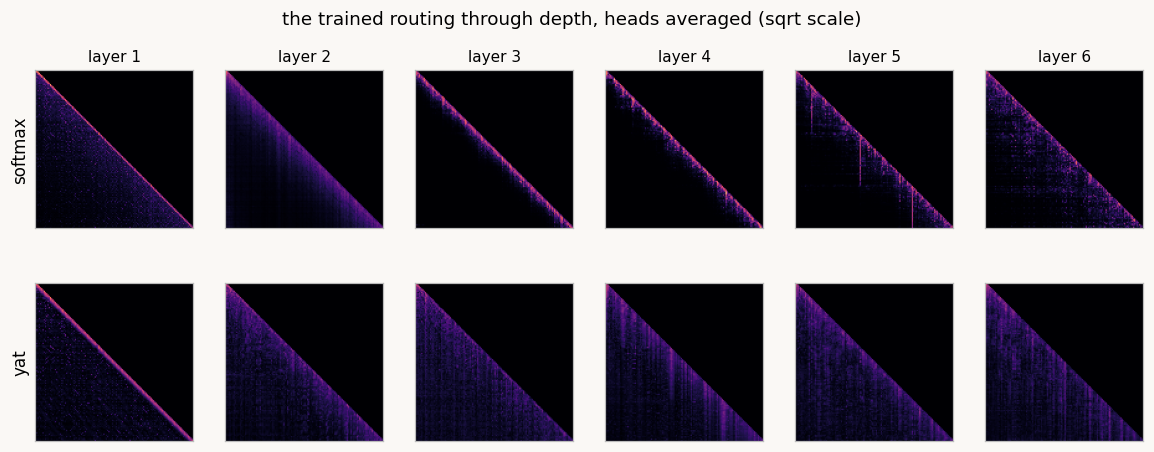
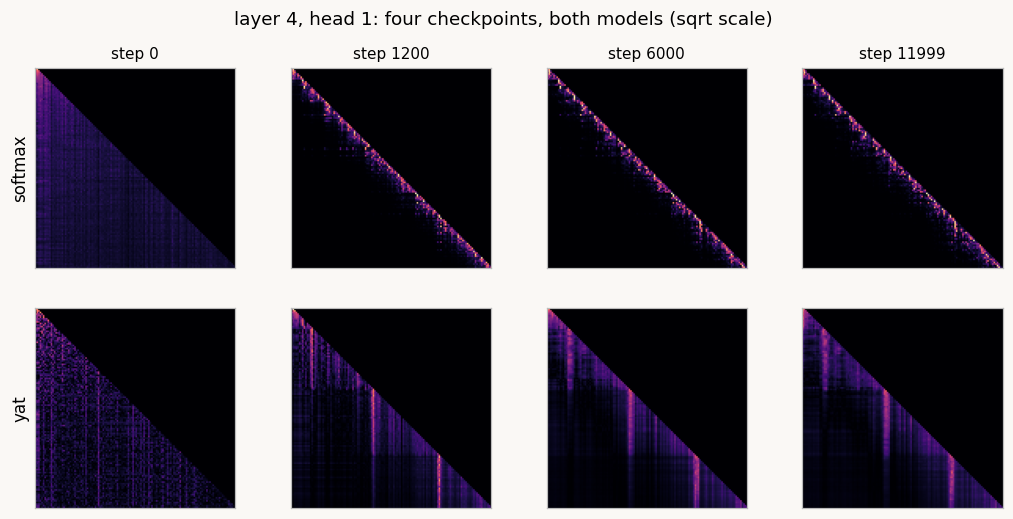
The telemetry run snapshots both models’ full attention tensors on one fixed validation window at four checkpoints. Two honest ways to look at them: through depth, and through training.
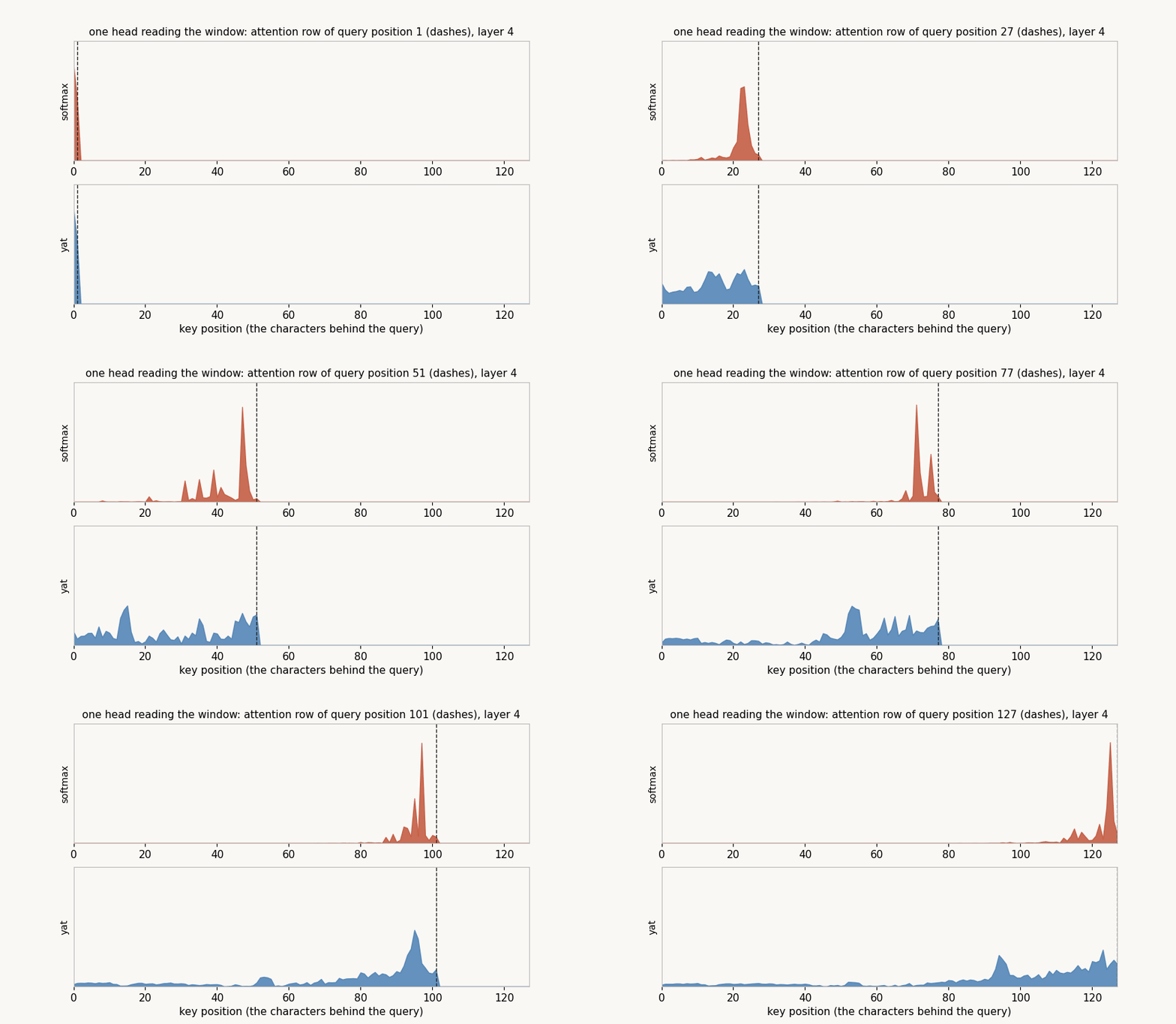
Watching a single head read is where the diffuseness difference stops being a statistic. One query position advancing through the window, its full attention row at every position:
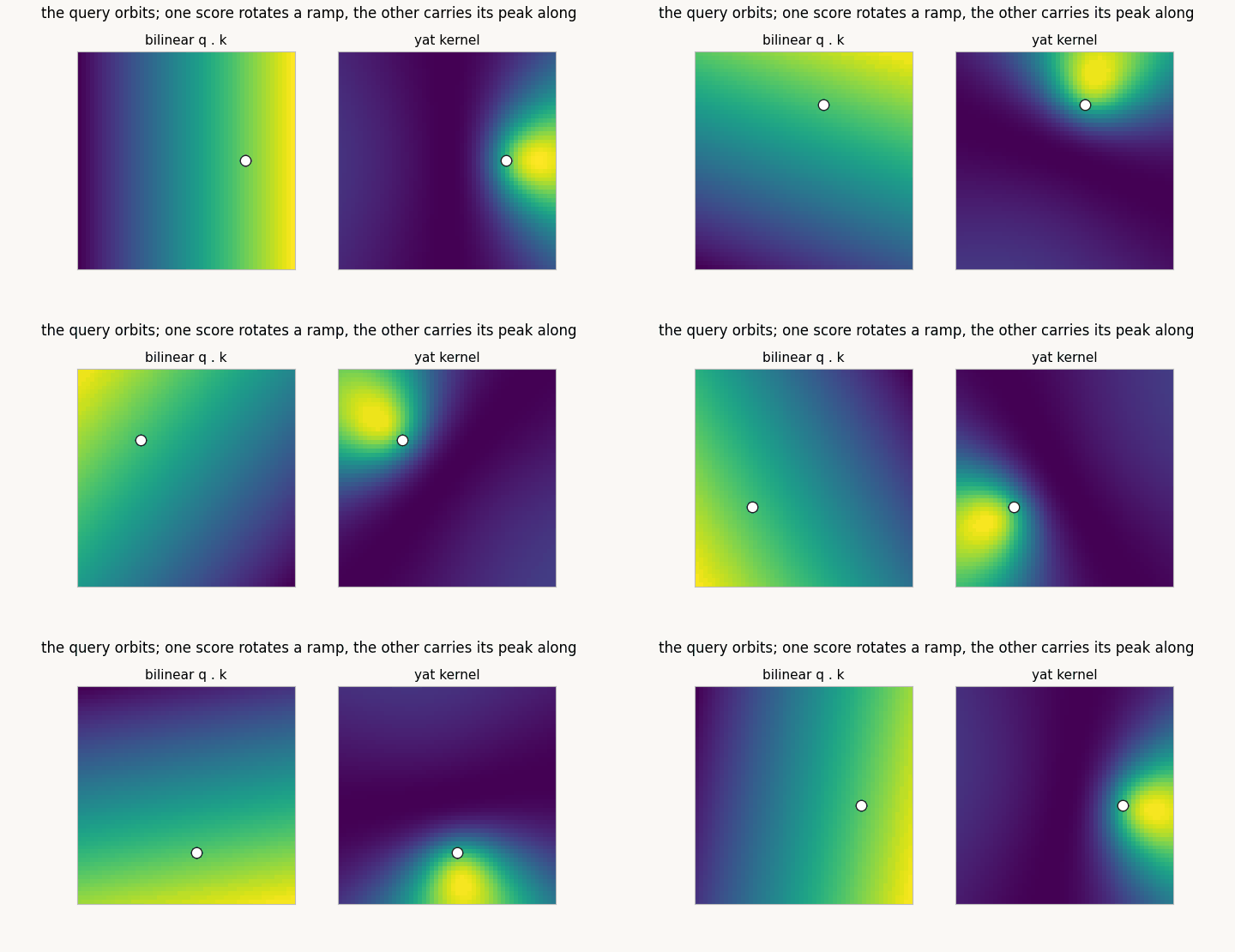
Every number above is from real runs on Kaggle (bundles kgl_blog-yatattn-v1 and kgl_blog-yatattn-telem); figures are rendered from those bundles. The linear-time road, positive random features for exactly this kernel, is SLAY (arXiv 2602.04915).
Cite as
Bouhsine, T. (). Softmax-Free Attention in JAX/Flax NNX. Records of the !mmortal Data Scientist. https://tahabouhsine.com/blog/attention-is-a-compatibility-kernel-jax-flax-nnx/
BibTeX
@misc{bouhsine2026attentionisacompatibilitykerneljaxflaxnnx,
  author       = {Bouhsine, Taha},
  title        = {Softmax-Free Attention in JAX/Flax NNX},
  year         = {2026},
  month        = {jul},
  howpublished = {\url{https://tahabouhsine.com/blog/attention-is-a-compatibility-kernel-jax-flax-nnx/}},
  note         = {Blog post, Records of the !mmortal Data Scientist}
}