A White-Box Kernel FFN in JAX/Flax NNX
#ml#kernels#transformers#mlp#representer-theorem#interpretability#model-editing#yat#jax#flax#nnx#theory
Part 4 of 4Weights in Kernel Space
The number that made this companion worth writing is a zero. The explainer argued that a transformer’s feed-forward block, with a kernel in place of its activation, becomes an explicit learned-center expansion: out(x) = Σ_u k(W_u, x) v_u. Write it that way and the slot decomposition below reconstructs the block’s output with residual 0.00e+00, because the decomposition and the computation are the same arithmetic. This builds the model in Flax NNX, trains it on tinyshakespeare, and then reads, attributes, edits, and probes the FFN.
Prefer a notebook? Run the whole thing on Kaggle: the same code, block by block, with the math written out, training the transformer live and reproducing every result above (it lands at the same val loss, 1.80).
The feed-forward block, rewritten as a memory
A transformer FFN maps a token’s residual vector x ∈ ℝ^d to a vector it adds back to the stream, out(x) = W_2 σ(W_1 x). Replace the activation with the Yat kernel and the block stops being a slab. Each row of W_1 becomes a key W_u, a prototype direction; each column of W_2 becomes a value v_u, a vector written into the residual stream; and the output is a similarity-weighted sum of values:
That is a finite kernel expansion, and it shares the weighted-sum shape of the attention equation Σ_j a_j v_j: the memory {(W_u, v_u)} is learned and persistent instead of read from the context. For fixed centers, each scalar output coordinate lies in their kernel-section span. Because the centers themselves are trained, however, the classical representer theorem is a comparison point rather than a justification for this optimization problem.
import jax, jax.numpy as jnp
from flax import nnx

class YatFFN(nnx.Module):
    """The FFN as a key-value memory: out(x) = Σ_u k(W_u, x) v_u."""
    def __init__(s, d, ff, *, rngs, b0=0.5, eps0=1.0):
        s.W  = nnx.Param(jax.random.normal(rngs.params(), (ff, d)) * 0.02)   # [ff, d] keys W_u
        s.Vv = nnx.Param(jax.random.normal(rngs.params(), (d, ff)) * 0.02)   # [d, ff] values, v_u = Vv[:, u]
        s.log_b = nnx.Param(jnp.full((), jnp.log(jnp.expm1(b0))))
        s.log_eps = nnx.Param(jnp.full((), jnp.log(jnp.expm1(eps0))))
    def kernel(s, x):                                  # k(W_u, x): the memory weights [..., ff]
        b = jax.nn.softplus(s.log_b.value); eps = jax.nn.softplus(s.log_eps.value)
        dot = x @ s.W.value.T
        d2 = (x**2).sum(-1, keepdims=True) + (s.W.value**2).sum(-1) - 2 * dot
        return (dot + b)**2 / (d2 + eps)
    def __call__(s, x):
        return s.kernel(x) @ s.Vv.value.T              # Σ_u k(W_u, x) v_u
Drop that into a standard pre-LN block (causal attention, then this FFN) and train a small char-level language model on tinyshakespeare: 3 layers, d=128, 256 memory slots per block. It reaches a validation loss of 1.80, an ordinary little transformer (the script trains no ReLU twin, so read that number as the model’s stated operating point rather than a comparison). The point is not its quality; it is that its feed-forward memory is now legible. The two arrays you read it from are the keys and values, nothing else:
ffn   = model.blocks[-1].ffn
keys  = ffn.W.value     # [ff, d]  the prototype directions W_u
vals  = ffn.Vv.value    # [d, ff]  the value vectors, v_u = vals[:, u]
U     = model.head.kernel.value   # [d, vocab]  the unembedding; U[:, t] reads token t
1. Read the memory
Because each slot writes a fixed vector v_u into the residual stream, you can ask what it writes by decoding v_u through the unembedding, the logit lens. Every slot gets a human-readable label:
def writes(u, k=6):                                    # the tokens slot u promotes
    return [itos[i] for i in (vals[:, u] @ U).argsort()[::-1][:k]]

# slot 198  writes: ['L', 'P', 'N', 'M', 'R', 'I']     a capital-letter / line-start slot
# slot 145  writes: [' ', 's', '\n', '-', 'd', 'T']    a word- and line-boundary slot
# slot 248  writes: ['\n', '3', 'm', 'k', 'e']         the newline slot
Geva et al. found this kind of structure heuristically inside ReLU FFNs, by probing. Here there is nothing to probe: the slot’s whole contribution is k(W_u, x) v_u, so v_u is what it adds and the decoding of v_u is what it promotes.
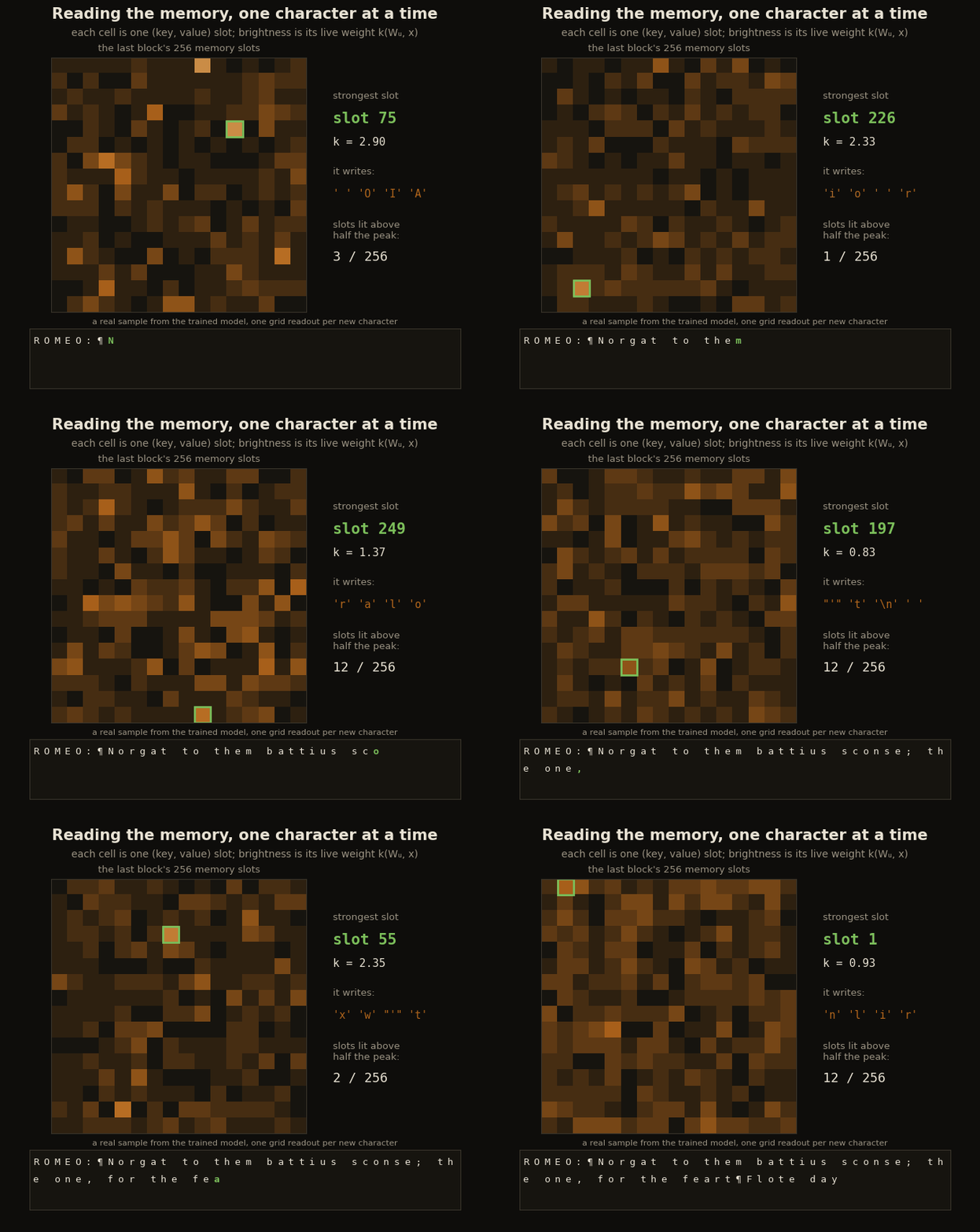
“ROMEO:\n”, and at each new character the grid shows the last block’s actual kernel weights k(Wᵤ, x), one cell per slot (brightness is gamma-scaled for visibility; every number in the readouts is raw). The ringed cell is the strongest slot, decoded on the right into the tokens it writes; step after step, only a handful of cells carry the output while the rest stay dark.2. Attribute an output to its slots
The FFN output is a sum, so any output decomposes, with no gradients and no approximation, into the slots that produced it. Take a context, compute each slot’s push toward the predicted next token, and rank:
x  = residual_into_ffn(model, encode("ROMEO:\nWhat"), layer=-1)[0, -1]  # the FFN's input
kw = ffn.kernel(x[None])[0]                             # k(W_u, x), the memory weights
out = kw @ vals.T                                       # the FFN output
nxt = (U.T @ out).argmax()                              # most-promoted next char
push = kw * (vals.T @ U[:, nxt])                        # each slot's signed push toward it

# the FFN most promotes next-char 'e'
# reconstruction error |Σ_u k_u v_u - out| = 0.00e+00   <- it IS the sum, exactly
#   slot 181  k=0.67  push=+0.43  writes ['e', ':', ',', '\n']
#   slot 202  k=0.86  push=+0.42  writes ['e', 'o', 's', 'a']
#   slot   4  k=0.94  push=+0.41  writes ['t', 'e', 'I', 'E']
The reconstruction error is zero to the last bit because the decomposition is not a story laid over the block; it is the block’s own arithmetic, rearranged into an order a person can read.
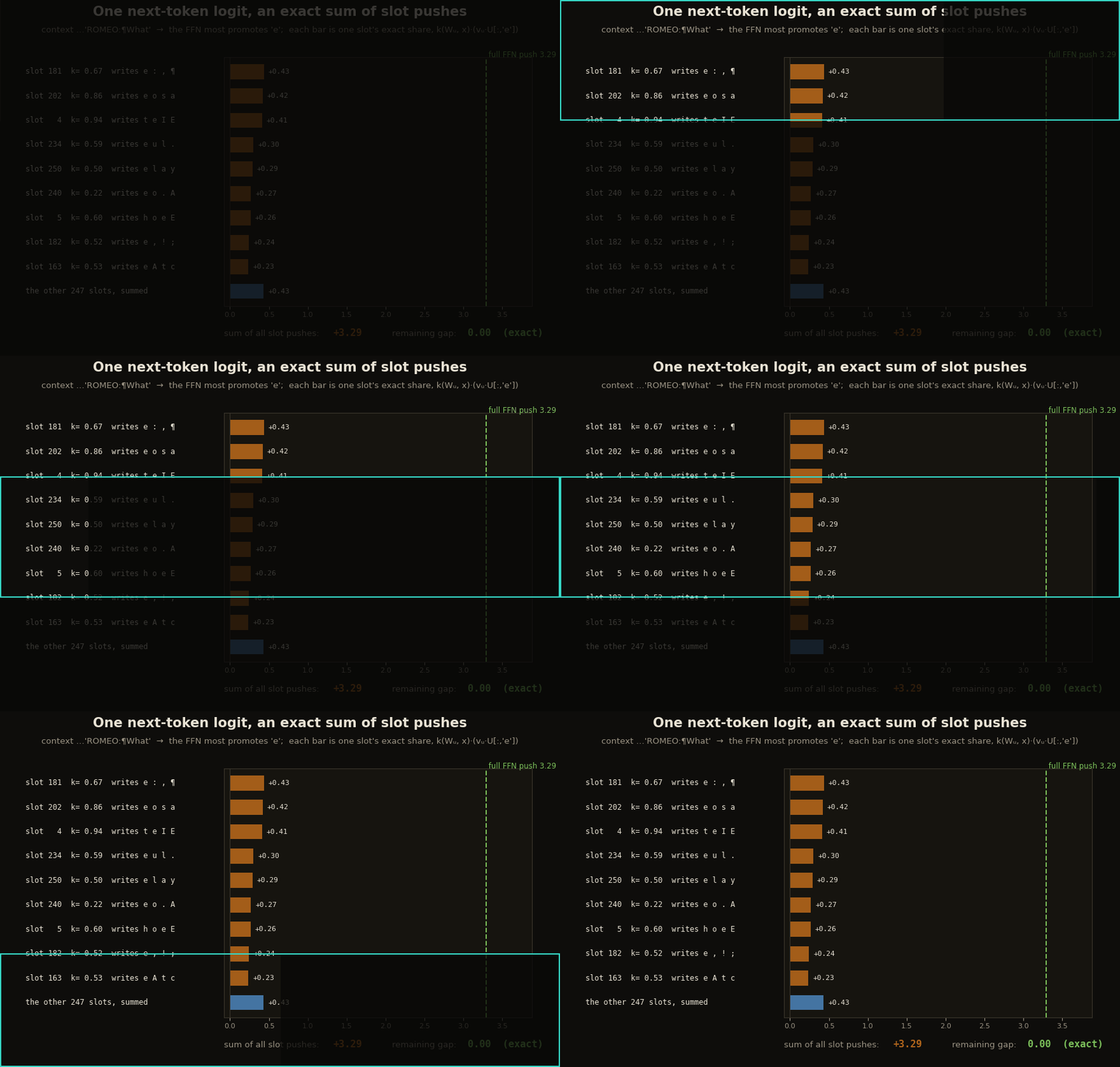
“ROMEO:\nWhat”, each bar is one slot’s exact share of the FFN’s push toward ‘e’, k(Wᵤ, x)·(vᵤ·U[:,‘e’]), labeled with the tokens that slot writes; the last bar is the other 247 slots summed. The bars sum to the block’s full push and the remaining gap is 0.00, exactly, because the sum is the block: no gradients, no approximation. The staged reveal follows the largest signed slot terms into the residual-zero reconstruction.3. Edit one slot and watch the output change
If a slot writes a known token, you can turn it up. Multiply one value vector v_u by a gain and regenerate: nothing else in the model touched, and the change is predictable in closed form because the output is linear in k(W_u, x).
def amplify(model, u, g, layer=-1):                    # v_u  ->  g * v_u
    v = model.blocks[layer].ffn.Vv
    nv = np.asarray(v.value); nv[:, u] *= g; v.value = jnp.asarray(nv)

# slot 248 is the newline-writer. Generate from "GLOUCESTER:\n":
#   gain x1   ->   4 newlines:  "He my deak not name! The sir, in my g..."   (coherent)
#   gain x12  ->  13 newlines:  "He my deak not name!\n\nBENVOLIO:\nThe sir..."  (choppy)
#   gain x30  -> 200 newlines:  "\n\n\n\n\n\n\n\n\n\n\n\n\n\n\n\n..."             (only newlines)
Sweep the gain and the effect is a clean phase transition: below a threshold the text stays coherent, then the one slot floods the residual stream and the model writes nothing but what that slot says. This is white-box model surgery, an edit to a single readable memory cell, and you predicted the result from its label before running it.
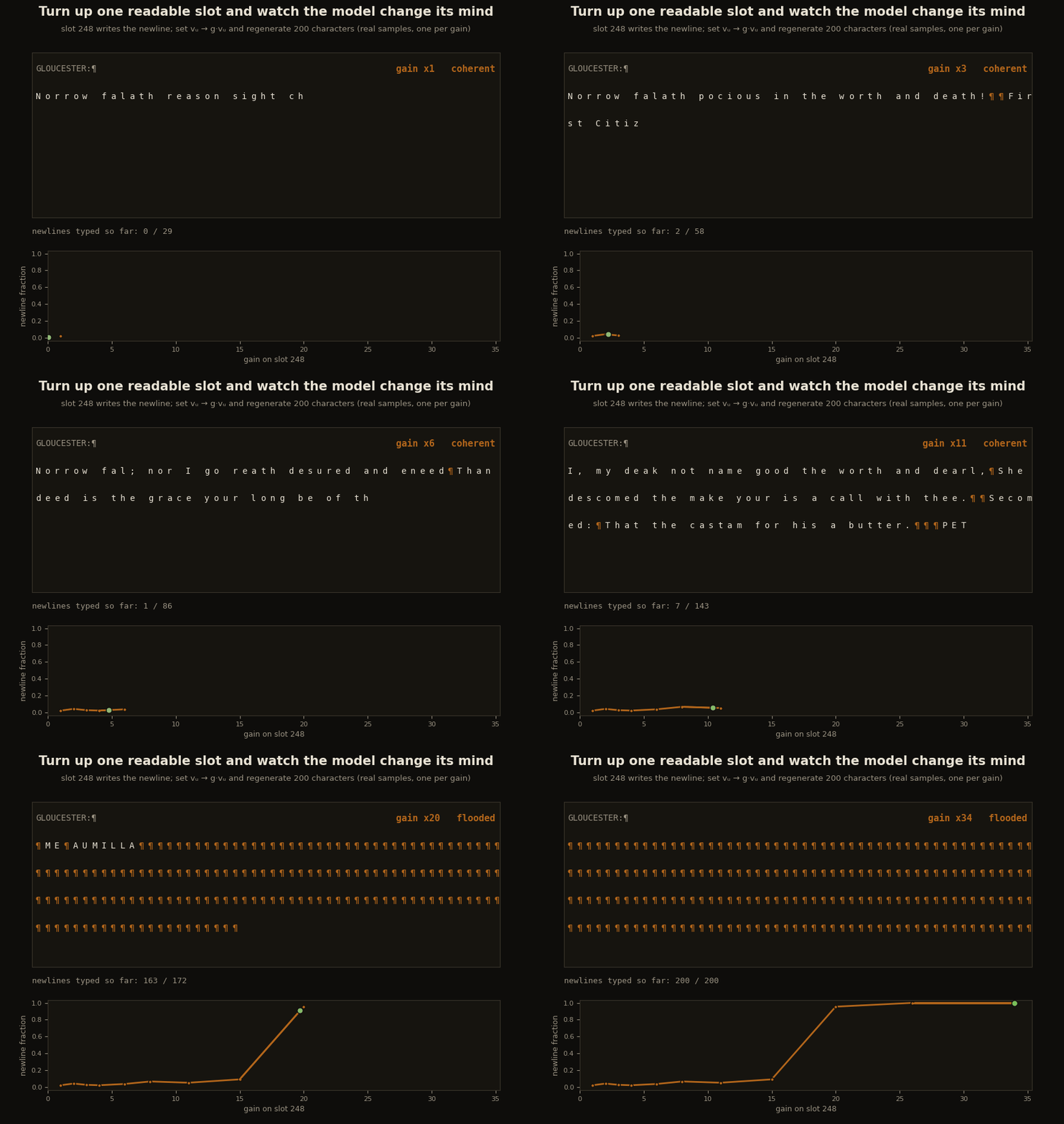
“GLOUCESTER:\n” (real samples, one per gain, newlines drawn as ¶) while the newline-fraction curve extends below. Through gain x15 the text stays coherent prose; between x15 and x20 the slot floods the residual stream and the output collapses into the one token that slot was decoded to write. One value vector, one knob, a phase transition.4. Read off when the memory is out of its depth
The Yat kernel is local and bounded: k(W_u, x) is large only when x is near and aligned with key W_u, and small everywhere else. So a token unlike anything the memory learned lights up no slot, and the FFN writes almost nothing. The kernel weights are an out-of-distribution signal you can read directly off the forward pass.
def peak_weight(seq):                                  # max_u k(W_u, x) at each token
    x = residual_into_ffn(model, seq, layer=-1)[0]
    return ffn.kernel(x).max(-1)

# peak memory weight, averaged over tokens:
#   real Shakespeare (in-distribution)  2.12
#   random characters                   0.96
#   a repeated character                0.77
In this checkpoint, real prose excites the memory more strongly than these two synthetic shifts. That makes peak response a candidate detection score, not a universal confidence measure. A deployment claim would require a held-out calibration set, representative shifts, and threshold-level false-positive and false-negative results.
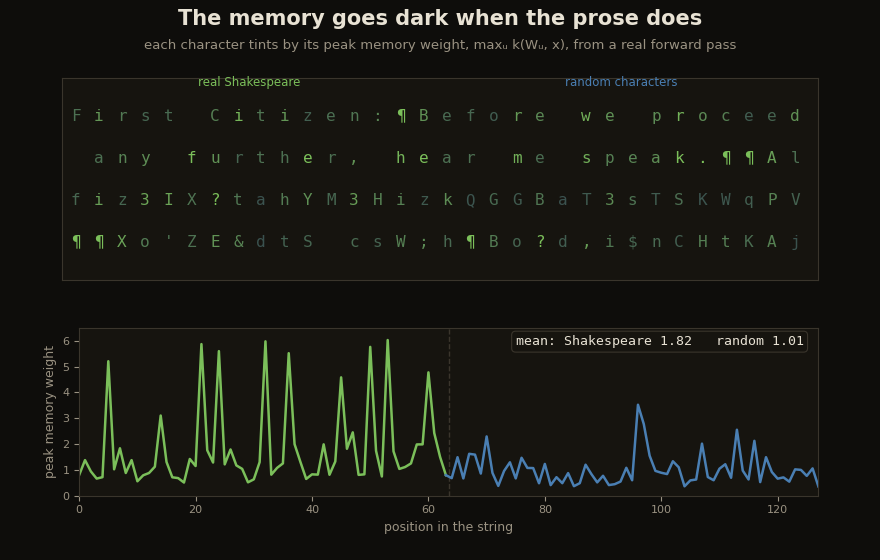
The point
The first three operations follow directly from one fact: a Yat FFN’s output is Σ_u k(W_u, x) v_u, a finite learned-center expansion. Its slots can be read, its output decomposes exactly, and a value vector can be edited directly. The fourth result is empirical: peak response separated Shakespeare from the synthetic shifts used here, and should be calibrated before being treated as confidence. This is an inspectable parameterization, not an application of the classical representer theorem and not a proof that the whole transformer explains itself.
Feed-forward layers as key-value memories is Geva et al. (2021); the FFN-as-persistent-memory equivalence is Sukhbaatar et al. (2019); the classical fixed-RKHS comparison is Schölkopf, Herbrich and Smola (2001); the Yat kernel is Bouhsine (2026). The conceptual companion is The MLP Block Can Be a Kernel Memory.
Cite as
Bouhsine, T. (). A White-Box Kernel FFN in JAX/Flax NNX. Records of the !mmortal Data Scientist. https://tahabouhsine.com/blog/mlp-block-is-a-representer-theorem-jax-flax-nnx/
BibTeX
@misc{bouhsine2026mlpblockisarepresentertheoremjaxflaxnnx,
  author       = {Bouhsine, Taha},
  title        = {A White-Box Kernel FFN in JAX/Flax NNX},
  year         = {2026},
  month        = {jun},
  howpublished = {\url{https://tahabouhsine.com/blog/mlp-block-is-a-representer-theorem-jax-flax-nnx/}},
  note         = {Blog post, Records of the !mmortal Data Scientist}
}References
- (2021). Transformer Feed-Forward Layers Are Key-Value Memories. EMNLP 2021.
- (2019). Augmenting Self-attention with Persistent Memory. arXiv:1907.01470.
- (2001). A Generalized Representer Theorem. COLT 2001.
- (2026). A Universal Reproducing Kernel Hilbert Space from Polynomial Alignment and IMQ Distance. arXiv:2605.03262