Self-Attention as Kernel Regression in JAX/Flax NNX
#ml#attention#kernels#interpretability#transformers#rkhs#jax#flax#nnx#implementation#nadaraya-watson#self-attention
Part 1 of 6Attention Is a Kernel
Two asserts carry this whole companion. The first says that an eight-line attention head in Flax NNX returns the same array, to within 1e-5, as a Nadaraya–Watson smoother written with no reference to transformers. The second says the kernel underneath that head is indefinite, so it was never Mercer to begin with. The explainer argues both in prose, and argues that this is what makes a head readable, rather than the matrix being plottable. Here they are as running code, at dimensions small enough to read every array on the page.
Prefer a notebook? Run the whole thing on Kaggle: the same code, block by block, with the math written out and every figure reproduced from a real run.
Scaled dot-product attention, by hand
How much machinery does a head actually take? Three learned projections and a softmax, nothing else. In nnx.Linear the kernel maps the last axis, so the module reads the same whether x is one token or a sequence.
import jax
import jax.numpy as jnp
from flax import nnx


class Head(nnx.Module):
    def __init__(self, d_model, d_head, *, rngs: nnx.Rngs):
        self.wq = nnx.Linear(d_model, d_head, use_bias=False, rngs=rngs)
        self.wk = nnx.Linear(d_model, d_head, use_bias=False, rngs=rngs)
        self.wv = nnx.Linear(d_model, d_head, use_bias=False, rngs=rngs)

    def __call__(self, x):                       # x: [L, d_model]
        q, k, v = self.wq(x), self.wk(x), self.wv(x)
        d = q.shape[-1]
        scores = q @ k.T / jnp.sqrt(d)           # [L, L]
        alpha = jax.nn.softmax(scores, axis=-1)  # rows are probability vectors
        return alpha @ v, alpha


head = Head(d_model=16, d_head=16, rngs=nnx.Rngs(0))
x = jax.random.normal(jax.random.key(1), (6, 16))
y, alpha = head(x)
That is the whole object. alpha is a row-stochastic matrix, each row a distribution over tokens, and y is the row-weighted average of the value vectors. Everything the explainer says follows from those two sentences.
It is Nadaraya–Watson, and you can assert it
So where is the 1964 estimator hiding in those eight lines? The classical Nadaraya–Watson estimator predicts at a query by normalizing a kernel over observations and using it to weight the targets: . Write that estimator with no reference to attention, just a kernel, a normalizer, and a weighted sum of targets, and feed it the exp-dot-product kernel:
def nadaraya_watson(q, k, v, kernel):
    K = kernel(q, k)                             # [Lq, Lk] nonnegative similarities
    w = K / K.sum(axis=-1, keepdims=True)        # normalize: rows sum to one
    return w @ v, w


q, kk, v = head.wq(x), head.wk(x), head.wv(x)
exp_dot = lambda q, k: jnp.exp(q @ k.T / jnp.sqrt(q.shape[-1]))

y_nw, w_nw = nadaraya_watson(q, kk, v, exp_dot)

assert jnp.allclose(y_nw, y, atol=1e-5)          # same output
assert jnp.allclose(w_nw, alpha, atol=1e-5)      # same weights
The two are not analogous; they are the same array up to relabeling. The dictionary is exact:
| Kernel regression | Self-attention | In the code |
|---|---|---|
| query point | query projection | head.wq(x) |
| observation | key projection | head.wk(x) |
| kernel | exp_dot | |
| target | value projection | head.wv(x) |
| normalizer | softmax denominator | K.sum(-1) |
Softmax is not a special activation that happens to live inside transformers. It is the Nadaraya–Watson normalizer applied to one specific kernel.
The kernel is not symmetric, that is the whole RKHS caveat
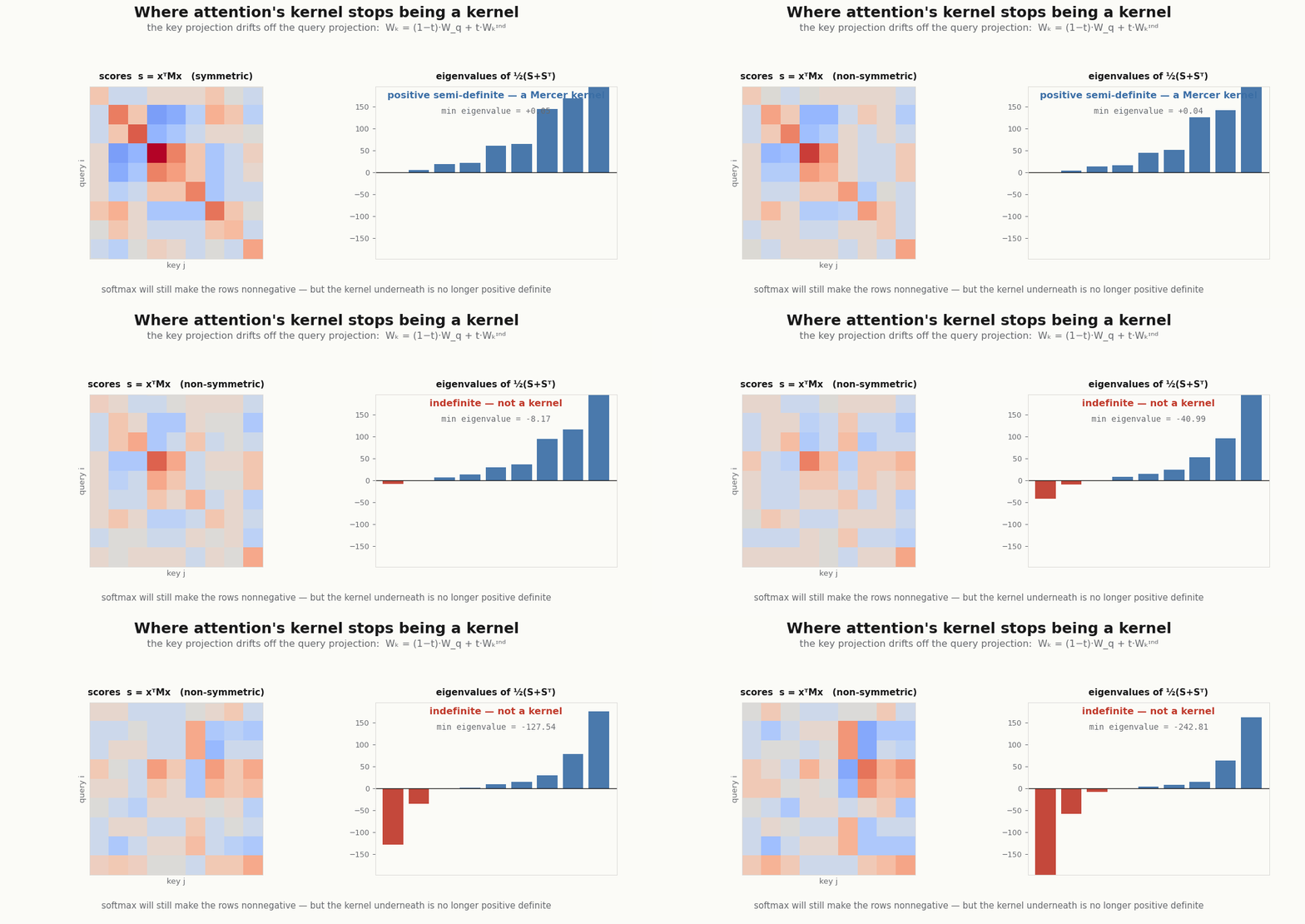
The explainer flags one wrinkle: queries and keys use different projections and , so the score is a bilinear form whose operator has no reason to be symmetric. A genuine (Mercer) kernel must be symmetric and positive semi-definite. This one is neither, and you can watch it fail:
wq, wk = head.wq.kernel.value, head.wk.kernel.value   # [d_model, d_head]
M = wq @ wk.T                                          # score_ij = x_i^T M x_j
print("operator symmetric? ", bool(jnp.allclose(M, M.T)))   # False

S = x @ M @ x.T                                        # raw scores q_i · k_j
sym_eigs = jnp.linalg.eigvalsh(0.5 * (S + S.T))       # symmetric part
print("score symmetric?   ", bool(jnp.allclose(S, S.T)))    # False
print("eig span of sym part:", float(sym_eigs.min()), float(sym_eigs.max()))
# min < 0 < max  -> indefinite, so NOT positive semi-definite, so not Mercer
Contrast with the symmetric exp-inner-product kernel on a single set of vectors, which is positive definite (it is a Hadamard exponential of a Gram matrix, a Schur product of PSD matrices):
z = jax.random.normal(jax.random.key(2), (6, 16))
G = jnp.exp(z @ z.T / jnp.sqrt(16))
print("symmetric exp-dot min eig:", float(jnp.linalg.eigvalsh(G).min()))  # >= 0
So the non-Mercer-ness comes entirely from , not from the exponential. Here is the subtle part the explainer leans on: softmax rescues the readout but not the kernel. Normalizing the rows makes alpha a stochastic matrix, nonnegative weights summing to one, so the output is still an honest convex combination of values (the attribution story survives). Positive-definiteness of the kernel is a different property, and it stays broken. The convex-readout companion makes the same nonnegative-is-not-positive-definite distinction from the readout side.
Swapping the kernel
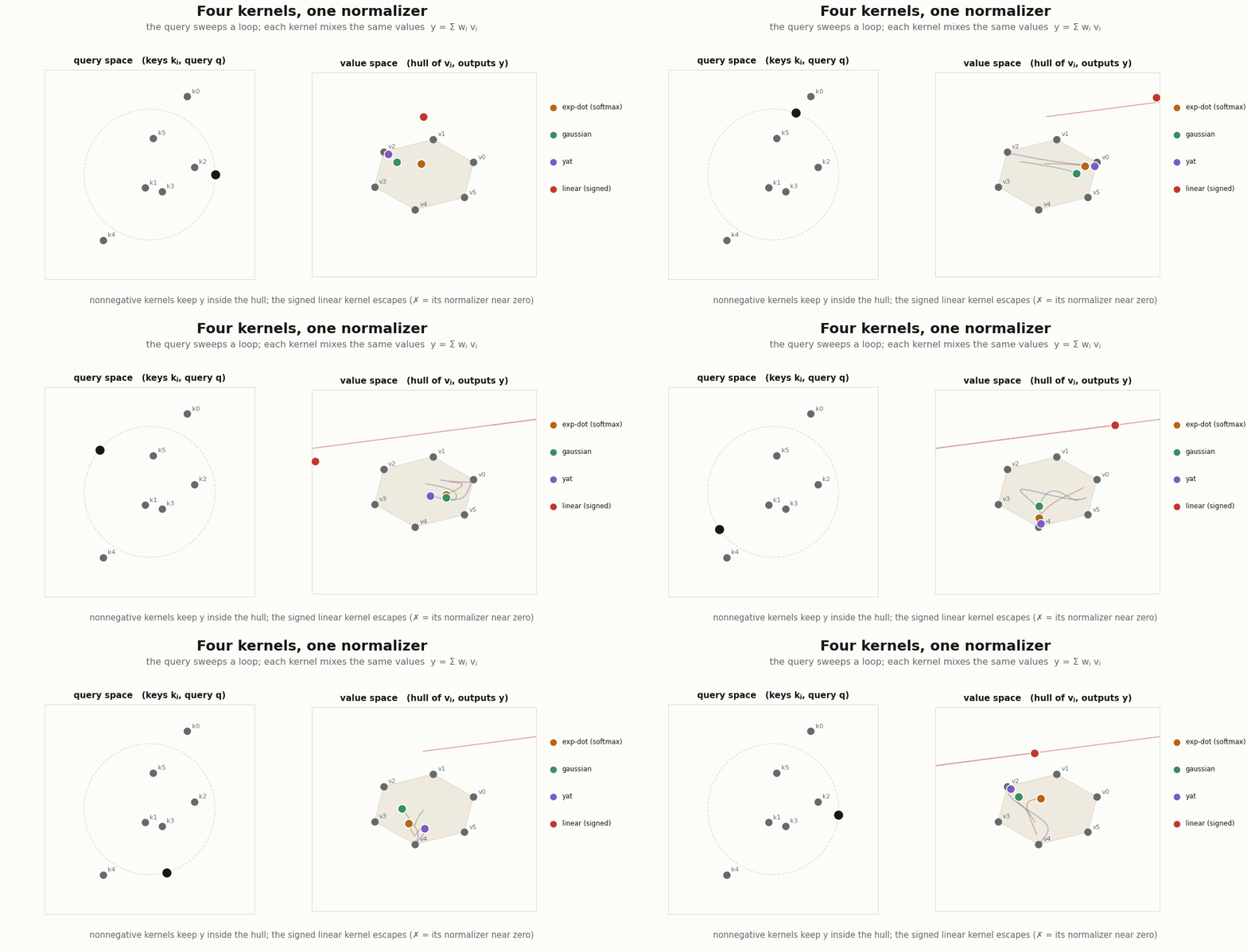
If attention is Nadaraya–Watson, the exp-dot-product is just one entry in the kernel slot. Drop in others through the same normalizer and ask the only question that decides whether the weights are an attribution: are they nonnegative?
def sqdist(a, b):
    return jnp.sum((a[:, None, :] - b[None, :, :]) ** 2, axis=-1)

d = q.shape[-1]
kernels = {
    "exp-dot (softmax)": lambda q, k: jnp.exp(q @ k.T / jnp.sqrt(d)),
    "gaussian":          lambda q, k: jnp.exp(-sqdist(q, k) / (2.0 * d)),
    "yat":               lambda q, k: (q @ k.T) ** 2 / (sqdist(q, k) + 1e-3),
    "linear (signed)":   lambda q, k: q @ k.T,
}

for name, kf in kernels.items():
    _, w = nadaraya_watson(q, kk, v, kf)
    nonneg = bool((w >= -1e-8).all())
    sums_to_one = bool(jnp.allclose(w.sum(-1), 1.0, atol=1e-5))
    print(f"{name:18s} nonneg={nonneg!s:5}  rows_sum_to_1={sums_to_one}")
# exp-dot, gaussian, yat -> nonneg=True   (valid mixtures; "30% from token j" means something)
# linear (signed)        -> nonneg=False  (weights can be negative, denominator can cross zero)
The exp-dot-product, the Gaussian, and the Yat kernel all keep the row a probability vector, so the output stays inside the convex hull of the values and “this token contributed ” is a real statement. The linear kernel divides by a sum that can pass through zero and hands back signed “weights”, a smoother in algebra only. Nonnegativity, not positive-definiteness, is what buys the interpretation.
The √d is a bandwidth
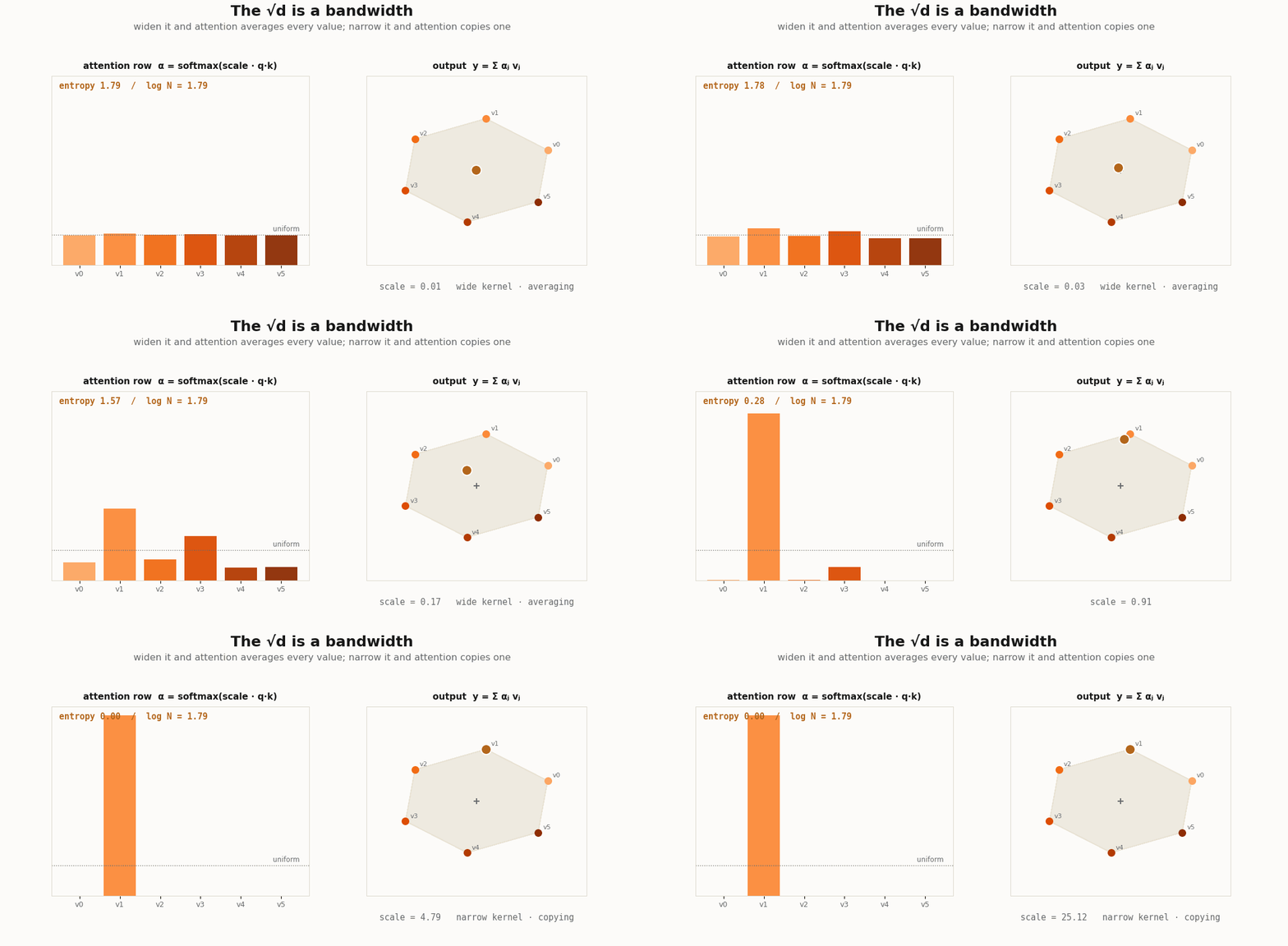
In a kernel smoother the bandwidth sets how far the averaging reaches. In attention the same dial is the temperature on the scores. Sweep it and read the mean entropy of the rows:
def weights_at(scale):
    return jax.nn.softmax((q @ kk.T) * scale, axis=-1)

def mean_entropy(w):
    return float(-jnp.sum(w * jnp.log(w + 1e-12), axis=-1).mean())

for scale in [0.0, 1.0 / jnp.sqrt(d), 1.0, 6.0]:
    print(f"scale={float(scale):.3f}  mean row entropy={mean_entropy(weights_at(scale)):.3f}")
# scale 0   -> uniform averaging, entropy ~ log(L)  (a wide kernel: every token counts equally)
# large     -> entropy -> 0, a near one-hot row     (a narrow kernel: nearest-neighbor copy)
A wide bandwidth makes the head a blur over all tokens; a narrow one makes it a hard copy from the single most similar token. The “copy” and induction heads the interpretability literature names are kernel smoothers run at the sharp end of this dial, the temperature is not a training nuisance, it is the bandwidth of the regression.
A head that routes to a marked token
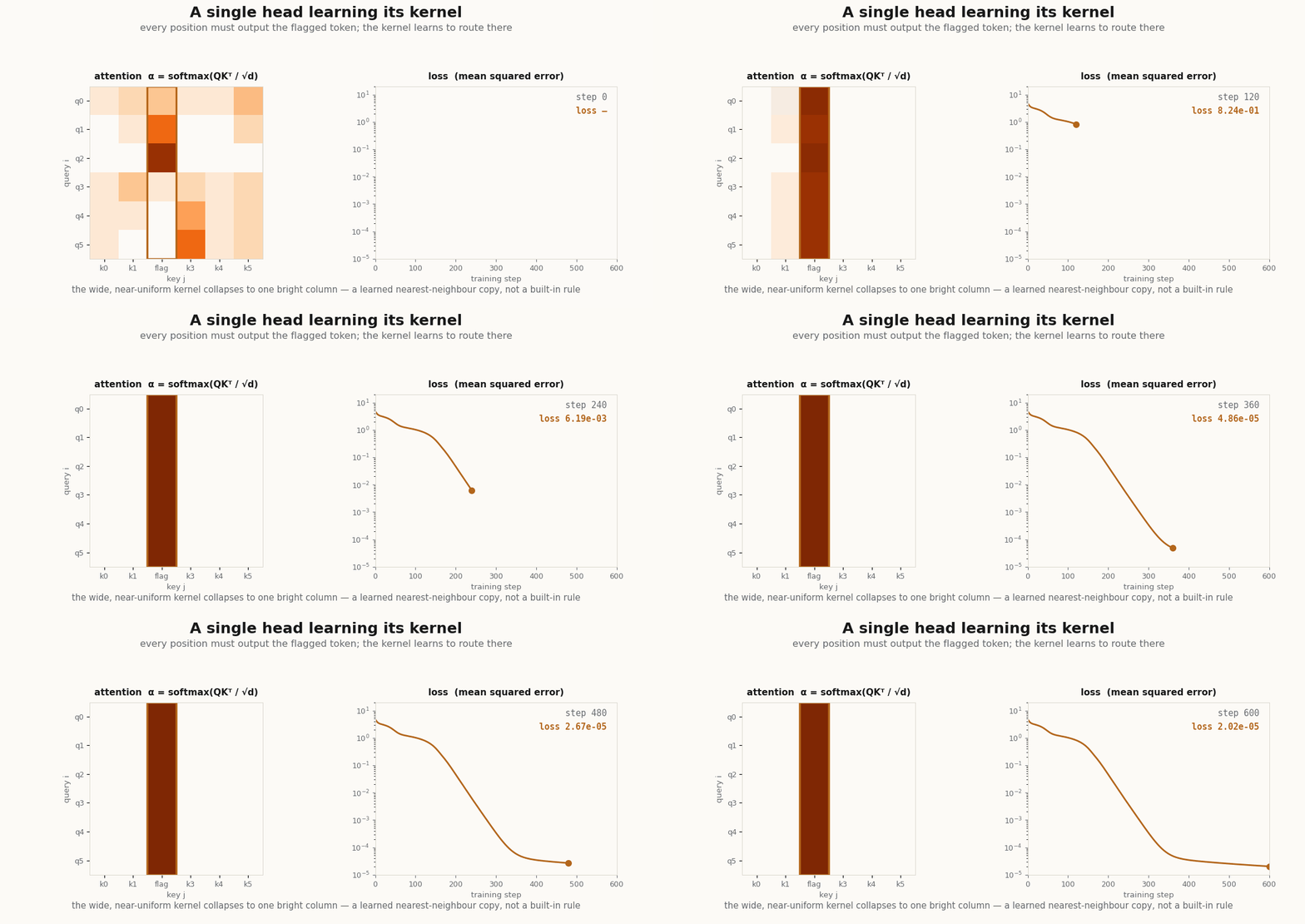
To see the kernel learn, give one head a job: in each sequence one token is flagged (a large value in its first coordinate), and every position must output that token’s vector. The head can only succeed by learning that route attention onto the flag and a that copies. One easy-to-miss detail decides whether this works: the projections need a bias. Every query has to point at the same token regardless of its own content, and a bias-free linear map of mean-zero inputs cannot produce a content-independent pull in a fixed direction; the constant term is what lets the query lean on the flag. Written batched with einsum, the module is otherwise unchanged in spirit:
import optax


class BatchHead(nnx.Module):
    def __init__(self, d_model, d_head, *, rngs: nnx.Rngs):
        self.wq = nnx.Linear(d_model, d_head, use_bias=True, rngs=rngs)
        self.wk = nnx.Linear(d_model, d_head, use_bias=True, rngs=rngs)
        self.wv = nnx.Linear(d_model, d_head, use_bias=True, rngs=rngs)

    def __call__(self, x):                                   # x: [..., L, d_model]
        q, k, v = self.wq(x), self.wk(x), self.wv(x)
        scores = jnp.einsum('...id,...jd->...ij', q, k) / jnp.sqrt(q.shape[-1])
        a = jax.nn.softmax(scores, axis=-1)
        return jnp.einsum('...ij,...jd->...id', a, v), a


def make_example(key):
    k1, k2 = jax.random.split(key)
    x = jax.random.normal(k1, (6, 16))
    t = jax.random.randint(k2, (), 0, 6)                     # the marked position
    x = x.at[t, 0].set(6.0)                                  # the flag
    target = jnp.broadcast_to(x[t], (6, 16))                # every row should become token t
    return x, target


xs, targets = jax.vmap(make_example)(jax.random.split(jax.random.key(3), 512))

model = BatchHead(d_model=16, d_head=16, rngs=nnx.Rngs(0))
optimizer = nnx.Optimizer(model, optax.adam(1e-2), wrt=nnx.Param)


@nnx.jit
def train_step(model, optimizer, xs, targets):
    def loss_fn(model):
        ys, _ = model(xs)
        return jnp.mean((ys - targets) ** 2)

    loss, grads = nnx.value_and_grad(loss_fn)(model)
    optimizer.update(model, grads)
    return loss


for step in range(600):
    loss = train_step(model, optimizer, xs, targets)
print("final loss:", float(loss))      # ~0.0, the target is exactly reconstructable
The head drives the loss to zero, and the learned kernel does what the task demands, putting all of its weight on the flagged token:
_, a = model(xs)
routed = a[:, 0, :].argmax(-1)          # where position 0 sends its weight, per sequence
marker = xs[:, :, 0].argmax(-1)         # the flagged token, per sequence
print("routes to the marker:", float((routed == marker).mean()))   # 1.0
No supervision named the marker; the head discovered that the way to minimize the loss is to put a sharp kernel on it. That discovered kernel is the explanation of what the head does, which is the explainer’s whole point, now a printed number.
Boundary of the result
Does any of this survive contact with a production layer? A real attention layer stacks many heads, carries a causal mask (a jnp.tril that sets the upper triangle to -jnp.inf before the softmax), and caches keys and values at inference. None of that touches the kernel reading: each head is its own Nadaraya–Watson smoother with its own learned kernel, and the mask just restricts which observations a query is allowed to see.
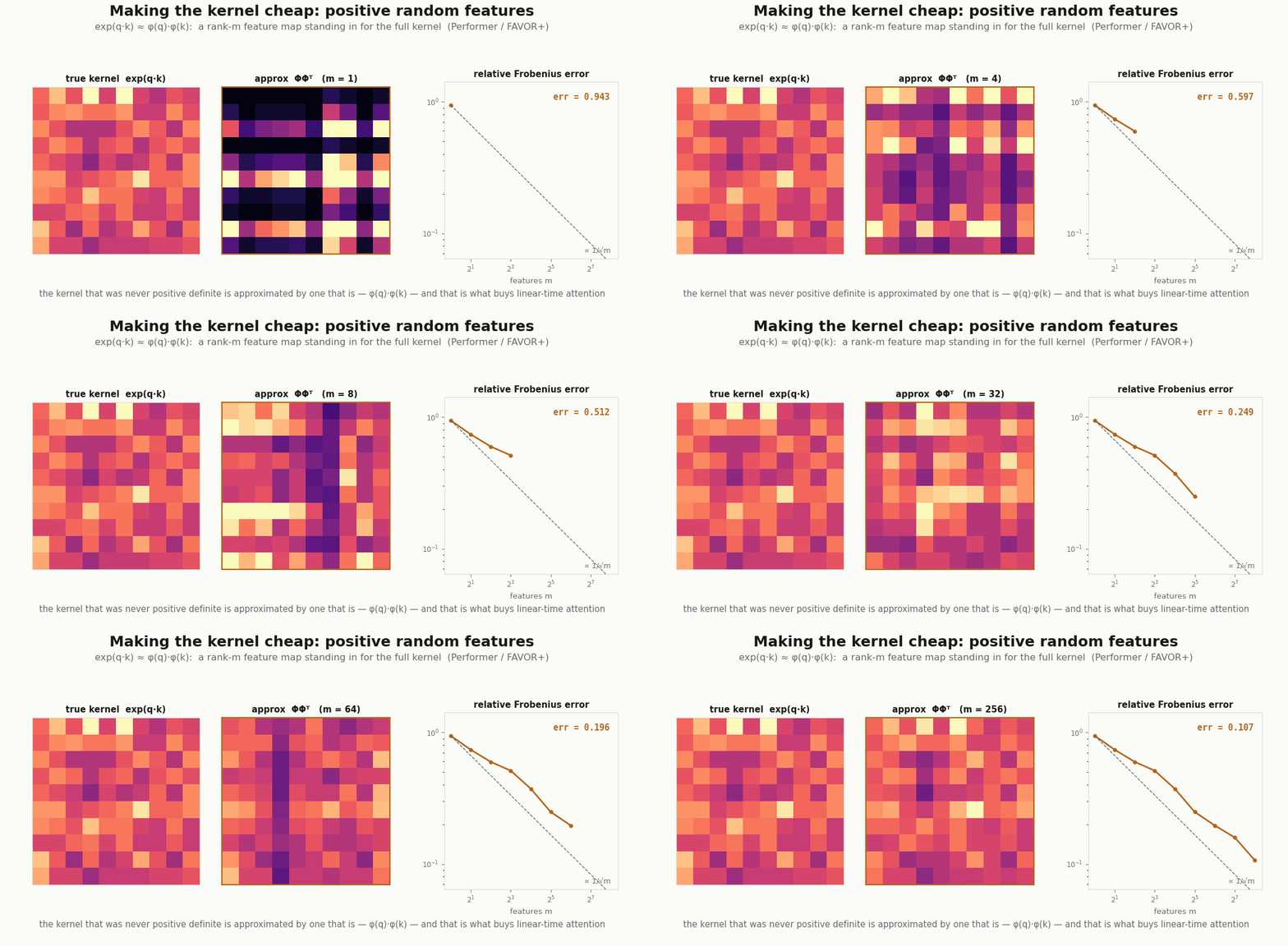
The non-positive-definiteness is also not only a curiosity. It is what the linear-attention companion has to confront: to make attention cheap you replace the exp-dot-product kernel with an explicit feature map , and the fidelity of that approximation (Performer; Katharopoulos et al.) is a statement about how well a positive-definite surrogate stands in for a kernel that never was one. The smoother view is what makes that question askable.
References: Flax NNX Module API; the kernel lens on attention from Tsai et al. (2019); Nadaraya–Watson regression from Nadaraya (1964) and Watson (1964); linear-attention feature maps from Katharopoulos et al. (2020) and Choromanski et al. (2021).
Cite as
Bouhsine, T. (). Self-Attention as Kernel Regression in JAX/Flax NNX. Records of the !mmortal Data Scientist. https://tahabouhsine.com/blog/attention-is-kernel-jax-flax-nnx/
BibTeX
@misc{bouhsine2026attentioniskerneljaxflaxnnx,
  author       = {Bouhsine, Taha},
  title        = {Self-Attention as Kernel Regression in JAX/Flax NNX},
  year         = {2026},
  month        = {may},
  howpublished = {\url{https://tahabouhsine.com/blog/attention-is-kernel-jax-flax-nnx/}},
  note         = {Blog post, Records of the !mmortal Data Scientist}
}References
- (1964). On Estimating Regression. Theory of Probability & Its Applications 9(1), 141–142.
- (1964). Smooth Regression Analysis. Sankhyā: The Indian Journal of Statistics, Series A 26(4), 359–372.
- (2019). Transformer Dissection: An Unified Understanding for Transformer's Attention via the Lens of Kernel. EMNLP-IJCNLP 2019.
- (2020). Transformers are RNNs: Fast Autoregressive Transformers with Linear Attention. ICML 2020.arXiv:2006.16236
- (2021). Rethinking Attention with Performers. ICLR 2021.arXiv:2009.14794
- (2026). A Universal Reproducing Kernel Hilbert Space from Polynomial Alignment and IMQ Distance. arXiv:2605.03262