 JAX Pathways
Phase 13 / Pallas kernels
A first TPU kernel
Revision v0.7.0 · Updated since your last visit. Review the changes; your progress is saved.
Lesson · about 110 minutes · CPU practice
Implement a real TPU-targeted Pallas launch with a broadcast BlockSpec. Specify target layout and float32 compute/output-cast policies.
Phase study guide: preparation, milestones and project evidence
Before you start
Before this: Pallas grids and BlockSpecs
Hardware: CPU Pallas interpretation; actual TPU lowering and performance unverified
Setup help: Python, notebook, or Cloud TPU VM
Use the tested CPU packages (the recorded environment uses Python 3.14.3). Other Python versions and accelerator environments require separate checks. The optional Cloud TPU specialization explains the target-specific execution boundaries. Logical CPU devices practice partitioning; they do not simulate TPU performance.
Download the repository ZIP or use your existing checkout. Extract it and open a terminal in the folder containing requirements-cpu.txt. The beginner ZIP is separate; these lessons use the full repository folder.
python3 -m venv .venv
source .venv/bin/activate
python -m pip install -r requirements-cpu.txtpy -3 -m venv .venv
.\.venv\Scripts\python.exe -m pip install -r requirements-cpu.txtAfter activation, run the complete worked example from that same folder:
python phases/13-kernels/02-a-first-tpu-kernel/code/main.py.\.venv\Scripts\python.exe phases/13-kernels/02-a-first-tpu-kernel/code/main.pyFor an incremental build, create main.py in your own practice folder, append each build block in order, and run python main.py with this environment active. Keep that file separate from the downloaded reference solution.
Download this lesson’s notebook. Open it with a Python kernel using the course environment. Run cells from the top after restarting the kernel; experiments depend on earlier definitions.
For local Jupyter, first install the course requirements using the Local Python steps, then use your environment’s Python to start Jupyter:
python -m pip install jupyterlab
python -m jupyter lab.\.venv\Scripts\python.exe -m pip install jupyterlab
.\.venv\Scripts\python.exe -m jupyter labSelect the downloaded kernels-02.ipynb file in JupyterLab. The notebook contains reference solutions; make your prediction and attempt each practice task before opening them. Restart the kernel before changing logical device setup.
The worked reference for this lesson is CPU-validated. Some references explicitly configure logical CPU devices; setting JAX_PLATFORMS does not adapt them to a TPU. Follow the execution matrix and reviewed multi-host example before attempting a target run.
For accelerator preparation, study TPU setup, observed runtime receipts, checkpointed jobs and precision and retained traces. These target paths remain unqualified on physical TPU hardware until an actual receipt is recorded. Cloud provisioning is optional for CPU learning.
Check: CPU interpretation agrees with NumPy, including the (9,129) tail. The final value is approximately 2.4. Requesting TPU mode on CPU raises an explicit refusal.
Revisit the guided CPU setup · Open 19: TPU Setup. Package instructions are CPU instructions; Windows and accelerator environments need their own validation.
What you will be able to do
- Implement a real TPU-targeted Pallas launch with a broadcast BlockSpec.
- Specify target layout and float32 compute/output-cast policies.
- Verify CPU semantics across tails and precision choices.
- Refuse target execution claims when only interpretation is available.
The problem
An interpreted kernel can be numerically correct and still violate a TPU layout or compilation restriction. How do we build a genuine TPU launch path without pretending that a CPU test ran on an accelerator? We will implement a fused bias-and-ReLU kernel with separate, enforceable execution modes.
The idea
Once a tile's inputs are identified, a kernel performs local arithmetic and writes the corresponding outputs. Bias broadcasting, activation and dtype rules must preserve the declared shape and value contract.
Separate tile ownership from the local arithmetic
Take one illustrative row and feature bias . Addition gives , and ReLU gives . A bias indexed by row instead of feature can preserve output shape while computing the wrong result.
Trace loads into the tile, the exact broadcast axis, activation and stores. Keep boundary guards visible beside the arithmetic rather than assuming a correct formula guarantees correct indexing.
The activation plot checks the resulting values. Compare against an independent array implementation on awkward dimensions and negative/positive inputs. CPU interpretation helps test semantics; it does not qualify TPU throughput or prove a particular memory schedule.
Map each operand according to its meaning
The activation matrix has shape ; the bias has shape . We reshape the padded bias to and map its block coordinates to , so changing the row-program index does not change the bias window. The output uses and is written exactly once per tile. This is intentional broadcasting with an explicit contract, unlike accepting accidentally mismatched matrices.
Use a conservative TPU tile contract
TPU vector-memory layout places restrictions on block dimensions. This wrapper requires block dimensions that are multiples of for target mode, then pads and crops arbitrary positive logical shapes. The one-row bias window spans its whole first dimension. This is a deliberately narrow supported contract, not a claim that every other block shape is forbidden on every TPU generation. CPU interpretation alone does not enforce or validate all lowering restrictions.
State where precision changes
Both inputs may be float32 or bfloat16, but their dtypes must match. The kernel promotes loaded values to float32 for addition and ReLU, then casts once to the output dtype. An independent reference must start from those same represented inputs and apply the same final cast. Comparing bfloat16 output directly to an unrounded original dataset mixes representation error with kernel correctness.
Make the execution mode inspectable
The wrapper accepts only the strings interpret and tpu. The TPU branch checks the actual default backend and the devices holding the inputs, and passes interpret=False. It never catches a target lowering failure and retries on CPU. A target failure should remain a failed result with its environment, not become a fabricated successful accelerator receipt.
Run the real target path as a separate lab
On an already configured TPU environment, use python3 projects/kernel-audit/target_tpu.py --kernel fused --block 8 128. That runner explicitly places inputs on a TPU, calls the target branch, synchronizes, and prints a JSON evidence record after numerical comparisons. Run it in a fresh TPU process rather than a CPU-forced lesson runner. The command is implemented; no target receipt exists in this authoring environment. CPU interpretation establishes neither target lowering success nor speedup.
Compare with a strong baseline before optimizing
The ordinary JAX expression can already be fused by XLA. A hand-written fused kernel is not automatically faster. On the target, compare with a warmed jitted baseline using the same dtype, data, padding boundary and output semantics. The final lesson defines the measurement protocol and distinguishes kernel-only timing from end-to-end wrapper cost.
Bias and ReLU alter the values, not the tile ownership contract
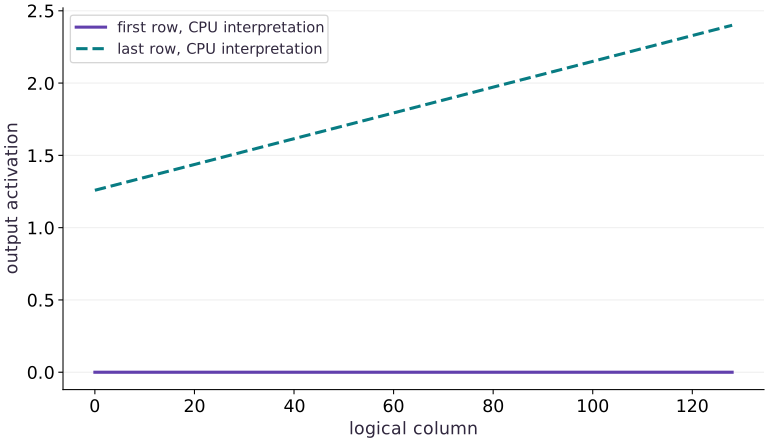
Predict before looking: Where will the biased first and last rows cross the zero threshold?
Read the figure
The horizontal axis is column index. The vertical axis is output activation after adding that column’s bias and applying ReLU. The two plotted series are the first and last rows from the actual interpreted kernel result.
The first row is entirely zero for this fixture because its negative activations remain below zero after bias. The last row stays positive and reaches approximately at column , including the final partial logical tile. These are output values, not timings.
Connect it to the computation
The per-column NumPy comparison verifies every element, while the displayed rows make the activation boundary and tail visible. The bias window depends on the column program index and is reused across row blocks.
This figure is labeled CPU interpretation. It does not prove TPU lowering, vector-memory scheduling or speed. The separate target-only runner refuses to create those claims without real TPU inputs and completed execution.
Open full-size figureDownload data and provenance
The notebook contains the data experiment, plotting code, and recorded figure output. Rerun it to test your changes.
Where to put & run this code: Work in phases/13-kernels/02-a-first-tpu-kernel/code/main.py (or downloaded exercises/kernels-02.py / exercises/kernels-02.ipynb) and execute from the repository root with python3 phases/13-kernels/02-a-first-tpu-kernel/code/main.py.
1 Define separate interpreted and target-only launch modes
Create main.py for the first block, then append each block in order in your course CPU environment.
# Step 1 — Define separate interpreted and target-only launch modes: The launch path states its execution mode explicitly.
import jax
import jax.numpy as jnp
import numpy as np
from jax.experimental import pallas as pl
from jax.experimental.pallas import tpu as pltpu

def fused_bias_relu(x,bias,block=(8,128),mode="interpret"):
    # Guard input contract (`x.ndim != 2 or bias.ndim != 1 or bias.shape[0] != x.shape[1] or (min(x.shape) < 1)`) and fail fast if violated.
    if x.ndim!=2 or bias.ndim!=1 or bias.shape[0]!=x.shape[1] or min(x.shape)<1:
        raise ValueError("x must be (M,N), bias must be (N,), and dimensions nonempty")
    # Guard input contract (`x.dtype != bias.dtype or x.dtype not in (jnp.float32, jnp.bfloat16)`) and fail fast if violated.
    if x.dtype!=bias.dtype or x.dtype not in (jnp.float32,jnp.bfloat16):
        raise ValueError("matching float32 or bfloat16 required")
    bm,bn=block
    # Guard input contract (`not isinstance(bm, int) or not isinstance(bn, int) or bm < 1 or (bn < 1)`) and fail fast if violated.
    if not isinstance(bm,int) or not isinstance(bn,int) or bm<1 or bn<1:
        raise ValueError("positive integer block sizes required")
    # Guard input contract (`mode not in ('interpret', 'tpu')`) and fail fast if violated.
    if mode not in ("interpret","tpu"):
        raise ValueError("mode must explicitly be interpret or tpu")
    if mode=="tpu":
        if jax.default_backend()!="tpu" or any(not isinstance(a,jax.core.Tracer) and any(d.platform!="tpu" for d in a.devices()) for a in (x,bias)):
            raise RuntimeError("Real TPU inputs/backend required; CPU fallback is disabled")
        if bm%8 or bn%128:
            raise ValueError("this TPU wrapper requires block multiples of (8,128)")
    m,n=x.shape
    pm=(m+bm-1)//bm*bm
    pn=(n+bn-1)//bn*bn
    # Combine or mask array elements to form `px`.
    px=jnp.pad(x,((0,pm-m),(0,pn-n)))
    # Combine or mask array elements to form `pb`.
    pb=jnp.pad(bias,(0,pn-n))[None,:]
    def kernel(x_ref,bias_ref,out_ref):
        value=x_ref[...].astype(jnp.float32)+bias_ref[...].astype(jnp.float32)
        out_ref[...]=jnp.maximum(value,0).astype(out_ref.dtype)
    # Invoke custom Pallas kernel or tile specification (`matrix_spec`).
    matrix_spec=pl.BlockSpec((bm,bn),lambda i,j:(i,j))
    # Invoke custom Pallas kernel or tile specification (`bias_spec`).
    bias_spec=pl.BlockSpec((1,bn),lambda i,j:(0,j))
    # Invoke custom Pallas kernel or tile specification (`output`).
    output=pl.pallas_call(kernel,
        out_shape=jax.ShapeDtypeStruct((pm,pn),x.dtype),
        grid=(pm//bm,pn//bn),in_specs=(matrix_spec,bias_spec),out_specs=matrix_spec,
        interpret=(mode=="interpret"),
        compiler_params=pltpu.CompilerParams(dimension_semantics=("parallel","parallel")))(px,pb)
    return output[:m,:n]
Code building blocks in this step
fused_bias_relu(...)— Callfused_bias_reluwith your updated parameters or inputs from this lesson's workspace.contract(...)— Callcontractwith your updated parameters or inputs from this lesson's workspace.
The launch path states its execution mode explicitly. TPU mode refuses non-TPU inputs and enforces a conservative target tile contract; interpretation remains a named testing mode.
2 Execute the kernel semantics on CPU
Create main.py for the first block, then append each block in order in your course CPU environment.
# Step 2 — Execute the kernel semantics on CPU: The matrix and column bias use different BlockSpecs.
# Construct and reshape `x` into the target tensor dimensions.
x=jnp.linspace(-2,2,9*129,dtype=jnp.float32).reshape(9,129)
bias=jnp.linspace(-.3,.4,129,dtype=jnp.float32)
actual=fused_bias_relu(x,bias)
# Convert `reference` to a host NumPy array for inspection or verification.
reference=np.maximum(np.asarray(x)+np.asarray(bias)[None,:],0)
np.testing.assert_allclose(actual,reference,rtol=1e-6,atol=1e-6)
# Check tensor shape invariant: `actual.shape==(9,129)`
assert actual.shape==(9,129)
print("Interpretation max error:",float(np.max(np.abs(np.asarray(actual)-reference))))
print("Zero fraction and endpoint:",float(np.mean(reference==0)),float(actual[-1,-1]))
Code building blocks in this step
jnp.linspace(start, stop, num)— Createsnumevenly spaced float points across the closed interval[start, stop].array.reshape(new_shape)— Reorganizes tensor axes without changing the total element count (array.size).x.sum(axis=...) / x.mean(axis=..., keepdims=...)— Reduces values along the namedaxis(the axis you name is collapsed unlesskeepdims=True).jnp.allclose(actual, expected, rtol=..., atol=...)— Checks that two arrays match elementwise within floating-point tolerance.
The matrix and column bias use different BlockSpecs. The bias window is reused across row blocks, while each output tile has unique ownership.
3 Prove the target path cannot silently claim CPU success
Create main.py for the first block, then append each block in order in your course CPU environment.
# Step 3 — Prove the target path cannot silently claim CPU success: The registered lesson executes CPU interpretation only.
if jax.default_backend()=="cpu":
    rejected=False
    try:fused_bias_relu(x,bias,mode="tpu")
    except RuntimeError as error:
        rejected=True
        print("Expected target refusal:",error)
    assert rejected
else:
    print("Reference lesson is intended for CPU; target execution uses the separate project runner")
Code building blocks in this step
jax.default_backend(...)— Calljax.default_backendwith your updated parameters or inputs from this lesson's workspace.fused_bias_relu(...)— Callfused_bias_reluwith your updated parameters or inputs from this lesson's workspace.assert condition— Verify that the observed output shape, status, or numerical value satisfies the contract.
The registered lesson executes CPU interpretation only. On real TPU hardware the project runner explicitly chooses mode=tpu, synchronizes, compares against a reference, and records the actual device.
View the cumulative build in main.py
These blocks append in order to the same file.
# Step 1 — Define separate interpreted and target-only launch modes: The launch path states its execution mode explicitly.
import jax
import jax.numpy as jnp
import numpy as np
from jax.experimental import pallas as pl
from jax.experimental.pallas import tpu as pltpu

def fused_bias_relu(x,bias,block=(8,128),mode="interpret"):
    # Guard input contract (`x.ndim != 2 or bias.ndim != 1 or bias.shape[0] != x.shape[1] or (min(x.shape) < 1)`) and fail fast if violated.
    if x.ndim!=2 or bias.ndim!=1 or bias.shape[0]!=x.shape[1] or min(x.shape)<1:
        raise ValueError("x must be (M,N), bias must be (N,), and dimensions nonempty")
    # Guard input contract (`x.dtype != bias.dtype or x.dtype not in (jnp.float32, jnp.bfloat16)`) and fail fast if violated.
    if x.dtype!=bias.dtype or x.dtype not in (jnp.float32,jnp.bfloat16):
        raise ValueError("matching float32 or bfloat16 required")
    bm,bn=block
    # Guard input contract (`not isinstance(bm, int) or not isinstance(bn, int) or bm < 1 or (bn < 1)`) and fail fast if violated.
    if not isinstance(bm,int) or not isinstance(bn,int) or bm<1 or bn<1:
        raise ValueError("positive integer block sizes required")
    # Guard input contract (`mode not in ('interpret', 'tpu')`) and fail fast if violated.
    if mode not in ("interpret","tpu"):
        raise ValueError("mode must explicitly be interpret or tpu")
    if mode=="tpu":
        if jax.default_backend()!="tpu" or any(not isinstance(a,jax.core.Tracer) and any(d.platform!="tpu" for d in a.devices()) for a in (x,bias)):
            raise RuntimeError("Real TPU inputs/backend required; CPU fallback is disabled")
        if bm%8 or bn%128:
            raise ValueError("this TPU wrapper requires block multiples of (8,128)")
    m,n=x.shape
    pm=(m+bm-1)//bm*bm
    pn=(n+bn-1)//bn*bn
    # Combine or mask array elements to form `px`.
    px=jnp.pad(x,((0,pm-m),(0,pn-n)))
    # Combine or mask array elements to form `pb`.
    pb=jnp.pad(bias,(0,pn-n))[None,:]
    def kernel(x_ref,bias_ref,out_ref):
        value=x_ref[...].astype(jnp.float32)+bias_ref[...].astype(jnp.float32)
        out_ref[...]=jnp.maximum(value,0).astype(out_ref.dtype)
    # Invoke custom Pallas kernel or tile specification (`matrix_spec`).
    matrix_spec=pl.BlockSpec((bm,bn),lambda i,j:(i,j))
    # Invoke custom Pallas kernel or tile specification (`bias_spec`).
    bias_spec=pl.BlockSpec((1,bn),lambda i,j:(0,j))
    # Invoke custom Pallas kernel or tile specification (`output`).
    output=pl.pallas_call(kernel,
        out_shape=jax.ShapeDtypeStruct((pm,pn),x.dtype),
        grid=(pm//bm,pn//bn),in_specs=(matrix_spec,bias_spec),out_specs=matrix_spec,
        interpret=(mode=="interpret"),
        compiler_params=pltpu.CompilerParams(dimension_semantics=("parallel","parallel")))(px,pb)
    return output[:m,:n]

# Step 2 — Execute the kernel semantics on CPU: The matrix and column bias use different BlockSpecs.
# Construct and reshape `x` into the target tensor dimensions.
x=jnp.linspace(-2,2,9*129,dtype=jnp.float32).reshape(9,129)
bias=jnp.linspace(-.3,.4,129,dtype=jnp.float32)
actual=fused_bias_relu(x,bias)
# Convert `reference` to a host NumPy array for inspection or verification.
reference=np.maximum(np.asarray(x)+np.asarray(bias)[None,:],0)
np.testing.assert_allclose(actual,reference,rtol=1e-6,atol=1e-6)
# Check tensor shape invariant: `actual.shape==(9,129)`
assert actual.shape==(9,129)
print("Interpretation max error:",float(np.max(np.abs(np.asarray(actual)-reference))))
print("Zero fraction and endpoint:",float(np.mean(reference==0)),float(actual[-1,-1]))

# Step 3 — Prove the target path cannot silently claim CPU success: The registered lesson executes CPU interpretation only.
if jax.default_backend()=="cpu":
    rejected=False
    try:fused_bias_relu(x,bias,mode="tpu")
    except RuntimeError as error:
        rejected=True
        print("Expected target refusal:",error)
    assert rejected
else:
    print("Reference lesson is intended for CPU; target execution uses the separate project runner")
Run the example
python3 phases/13-kernels/02-a-first-tpu-kernel/code/main.pyAbout this command
This shortcut uses an activated macOS/Linux course environment in the repository folder. For Windows, use the explicit interpreter command in “Setup help” above. The script includes worked examples and reference solutions.
Inspect the complete assembled example
# Step 1 — Define separate interpreted and target-only launch modes: The launch path states its execution mode explicitly.
import jax
import jax.numpy as jnp
import numpy as np
from jax.experimental import pallas as pl
from jax.experimental.pallas import tpu as pltpu

def fused_bias_relu(x,bias,block=(8,128),mode="interpret"):
    # Guard input contract (`x.ndim != 2 or bias.ndim != 1 or bias.shape[0] != x.shape[1] or (min(x.shape) < 1)`) and fail fast if violated.
    if x.ndim!=2 or bias.ndim!=1 or bias.shape[0]!=x.shape[1] or min(x.shape)<1:
        raise ValueError("x must be (M,N), bias must be (N,), and dimensions nonempty")
    # Guard input contract (`x.dtype != bias.dtype or x.dtype not in (jnp.float32, jnp.bfloat16)`) and fail fast if violated.
    if x.dtype!=bias.dtype or x.dtype not in (jnp.float32,jnp.bfloat16):
        raise ValueError("matching float32 or bfloat16 required")
    bm,bn=block
    # Guard input contract (`not isinstance(bm, int) or not isinstance(bn, int) or bm < 1 or (bn < 1)`) and fail fast if violated.
    if not isinstance(bm,int) or not isinstance(bn,int) or bm<1 or bn<1:
        raise ValueError("positive integer block sizes required")
    # Guard input contract (`mode not in ('interpret', 'tpu')`) and fail fast if violated.
    if mode not in ("interpret","tpu"):
        raise ValueError("mode must explicitly be interpret or tpu")
    if mode=="tpu":
        if jax.default_backend()!="tpu" or any(not isinstance(a,jax.core.Tracer) and any(d.platform!="tpu" for d in a.devices()) for a in (x,bias)):
            raise RuntimeError("Real TPU inputs/backend required; CPU fallback is disabled")
        if bm%8 or bn%128:
            raise ValueError("this TPU wrapper requires block multiples of (8,128)")
    m,n=x.shape
    pm=(m+bm-1)//bm*bm
    pn=(n+bn-1)//bn*bn
    # Combine or mask array elements to form `px`.
    px=jnp.pad(x,((0,pm-m),(0,pn-n)))
    # Combine or mask array elements to form `pb`.
    pb=jnp.pad(bias,(0,pn-n))[None,:]
    def kernel(x_ref,bias_ref,out_ref):
        value=x_ref[...].astype(jnp.float32)+bias_ref[...].astype(jnp.float32)
        out_ref[...]=jnp.maximum(value,0).astype(out_ref.dtype)
    # Invoke custom Pallas kernel or tile specification (`matrix_spec`).
    matrix_spec=pl.BlockSpec((bm,bn),lambda i,j:(i,j))
    # Invoke custom Pallas kernel or tile specification (`bias_spec`).
    bias_spec=pl.BlockSpec((1,bn),lambda i,j:(0,j))
    # Invoke custom Pallas kernel or tile specification (`output`).
    output=pl.pallas_call(kernel,
        out_shape=jax.ShapeDtypeStruct((pm,pn),x.dtype),
        grid=(pm//bm,pn//bn),in_specs=(matrix_spec,bias_spec),out_specs=matrix_spec,
        interpret=(mode=="interpret"),
        compiler_params=pltpu.CompilerParams(dimension_semantics=("parallel","parallel")))(px,pb)
    return output[:m,:n]

# Step 2 — Execute the kernel semantics on CPU: The matrix and column bias use different BlockSpecs.
# Construct and reshape `x` into the target tensor dimensions.
x=jnp.linspace(-2,2,9*129,dtype=jnp.float32).reshape(9,129)
bias=jnp.linspace(-.3,.4,129,dtype=jnp.float32)
actual=fused_bias_relu(x,bias)
# Convert `reference` to a host NumPy array for inspection or verification.
reference=np.maximum(np.asarray(x)+np.asarray(bias)[None,:],0)
np.testing.assert_allclose(actual,reference,rtol=1e-6,atol=1e-6)
# Check tensor shape invariant: `actual.shape==(9,129)`
assert actual.shape==(9,129)
print("Interpretation max error:",float(np.max(np.abs(np.asarray(actual)-reference))))
print("Zero fraction and endpoint:",float(np.mean(reference==0)),float(actual[-1,-1]))

# Step 3 — Prove the target path cannot silently claim CPU success: The registered lesson executes CPU interpretation only.
if jax.default_backend()=="cpu":
    rejected=False
    try:fused_bias_relu(x,bias,mode="tpu")
    except RuntimeError as error:
        rejected=True
        print("Expected target refusal:",error)
    assert rejected
else:
    print("Reference lesson is intended for CPU; target execution uses the separate project runner")
Expected result: CPU interpretation agrees with NumPy, including the (9,129) tail. The final value is approximately 2.4. Requesting TPU mode on CPU raises an explicit refusal.
Recorded reference execution
Reference output captured from executing the complete lesson script (code/main.py) and its assertions in the course CPU environment.
Interpretation max error: 0.0
Zero fraction and endpoint: 0.48578811369509045 2.4000000953674316
Expected target refusal: Real TPU inputs/backend required; CPU fallback is disabled
Interpretation max error: 0.0
Zero fraction and endpoint: 0.48578811369509045 2.4000000953674316
Expected target refusal: Real TPU inputs/backend required; CPU fallback is disabled
bfloat16 represented-input reference matched exactly
Boundary fixture: [[0. 0. 0.]
 [2. 0. 0.]]
Changed tails and two TPU-compatible blocks verified in interpretation
Malformed bias axes rejected
Column/bias pairing survives a joint permutation
PASS: kernels-02
Download execution record · The notebook includes executed cells and figure outputs. Compare your run with these values; timings depend on the machine.
Check the represented bfloat16 contract
# Experiment — Check the represented bfloat16 contract: This checks the declared compute/cast policy.
bx=x.astype(jnp.bfloat16)
bb=bias.astype(jnp.bfloat16)
bactual=fused_bias_relu(bx,bb)
bref=jnp.maximum(bx.astype(jnp.float32)+bb.astype(jnp.float32)[None,:],0).astype(jnp.bfloat16)
# Convert `` to a host NumPy array for inspection or verification.
np.testing.assert_array_equal(np.asarray(bactual),np.asarray(bref))
assert bactual.dtype==jnp.bfloat16
print("bfloat16 represented-input reference matched exactly")
Expected: The represented-input reference matches exactly for this fixture.
This checks the declared compute/cast policy. Any difference from the original float32 experiment is a separate precision-policy observation.
Place the ReLU boundary deliberately
# Experiment — Place the ReLU boundary deliberately: Testing activation boundaries catches wrong bias axes and...
edge_x=jnp.array([[-1.,0.,1.],[1.,-2.,.5]],dtype=jnp.float32)
edge_bias=jnp.array([1.,0.,-1.],dtype=jnp.float32)
edge=fused_bias_relu(edge_x,edge_bias)
# Convert `` to a host NumPy array for inspection or verification.
np.testing.assert_array_equal(edge,np.array([[0.,0.,0.],[2.,0.,0.]],dtype=np.float32))
print("Boundary fixture:",np.asarray(edge))
Expected: Exact cancellations become zero; the only positive result is 2.
Testing activation boundaries catches wrong bias axes and accidental operations applied before or after casting.
Make it yours
Where to put your code: Append your solution at the bottom of phases/13-kernels/02-a-first-tpu-kernel/code/main.py (or inside the Make it yours cell of exercises/kernels-02.ipynb) and run python3 phases/13-kernels/02-a-first-tpu-kernel/code/main.py to verify your prediction before opening the reference solution.
Change the activation shape to (17,257), freeze a NumPy random seed and compare two target-compatible block choices in interpretation. Keep the bias values distinct by column.
Show a writing guide and starter scaffold
How to write this exercise code: step-by-step recipe & starter scaffold
1. Key functions & syntax to use:
jnp.allclose(actual, expected, rtol=..., atol=...)— Checks that two arrays match elementwise within floating-point tolerance.
2. Step-by-step implementation plan:
- Create device-backed JAX array
changed_x. - Create device-backed JAX array
changed_bias. - Convert
expectedto a host NumPy array for inspection or verification.
# Exercise solution: Change the activation shape to (17,257), freeze a NumPy random seed...
rng = np.random.default_rng(...)  # TODO: compute rng
# Create device-backed JAX array `changed_x`.
changed_x = jnp.asarray(...)  # TODO: compute changed_x
# Create device-backed JAX array `changed_bias`.
changed_bias = jnp.asarray(...)  # TODO: compute changed_bias
# Convert `expected` to a host NumPy array for inspection or verification.
expected = np.maximum(...)  # TODO: compute expected
for block in [(8,128),(16,256)]:
    result = fused_bias_relu(...)  # TODO: compute result
    np.testing.assert_allclose(result,expected,rtol = ...  # TODO: compute np.testing.assert_allclose(result,expected,rtol
print("Changed tails and two TPU-compatible blocks verified in interpretation")
Reveal the reference solution
# Exercise solution: Change the activation shape to (17,257), freeze a NumPy random seed...
rng=np.random.default_rng(5)
# Create device-backed JAX array `changed_x`.
changed_x=jnp.asarray(rng.normal(size=(17,257)),dtype=jnp.float32)
# Create device-backed JAX array `changed_bias`.
changed_bias=jnp.asarray(rng.normal(size=257),dtype=jnp.float32)
# Convert `expected` to a host NumPy array for inspection or verification.
expected=np.maximum(np.asarray(changed_x)+np.asarray(changed_bias)[None,:],0)
for block in [(8,128),(16,256)]:
    result=fused_bias_relu(changed_x,changed_bias,block)
    np.testing.assert_allclose(result,expected,rtol=1e-6,atol=1e-6)
print("Changed tails and two TPU-compatible blocks verified in interpretation")
Reject hidden bias-axis broadcasting
Practice
Give the wrapper a matrix-shaped bias and then a wrong-length vector. Verify both fail before launch.
Show a writing guide and starter scaffold
How to write this practice solution: step-by-step recipe & starter scaffold
1. Key functions & syntax to use:
jnp.zeros / jnp.ones(shape, dtype=...)— Allocates a tensor of the givenshapeinitialized with constants.
2. Step-by-step implementation plan:
- Run the boundary check and catch the expected exception:
# Reject hidden bias-axis broadcasting (Practice): Explicit validation turns a confusing broadcast result into...
for malformed in (jnp.ones((1,129),dtype=jnp.float32),jnp.ones(9,dtype=jnp.float32)):
    rejected = ...  # TODO: compute rejected
    # Run the boundary check and catch the expected exception:
    try:fused_bias_relu(x,malformed)
    except ValueError:rejected=True
    assert rejected  # TODO: complete assertion check
print("Malformed bias axes rejected")
Show a hint
A column bias is a vector with exactly one entry per matrix column.
Reveal reference solution and reasoning
# Reject hidden bias-axis broadcasting (Practice): Explicit validation turns a confusing broadcast result into...
for malformed in (jnp.ones((1,129),dtype=jnp.float32),jnp.ones(9,dtype=jnp.float32)):
    rejected=False
    # Run the boundary check and catch the expected exception:
    try:fused_bias_relu(x,malformed)
    except ValueError:rejected=True
    assert rejected
print("Malformed bias axes rejected")
Explicit validation turns a confusing broadcast result into a local contract error.
Check a permutation invariant
Challenge
Permute columns and bias entries together, then undo the permutation. Verify the output is unchanged.
Show a writing guide and starter scaffold
How to write this practice solution: step-by-step recipe & starter scaffold
1. Key functions & syntax to use:
jnp.arange(n, dtype=...)— Creates a 1-D JAX array of evenly spaced values[0, 1, ..., n-1]on the target device.jnp.allclose(actual, expected, rtol=..., atol=...)— Checks that two arrays match elementwise within floating-point tolerance.
2. Step-by-step implementation plan:
- Set up the changed input or configuration parameters requested in the prompt.
- Run the target function or transformation and assert that the output matches your prediction.
# Check a permutation invariant (Challenge): The kernel is columnwise when the corresponding bias travels...
order = jnp.arange(...)  # TODO: compute order
permuted = fused_bias_relu(...)  # TODO: compute permuted
np.testing.assert_allclose(permuted[:,order],actual,rtol=1e-6,atol=1e-6)
print("Column/bias pairing survives a joint permutation")
Show a hint
Use a deterministic reversed column order; do not permute the bias independently.
Reveal reference solution and reasoning
# Check a permutation invariant (Challenge): The kernel is columnwise when the corresponding bias travels...
order=jnp.arange(128,-1,-1)
permuted=fused_bias_relu(x[:,order],bias[order])
np.testing.assert_allclose(permuted[:,order],actual,rtol=1e-6,atol=1e-6)
print("Column/bias pairing survives a joint permutation")
The kernel is columnwise when the corresponding bias travels with each column. This catches a wrong window map without relying only on one original fixture.
Diagnose the result
If every row has a repeated bias pattern, inspect the bias BlockSpec and its column coordinate. If CPU interpretation passes but TPU lowering fails, preserve the target error and inspect layout/dtype restrictions. If a target command succeeds on a CPU-only environment, its fallback guard is broken and the receipt must not be called TPU validation.
Carry forward
- Map each operand according to its meaning
- Use a conservative TPU tile contract
- State where precision changes
- Make the execution mode inspectable
- Run the real target path as a separate lab
- Compare with a strong baseline before optimizing
Keep your evidence
Broadcast/boundary checks, represented-input precision oracle and a tested no-fallback TPU guard; target execution remains separately unverified. Keep the environment, observed outputs and your explanation of the figure.
Save your modified code, its output, and an explanation of your prediction. Checkpoint answers and exercise evidence are tracked separately.
Saved in this browser. Export or back up your portfolio anytime in My learning.
Verified on local CPU. Stage to a Cloud TPU VM via Cloud TPU setup to record accelerator execution receipts (TODO: add automated Cloud TPU CI execution receipts).