 JAX Pathways
Phase 21 / TPU Systems: Generations, Memory, Precision & XProf
TPU generations and HBM memory budgeting
Revision v0.7.0 · Updated since your last visit. Review the changes; your progress is saved.
Lesson · about 25 minutes · CPU practice
Compare TPU v5e, v5p, and v6e specifications and roofline ridge points, budget FP32 vs mixed-BF16 training state and KV-cache HBM, and size the minimum chip count for a model.
Phase study guide: preparation, milestones and project evidence
Before you start
Before this: TPU Workflows: Launching Jobs & Checkpointed Experiments
Hardware: CPU capacity & roofline planner; Cloud TPU VM for target HBM verification
Setup help: Python, notebook, or Cloud TPU VM
Use the tested CPU packages (the recorded environment uses Python 3.14.3). Other Python versions and accelerator environments require separate checks. The optional Cloud TPU specialization explains the target-specific execution boundaries. Logical CPU devices practice partitioning; they do not simulate TPU performance.
Download the repository ZIP or use your existing checkout. Extract it and open a terminal in the folder containing requirements-cpu.txt. The beginner ZIP is separate; these lessons use the full repository folder.
python3 -m venv .venv
source .venv/bin/activate
python -m pip install -r requirements-cpu.txtpy -3 -m venv .venv
.\.venv\Scripts\python.exe -m pip install -r requirements-cpu.txtAfter activation, run the complete worked example from that same folder:
python phases/21-tpu-systems/01-tpu-generations-and-hbm-memory-budgeting/code/main.py.\.venv\Scripts\python.exe phases/21-tpu-systems/01-tpu-generations-and-hbm-memory-budgeting/code/main.pyFor an incremental build, create main.py in your own practice folder, append each build block in order, and run python main.py with this environment active. Keep that file separate from the downloaded reference solution.
Download this lesson’s notebook. Open it with a Python kernel using the course environment. Run cells from the top after restarting the kernel; experiments depend on earlier definitions.
For local Jupyter, first install the course requirements using the Local Python steps, then use your environment’s Python to start Jupyter:
python -m pip install jupyterlab
python -m jupyter lab.\.venv\Scripts\python.exe -m pip install jupyterlab
.\.venv\Scripts\python.exe -m jupyter labSelect the downloaded tpu-03.ipynb file in JupyterLab. The notebook contains reference solutions; make your prediction and attempt each practice task before opening them. Restart the kernel before changing logical device setup.
The worked reference for this lesson is CPU-validated. Some references explicitly configure logical CPU devices; setting JAX_PLATFORMS does not adapt them to a TPU. Follow the execution matrix and reviewed multi-host example before attempting a target run.
For accelerator preparation, study TPU setup, observed runtime receipts, checkpointed jobs and precision and retained traces. These target paths remain unqualified on physical TPU hardware until an actual receipt is recorded. Cloud provisioning is optional for CPU learning.
Check: Prints the ridge-point FLOP/byte ratios for v5e (240.5), v5p (166.0), and v6e (573.8) along with the 7B and 1.5B memory budgets in GiB.
Revisit the guided CPU setup · Open 19: TPU Setup. Package instructions are CPU instructions; Windows and accelerator environments need their own validation.
What you will be able to do
- Compare Google Cloud TPU generations (
v5e,v5p,v6eTrillium, and Ironwood) by HBM capacity, HBM bandwidth, and MXU BF16 throughput. - Calculate the Roofline ridge point (
bf16_tflops / bw_gbs) in FLOPs per byte for each TPU generation. - Compute training-state and KV-cache HBM from explicit tensor byte counts, including master weights, compute weights, gradients, and Adam moments.
- Select the minimum single-host or Pod TPU slice that fits a given model's training state with activation headroom.
The problem
Provisioning and launching a TPU VM is only half the engineering job: if you pick the wrong TPU generation or miscalculate parameter + optimizer + KV-cache HBM bytes, your TPU experiment will either fail with RESOURCE_EXHAUSTED: Out of memory or under-utilize the Matrix Multiply Unit (MXU).
The idea
Budget capacity with a byte ledger before selecting a TPU slice, and treat the roofline ridge point as a theoretical screening estimate. GiB capacity and FLOP/byte ridge points are different quantities and must be read in separate panels. The worked training-state estimates state their tensor dtypes and exclusions; they are not observed runtime memory.
Connect MXU arithmetic intensity and HBM capacity to TPU slice sizing
The ridge point is peak BF16 FLOP/s divided by HBM bandwidth. It is a theoretical balance point for a roofline model, not a measured bottleneck; use a target workload profile to investigate utilization. HBM capacity is a separate quantity.
For this lesson, the full-FP32 training-state ledger is 4 bytes/parameter for weights + 4 for gradients + 4 each for Adam first and second moments = 16 bytes/parameter. The mixed-BF16 ledger assumes an FP32 master weight (4), a BF16 compute copy (2), an FP32 gradient buffer (4), and two FP32 moments (8), totaling 18 bytes/parameter. This deliberately conservative case includes the compute copy and does not include activations, communication buffers, allocator overhead, or temporary copies. If gradients are kept in BF16, subtract 2 bytes/parameter and state that assumption.
TPU HBM-to-MXU dataflow and mixed-precision state budget
Predict: Which tensors stay in float32 in HBM and which operands stream as bfloat16 into the MXU?
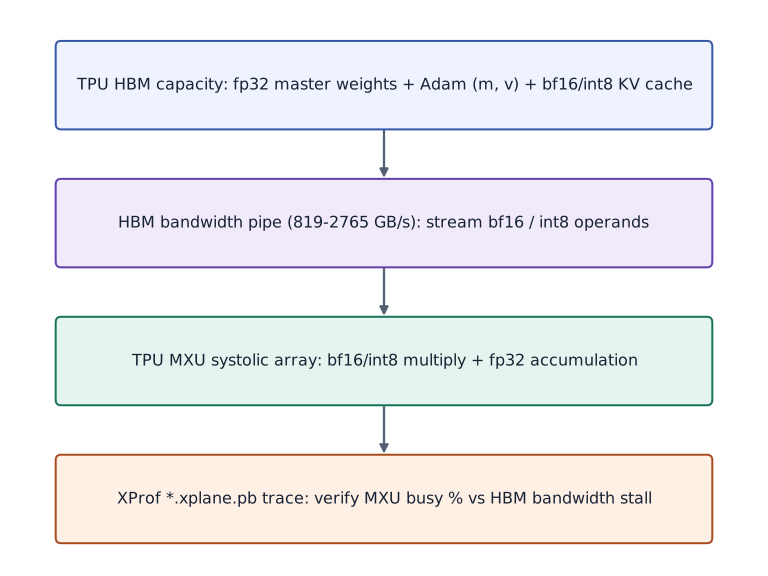
Read top to bottom: HBM stores master fp32 parameters and Adam moments (m, v) alongside bf16 activations and KV cache; operands are cast to bf16 (or int8) to stream across the HBM bandwidth bottleneck into the MXU, which accumulates dot products in fp32 before writing updated state back.
1. Compare TPU generations (v5e, v5p, v6e, Ironwood) and calculate HBM budgets
Published per-chip TPU specifications determine which slice fits your model:
- TPU v5e (
v5litepod): GiB HBM per chip, GB/s HBM bandwidth, BF16 TFLOP/s (240.5FLOP/byte ridge point). Single-host slices:1,4(64GiB), or8(128GiB) chips. - TPU v5p: GiB HBM per chip, GB/s HBM bandwidth, BF16 TFLOP/s (
166.0FLOP/byte ridge point). - TPU v6e (Trillium): GiB HBM per chip, GB/s HBM bandwidth, BF16 TFLOP/s (
573.8FLOP/byte ridge point). Single-host slices:1,4(128GiB), or8(256GiB) chips. - TPU Ironwood (7th-gen scale): GiB HBM per chip, GB/s HBM bandwidth.
Run the TPU generation & HBM budgeting verifier on your TPU VM or workstation
# Run the TPU generation & HBM budgeting verifier on your TPU VM or workstation
gcloud compute tpus tpu-vm scp public/exercises/tpu-03.py "$TPU_NAME":~/jax-tpu-lab/ --zone="$ZONE"
gcloud compute tpus tpu-vm ssh "$TPU_NAME" --zone="$ZONE" \
  --command="JAX_PLATFORMS=tpu ~/jax-tpu-lab/.venv/bin/python ~/jax-tpu-lab/tpu-03.py"
Expected:
Prints the TPU ridge points (FLOP/byte) and the 7B and 1.5B training + KV-cache HBM budgets in GiB.
Calculated TPU memory capacity and theoretical ridge point
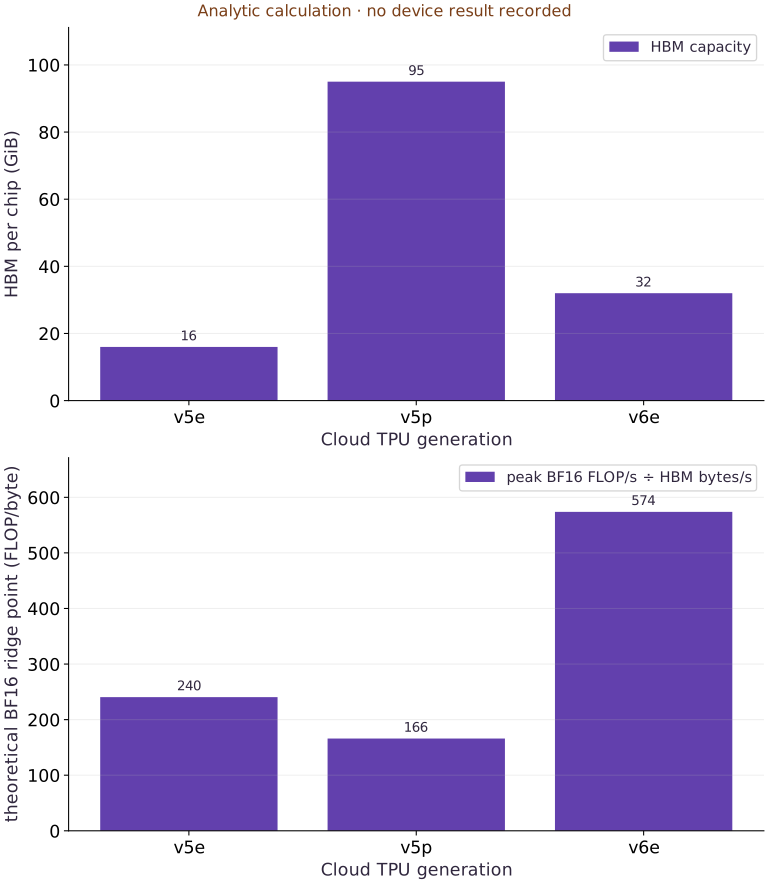
Predict before looking: How do per-chip HBM capacity (GiB) and the compute-to-memory ridge point (FLOP/byte) change across TPU v5e, v5p, and v6e?
Read the figure
Two panels show per-chip HBM capacity in GiB and theoretical BF16 ridge point in FLOP/byte for the same TPU generations. Read the panels independently; their heights are not comparable.
Connect it to the computation
These bars are calculations from published specifications and stated tensor byte assumptions. They are not device measurements or a workload profile.
Open full-size figureDownload data and provenance
This figure is a calculated expectation. It does not report device execution.
Where to put & run this code: Work in phases/21-tpu-systems/01-tpu-generations-and-hbm-memory-budgeting/code/main.py (or downloaded exercises/tpu-03.py / exercises/tpu-03.ipynb) and execute from the repository root with python3 phases/21-tpu-systems/01-tpu-generations-and-hbm-memory-budgeting/code/main.py.
1 Define TPU generation specs and compute Roofline ridge points
Create main.py with TPU_SPECS and calculate ridge_flops_per_byte for v5e, v5p, and v6e.
# Step 1 — Define TPU generation specs and compute Roofline ridge points: Dividing peak BF16 FLOP/s by HBM bandwidth (B/s) gives the minimum...
# Import jax for this computation.
import jax
import jax.numpy as jnp
import numpy as np

# Initialize list `TPU_SPECS` for the stage values.
TPU_SPECS = [
    {"gen": "v5e", "hbm_gib": 16.0, "bw_gbs": 819.0, "bf16_tflops": 197.0},
    {"gen": "v5p", "hbm_gib": 95.0, "bw_gbs": 2765.0, "bf16_tflops": 459.0},
    {"gen": "v6e", "hbm_gib": 32.0, "bw_gbs": 1600.0, "bf16_tflops": 918.0},
]
# Iterate over `s` to step through the computation:
for s in TPU_SPECS:
    # Run `round` to compute `s['ridge_flops_per_byte']`.
    s["ridge_flops_per_byte"] = round((s["bf16_tflops"] * 1e12) / (s["bw_gbs"] * 1e9), 1)
Code building blocks in this step
bandwidth(...)— Callbandwidthwith your updated parameters or inputs from this lesson's workspace.round(...)— Callroundwith your updated parameters or inputs from this lesson's workspace.
Dividing peak BF16 FLOP/s by HBM bandwidth (B/s) gives the minimum FLOPs per byte needed to saturate the MXU.
2 Estimate training-state and KV-cache HBM budgets across precisions
Append estimate_memory_gib and compare 7B vs 1.5B model memory footprints.
# Step 2 — Estimate training-state and KV-cache HBM budgets across precisions: Computing both training state and KV-cache GiB upfront prevents...
def estimate_memory_gib(params_billions, kv_tokens, layers=32, kv_heads=8, head_dim=128):
    # Compute `n_params` from `params_billions * 1e9`
    n_params = params_billions * 1e9
    # Compute `kv_elements` from `2.0 * layers * kv_tokens * kv_heads * head_dim`
    kv_elements = 2.0 * layers * kv_tokens * kv_heads * head_dim
    # Evaluate `1024 ** 3` and convert the result into Python scalar/collection `gib`.
    gib = float(1024 ** 3)
    # Return `{'fp32_train_state_gib': round(n_params * 16.0 / gib, 3), 'mixed_bf16_train_state_gib': round(n_params * 18.0 / gib, 3), 'kv_fp32_gib': round(kv_elements * 4.0 / gib, 3), 'kv_bf16_gib': round(kv_elements * 2.0 / gib, 3), 'kv_int8_gib': round(kv_elements * 1.0 / gib, 3)}` to the caller.
    return {
        "fp32_train_state_gib": round((n_params * 16.0) / gib, 3),
        "mixed_bf16_train_state_gib": round((n_params * 18.0) / gib, 3),
        "kv_fp32_gib": round((kv_elements * 4.0) / gib, 3),
        "kv_bf16_gib": round((kv_elements * 2.0) / gib, 3),
        "kv_int8_gib": round((kv_elements * 1.0) / gib, 3),
    }


# Run `estimate_memory_gib` to compute `budget_7b`.
budget_7b = estimate_memory_gib(params_billions=7.0, kv_tokens=8192)
# Run `estimate_memory_gib` to compute `budget_1p5b`.
budget_1p5b = estimate_memory_gib(params_billions=1.5, kv_tokens=4096)
# Assert that `budget_7b["mixed_bf16_train_state_gib"] > 64.0 and budget_7b["mixed_bf16_train_state_gib"] <`.
assert budget_7b["mixed_bf16_train_state_gib"] > 64.0 and budget_7b["mixed_bf16_train_state_gib"] < 128.0
# Assert invariant `budget_1p5b["mixed_bf16_train_state_gib"] < 64.0` holds
assert budget_1p5b["mixed_bf16_train_state_gib"] < 64.0
# Print the observed values to compare against the expected result.
print("TPU ridge points (FLOP/byte):", {s["gen"]: s["ridge_flops_per_byte"] for s in TPU_SPECS})
# Print diagnostic summary of the computed outputs.
print("7B memory budget (GiB):", budget_7b)
# Print diagnostic summary of the computed outputs.
print("1.5B memory budget (GiB):", budget_1p5b)
Code building blocks in this step
estimate_memory_gib(...)— Callestimate_memory_gibwith your updated parameters or inputs from this lesson's workspace.round(...)— Callroundwith your updated parameters or inputs from this lesson's workspace.assert condition— Verify that the observed output shape, status, or numerical value satisfies the contract.
Computing the named-tensor ledger identifies whether a topology has enough total HBM, but usable capacity must also reserve room for activations, communication buffers, temporary copies and allocator overhead. The 7B estimate exceeds the 80%-usable budget of a 4-chip v6e slice; it is an estimate, not a fit guarantee.
3 Step 3: Verify invariants on the completed state
Run the final shape and numerical assertions to confirm the state built in Steps 1 and 2.
assert budget_7b["mixed_bf16_train_state_gib"] > 64.0 and budget_7b["mixed_bf16_train_state_gib"] < 128.0
assert budget_1p5b["mixed_bf16_train_state_gib"] < 64.0
Code building blocks in this step
assert condition— Verify that the observed output shape, status, or numerical value satisfies the contract.
Checking these invariants confirms the computation is ready for the full worked experiment.
View the cumulative build in main.py
These blocks append in order to the same file.
# Step 1 — Define TPU generation specs and compute Roofline ridge points: Dividing peak BF16 FLOP/s by HBM bandwidth (B/s) gives the minimum...
# Import jax for this computation.
import jax
import jax.numpy as jnp
import numpy as np

# Initialize list `TPU_SPECS` for the stage values.
TPU_SPECS = [
    {"gen": "v5e", "hbm_gib": 16.0, "bw_gbs": 819.0, "bf16_tflops": 197.0},
    {"gen": "v5p", "hbm_gib": 95.0, "bw_gbs": 2765.0, "bf16_tflops": 459.0},
    {"gen": "v6e", "hbm_gib": 32.0, "bw_gbs": 1600.0, "bf16_tflops": 918.0},
]
# Iterate over `s` to step through the computation:
for s in TPU_SPECS:
    # Run `round` to compute `s['ridge_flops_per_byte']`.
    s["ridge_flops_per_byte"] = round((s["bf16_tflops"] * 1e12) / (s["bw_gbs"] * 1e9), 1)

# Step 2 — Estimate training-state and KV-cache HBM budgets across precisions: Computing both training state and KV-cache GiB upfront prevents...
def estimate_memory_gib(params_billions, kv_tokens, layers=32, kv_heads=8, head_dim=128):
    # Compute `n_params` from `params_billions * 1e9`
    n_params = params_billions * 1e9
    # Compute `kv_elements` from `2.0 * layers * kv_tokens * kv_heads * head_dim`
    kv_elements = 2.0 * layers * kv_tokens * kv_heads * head_dim
    # Evaluate `1024 ** 3` and convert the result into Python scalar/collection `gib`.
    gib = float(1024 ** 3)
    # Return `{'fp32_train_state_gib': round(n_params * 16.0 / gib, 3), 'mixed_bf16_train_state_gib': round(n_params * 18.0 / gib, 3), 'kv_fp32_gib': round(kv_elements * 4.0 / gib, 3), 'kv_bf16_gib': round(kv_elements * 2.0 / gib, 3), 'kv_int8_gib': round(kv_elements * 1.0 / gib, 3)}` to the caller.
    return {
        "fp32_train_state_gib": round((n_params * 16.0) / gib, 3),
        "mixed_bf16_train_state_gib": round((n_params * 18.0) / gib, 3),
        "kv_fp32_gib": round((kv_elements * 4.0) / gib, 3),
        "kv_bf16_gib": round((kv_elements * 2.0) / gib, 3),
        "kv_int8_gib": round((kv_elements * 1.0) / gib, 3),
    }


# Run `estimate_memory_gib` to compute `budget_7b`.
budget_7b = estimate_memory_gib(params_billions=7.0, kv_tokens=8192)
# Run `estimate_memory_gib` to compute `budget_1p5b`.
budget_1p5b = estimate_memory_gib(params_billions=1.5, kv_tokens=4096)
# Assert that `budget_7b["mixed_bf16_train_state_gib"] > 64.0 and budget_7b["mixed_bf16_train_state_gib"] <`.
assert budget_7b["mixed_bf16_train_state_gib"] > 64.0 and budget_7b["mixed_bf16_train_state_gib"] < 128.0
# Assert invariant `budget_1p5b["mixed_bf16_train_state_gib"] < 64.0` holds
assert budget_1p5b["mixed_bf16_train_state_gib"] < 64.0
# Print the observed values to compare against the expected result.
print("TPU ridge points (FLOP/byte):", {s["gen"]: s["ridge_flops_per_byte"] for s in TPU_SPECS})
# Print diagnostic summary of the computed outputs.
print("7B memory budget (GiB):", budget_7b)
# Print diagnostic summary of the computed outputs.
print("1.5B memory budget (GiB):", budget_1p5b)

assert budget_7b["mixed_bf16_train_state_gib"] > 64.0 and budget_7b["mixed_bf16_train_state_gib"] < 128.0
assert budget_1p5b["mixed_bf16_train_state_gib"] < 64.0
Run the example
python3 phases/21-tpu-systems/01-tpu-generations-and-hbm-memory-budgeting/code/main.pyAbout this command
This shortcut uses an activated macOS/Linux course environment in the repository folder. For Windows, use the explicit interpreter command in “Setup help” above. The script includes worked examples and reference solutions.
Inspect the complete assembled example
# Step 1 — Define TPU generation specs and compute Roofline ridge points: Dividing peak BF16 FLOP/s by HBM bandwidth (B/s) gives the minimum...
# Import jax for this computation.
import jax
import jax.numpy as jnp
import numpy as np

# Initialize list `TPU_SPECS` for the stage values.
TPU_SPECS = [
    {"gen": "v5e", "hbm_gib": 16.0, "bw_gbs": 819.0, "bf16_tflops": 197.0},
    {"gen": "v5p", "hbm_gib": 95.0, "bw_gbs": 2765.0, "bf16_tflops": 459.0},
    {"gen": "v6e", "hbm_gib": 32.0, "bw_gbs": 1600.0, "bf16_tflops": 918.0},
]
# Iterate over `s` to step through the computation:
for s in TPU_SPECS:
    # Run `round` to compute `s['ridge_flops_per_byte']`.
    s["ridge_flops_per_byte"] = round((s["bf16_tflops"] * 1e12) / (s["bw_gbs"] * 1e9), 1)


# Step 2 — Estimate training-state and KV-cache HBM budgets across precisions: Computing both training state and KV-cache GiB upfront prevents...
def estimate_memory_gib(params_billions, kv_tokens, layers=32, kv_heads=8, head_dim=128):
    # Compute `n_params` from `params_billions * 1e9`
    n_params = params_billions * 1e9
    # Compute `kv_elements` from `2.0 * layers * kv_tokens * kv_heads * head_dim`
    kv_elements = 2.0 * layers * kv_tokens * kv_heads * head_dim
    # Evaluate `1024 ** 3` and convert the result into Python scalar/collection `gib`.
    gib = float(1024 ** 3)
    # Return `{'fp32_train_state_gib': round(n_params * 16.0 / gib, 3), 'mixed_bf16_train_state_gib': round(n_params * 18.0 / gib, 3), 'kv_fp32_gib': round(kv_elements * 4.0 / gib, 3), 'kv_bf16_gib': round(kv_elements * 2.0 / gib, 3), 'kv_int8_gib': round(kv_elements * 1.0 / gib, 3)}` to the caller.
    return {
        "fp32_train_state_gib": round((n_params * 16.0) / gib, 3),
        "mixed_bf16_train_state_gib": round((n_params * 18.0) / gib, 3),
        "kv_fp32_gib": round((kv_elements * 4.0) / gib, 3),
        "kv_bf16_gib": round((kv_elements * 2.0) / gib, 3),
        "kv_int8_gib": round((kv_elements * 1.0) / gib, 3),
    }


# Run `estimate_memory_gib` to compute `budget_7b`.
budget_7b = estimate_memory_gib(params_billions=7.0, kv_tokens=8192)
# Run `estimate_memory_gib` to compute `budget_1p5b`.
budget_1p5b = estimate_memory_gib(params_billions=1.5, kv_tokens=4096)
# Assert that `budget_7b["mixed_bf16_train_state_gib"] > 64.0 and budget_7b["mixed_bf16_train_state_gib"] <`.
assert budget_7b["mixed_bf16_train_state_gib"] > 64.0 and budget_7b["mixed_bf16_train_state_gib"] < 128.0
# Assert invariant `budget_1p5b["mixed_bf16_train_state_gib"] < 64.0` holds
assert budget_1p5b["mixed_bf16_train_state_gib"] < 64.0
# Print the observed values to compare against the expected result.
print("TPU ridge points (FLOP/byte):", {s["gen"]: s["ridge_flops_per_byte"] for s in TPU_SPECS})
# Print diagnostic summary of the computed outputs.
print("7B memory budget (GiB):", budget_7b)
# Print diagnostic summary of the computed outputs.
print("1.5B memory budget (GiB):", budget_1p5b)
Expected result: Prints the ridge-point FLOP/byte ratios for v5e (240.5), v5p (166.0), and v6e (573.8) along with the 7B and 1.5B memory budgets in GiB.
Recorded reference execution
Reference output captured from executing the complete lesson script (code/main.py) and its assertions in the course CPU environment.
TPU ridge points (FLOP/byte): {'v5e': 240.5, 'v5p': 166.0, 'v6e': 573.8}
7B memory budget (GiB): {'fp32_train_state_gib': 104.308, 'mixed_bf16_train_state_gib': 117.347, 'kv_fp32_gib': 2.0, 'kv_bf16_gib': 1.0, 'kv_int8_gib': 0.5}
1.5B memory budget (GiB): {'fp32_train_state_gib': 22.352, 'mixed_bf16_train_state_gib': 25.146, 'kv_fp32_gib': 1.0, 'kv_bf16_gib': 0.5, 'kv_int8_gib': 0.25}
KV cache GiB (FP32 / BF16 / INT8): 2.0 1.0 0.5
7B mixed train state GiB: 117.347 Minimum chips at 80% usable HBM: 10
1.5B state plus BF16 KV cache (GiB): 25.646
Arithmetic intensity: 341.3333333333333 FLOPs/byte
v6e-4 80% usable GiB: 102.4 Fits 7B state estimate: False
PASS: tpu-03
Download execution record · The notebook includes executed cells and figure outputs. Compare your run with these values; timings depend on the machine.
Compare KV-cache memory across FP32, BF16, and INT8
# Experiment — Compare KV-cache memory across FP32, BF16, and INT8: Halving bytes per element halves both the HBM capacity consumed...
# Assert that `np.isclose(budget_7b["kv_fp32_gib"], 2.0 * budget_7b["kv_bf16_gib"])`.
assert np.isclose(budget_7b["kv_fp32_gib"], 2.0 * budget_7b["kv_bf16_gib"])
# Assert that `np.isclose(budget_7b["kv_bf16_gib"], 2.0 * budget_7b["kv_int8_gib"])`.
assert np.isclose(budget_7b["kv_bf16_gib"], 2.0 * budget_7b["kv_int8_gib"])
# Print the observed values to compare against the expected result.
print("KV cache GiB (FP32 / BF16 / INT8):", budget_7b["kv_fp32_gib"], budget_7b["kv_bf16_gib"], budget_7b["kv_int8_gib"])
Expected: For 8192 tokens, KV cache drops from 2.0 GiB (FP32) to 1.0 GiB (BF16) and 0.5 GiB (INT8).
Halving bytes per element halves both the HBM capacity consumed by the KV cache and the HBM bytes read on every decode step.
Verify how many v5e chips are needed to hold a 7B mixed-precision training state
v5e_chip_gib = 16.0
usable_fraction = 0.8
min_v5e_chips = int(np.ceil(budget_7b["mixed_bf16_train_state_gib"] / (v5e_chip_gib * usable_fraction)))
print("7B mixed train state GiB:", budget_7b["mixed_bf16_train_state_gib"], "Minimum chips at 80% usable HBM:", min_v5e_chips)
assert min_v5e_chips == 10
assert min_v5e_chips > 8 and min_v5e_chips <= 16
Expected: The 18-byte-per-parameter ledger estimates 117.347 GiB. At 16 GiB per chip and 80% usable HBM, at least 10 chips are needed; the listed 16-chip v5litepod-16 is the first listed topology large enough.
The estimate includes 2-byte BF16 weights, 4-byte FP32 master weights, 4-byte gradients and two 4-byte FP32 Adam moments, for 18 bytes per parameter. This is a named-tensor ledger, not a complete fit guarantee: activations, communication buffers, temporary copies and allocator overhead need additional headroom.
Make it yours
Where to put your code: Append your solution at the bottom of phases/21-tpu-systems/01-tpu-generations-and-hbm-memory-budgeting/code/main.py (or inside the Make it yours cell of exercises/tpu-03.ipynb) and run python3 phases/21-tpu-systems/01-tpu-generations-and-hbm-memory-budgeting/code/main.py to verify your prediction before opening the reference solution.
Compute estimate_memory_gib for a 1.5B parameter model with 4096 KV tokens and verify that its mixed-precision training-state estimate is below 30 GiB and that state plus BF16 KV cache is below 80% of a single-host v5litepod-4 (64 GiB total HBM).
Show a writing guide and starter scaffold
How to write this exercise code: step-by-step recipe & starter scaffold
1. Key functions & syntax to use:
estimate_memory_gib(...)— Callestimate_memory_gibwith your updated parameters or inputs from this lesson's workspace.cache(...)— Callcachewith your updated parameters or inputs from this lesson's workspace.assert condition— Verify that the observed output shape, status, or numerical value satisfies the contract.
2. Step-by-step implementation plan:
- Set up the changed input or configuration parameters requested in the prompt.
- Run the target function or transformation and assert that the output matches your prediction.
budget_check = estimate_memory_gib(...)  # TODO: compute budget_check
usable_hbm_gib = ...  # TODO: compute usable_hbm_gib
state_and_kv_gib = ...  # TODO: compute state_and_kv_gib
print("1.5B state plus BF16 KV cache (GiB):", state_and_kv_gib)
assert budget_check["mixed_bf16_train_state_gib"]  # TODO: complete assertion check
assert state_and_kv_gib  # TODO: complete assertion check
Reveal the reference solution
budget_check = estimate_memory_gib(params_billions=1.5, kv_tokens=4096)
usable_hbm_gib = 4 * 16.0 * 0.8
state_and_kv_gib = budget_check["mixed_bf16_train_state_gib"] + budget_check["kv_bf16_gib"]
print("1.5B state plus BF16 KV cache (GiB):", state_and_kv_gib)
assert budget_check["mixed_bf16_train_state_gib"] < 30.0
assert state_and_kv_gib < usable_hbm_gib
Compare arithmetic intensity against the TPU v5e and v6e ridge points
Foundations
Compute the arithmetic intensity (FLOPs/byte) of a bfloat16 square matrix multiply of size (2 * N^3 FLOPs divided by 3 * 2 * N^2 bytes) and check whether it exceeds the v5e ridge point.
Show a writing guide and starter scaffold
How to write this practice solution: step-by-step recipe & starter scaffold
1. Key functions & syntax to use:
assert condition— Verify that the observed output shape, status, or numerical value satisfies the contract.
2. Step-by-step implementation plan:
- Set up the changed input or configuration parameters requested in the prompt.
- Run the target function or transformation and assert that the output matches your prediction.
n = ...  # TODO: compute n
intensity = ...  # TODO: compute intensity
print("Arithmetic intensity:", intensity, "FLOPs/byte")
assert intensity  # TODO: complete assertion check
assert intensity  # TODO: complete assertion check
Show a hint
For two N x N BF16 inputs and one BF16 output, arithmetic intensity simplifies to N / 3.0 FLOPs/byte.
Reveal reference solution and reasoning
n = 1024
intensity = (2 * n**3) / (3 * 2 * n**2)
print("Arithmetic intensity:", intensity, "FLOPs/byte")
assert intensity == n / 3.0
assert intensity > TPU_SPECS[0]["ridge_flops_per_byte"]
The matrix multiply performs about 341.3 FLOPs per byte. That exceeds the v5e ridge point of 240.5 FLOPs/byte, so this idealized operation is compute-bound by the Roofline comparison. Actual kernels may have different data reuse and overhead.
Size a Trillium v6e-4 slice for a 7B training state
Transfer / diagnosis
Compute the total HBM (in GiB) of a 4-chip v6e-4 slice (32 GiB/chip) and check whether budget_7b['mixed_bf16_train_state_gib'] fits inside 80% of that slice's HBM.
Show a writing guide and starter scaffold
How to write this practice solution: step-by-step recipe & starter scaffold
1. Key functions & syntax to use:
assert condition— Verify that the observed output shape, status, or numerical value satisfies the contract.
2. Step-by-step implementation plan:
- Set up the changed input or configuration parameters requested in the prompt.
- Run the target function or transformation and assert that the output matches your prediction.
v6e4_usable_gib = ...  # TODO: compute v6e4_usable_gib
fits_v6e4 = ...  # TODO: compute fits_v6e4
print("v6e-4 80% usable GiB:", v6e4_usable_gib, "Fits 7B state estimate:", fits_v6e4)
assert fits_v6e4 is False  # TODO: complete assertion check
Show a hint
Compare budget_7b['mixed_bf16_train_state_gib'] with 4 * 32.0 * 0.8.
Reveal reference solution and reasoning
v6e4_usable_gib = 4 * 32.0 * 0.8
fits_v6e4 = budget_7b["mixed_bf16_train_state_gib"] <= v6e4_usable_gib
print("v6e-4 80% usable GiB:", v6e4_usable_gib, "Fits 7B state estimate:", fits_v6e4)
assert fits_v6e4 is False
A 4-chip v6e slice has 128 GiB total HBM and 102.4 GiB at an 80% budget. The 117.347 GiB named-tensor estimate exceeds that budget, before activations and other excluded allocations.
Diagnose the result
If your TPU job fails with RESOURCE_EXHAUSTED: Out of memory while trying to allocate..., compare your parameter + optimizer + activation + KV-cache byte estimate against per-chip HBM (16 GiB on v5e, 32 GiB on v6e) and shard the state across chips (NamedSharding / FSDP) or reduce microbatch size.
Carry forward
- Size your TPU slice (
v5e,v5p,v6e) from explicit HBM byte budgets for training state and KV caches before launching. - Compare your workload's FLOPs/byte against the chip's ridge point to know whether fusion/quantization (bandwidth) or MXU tiling (compute) will speed it up.
Keep your evidence
Keep the TPU ridge-point table, 7B and 1.5B training/KV-cache HBM budgets, and minimum chip count calculation at an 80% HBM ceiling.
Save your modified code, its output, and an explanation of your prediction. Checkpoint answers and exercise evidence are tracked separately.
Saved in this browser. Export or back up your portfolio anytime in My learning.
Verified on local CPU. Stage to a Cloud TPU VM via Cloud TPU setup to record accelerator execution receipts (TODO: add automated Cloud TPU CI execution receipts).