Deep Convolutional GAN (DCGAN)
Pit a forger against a detective: two networks train against each other until the fakes become indistinguishable from real digits.
- Variational Autoencoder (VAE) — the
nnx.ConvTransposedecoder and MNIST scaling this guide builds on. - Custom Training Loops — GANs need two optimizers and hand-written alternating updates.
- The minimax game behind GANs and how a generator and discriminator co-evolve.
- The non-saturating generator loss, and why the naive minimax objective stalls early.
- Driving two independent
nnx.Optimizers — one per network — with separate@nnx.jitsteps. - Applying
nnx.SpectralNormto the discriminator to bound its Lipschitz constant and stabilize training. - What mode collapse looks like and how to recognize healthy adversarial losses.
The complete, runnable script for this guide lives at
examples/generative/dcgan.py.
The adversarial idea
A VAE learns an explicit density by maximizing a likelihood bound. A generative adversarial network takes the opposite route: it learns the data distribution implicitly by playing a game.
Two networks compete:
- The generator maps a random latent vector to a fake image . It never sees real data directly — it only learns from the discriminator's feedback.
- The discriminator takes an image and outputs a single logit: high for real, low for fake.
is trained to tell real from fake; is trained to fool . As gets sharper, is pushed to produce ever more realistic samples, until — at the theoretical optimum — the fakes match the real distribution and can only guess.
The math: a minimax game
Goodfellow et al. framed this as a two-player minimax game with value function
The discriminator maximizes this: it wants on real data and on fakes. The generator minimizes the second term: it wants .
The non-saturating trick
In practice, minimizing directly is a bad idea. Early in training the discriminator easily rejects the generator's garbage, so — exactly where is flat, giving the generator almost no gradient. The generator starves precisely when it needs to learn the most.
The fix is the non-saturating loss: instead of minimizing , the generator maximizes — equivalently, it minimizes the binary cross-entropy of the fake logits against the label 1:
Both are just sigmoid binary cross-entropy with the right target labels — for "should look real", for "should look fake" — which is numerically stable when computed from logits.
Building the generator
The generator mirrors a VAE decoder: project the latent vector into a small
spatial grid, then upsample with strided nnx.ConvTranspose layers. The final
nnx.tanh puts pixels in , so real images are scaled to too.
from flax import nnx

class Generator(nnx.Module):
    def __init__(self, z_dim: int = 64, base: int = 16, *, rngs: nnx.Rngs):
        self.z_dim = z_dim
        self.base = base
        self.fc = nnx.Linear(z_dim, base * 2 * 7 * 7, rngs=rngs)
        self.deconv1 = nnx.ConvTranspose(base * 2, base, kernel_size=(3, 3),
                                         strides=(2, 2), padding='SAME', rngs=rngs)  # 7 -> 14
        self.deconv2 = nnx.ConvTranspose(base, 1, kernel_size=(3, 3),
                                         strides=(2, 2), padding='SAME', rngs=rngs)  # 14 -> 28

    def __call__(self, z):
        h = self.fc(z)
        h = h.reshape(z.shape[0], 7, 7, self.base * 2)
        h = nnx.relu(self.deconv1(h))
        h = self.deconv2(h)
        return nnx.tanh(h)   # outputs in [-1, 1]
Building the discriminator (with SpectralNorm)
The discriminator is a plain strided-conv classifier, but every conv/linear
kernel is wrapped in nnx.SpectralNorm. Spectral normalization divides each
weight matrix by its largest singular value (estimated with power iteration),
which bounds the network's Lipschitz constant. That keeps the discriminator from
becoming arbitrarily confident — a runaway produces exploding gradients and
collapses the game — so the two players stay in balance.
class Discriminator(nnx.Module):
    def __init__(self, base: int = 16, *, rngs: nnx.Rngs):
        self.conv1 = nnx.SpectralNorm(
            nnx.Conv(1, base, kernel_size=(3, 3), strides=(2, 2),
                     padding='SAME', rngs=rngs), rngs=rngs)          # 28 -> 14
        self.conv2 = nnx.SpectralNorm(
            nnx.Conv(base, base * 2, kernel_size=(3, 3), strides=(2, 2),
                     padding='SAME', rngs=rngs), rngs=rngs)          # 14 -> 7
        self.fc = nnx.SpectralNorm(
            nnx.Linear(base * 2 * 7 * 7, 1, rngs=rngs), rngs=rngs)

    def __call__(self, x, train: bool = False):
        # update_stats only when we are actually training the discriminator.
        x = nnx.leaky_relu(self.conv1(x, update_stats=train), negative_slope=0.2)
        x = nnx.leaky_relu(self.conv2(x, update_stats=train), negative_slope=0.2)
        x = x.reshape(x.shape[0], -1)
        return self.fc(x, update_stats=train)   # (B, 1) logit
nnx.SpectralNorm keeps its power-iteration estimate (u, sigma) as
BatchStat variables, not Params — so they are not differentiated by
wrt=nnx.Param, and we only refresh them (update_stats=True) while the
discriminator is the one being optimized.
Two optimizers
A GAN has two sets of parameters updated by two different objectives, so it needs two optimizers. We use Adam with a low learning rate and — the DCGAN recipe that damps the momentum term Adam would otherwise carry across the adversarial oscillation.
import optax

rngs = nnx.Rngs(0)
gen = Generator(z_dim=64, rngs=rngs)
disc = Discriminator(rngs=rngs)

opt_g = nnx.Optimizer(gen, optax.adam(2e-4, b1=0.5), wrt=nnx.Param)
opt_d = nnx.Optimizer(disc, optax.adam(2e-4, b1=0.5), wrt=nnx.Param)
The two training steps
Each network gets its own @nnx.jit step. The discriminator step pushes real
logits up and fake logits down; the generator step uses the non-saturating loss,
labeling its own fakes as real.
The shared bce_loss(logits, targets) is exactly sigmoid binary cross-entropy
computed from logits, so we feed it target tensors of ones or zeros.
from shared.training_utils import bce_loss

@nnx.jit
def d_step(gen, disc, opt_d, real, z):
    fake = gen(z)   # generator is fixed here (not in the grad set)

    def loss_fn(disc):
        real_logits = disc(real, train=True)
        fake_logits = disc(fake, train=True)
        loss = (bce_loss(real_logits, jnp.ones_like(real_logits))
                + bce_loss(fake_logits, jnp.zeros_like(fake_logits)))
        return loss, (real_logits, fake_logits)

    (loss, aux), grads = nnx.value_and_grad(loss_fn, has_aux=True)(disc)
    opt_d.update(disc, grads)
    return loss, aux


@nnx.jit
def g_step(gen, disc, opt_g, z):
    def loss_fn(gen, disc):
        fake = gen(z)
        fake_logits = disc(fake, train=False)   # discriminator frozen
        loss = bce_loss(fake_logits, jnp.ones_like(fake_logits))
        return loss, fake_logits

    # Pass disc as a (non-differentiated) argument so its spectral-norm layers
    # stay at the transform's trace level; value_and_grad differentiates
    # argnums=0 (gen) only.
    (loss, aux), grads = nnx.value_and_grad(loss_fn, has_aux=True)(gen, disc)
    opt_g.update(gen, grads)
    return loss, aux
Two subtleties worth calling out:
- In
d_step, the fake batch is computed outsideloss_fn, so the generator is treated as a constant — no gradients leak into while training . - In
g_step, we differentiate w.r.t.genonly, but we still passdiscintovalue_and_grad.nnx.SpectralNormmutates its layer's weights in place on every call; passingdiscas a transform argument keeps that mutation at the correct JAX trace level and avoids aTraceContextError.
The training loop just alternates them, one discriminator update then one generator update per batch:
d_loss, _ = d_step(gen, disc, opt_d, real, sample_z(kd, batch, z_dim))
g_loss, _ = g_step(gen, disc, opt_g, sample_z(kg, batch, z_dim))
Results / What to Expect
Running the script on CPU with the synthetic defaults produces output like:
$ python generative/dcgan.py
epoch 0: d_loss=1.2278  g_loss=0.6531
epoch 1: d_loss=1.0854  g_loss=0.6295
After training on real MNIST (SYNTHETIC=0, 20 epochs), the generator turns
random noise into recognizable digits:
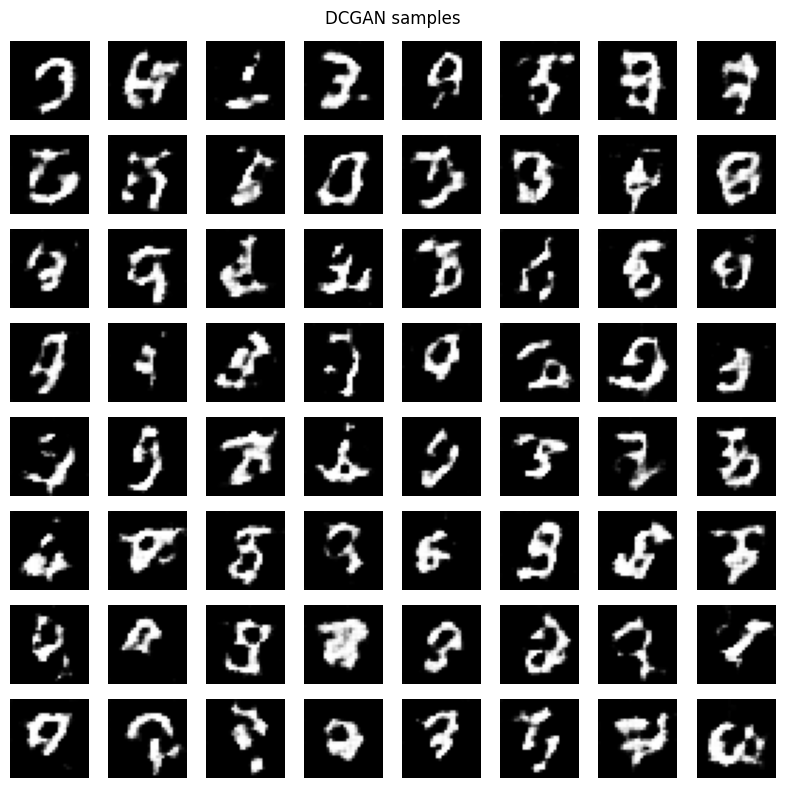
Each tile is G(z) for a fresh random z — the generator never saw these; it
learned the manifold of digit shapes from the adversarial signal alone.
Do not expect the losses to fall monotonically — that is the wrong mental model for a GAN. Because and optimize opposing objectives, the losses oscillate: when the generator improves, the discriminator's job gets harder (its loss rises), and vice versa. A healthy run keeps both losses finite and bounded and hovering in a stable range, with roughly around and near at the theoretical equilibrium where .
What you should watch for instead: NaN/inf losses (the discriminator
overpowered the generator — spectral norm is your first defense), or a
that climbs to the sky while crashes to zero (the
discriminator won outright and the generator's gradient vanished).
Set SYNTHETIC=0 to train on real MNIST via tfds, and tune EPOCHS / BATCH
through environment variables.
Common Pitfalls
-
❌ Using the naive minimax generator loss, minimizing
log(1 - D(G(z))). ✅ Use the non-saturating loss — BCE of the fake logits against label1— so the generator gets strong gradients even while its samples are poor. -
❌ Feeding raw images to a discriminator whose generator ends in
tanh. ✅ Scale real images to (e.g.img * 2 - 1) so real and fake share the same range. -
❌ Sharing one optimizer, or letting the generator step leak gradients into the discriminator. ✅ Keep two
nnx.Optimizers; compute the fake batch outsideloss_fnind_step, and differentiateg_stepw.r.t. the generator only. -
❌ Applying
sigmoidinside the discriminator and then using BCE (double sigmoid, unstable). ✅ Return raw logits from the discriminator and use sigmoid-BCE from logits. -
❌ An unconstrained discriminator that grows arbitrarily confident, exploding the generator's gradients (classic mode collapse, where emits one repeated sample). ✅ Wrap the discriminator's conv/linear kernels in
nnx.SpectralNormto bound its Lipschitz constant and keep the game balanced.
Next steps
- Diffusion Models (DDPM) — swap the adversarial game for iterative denoising, trading training instability for many sampling steps.
- Variational Autoencoder (VAE) — the explicit, likelihood-based alternative to the implicit GAN objective.
Complete Example
The full, verified script is at
examples/generative/dcgan.py
— a CPU-friendly DCGAN with synthetic-data defaults, spectral-normalized
discriminator, two optimizers, and alternating @nnx.jit train steps.
References
- Goodfellow et al., Generative Adversarial Networks (2014). arXiv:1406.2661
- Radford, Metz & Chintala, Unsupervised Representation Learning with Deep Convolutional GANs (DCGAN) (2015). arXiv:1511.06434
- Miyato et al., Spectral Normalization for Generative Adversarial Networks (2018). arXiv:1802.05957
- Arjovsky, Chintala & Bottou, Wasserstein GAN (2017). arXiv:1701.07875