Variational Autoencoder (VAE)
Turn an autoencoder's bottleneck into a probability distribution you can sample from, and generate brand-new digits.
- Autoencoders — the encoder/decoder and
nnx.ConvTransposeupsampling this guide reuses. - Understanding State & RNGs — why NNX makes randomness explicit.
- Why a plain autoencoder's latent space can't be sampled, and how a VAE fixes it.
- The ELBO objective: a reconstruction term plus a KL regularizer, in closed form.
- The reparameterization trick that lets gradients flow through a random sample.
- How Flax NNX's explicit RNG streams (
paramsvs.noise) cleanly separate weight init from latent sampling. - Reusing shared
ConvEncoder/ConvDecoderbodies for the encoder and decoder.
The complete, runnable script for this guide lives at
examples/generative/vae.py.
From autoencoder to VAE
A plain autoencoder maps each image to a single point in latent space. That's great for reconstruction, but the latent space is full of holes: pick a random point and the decoder produces garbage, because nothing forced nearby points to be meaningful.
A variational autoencoder fixes this by making the encoder output a distribution instead of a point — a Gaussian — and by pulling every one of those Gaussians toward a shared prior . Once training packs the latent space against that prior, you can sample and decode it into a realistic new digit.
The math: the ELBO
We want to maximize the likelihood , but the marginal is intractable. Instead we maximize a tractable lower bound, the evidence lower bound (ELBO):
Two forces balance here:
- The reconstruction term wants the decoder to rebuild from its latent code. For binary/greyscale pixels we model as independent Bernoullis, so is the sigmoid binary cross-entropy between the decoder logits and the input.
- The KL term pulls each encoded Gaussian toward the prior. For two Gaussians it has a closed form (no sampling needed):
We minimize the negative ELBO: loss = recon + kl.
The reparameterization trick
To train with gradient descent we need to backprop through the sampling step — but sampling is not differentiable. The trick is to move the randomness outside the parameters:
Now and are deterministic functions of the weights, is
an external noise source, and gradients flow cleanly into the encoder. In
practice we predict (logvar) for numerical stability and
recover .
Why NNX explicit RNG streams matter
The VAE needs randomness in two unrelated places: initializing weights, and drawing every forward pass. If they shared one stream, changing the model size would shift your sampling noise, and vice versa — a debugging nightmare. Flax NNX makes each stream a named, independent generator:
rngs = nnx.Rngs(params=0, noise=1) # weight init vs. latent sampling
Layers pull their init keys from the params stream, while our __call__ pulls
fresh noise from self.rngs.noise(). The RNG state lives inside the model, so
it is tracked correctly under nnx.jit and advances on every call.
Building the model
Encoder: two heads for μ and log σ²
The encoder reuses the shared ConvEncoder body — two stride-2 conv blocks that
take a (B, 28, 28, 1) image down to (B, 7, 7, 32) — then flattens and splits
into a mu head and a logvar head.
from flax import nnx
from shared.models import ConvEncoder, ConvDecoder

class Encoder(nnx.Module):
    def __init__(self, latent_dim: int, base: int = 16, *, rngs: nnx.Rngs):
        self.body = ConvEncoder(1, base, rngs=rngs)   # (B,28,28,1) -> (B,7,7,base*2)
        feat = base * 2 * 7 * 7                        # 32 * 7 * 7 = 1568
        self.mu = nnx.Linear(feat, latent_dim, rngs=rngs)
        self.logvar = nnx.Linear(feat, latent_dim, rngs=rngs)

    def __call__(self, x):
        h = self.body(x)
        h = h.reshape(h.shape[0], -1)                  # flatten
        return self.mu(h), self.logvar(h)
VAE: reparameterize and decode
The decoder is the shared ConvDecoder, which upsamples a latent vector back to
(B, 28, 28, 1) logits. The VAE module ties encoder, sampling, and
decoder together, and keeps a sample() helper for pure generation.
import jax
import jax.numpy as jnp

class VAE(nnx.Module):
    def __init__(self, latent_dim: int = 16, base: int = 16, *, rngs: nnx.Rngs):
        self.latent_dim = latent_dim
        self.encoder = Encoder(latent_dim, base, rngs=rngs)
        self.decoder = ConvDecoder(latent_dim, base, 1, rngs=rngs)  # -> logits
        self.rngs = rngs

    def __call__(self, x):
        mu, logvar = self.encoder(x)
        std = jnp.exp(0.5 * logvar)
        eps = jax.random.normal(self.rngs.noise(), mu.shape)  # external noise
        z = mu + std * eps                                    # reparameterization
        return self.decoder(z), mu, logvar

    def sample(self, n: int, seed: int = 0):
        z = jax.random.normal(jax.random.key(seed), (n, self.latent_dim))
        return nnx.sigmoid(self.decoder(z))                   # logits -> [0, 1]
Note the decoder returns logits in __call__ (so the loss can use numerically
stable sigmoid-BCE) but sample() applies nnx.sigmoid to produce viewable
pixels in .
The loss and train step
The loss returns the negative ELBO plus its two components as auxiliary data. We
reuse the shared bce_loss (summed sigmoid BCE per image) and kl_divergence
(the closed-form Gaussian KL above).
from shared.training_utils import bce_loss, kl_divergence

def vae_loss(model, x):
    logits, mu, logvar = model(x)
    recon = bce_loss(logits, x)        # -E_q[log p(x|z)]
    kl = kl_divergence(mu, logvar)     # D_KL(q(z|x) || N(0, I))
    return recon + kl, (recon, kl)
The train step follows the standard NNX pattern — nnx.value_and_grad with
has_aux=True, then optimizer.update(model, grads):
@nnx.jit
def train_step(model, optimizer, batch):
    def loss_fn(model):
        return vae_loss(model, batch)

    (loss, (recon, kl)), grads = nnx.value_and_grad(loss_fn, has_aux=True)(model)
    optimizer.update(model, grads)
    return loss, (recon, kl)
Wire it together with two RNG streams and Adam:
import optax

rngs = nnx.Rngs(params=0, noise=1)
model = VAE(latent_dim=16, rngs=rngs)
optimizer = nnx.Optimizer(model, optax.adam(1e-3), wrt=nnx.Param)
Results / What to expect
The script defaults to tiny synthetic data (smooth Gaussian blobs, no downloads) so it runs offline on CPU in seconds. You should see the negative ELBO fall steadily as reconstruction improves while the KL term settles:
$ python generative/vae.py
epoch 1/3  ELBO loss 545.47  (recon 531.13  kl 0.51)
epoch 2/3  ELBO loss 511.34  (recon 492.09  kl 1.00)
epoch 3/3  ELBO loss 450.06  (recon 392.50  kl 20.26)
generated samples: (8, 28, 28, 1)
Early on the KL term sits near zero (the encoder collapses to the prior while it learns to reconstruct); as training continues the latent code starts carrying information and the KL grows — exactly the reconstruction-vs-regularization balance the ELBO trades off.
On real MNIST (SYNTHETIC=0, 80 epochs), decoding the posterior mean back to
pixels recovers the input through the probabilistic latent:
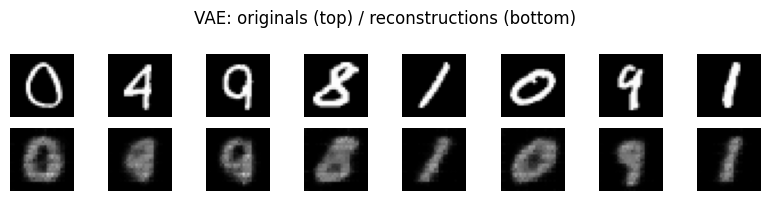
Top: real inputs. Bottom: each digit encoded to (mu, logvar), then decoded
from mu. The reconstructions are soft — a VAE trades sharpness for a smooth,
samplable latent space — but clearly the same digits.
If reconstructions come out as identical grey blobs, the KL term has overpowered
reconstruction and the decoder is ignoring the latent (posterior collapse).
The fix is a β-VAE: down-weight the KL with loss = recon + β·kl for β < 1
(this script exposes a BETA env knob; the image above used BETA=0.15).
Set SYNTHETIC=0 to train on real MNIST via tfds, and tune EPOCHS / BATCH /
BETA via environment variables. As training continues the KL term grows as the
latent space organizes toward the prior — after which model.sample(n, seed)
yields novel digits sampled from that latent.
Common Pitfalls
-
❌ Predicting directly and taking its log (can go negative →
NaN). ✅ Predictlogvarand usestd = jnp.exp(0.5 * logvar); the exp keeps . -
❌ Sampling with
z = jax.random.normal(...)insideloss_fnfrom a key you reuse every step (frozen or duplicated noise). ✅ Pull fresh noise from an NNX stream,self.rngs.noise(), so each call advances the RNG state andnnx.jittracks it. -
❌ Applying
sigmoidbefore the loss and then using BCE (double sigmoid, unstable). ✅ Keep the decoder's__call__output as logits and feed them to sigmoid-BCE; only applynnx.sigmoidwhen you want images to look at. -
❌ Dropping the KL term (or averaging BCE over pixels while summing KL). The two terms end up on wildly different scales and the model ignores the prior. ✅ Sum BCE over pixels and sum KL over latent dims, then average both over the batch — as the shared
bce_lossandkl_divergencedo. -
❌ Sharing one RNG stream for weights and sampling (
nnx.Rngs(0)), so resizing the model silently changes your noise. ✅ Use named streams:nnx.Rngs(params=0, noise=1).
Next steps
- Generative Adversarial Networks (GAN) — learn the data density implicitly with an adversarial game instead of an explicit ELBO.
- Diffusion Models (DDPM) — generate by iteratively denoising, trading one latent draw for many refinement steps.
Complete Example
The full, verified script is at
examples/generative/vae.py
— a CPU-friendly VAE with synthetic-data defaults, ELBO training loop, and a
sample() generator.
References
- Kingma & Welling, Auto-Encoding Variational Bayes (2013). arXiv:1312.6114
- Rezende, Mohamed & Wierstra, Stochastic Backpropagation and Approximate Inference in Deep Generative Models (2014). arXiv:1401.4082
- Doersch, Tutorial on Variational Autoencoders (2016). arXiv:1606.05908
- Higgins et al., β-VAE: Learning Basic Visual Concepts with a Constrained Variational Framework (2017). OpenReview