 JAX Pathways
Phase 16 / Workload operations
Accelerator jobs and runtime lifecycle
Revision v0.7.0 · Updated since your last visit. Review the changes; your progress is saved.
Lesson · about 90 minutes · CPU practice
Launch and reap a real bounded subprocess with explicit runtime requirements. Distinguish successful completion, worker failure and supervisor timeout.
Phase study guide: preparation, milestones and project evidence
Before you start
Before this: Distributed training
Hardware: CPU
Setup help: Python, notebook, or Cloud TPU VM
Use the tested CPU packages (the recorded environment uses Python 3.14.3). Other Python versions and accelerator environments require separate checks. The optional Cloud TPU specialization explains the target-specific execution boundaries. Logical CPU devices practice partitioning; they do not simulate TPU performance.
Download the repository ZIP or use your existing checkout. Extract it and open a terminal in the folder containing requirements-cpu.txt. The beginner ZIP is separate; these lessons use the full repository folder.
python3 -m venv .venv
source .venv/bin/activate
python -m pip install -r requirements-cpu.txtpy -3 -m venv .venv
.\.venv\Scripts\python.exe -m pip install -r requirements-cpu.txtAfter activation, run the complete worked example from that same folder:
python phases/16-operations/01-accelerator-jobs-and-runtime-lifecycle/code/main.py.\.venv\Scripts\python.exe phases/16-operations/01-accelerator-jobs-and-runtime-lifecycle/code/main.pyFor an incremental build, create main.py in your own practice folder, append each build block in order, and run python main.py with this environment active. Keep that file separate from the downloaded reference solution.
Download this lesson’s notebook. Open it with a Python kernel using the course environment. Run cells from the top after restarting the kernel; experiments depend on earlier definitions.
For local Jupyter, first install the course requirements using the Local Python steps, then use your environment’s Python to start Jupyter:
python -m pip install jupyterlab
python -m jupyter lab.\.venv\Scripts\python.exe -m pip install jupyterlab
.\.venv\Scripts\python.exe -m jupyter labSelect the downloaded operations-01.ipynb file in JupyterLab. The notebook contains reference solutions; make your prediction and attempt each practice task before opening them. Restart the kernel before changing logical device setup.
The worked reference for this lesson is CPU-validated. Some references explicitly configure logical CPU devices; setting JAX_PLATFORMS does not adapt them to a TPU. Follow the execution matrix and reviewed multi-host example before attempting a target run.
For accelerator preparation, study TPU setup, observed runtime receipts, checkpointed jobs and precision and retained traces. These target paths remain unqualified on physical TPU hardware until an actual receipt is recorded. Cloud provisioning is optional for CPU learning.
Check: The actual child outcomes are completed, failed and timed_out. A worker requirement failure exits nonzero; the stalled worker is terminated and reaped.
Revisit the guided CPU setup · Open 19: TPU Setup. Package instructions are CPU instructions; Windows and accelerator environments need their own validation.
What you will be able to do
- Launch and reap a real bounded subprocess with explicit runtime requirements.
- Distinguish successful completion, worker failure and supervisor timeout.
- Keep configuration and observed runtime evidence with the run artifact.
The problem
A training command starts, but that does not tell us whether its runtime is correct, its initialization finished, or its process will ever exit. We will supervise a real small JAX worker through success, rejected runtime requirements and an intentionally stalled update. The result will contain observed process outcomes rather than a list of assumed job statuses.
The idea
Workload lifecycle states describe what a job can do now. Creation, startup, readiness, execution, completion and failure are different transitions. Observing the process alone is separate from that its useful work is available.
A running process is not necessarily a ready service
A process can exist while loading weights, waiting for resources or failing repeated health checks. A ready state should correspond to a concrete capability, such as accepting a validated inference request, rather than elapsed startup time.
Attach each transition to an observed event and define timeouts. If a job is rejected before launch, do not record that as a completed training run. If it terminates, preserve whether useful work completed or a failure interrupted it.
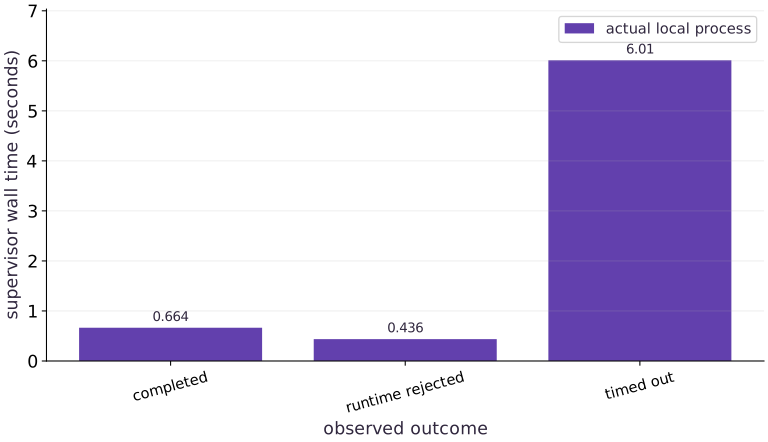
The lifetime bars compare actual process intervals in this fixture. They do not by themselves show readiness or accelerator utilization. Use the state timeline to explain what each interval includes.
Separate intent from observation
The configuration requests CPU and at least one device. The started event records what JAX actually discovered. Requesting devices should fail before training rather than silently run on fewer resources. An exit code of zero alone is insufficient: a worker that exits early without its completed event did not satisfy our job contract. Conversely, the last progress event is not proof of completion.
The process handle is the lifecycle authority
The supervisor owns a Popen handle and calls communicate with a deadline. On timeout it requests termination, waits briefly, then kills and reaps if needed. Merely writing timed_out into a JSON file would leave the actual worker alive. Exit values differ by platform: on POSIX a signal can appear as a negative return code, so our checks require a nonzero outcome rather than one portable magic number. This worker does not spawn descendants; a production process tree needs its own process-group or scheduler cancellation contract.
Ready means initialization finished
The worker imports JAX, validates the device contract, constructs data and compiles one update using a disposable result. It waits for that warmup result before emitting ready. The real parameters, momentum and random key remain unchanged during warmup. This makes the first progress event a genuine update from initial state, and keeps compile time separate from steady update time. A started process can still fail before ready.
Configuration should reject nonsense early
Total steps, batch size, checkpoint cadence and minimum device count must be positive integers. The minibatch cannot exceed the -example fixture when sampling without replacement. Momentum lies in , and learning rate is positive under this example’s bounded configuration. These validation choices document the teaching workload, not all valid optimizers. The worker command is an argument list and does not invoke a shell.
Treat a deadline as evidence, not a diagnosis
The lab inserts a real sleep after initialization and emits stall_injected. The supervisor times out and terminates the child. In an actual job, reaching a deadline would not by itself distinguish slow compilation, input starvation, deadlock or a workload that simply needs more time. Keep the last event, stderr and runtime contract before choosing a repair. Our intentional event makes this particular test diagnosable without pretending to emulate every failure.
Transfer the contract to available hardware
On a separately prepared accelerator host from the TPU course (phase-tpu), the same launch function accepts backend='tpu' (or gpu) and a required min_devices count. It requests that backend through JAX_PLATFORMS and records discovery; missing runtime support fails immediately before training starts. You can also run the portable TPU launcher (resources/tpu-gcp/launch.py --platform tpu) over SSH and copy the run folder back before deleting the TPU VM. Do not run that path on a laptop and call failure a hardware benchmark. Multi-host initialization, scheduler allocation, credentials, preemption signals and target-specific installation remain additional deployment contracts. No cloud resource is provisioned automatically by this lesson.
Supervise a bounded TPU worker on a Cloud TPU VM and copy back the run record
# Supervise a bounded TPU worker on a Cloud TPU VM and copy back the run record
gcloud compute tpus tpu-vm scp exercises/operations-01.py $TPU_NAME:~/jax-tpu-lab/ --zone=$ZONE
gcloud compute tpus tpu-vm ssh $TPU_NAME --zone=$ZONE \
  --command="JAX_PLATFORMS=tpu ~/jax-tpu-lab/.venv/bin/python -c 'import operations_01 as op; r = op.launch(\"/tmp/tpu-ops-run\", dict(backend=\"tpu\", min_devices=1, steps=4)); assert r[\"status\"] == \"completed\"; print(r[\"events\"][0], r[\"events\"][-1])'"
Expected:
Launches the supervised worker on the TPU VM with backend='tpu', verifies that started reports backend='tpu' and device_count >= 1, and records completed status in /tmp/tpu-ops-run/run.json.
Three actual process lifetimes
Predict before looking: Will the runtime-rejected job spend time training?
Read the figure
The horizontal categories identify three actual child runs. The vertical axis is supervisor wall-clock seconds, from launch to reaped exit. The timeout bar reflects the configured deadline plus cancellation overhead. The failure bar includes Python and JAX startup before the runtime check rejects the job. These are measured durations, so their exact values vary across hosts and reruns.
Connect it to the computation
Compare the bars with the event traces, not by height alone. The completed run contains progress and a completed event; the rejected run has no progress; the stalled run reaches ready but never finishes. A shorter failing bar does not mean an efficient job. This plot demonstrates lifecycle measurement on the local CPU, not accelerator throughput.
Open full-size figureDownload data and provenance
The notebook contains the data experiment, plotting code, and recorded figure output. Rerun it to test your changes.
Where to put & run this code: Work in phases/16-operations/01-accelerator-jobs-and-runtime-lifecycle/code/main.py (or downloaded exercises/operations-01.py / exercises/operations-01.ipynb) and execute from the repository root with python3 phases/16-operations/01-accelerator-jobs-and-runtime-lifecycle/code/main.py.
1 Create the local artifact helpers
Create main.py with this block. Run python3 main.py in the CPU course environment.
# Step 1: Create the local artifact helpers
"""Bounded local JAX subprocess supervisor and lifecycle verifier."""
from pathlib import Path
import hashlib
import json
import math
import os
import subprocess
import sys
import tempfile
import time


def digest(value):
    return hashlib.sha256(json.dumps(value, sort_keys=True, separators=(',', ':'), allow_nan=False).encode()).hexdigest()


def atomic_json(path, value):
    """Replace one local JSON file only after its bytes have been flushed."""
    path = Path(path)
    path.parent.mkdir(parents=True, exist_ok=True)
    fd, temporary = tempfile.mkstemp(prefix=path.name+'.', suffix='.tmp', dir=path.parent)
    # Run the boundary check and catch the expected exception:
    try:
        # Enter `os.fdopen(fd, 'w')` context block:
        with os.fdopen(fd, 'w') as stream:
            json.dump(value, stream, sort_keys=True, allow_nan=False)
            stream.flush()
            os.fsync(stream.fileno())
        os.replace(temporary, path)
    finally:
        if os.path.exists(temporary):
            os.unlink(temporary)
Code building blocks in this step
digest(...)— Calldigestwith your updated parameters or inputs from this lesson's workspace.hashlib.sha256(...)— Callhashlib.sha256with your updated parameters or inputs from this lesson's workspace.
The only filesystem writes are to the caller-selected run directory. Stable JSON encoding makes hashes reproducible.
2 Define the supervised worker
Append this block to main.py. Run python3 main.py in the CPU course environment.
# This file is materialized only inside the caller-owned temporary run folder.
WORKER = r'''
import hashlib, json, os, sys, time
from pathlib import Path
import jax
import jax.numpy as jnp
import numpy as np
root = Path(sys.argv[1])
cfg = json.loads((root/'config.json').read_text())
worker_hash = hashlib.sha256(Path(__file__).read_bytes()).hexdigest()
def emit(event, **fields):
    print(json.dumps(dict(event=event, monotonic_s=time.monotonic(), **fields)), flush=True)
def digest(value):
    return hashlib.sha256(json.dumps(value,sort_keys=True,separators=(',', ':'),allow_nan=False).encode()).hexdigest()
def write_checkpoint(state):
    target = root/'checkpoint.json'
    temporary = root/'checkpoint.pending'
    with temporary.open('w') as stream:
        json.dump(dict(state,checksum=digest(state)),stream,sort_keys=True,allow_nan=False)
        stream.flush()
        os.fsync(stream.fileno())
    os.replace(temporary,target)
    emit('checkpoint',step=state['step'],state_hash=digest(state))
try:
    emit('started',pid=os.getpid(),backend=jax.default_backend(),device_count=jax.device_count())
    if jax.default_backend() != cfg['backend'] or jax.device_count() < cfg['min_devices']:
        raise ValueError('runtime backend/device contract failed')
    x = jnp.linspace(-1.,1.,64)
    y = 2*x+1
    data_hash = digest(dict(x=np.asarray(x).tolist(),y=np.asarray(y).tolist()))
    training = {name:cfg[name] for name in ('seed','learning_rate','momentum','batch_size')}
    config_hash = digest(training)
    if cfg['resume']:
        saved = json.loads((root/'checkpoint.json').read_text())
        checksum = saved.pop('checksum',None)
        if checksum != digest(saved) or saved.get('worker_hash') != worker_hash:
            raise ValueError('checkpoint checksum/source mismatch')
        if saved['schema_version'] != 1 or saved['config_hash'] != config_hash or saved['data_hash'] != data_hash:
            raise ValueError('checkpoint provenance mismatch')
        state = saved
        step = saved['step']
        params=jnp.array(saved['params'])
        velocity=jnp.array(saved['velocity'])
        key=jnp.array(saved['key'],dtype=jnp.uint32)
        if not isinstance(step,int) or isinstance(step,bool) or step < 0 or step > cfg['steps'] or params.shape != (2,) or velocity.shape != (2,) or key.shape != (2,):
            raise ValueError('invalid checkpoint state shape or step')
        if not bool(jnp.all(jnp.isfinite(params))) or not bool(jnp.all(jnp.isfinite(velocity))):
            raise ValueError('nonfinite checkpoint state')
        emit('restored',step=step,state_hash=digest(saved))
    else:
        step=0
        params=jnp.zeros(2)
        velocity=jnp.zeros(2)
        key=jax.random.PRNGKey(cfg['seed'])
    def update(params,velocity,key):
        key, sample = jax.random.split(key)
        indices=jax.random.choice(sample,64,(cfg['batch_size'],),replace=False)
        objective=lambda p:jnp.mean((p[0]*x[indices]+p[1]-y[indices])**2)
        loss, grad=jax.value_and_grad(objective)(params)
        velocity=cfg['momentum']*velocity+grad
        params=params-cfg['learning_rate']*velocity
        return params,velocity,key,loss
    compiled=jax.jit(update)
    # Compile and synchronize once without consuming actual training state.
    begin=time.perf_counter()
    warm=compiled(params,velocity,key)
    jax.block_until_ready(warm)
    emit('ready',compile_warmup_s=time.perf_counter()-begin,step=step)
    while step < cfg['steps']:
        if cfg.get('stall_at') == step:
            emit('stall_injected',step=step)
            time.sleep(cfg.get('stall_seconds',10.))
        begin=time.perf_counter()
        params,velocity,key,loss=compiled(params,velocity,key)
        jax.block_until_ready((params,velocity,key,loss))
        elapsed=time.perf_counter()-begin
        step+=1
        state=dict(schema_version=1,worker_hash=worker_hash,step=step,params=np.asarray(params).tolist(),velocity=np.asarray(velocity).tolist(),key=np.asarray(key).tolist(),config_hash=config_hash,data_hash=data_hash)
        emit('progress',step=step,loss=float(loss),examples=cfg['batch_size'],update_s=elapsed,state_hash=digest(state))
        if step % cfg['checkpoint_every'] == 0 or step == cfg['steps']:
            write_checkpoint(state)
        if cfg.get('fail_after') == step:
            raise RuntimeError('controlled failure after update')
    write_checkpoint(state)
    emit('completed',step=step,state_hash=digest(state))
except Exception as error:
    emit('failed',kind=type(error).__name__,message=str(error))
    raise SystemExit(23)
'''
Code building blocks in this step
jnp.linspace(start, stop, num)— Createsnumevenly spaced float points across the closed interval[start, stop].jnp.array(values, dtype=...)— Constructs an immutable device-backed JAX array from Python/NumPy values.jnp.zeros / jnp.ones(shape, dtype=...)— Allocates a tensor of the givenshapeinitialized with constants.x.sum(axis=...) / x.mean(axis=..., keepdims=...)— Reduces values along the namedaxis(the axis you name is collapsed unlesskeepdims=True).
The string is a real Python program launched in a separate process. It emits structured events, synchronizes JAX updates and preserves complete state.
3 Add bounded launch and result collection
Append this block to main.py. Run python3 main.py in the CPU course environment.
# Step 3 — Add bounded launch and result collection: The supervisor owns the child handle, captures its output and...
def default_config(**changes):
    cfg=dict(seed=3,learning_rate=.04,momentum=.8,batch_size=8,steps=8,
             checkpoint_every=2,backend='cpu',min_devices=1,resume=False,
             fail_after=None,stall_at=None,stall_seconds=10.)
    # Update state in place with the new values.
    cfg.update(changes)
    for name in ('steps','checkpoint_every','batch_size','min_devices'):
        # Guard input contract (`not isinstance(cfg[name], int) or isinstance(cfg[name], bool) or cfg[name] < 1`) and fail fast if violated.
        if not isinstance(cfg[name],int) or isinstance(cfg[name],bool) or cfg[name] < 1:
            raise ValueError(name+' must be a positive integer')
    # Guard input contract (`cfg['batch_size'] > 64 or not 0 <= cfg['momentum'] < 1 or (not 0 < cfg['learning_rate'] < 1)`) and fail fast if violated.
    if cfg['batch_size'] > 64 or not 0 <= cfg['momentum'] < 1 or not 0 < cfg['learning_rate'] < 1:
        raise ValueError('invalid training configuration')
    return cfg


def launch(root, config=None, timeout=10.):
    root=Path(root)
    root.mkdir(parents=True,exist_ok=True)
    cfg=default_config(**(config or {}))
    # Guard input contract (`timeout <= 0`) and fail fast if violated.
    if timeout <= 0:
        raise ValueError('timeout must be positive')
    atomic_json(root/'config.json',cfg)
    worker=root/'worker.py'
    worker.write_text(WORKER)
    # Configure environment variable before initializing the runtime.
    env=dict(os.environ,JAX_PLATFORMS=cfg['backend'],PYTHONUNBUFFERED='1')
    started=time.perf_counter()
    process=subprocess.Popen([sys.executable,str(worker),str(root)],stdout=subprocess.PIPE,stderr=subprocess.PIPE,text=True,env=env)
    timed_out=False
    try:
        stdout,stderr=process.communicate(timeout=timeout)
    except subprocess.TimeoutExpired:
        timed_out=True
        process.terminate()
        try:
            stdout,stderr=process.communicate(timeout=1.)
        except subprocess.TimeoutExpired:
            process.kill()
            stdout,stderr=process.communicate(timeout=1.)
    wall=time.perf_counter()-started
    events=[]
    malformed=[]
    for line in stdout.splitlines():
        if not line.strip():
            continue
        try:
            event=json.loads(line)
            if not isinstance(event,dict) or 'event' not in event:
                raise ValueError('not an event')
            events.append(event)
        except (ValueError,TypeError):
            malformed.append(line)
    status='timed_out' if timed_out else 'completed' if process.returncode == 0 and not malformed and events and events[-1]['event']=='completed' else 'failed'
    # Compute deterministic cryptographic digest `result` for provenance verification.
    result=dict(status=status,returncode=process.returncode,wall_s=wall,events=events,stderr=stderr,
                worker_hash=hashlib.sha256(WORKER.encode()).hexdigest(),config=cfg,malformed_stdout=malformed)
    atomic_json(root/'run.json',result)
    return result
Code building blocks in this step
default_config(...)— Calldefault_configwith your updated parameters or inputs from this lesson's workspace.cfg.update(...)— Callcfg.updatewith your updated parameters or inputs from this lesson's workspace.
The supervisor owns the child handle, captures its output and always waits for termination after a timeout.
4 Exercise all three lifecycle outcomes
Append this block to main.py. Run python3 main.py in the CPU course environment.
# Step 4 — Exercise all three lifecycle outcomes: Each outcome comes from a real subprocess.
# Create an isolated temporary directory to run and inspect artifacts safely:
with tempfile.TemporaryDirectory(prefix='ops-lifecycle-') as folder:
    base = Path(folder)
    successful = launch(base/'success')
    rejected = launch(base/'wrong-runtime',dict(min_devices=999))
    stalled = launch(base/'timeout',dict(stall_at=0,stall_seconds=20),timeout=6)
assert successful['status'] == 'completed'
assert rejected['status'] == 'failed' and rejected['returncode'] != 0
assert stalled['status'] == 'timed_out' and stalled['returncode'] != 0
assert any(e['event']=='stall_injected' for e in stalled['events'])
print('statuses:',successful['status'],rejected['status'],stalled['status'])
print('actual exit codes:',successful['returncode'],rejected['returncode'],stalled['returncode'])
Code building blocks in this step
tempfile.TemporaryDirectory(...)— Calltempfile.TemporaryDirectorywith your updated parameters or inputs from this lesson's workspace.Path(...)— CallPathwith your updated parameters or inputs from this lesson's workspace.assert condition— Verify that the observed output shape, status, or numerical value satisfies the contract.
Each outcome comes from a real subprocess. Temporary directories contain and clean up every artifact.
View the cumulative build in main.py
These blocks append in order to the same file.
# Step 1: Create the local artifact helpers
"""Bounded local JAX subprocess supervisor and lifecycle verifier."""
from pathlib import Path
import hashlib
import json
import math
import os
import subprocess
import sys
import tempfile
import time


def digest(value):
    return hashlib.sha256(json.dumps(value, sort_keys=True, separators=(',', ':'), allow_nan=False).encode()).hexdigest()


def atomic_json(path, value):
    """Replace one local JSON file only after its bytes have been flushed."""
    path = Path(path)
    path.parent.mkdir(parents=True, exist_ok=True)
    fd, temporary = tempfile.mkstemp(prefix=path.name+'.', suffix='.tmp', dir=path.parent)
    # Run the boundary check and catch the expected exception:
    try:
        # Enter `os.fdopen(fd, 'w')` context block:
        with os.fdopen(fd, 'w') as stream:
            json.dump(value, stream, sort_keys=True, allow_nan=False)
            stream.flush()
            os.fsync(stream.fileno())
        os.replace(temporary, path)
    finally:
        if os.path.exists(temporary):
            os.unlink(temporary)

# This file is materialized only inside the caller-owned temporary run folder.
WORKER = r'''
import hashlib, json, os, sys, time
from pathlib import Path
import jax
import jax.numpy as jnp
import numpy as np
root = Path(sys.argv[1])
cfg = json.loads((root/'config.json').read_text())
worker_hash = hashlib.sha256(Path(__file__).read_bytes()).hexdigest()
def emit(event, **fields):
    print(json.dumps(dict(event=event, monotonic_s=time.monotonic(), **fields)), flush=True)
def digest(value):
    return hashlib.sha256(json.dumps(value,sort_keys=True,separators=(',', ':'),allow_nan=False).encode()).hexdigest()
def write_checkpoint(state):
    target = root/'checkpoint.json'
    temporary = root/'checkpoint.pending'
    with temporary.open('w') as stream:
        json.dump(dict(state,checksum=digest(state)),stream,sort_keys=True,allow_nan=False)
        stream.flush()
        os.fsync(stream.fileno())
    os.replace(temporary,target)
    emit('checkpoint',step=state['step'],state_hash=digest(state))
try:
    emit('started',pid=os.getpid(),backend=jax.default_backend(),device_count=jax.device_count())
    if jax.default_backend() != cfg['backend'] or jax.device_count() < cfg['min_devices']:
        raise ValueError('runtime backend/device contract failed')
    x = jnp.linspace(-1.,1.,64)
    y = 2*x+1
    data_hash = digest(dict(x=np.asarray(x).tolist(),y=np.asarray(y).tolist()))
    training = {name:cfg[name] for name in ('seed','learning_rate','momentum','batch_size')}
    config_hash = digest(training)
    if cfg['resume']:
        saved = json.loads((root/'checkpoint.json').read_text())
        checksum = saved.pop('checksum',None)
        if checksum != digest(saved) or saved.get('worker_hash') != worker_hash:
            raise ValueError('checkpoint checksum/source mismatch')
        if saved['schema_version'] != 1 or saved['config_hash'] != config_hash or saved['data_hash'] != data_hash:
            raise ValueError('checkpoint provenance mismatch')
        state = saved
        step = saved['step']
        params=jnp.array(saved['params'])
        velocity=jnp.array(saved['velocity'])
        key=jnp.array(saved['key'],dtype=jnp.uint32)
        if not isinstance(step,int) or isinstance(step,bool) or step < 0 or step > cfg['steps'] or params.shape != (2,) or velocity.shape != (2,) or key.shape != (2,):
            raise ValueError('invalid checkpoint state shape or step')
        if not bool(jnp.all(jnp.isfinite(params))) or not bool(jnp.all(jnp.isfinite(velocity))):
            raise ValueError('nonfinite checkpoint state')
        emit('restored',step=step,state_hash=digest(saved))
    else:
        step=0
        params=jnp.zeros(2)
        velocity=jnp.zeros(2)
        key=jax.random.PRNGKey(cfg['seed'])
    def update(params,velocity,key):
        key, sample = jax.random.split(key)
        indices=jax.random.choice(sample,64,(cfg['batch_size'],),replace=False)
        objective=lambda p:jnp.mean((p[0]*x[indices]+p[1]-y[indices])**2)
        loss, grad=jax.value_and_grad(objective)(params)
        velocity=cfg['momentum']*velocity+grad
        params=params-cfg['learning_rate']*velocity
        return params,velocity,key,loss
    compiled=jax.jit(update)
    # Compile and synchronize once without consuming actual training state.
    begin=time.perf_counter()
    warm=compiled(params,velocity,key)
    jax.block_until_ready(warm)
    emit('ready',compile_warmup_s=time.perf_counter()-begin,step=step)
    while step < cfg['steps']:
        if cfg.get('stall_at') == step:
            emit('stall_injected',step=step)
            time.sleep(cfg.get('stall_seconds',10.))
        begin=time.perf_counter()
        params,velocity,key,loss=compiled(params,velocity,key)
        jax.block_until_ready((params,velocity,key,loss))
        elapsed=time.perf_counter()-begin
        step+=1
        state=dict(schema_version=1,worker_hash=worker_hash,step=step,params=np.asarray(params).tolist(),velocity=np.asarray(velocity).tolist(),key=np.asarray(key).tolist(),config_hash=config_hash,data_hash=data_hash)
        emit('progress',step=step,loss=float(loss),examples=cfg['batch_size'],update_s=elapsed,state_hash=digest(state))
        if step % cfg['checkpoint_every'] == 0 or step == cfg['steps']:
            write_checkpoint(state)
        if cfg.get('fail_after') == step:
            raise RuntimeError('controlled failure after update')
    write_checkpoint(state)
    emit('completed',step=step,state_hash=digest(state))
except Exception as error:
    emit('failed',kind=type(error).__name__,message=str(error))
    raise SystemExit(23)
'''

# Step 3 — Add bounded launch and result collection: The supervisor owns the child handle, captures its output and...
def default_config(**changes):
    cfg=dict(seed=3,learning_rate=.04,momentum=.8,batch_size=8,steps=8,
             checkpoint_every=2,backend='cpu',min_devices=1,resume=False,
             fail_after=None,stall_at=None,stall_seconds=10.)
    # Update state in place with the new values.
    cfg.update(changes)
    for name in ('steps','checkpoint_every','batch_size','min_devices'):
        # Guard input contract (`not isinstance(cfg[name], int) or isinstance(cfg[name], bool) or cfg[name] < 1`) and fail fast if violated.
        if not isinstance(cfg[name],int) or isinstance(cfg[name],bool) or cfg[name] < 1:
            raise ValueError(name+' must be a positive integer')
    # Guard input contract (`cfg['batch_size'] > 64 or not 0 <= cfg['momentum'] < 1 or (not 0 < cfg['learning_rate'] < 1)`) and fail fast if violated.
    if cfg['batch_size'] > 64 or not 0 <= cfg['momentum'] < 1 or not 0 < cfg['learning_rate'] < 1:
        raise ValueError('invalid training configuration')
    return cfg


def launch(root, config=None, timeout=10.):
    root=Path(root)
    root.mkdir(parents=True,exist_ok=True)
    cfg=default_config(**(config or {}))
    # Guard input contract (`timeout <= 0`) and fail fast if violated.
    if timeout <= 0:
        raise ValueError('timeout must be positive')
    atomic_json(root/'config.json',cfg)
    worker=root/'worker.py'
    worker.write_text(WORKER)
    # Configure environment variable before initializing the runtime.
    env=dict(os.environ,JAX_PLATFORMS=cfg['backend'],PYTHONUNBUFFERED='1')
    started=time.perf_counter()
    process=subprocess.Popen([sys.executable,str(worker),str(root)],stdout=subprocess.PIPE,stderr=subprocess.PIPE,text=True,env=env)
    timed_out=False
    try:
        stdout,stderr=process.communicate(timeout=timeout)
    except subprocess.TimeoutExpired:
        timed_out=True
        process.terminate()
        try:
            stdout,stderr=process.communicate(timeout=1.)
        except subprocess.TimeoutExpired:
            process.kill()
            stdout,stderr=process.communicate(timeout=1.)
    wall=time.perf_counter()-started
    events=[]
    malformed=[]
    for line in stdout.splitlines():
        if not line.strip():
            continue
        try:
            event=json.loads(line)
            if not isinstance(event,dict) or 'event' not in event:
                raise ValueError('not an event')
            events.append(event)
        except (ValueError,TypeError):
            malformed.append(line)
    status='timed_out' if timed_out else 'completed' if process.returncode == 0 and not malformed and events and events[-1]['event']=='completed' else 'failed'
    # Compute deterministic cryptographic digest `result` for provenance verification.
    result=dict(status=status,returncode=process.returncode,wall_s=wall,events=events,stderr=stderr,
                worker_hash=hashlib.sha256(WORKER.encode()).hexdigest(),config=cfg,malformed_stdout=malformed)
    atomic_json(root/'run.json',result)
    return result

# Step 4 — Exercise all three lifecycle outcomes: Each outcome comes from a real subprocess.
# Create an isolated temporary directory to run and inspect artifacts safely:
with tempfile.TemporaryDirectory(prefix='ops-lifecycle-') as folder:
    base = Path(folder)
    successful = launch(base/'success')
    rejected = launch(base/'wrong-runtime',dict(min_devices=999))
    stalled = launch(base/'timeout',dict(stall_at=0,stall_seconds=20),timeout=6)
assert successful['status'] == 'completed'
assert rejected['status'] == 'failed' and rejected['returncode'] != 0
assert stalled['status'] == 'timed_out' and stalled['returncode'] != 0
assert any(e['event']=='stall_injected' for e in stalled['events'])
print('statuses:',successful['status'],rejected['status'],stalled['status'])
print('actual exit codes:',successful['returncode'],rejected['returncode'],stalled['returncode'])
Run the example
python3 phases/16-operations/01-accelerator-jobs-and-runtime-lifecycle/code/main.pyAbout this command
This shortcut uses an activated macOS/Linux course environment in the repository folder. For Windows, use the explicit interpreter command in “Setup help” above. The script includes worked examples and reference solutions.
Inspect the complete assembled example
# Complete runnable example (operations-01)
"""Bounded local JAX subprocess supervisor and lifecycle verifier."""
from pathlib import Path
import hashlib
import json
import math
import os
import subprocess
import sys
import tempfile
import time


def digest(value):
    return hashlib.sha256(json.dumps(value, sort_keys=True, separators=(',', ':'), allow_nan=False).encode()).hexdigest()


def atomic_json(path, value):
    """Replace one local JSON file only after its bytes have been flushed."""
    path = Path(path)
    path.parent.mkdir(parents=True, exist_ok=True)
    fd, temporary = tempfile.mkstemp(prefix=path.name+'.', suffix='.tmp', dir=path.parent)
    # Run the boundary check and catch the expected exception:
    try:
        # Enter `os.fdopen(fd, 'w')` context block:
        with os.fdopen(fd, 'w') as stream:
            json.dump(value, stream, sort_keys=True, allow_nan=False)
            stream.flush()
            os.fsync(stream.fileno())
        os.replace(temporary, path)
    finally:
        if os.path.exists(temporary):
            os.unlink(temporary)

# This file is materialized only inside the caller-owned temporary run folder.
WORKER = r'''
import hashlib, json, os, sys, time
from pathlib import Path
import jax
import jax.numpy as jnp
import numpy as np
root = Path(sys.argv[1])
cfg = json.loads((root/'config.json').read_text())
worker_hash = hashlib.sha256(Path(__file__).read_bytes()).hexdigest()
def emit(event, **fields):
    print(json.dumps(dict(event=event, monotonic_s=time.monotonic(), **fields)), flush=True)
def digest(value):
    return hashlib.sha256(json.dumps(value,sort_keys=True,separators=(',', ':'),allow_nan=False).encode()).hexdigest()
def write_checkpoint(state):
    target = root/'checkpoint.json'
    temporary = root/'checkpoint.pending'
    with temporary.open('w') as stream:
        json.dump(dict(state,checksum=digest(state)),stream,sort_keys=True,allow_nan=False)
        stream.flush()
        os.fsync(stream.fileno())
    os.replace(temporary,target)
    emit('checkpoint',step=state['step'],state_hash=digest(state))
try:
    emit('started',pid=os.getpid(),backend=jax.default_backend(),device_count=jax.device_count())
    if jax.default_backend() != cfg['backend'] or jax.device_count() < cfg['min_devices']:
        raise ValueError('runtime backend/device contract failed')
    x = jnp.linspace(-1.,1.,64)
    y = 2*x+1
    data_hash = digest(dict(x=np.asarray(x).tolist(),y=np.asarray(y).tolist()))
    training = {name:cfg[name] for name in ('seed','learning_rate','momentum','batch_size')}
    config_hash = digest(training)
    if cfg['resume']:
        saved = json.loads((root/'checkpoint.json').read_text())
        checksum = saved.pop('checksum',None)
        if checksum != digest(saved) or saved.get('worker_hash') != worker_hash:
            raise ValueError('checkpoint checksum/source mismatch')
        if saved['schema_version'] != 1 or saved['config_hash'] != config_hash or saved['data_hash'] != data_hash:
            raise ValueError('checkpoint provenance mismatch')
        state = saved
        step = saved['step']
        params=jnp.array(saved['params'])
        velocity=jnp.array(saved['velocity'])
        key=jnp.array(saved['key'],dtype=jnp.uint32)
        if not isinstance(step,int) or isinstance(step,bool) or step < 0 or step > cfg['steps'] or params.shape != (2,) or velocity.shape != (2,) or key.shape != (2,):
            raise ValueError('invalid checkpoint state shape or step')
        if not bool(jnp.all(jnp.isfinite(params))) or not bool(jnp.all(jnp.isfinite(velocity))):
            raise ValueError('nonfinite checkpoint state')
        emit('restored',step=step,state_hash=digest(saved))
    else:
        step=0
        params=jnp.zeros(2)
        velocity=jnp.zeros(2)
        key=jax.random.PRNGKey(cfg['seed'])
    def update(params,velocity,key):
        key, sample = jax.random.split(key)
        indices=jax.random.choice(sample,64,(cfg['batch_size'],),replace=False)
        objective=lambda p:jnp.mean((p[0]*x[indices]+p[1]-y[indices])**2)
        loss, grad=jax.value_and_grad(objective)(params)
        velocity=cfg['momentum']*velocity+grad
        params=params-cfg['learning_rate']*velocity
        return params,velocity,key,loss
    compiled=jax.jit(update)
    # Compile and synchronize once without consuming actual training state.
    begin=time.perf_counter()
    warm=compiled(params,velocity,key)
    jax.block_until_ready(warm)
    emit('ready',compile_warmup_s=time.perf_counter()-begin,step=step)
    while step < cfg['steps']:
        if cfg.get('stall_at') == step:
            emit('stall_injected',step=step)
            time.sleep(cfg.get('stall_seconds',10.))
        begin=time.perf_counter()
        params,velocity,key,loss=compiled(params,velocity,key)
        jax.block_until_ready((params,velocity,key,loss))
        elapsed=time.perf_counter()-begin
        step+=1
        state=dict(schema_version=1,worker_hash=worker_hash,step=step,params=np.asarray(params).tolist(),velocity=np.asarray(velocity).tolist(),key=np.asarray(key).tolist(),config_hash=config_hash,data_hash=data_hash)
        emit('progress',step=step,loss=float(loss),examples=cfg['batch_size'],update_s=elapsed,state_hash=digest(state))
        if step % cfg['checkpoint_every'] == 0 or step == cfg['steps']:
            write_checkpoint(state)
        if cfg.get('fail_after') == step:
            raise RuntimeError('controlled failure after update')
    write_checkpoint(state)
    emit('completed',step=step,state_hash=digest(state))
except Exception as error:
    emit('failed',kind=type(error).__name__,message=str(error))
    raise SystemExit(23)
'''

# Step 3 — Add bounded launch and result collection: The supervisor owns the child handle, captures its output and...
def default_config(**changes):
    cfg=dict(seed=3,learning_rate=.04,momentum=.8,batch_size=8,steps=8,
             checkpoint_every=2,backend='cpu',min_devices=1,resume=False,
             fail_after=None,stall_at=None,stall_seconds=10.)
    # Update state in place with the new values.
    cfg.update(changes)
    for name in ('steps','checkpoint_every','batch_size','min_devices'):
        # Guard input contract (`not isinstance(cfg[name], int) or isinstance(cfg[name], bool) or cfg[name] < 1`) and fail fast if violated.
        if not isinstance(cfg[name],int) or isinstance(cfg[name],bool) or cfg[name] < 1:
            raise ValueError(name+' must be a positive integer')
    # Guard input contract (`cfg['batch_size'] > 64 or not 0 <= cfg['momentum'] < 1 or (not 0 < cfg['learning_rate'] < 1)`) and fail fast if violated.
    if cfg['batch_size'] > 64 or not 0 <= cfg['momentum'] < 1 or not 0 < cfg['learning_rate'] < 1:
        raise ValueError('invalid training configuration')
    return cfg


def launch(root, config=None, timeout=10.):
    root=Path(root)
    root.mkdir(parents=True,exist_ok=True)
    cfg=default_config(**(config or {}))
    # Guard input contract (`timeout <= 0`) and fail fast if violated.
    if timeout <= 0:
        raise ValueError('timeout must be positive')
    atomic_json(root/'config.json',cfg)
    worker=root/'worker.py'
    worker.write_text(WORKER)
    # Configure environment variable before initializing the runtime.
    env=dict(os.environ,JAX_PLATFORMS=cfg['backend'],PYTHONUNBUFFERED='1')
    started=time.perf_counter()
    process=subprocess.Popen([sys.executable,str(worker),str(root)],stdout=subprocess.PIPE,stderr=subprocess.PIPE,text=True,env=env)
    timed_out=False
    try:
        stdout,stderr=process.communicate(timeout=timeout)
    except subprocess.TimeoutExpired:
        timed_out=True
        process.terminate()
        try:
            stdout,stderr=process.communicate(timeout=1.)
        except subprocess.TimeoutExpired:
            process.kill()
            stdout,stderr=process.communicate(timeout=1.)
    wall=time.perf_counter()-started
    events=[]
    malformed=[]
    for line in stdout.splitlines():
        if not line.strip():
            continue
        try:
            event=json.loads(line)
            if not isinstance(event,dict) or 'event' not in event:
                raise ValueError('not an event')
            events.append(event)
        except (ValueError,TypeError):
            malformed.append(line)
    status='timed_out' if timed_out else 'completed' if process.returncode == 0 and not malformed and events and events[-1]['event']=='completed' else 'failed'
    # Compute deterministic cryptographic digest `result` for provenance verification.
    result=dict(status=status,returncode=process.returncode,wall_s=wall,events=events,stderr=stderr,
                worker_hash=hashlib.sha256(WORKER.encode()).hexdigest(),config=cfg,malformed_stdout=malformed)
    atomic_json(root/'run.json',result)
    return result

# Step 4 — Exercise all three lifecycle outcomes: Each outcome comes from a real subprocess.
# Create an isolated temporary directory to run and inspect artifacts safely:
with tempfile.TemporaryDirectory(prefix='ops-lifecycle-') as folder:
    base = Path(folder)
    successful = launch(base/'success')
    rejected = launch(base/'wrong-runtime',dict(min_devices=999))
    stalled = launch(base/'timeout',dict(stall_at=0,stall_seconds=20),timeout=6)
assert successful['status'] == 'completed'
assert rejected['status'] == 'failed' and rejected['returncode'] != 0
assert stalled['status'] == 'timed_out' and stalled['returncode'] != 0
assert any(e['event']=='stall_injected' for e in stalled['events'])
print('statuses:',successful['status'],rejected['status'],stalled['status'])
print('actual exit codes:',successful['returncode'],rejected['returncode'],stalled['returncode'])
Expected result: The actual child outcomes are completed, failed and timed_out. A worker requirement failure exits nonzero; the stalled worker is terminated and reaped.
Recorded reference execution
Reference output captured from executing the complete lesson script (code/main.py) and its assertions in the course CPU environment.
statuses: completed failed timed_out
actual exit codes: 0 23 -15
statuses: completed failed timed_out
actual exit codes: 0 23 -15
timed-out worker events: ['started', 'ready', 'stall_injected']
PASS: operations-01
Download execution record · The notebook includes executed cells and figure outputs. Compare your run with these values; timings depend on the machine.
A child that fails before training
# Experiment — A child that fails before training: This check links the failure classification to a concrete...
assert any(e['event']=='failed' and 'runtime' in e['message'] for e in rejected['events'])
assert not any(e['event']=='progress' for e in rejected['events'])
Expected: The runtime mismatch is recorded, and no update event exists.
This check links the failure classification to a concrete boundary in the worker lifecycle.
A started process need not be ready
# Experiment — A started process need not be ready: The sequence rules out startup failure in this controlled drill.
names=[e['event'] for e in stalled['events']]
assert names.index('started') < names.index('ready') < names.index('stall_injected')
assert 'completed' not in names
print('timed-out worker events:',names)
Expected: The worker reaches ready, then stalls before its first update.
The sequence rules out startup failure in this controlled drill. A different trace would demand a different diagnosis.
Make it yours
Where to put your code: Append your solution at the bottom of phases/16-operations/01-accelerator-jobs-and-runtime-lifecycle/code/main.py (or inside the Make it yours cell of exercises/operations-01.ipynb) and run python3 phases/16-operations/01-accelerator-jobs-and-runtime-lifecycle/code/main.py to verify your prediction before opening the reference solution.
Launch a changed job with updates and batch size . Verify the observed progress steps and completion event rather than relying only on its exit code.
Show a writing guide and starter scaffold
How to write this exercise code: step-by-step recipe & starter scaffold
1. Key functions & syntax to use:
tempfile.TemporaryDirectory(...)— Calltempfile.TemporaryDirectorywith your updated parameters or inputs from this lesson's workspace.launch(...)— Calllaunchwith your updated parameters or inputs from this lesson's workspace.assert condition— Verify that the observed output shape, status, or numerical value satisfies the contract.
2. Step-by-step implementation plan:
- Create an isolated temporary directory to run and inspect artifacts safely:
# Exercise solution: Launch a changed job with 3 updates and batch size 5.
# Create an isolated temporary directory to run and inspect artifacts safely:
with tempfile.TemporaryDirectory() as folder:
    short = launch(...)  # TODO: compute short
assert short['status']  # TODO: complete assertion check
assert [e['step'] for e  # TODO: complete assertion check
assert short['events'][-1]['step']  # TODO: complete assertion check
Reveal the reference solution
# Exercise solution: Launch a changed job with 3 updates and batch size 5.
# Create an isolated temporary directory to run and inspect artifacts safely:
with tempfile.TemporaryDirectory() as folder:
    short=launch(folder,dict(steps=3,batch_size=5))
assert short['status']=='completed'
assert [e['step'] for e in short['events'] if e['event']=='progress']==[1,2,3]
assert short['events'][-1]['step']==3
Reject invalid work before spawning
Transfer / diagnosis
Try a zero step budget and an oversized minibatch. Require a clear configuration error for each.
Show a writing guide and starter scaffold
How to write this practice solution: step-by-step recipe & starter scaffold
1. Key functions & syntax to use:
spawning(...)— Callspawningwith your updated parameters or inputs from this lesson's workspace.default_config(...)— Calldefault_configwith your updated parameters or inputs from this lesson's workspace.
2. Step-by-step implementation plan:
- Set up the changed input or configuration parameters requested in the prompt.
- Run the target function or transformation and assert that the output matches your prediction.
# Reject invalid work before spawning (Transfer / diagnosis): Validation makes an impossible workload fail at the caller...
for values in [dict(steps=0),dict(batch_size=65)]:
    try:
        default_config(**values)
    except ValueError:
        pass
    else:
        raise AssertionError('invalid work accepted')
Show a hint
Call default_config directly; no child should be needed.
Reveal reference solution and reasoning
# Reject invalid work before spawning (Transfer / diagnosis): Validation makes an impossible workload fail at the caller...
for values in [dict(steps=0),dict(batch_size=65)]:
    try:
        default_config(**values)
    except ValueError:
        pass
    else:
        raise AssertionError('invalid work accepted')
Validation makes an impossible workload fail at the caller boundary instead of consuming runtime first.
Preserve a successful checkpoint
Transfer / diagnosis
Run updates in a temporary directory and verify that the final checkpoint and run record both refer to the completed work.
Show a writing guide and starter scaffold
How to write this practice solution: step-by-step recipe & starter scaffold
1. Key functions & syntax to use:
checkpoint(...)— Callcheckpointwith your updated parameters or inputs from this lesson's workspace.tempfile.TemporaryDirectory(...)— Calltempfile.TemporaryDirectorywith your updated parameters or inputs from this lesson's workspace.assert condition— Verify that the observed output shape, status, or numerical value satisfies the contract.
2. Step-by-step implementation plan:
- Create an isolated temporary directory to run and inspect artifacts safely:
# Preserve a successful checkpoint (Transfer / diagnosis): A status and a durable artifact should agree about what was...
# Create an isolated temporary directory to run and inspect artifacts safely:
with tempfile.TemporaryDirectory() as folder:
    result = launch(...)  # TODO: compute result
    saved = json.loads(...)  # TODO: compute saved
    record = json.loads(...)  # TODO: compute record
    assert saved['step']  # TODO: complete assertion check
    assert record['worker_hash']  # TODO: complete assertion check
Show a hint
Read the files before leaving the temporary-directory context.
Reveal reference solution and reasoning
# Preserve a successful checkpoint (Transfer / diagnosis): A status and a durable artifact should agree about what was...
# Create an isolated temporary directory to run and inspect artifacts safely:
with tempfile.TemporaryDirectory() as folder:
    result=launch(folder,dict(steps=4))
    saved=json.loads((Path(folder)/'checkpoint.json').read_text())
    record=json.loads((Path(folder)/'run.json').read_text())
    assert saved['step']==4 and record['status']=='completed'
    assert record['worker_hash']==saved['worker_hash']
A status and a durable artifact should agree about what was completed; neither should be assumed from the command alone.
Diagnose the result
Use the last structured event to locate the boundary: no ready event points toward runtime or initialization; ready without progress points toward update/input work; completed with a nonzero exit still requires investigation. Preserve stderr. Verify the child has exited before retrying so two runs do not write the same checkpoint.
Carry forward
- A requested runtime and an observed runtime are separate facts.
- A process deadline needs cancellation and reaping, not just a status string.
Keep your evidence
Keep actual child exit codes, bounded timeout/termination output and proof that children were reaped. Distinguish launch failure, failed preflight, slow work and a stalled job.
Save your modified code, its output, and an explanation of your prediction. Checkpoint answers and exercise evidence are tracked separately.
Saved in this browser. Export or back up your portfolio anytime in My learning.
Verified on local CPU. Stage to a Cloud TPU VM via Cloud TPU setup to record accelerator execution receipts (TODO: add automated Cloud TPU CI execution receipts).