 JAX Pathways
Phase 16 / Workload operations
MLOps: data contracts, CI gates and monitoring
Revision v0.7.0 · Updated since your last visit. Review the changes; your progress is saved.
Lesson · about 70 minutes · CPU practice
Reject data leakage and incomplete evaluation, compute count-weighted slice metrics and distinguish drift investigation from model promotion.
Phase study guide: preparation, milestones and project evidence
Before you start
Before this: Capacity, utilization, and operating cost
Hardware: CPU
Setup help: Python, notebook, or Cloud TPU VM
Use the tested CPU packages (the recorded environment uses Python 3.14.3). Other Python versions and accelerator environments require separate checks. The optional Cloud TPU specialization explains the target-specific execution boundaries. Logical CPU devices practice partitioning; they do not simulate TPU performance.
Download the repository ZIP or use your existing checkout. Extract it and open a terminal in the folder containing requirements-cpu.txt. The beginner ZIP is separate; these lessons use the full repository folder.
python3 -m venv .venv
source .venv/bin/activate
python -m pip install -r requirements-cpu.txtpy -3 -m venv .venv
.\.venv\Scripts\python.exe -m pip install -r requirements-cpu.txtAfter activation, run the complete worked example from that same folder:
python phases/16-operations/06-mlops-data-contracts-and-release-pipelines/code/main.py.\.venv\Scripts\python.exe phases/16-operations/06-mlops-data-contracts-and-release-pipelines/code/main.pyFor an incremental build, create main.py in your own practice folder, append each build block in order, and run python main.py with this environment active. Keep that file separate from the downloaded reference solution.
Download this lesson’s notebook. Open it with a Python kernel using the course environment. Run cells from the top after restarting the kernel; experiments depend on earlier definitions.
For local Jupyter, first install the course requirements using the Local Python steps, then use your environment’s Python to start Jupyter:
python -m pip install jupyterlab
python -m jupyter lab.\.venv\Scripts\python.exe -m pip install jupyterlab
.\.venv\Scripts\python.exe -m jupyter labSelect the downloaded operations-06.ipynb file in JupyterLab. The notebook contains reference solutions; make your prediction and attempt each practice task before opening them. Restart the kernel before changing logical device setup.
The worked reference for this lesson is CPU-validated. Some references explicitly configure logical CPU devices; setting JAX_PLATFORMS does not adapt them to a TPU. Follow the execution matrix and reviewed multi-host example before attempting a target run.
For accelerator preparation, study TPU setup, observed runtime receipts, checkpointed jobs and precision and retained traces. These target paths remain unqualified on physical TPU hardware until an actual receipt is recorded. Cloud provisioning is optional for CPU learning.
Check: Overall MSE: 0.409 high-slice MSE: 4.0 release: False Two-bin input total variation: 0.4 (requires investigation; not an automatic retraining order)
Revisit the guided CPU setup · Open 19: TPU Setup. Package instructions are CPU instructions; Windows and accelerator environments need their own validation.
What you will be able to do
- Validate data before the expensive job
- Use a fixed release evaluation
- Separate code CI from model delivery
- Compare distributions without inventing labels
The problem
A candidate looks good on an average dashboard, yet performs badly for a small group of requests. Let’s make an MLOps release decision from data identity, slice counts and independently checked metrics.
The idea
A release pipeline should connect data contracts, evaluation and artifact selection. Aggregate metrics help summarize behavior, but important subpopulations may require explicit gates. Define those slices and acceptance rules before selecting the model.
A passing average can hide a failing slice
Suppose nine examples have error and one important slice has error . The overall mean error is . Whether that is acceptable depends on the task and slice policy; the average alone cannot answer it.
Keep counts with slice metrics so a tiny subgroup is not mistaken for strong statistical evidence. Freeze evaluation data and decisions separately from training, and bind the resulting approval to the evaluated artifact.
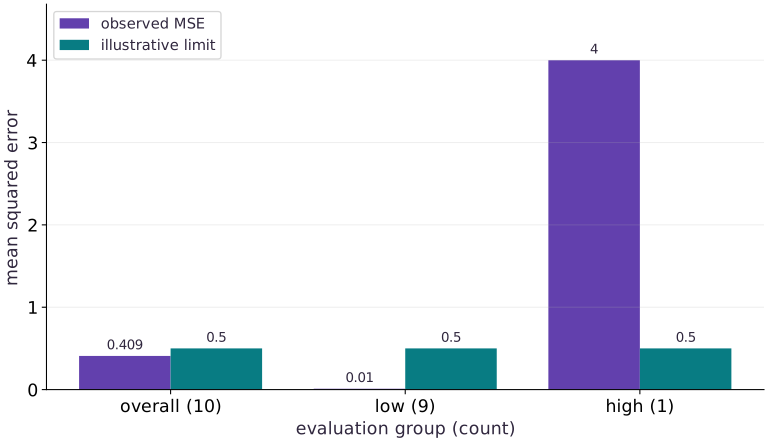
The slice plot shows where the fixture's aggregate hides a problem. Monitoring later asks whether input or outcome behavior changed. Drift is a signal to investigate; it does not by itself determine that retraining is the correct intervention.
Validate data before the expensive job
The fixture gives every observation an ID, a source group and a split. Validate names, finite numbers, allowed split values and group separation before training. Two different rows from the same subject or document can leak across splits even when row IDs differ. Hash the accepted manifest; reject unexpected schema changes explicitly. In a feature pipeline, also record event time, transformation version and missing-value rules to diagnose training-serving skew.
Use a fixed release evaluation
We inspect ten squared errors: nine values of and one value of . The count-weighted overall MSE is , below the illustrative limit . But the high-input slice has MSE , so the release must fail. An empty required slice also fails: zero observations are missing evidence, not perfect quality.
Separate code CI from model delivery
A practical pipeline validates the schema and source, runs numerical/unit checks, trains or retrieves a candidate, evaluates a frozen versioned set, packages and tests the serving artifact, then promotes a recorded image/model pair. Failed jobs must preserve the previous accepted bundle. The project contains a portable CI example; its MLflow SQLite store is isolated per job, and its container stage never publishes an image. In a team, durable metadata and artifact storage belong outside disposable workers.
Compare distributions without inventing labels
The input mix changes from to across two declared bins. Total variation is . This says the observed input distribution changed under that binning. It does not say the model became inaccurate: labels may arrive later, and seasonal mix changes can be harmless. Track data-quality errors, request volume, latency/error budgets, slice outcomes and delayed labels separately.
Plan a response instead of a reflex
An alert should name an owner, a runbook and a decision. Inspect whether a schema change, new population, broken preprocessing or genuine concept shift explains the evidence. Quarantine malformed inputs where appropriate; gather labels and compare a candidate before retraining or rollback. Retraining on corrupted data can make the situation worse. Record sample counts, time windows and alert thresholds; a small window can exaggerate apparent change.
Rehearse the failed gate
The connected project varies errors, rejects nonfinite metrics and absent slices, checks data leakage, and confirms that failed approval cannot change the active pointer. Add representative protected/business slices appropriate to your domain, with minimum counts and uncertainty review. The fixed two-slice exercise teaches the decision mechanism; it is not a fairness audit or production statistical threshold.
Run the release-policy stage from the extracted workspace
# Run run the release-policy stage from the extracted workspace using the course Python environment
python projects/engineering-release/tests/check.py --implementation solution --stage 1
Expected:
Independent data and slice-gate checks pass, including changed-condition failures.
An average can conceal the failing slice
Predict before looking: Which bar would an aggregate-only dashboard hide?
Read the figure
The categories are the overall set, the low-input slice and the high-input slice. Heights are squared-error means: , and . The second series marks the same illustrative acceptance limit for each category. The high slice crosses its limit even though the overall bar does not. There are nine low examples and only one high example; that imbalance explains the aggregate.
Connect it to the computation
The plot comes from the exact errors checked by gate_metrics. The changed-mix exercise makes the overall bar rise while preserving the two slice bars. Counts, uncertainty and domain-specific acceptance rules are necessary before using a similar policy on real data.
Open full-size figureDownload data and provenance
The notebook contains the data experiment, plotting code, and recorded figure output. Rerun it to test your changes.
Where to put & run this code: Work in phases/16-operations/06-mlops-data-contracts-and-release-pipelines/code/main.py (or downloaded exercises/operations-06.py / exercises/operations-06.ipynb) and execute from the repository root with python3 phases/16-operations/06-mlops-data-contracts-and-release-pipelines/code/main.py.
1 Prepare the explicit contract
Create main.py and add this setup block. Continue with the next block in the same file.
# Step 1 — Prepare the explicit contract: The fixture gives every observation an ID, a source group and a split.
import hashlib, json, math
The fixture gives every observation an ID, a source group and a split. Validate names, finite numbers, allowed split values and group separation before training. Two different rows from the same subject or document can leak across splits even when row IDs differ. Hash the accepted manifest; reject unexpected schema changes explicitly. In a feature pipeline, also record event time, transformation version and missing-value rules to diagnose training-serving skew.
2 Run and inspect the controlled experiment
Append this block, run main.py in the course environment, and retain the actual output.
# Step 2 — Run and inspect the controlled experiment: The input mix changes from [0.9,0.1] to [0.5,0.5] across two...
def digest(value):
    return hashlib.sha256(json.dumps(value, sort_keys=True, separators=(',', ':'), allow_nan=False).encode()).hexdigest()

def validate_rows(rows):
    """An observation has a stable identity, split, group, input and target."""
    # Guard input contract (`not rows`) and fail fast if violated.
    if not rows:
        raise ValueError('empty dataset')
    ids = set()
    groups = {}
    for row in rows:
        # Guard input contract (`set(row) != {'id', 'group', 'split', 'x', 'y'}`) and fail fast if violated.
        if set(row) != {'id', 'group', 'split', 'x', 'y'}:
            raise ValueError('schema mismatch')
        # Guard input contract (`not isinstance(row['id'], str) or not row['id'] or row['id'] in ids`) and fail fast if violated.
        if not isinstance(row['id'], str) or not row['id'] or row['id'] in ids:
            raise ValueError('duplicate or empty ID')
        # Guard input contract (`not isinstance(row['group'], str) or not row['group']`) and fail fast if violated.
        if not isinstance(row['group'], str) or not row['group']:
            raise ValueError('missing source group')
        # Guard input contract (`row['split'] not in {'train', 'validation', 'test'}`) and fail fast if violated.
        if row['split'] not in {'train', 'validation', 'test'}:
            raise ValueError('unknown split')
        for name in ['x', 'y']:
            # Guard input contract (`isinstance(row[name], bool) or not isinstance(row[name], (float, int)) or (not math.isfinite(row[name]))`) and fail fast if violated.
            if isinstance(row[name], bool) or not isinstance(row[name], (float, int)) or not math.isfinite(row[name]):
                raise ValueError('nonfinite or nonnumeric observation')
        # Guard input contract (`row['group'] in groups and groups[row['group']] != row['split']`) and fail fast if violated.
        if row['group'] in groups and groups[row['group']] != row['split']:
            raise ValueError('source group leaks between splits')
        # Execute `ids.add(row['id'])`
        ids.add(row['id'])
        groups[row['group']] = row['split']
    return digest(rows)

def gate_metrics(errors, slices, limit):
    """Count-weighted MSE plus every required slice; no empty-slice pass."""
    # Guard input contract (`len(errors) != len(slices) or not errors or (not math.isfinite(limit)) or (limit < 0)`) and fail fast if violated.
    if len(errors) != len(slices) or not errors or not math.isfinite(limit) or limit < 0:
        raise ValueError('invalid metric contract')
    # Guard input contract (`any((not math.isfinite(e) or e < 0 for e in errors))`) and fail fast if violated.
    if any(not math.isfinite(e) or e < 0 for e in errors):
        raise ValueError('invalid squared error')
    # Guard input contract (`not set(slices) <= {'low', 'high'}`) and fail fast if violated.
    if not set(slices) <= {'low', 'high'}:
        raise ValueError('unknown slice')
    result = {name: {'count': slices.count(name), 'mse': None} for name in ['low', 'high']}
    for name, item in result.items():
        selected = [e for e, s in zip(errors, slices) if s == name]
        if selected: item['mse'] = math.fsum(selected) / len(selected)
    result['overall'] = {'count': len(errors), 'mse': math.fsum(errors) / len(errors)}
    result['passed'] = all(v['count'] > 0 and v['mse'] <= limit for v in result.values())
    return result

rows = [dict(id=f'r{i}', group=f'g{i}', split='train' if i<4 else 'validation', x=float(i), y=2.*i+1.) for i in range(6)]
fingerprint = validate_rows(rows)
# Accumulate the next contribution into `changed[-1]['x']`.
changed = [dict(r) for r in rows]
changed[-1]['x'] += 1
assert validate_rows(changed) != fingerprint
leaked = [dict(r) for r in rows]
leaked[-1]['group'] = rows[0]['group']
# Run the boundary check and catch the expected exception:
try:
    validate_rows(leaked)
except ValueError:
    pass
else:
    raise AssertionError('cross-split source leakage accepted')
errors = [.01] * 9 + [4.]
slices = ['low'] * 9 + ['high']
metrics = gate_metrics(errors, slices, .5)
assert math.isclose(metrics['overall']['mse'], .409)
assert metrics['overall']['mse'] < .5 and not metrics['passed']
assert metrics['high']['count'] == 1 and metrics['high']['mse'] == 4.
assert not gate_metrics([.01]*9, ['low']*9, .5)['passed']
# Total variation on two declared bins: changed input mix is a diagnostic, not proof of degraded accuracy.
reference_mix = [.9, .1]
current_mix = [.5, .5]
shift = .5 * sum(abs(a-b) for a,b in zip(reference_mix,current_mix))
assert math.isclose(shift, .4)
print('Overall MSE:',metrics['overall']['mse'],'high-slice MSE:',metrics['high']['mse'],'release:',metrics['passed'])
print('Two-bin input total variation:',shift,'(requires investigation; not an automatic retraining order)')
Code building blocks in this step
digest(...)— Calldigestwith your updated parameters or inputs from this lesson's workspace.hashlib.sha256(...)— Callhashlib.sha256with your updated parameters or inputs from this lesson's workspace.assert condition— Verify that the observed output shape, status, or numerical value satisfies the contract.
The input mix changes from to across two declared bins. Total variation is . This says the observed input distribution changed under that binning. It does not say the model became inaccurate: labels may arrive later, and seasonal mix changes can be harmless. Track data-quality errors, request volume, latency/error budgets, slice outcomes and delayed labels separately.
3 Step 3: Verify invariants on the completed state
Run the final shape and numerical assertions to confirm the state built in Steps 1 and 2.
shift = .5 * sum(abs(a-b) for a,b in zip(reference_mix,current_mix))
assert math.isclose(shift, .4)
Code building blocks in this step
sum(...)— Callsumwith your updated parameters or inputs from this lesson's workspace.abs(...)— Callabswith your updated parameters or inputs from this lesson's workspace.assert condition— Verify that the observed output shape, status, or numerical value satisfies the contract.
Checking these invariants confirms the computation is ready for the full worked experiment.
View the cumulative build in main.py
These blocks append in order to the same file.
# Step 1 — Prepare the explicit contract: The fixture gives every observation an ID, a source group and a split.
import hashlib, json, math

# Step 2 — Run and inspect the controlled experiment: The input mix changes from [0.9,0.1] to [0.5,0.5] across two...
def digest(value):
    return hashlib.sha256(json.dumps(value, sort_keys=True, separators=(',', ':'), allow_nan=False).encode()).hexdigest()

def validate_rows(rows):
    """An observation has a stable identity, split, group, input and target."""
    # Guard input contract (`not rows`) and fail fast if violated.
    if not rows:
        raise ValueError('empty dataset')
    ids = set()
    groups = {}
    for row in rows:
        # Guard input contract (`set(row) != {'id', 'group', 'split', 'x', 'y'}`) and fail fast if violated.
        if set(row) != {'id', 'group', 'split', 'x', 'y'}:
            raise ValueError('schema mismatch')
        # Guard input contract (`not isinstance(row['id'], str) or not row['id'] or row['id'] in ids`) and fail fast if violated.
        if not isinstance(row['id'], str) or not row['id'] or row['id'] in ids:
            raise ValueError('duplicate or empty ID')
        # Guard input contract (`not isinstance(row['group'], str) or not row['group']`) and fail fast if violated.
        if not isinstance(row['group'], str) or not row['group']:
            raise ValueError('missing source group')
        # Guard input contract (`row['split'] not in {'train', 'validation', 'test'}`) and fail fast if violated.
        if row['split'] not in {'train', 'validation', 'test'}:
            raise ValueError('unknown split')
        for name in ['x', 'y']:
            # Guard input contract (`isinstance(row[name], bool) or not isinstance(row[name], (float, int)) or (not math.isfinite(row[name]))`) and fail fast if violated.
            if isinstance(row[name], bool) or not isinstance(row[name], (float, int)) or not math.isfinite(row[name]):
                raise ValueError('nonfinite or nonnumeric observation')
        # Guard input contract (`row['group'] in groups and groups[row['group']] != row['split']`) and fail fast if violated.
        if row['group'] in groups and groups[row['group']] != row['split']:
            raise ValueError('source group leaks between splits')
        # Execute `ids.add(row['id'])`
        ids.add(row['id'])
        groups[row['group']] = row['split']
    return digest(rows)

def gate_metrics(errors, slices, limit):
    """Count-weighted MSE plus every required slice; no empty-slice pass."""
    # Guard input contract (`len(errors) != len(slices) or not errors or (not math.isfinite(limit)) or (limit < 0)`) and fail fast if violated.
    if len(errors) != len(slices) or not errors or not math.isfinite(limit) or limit < 0:
        raise ValueError('invalid metric contract')
    # Guard input contract (`any((not math.isfinite(e) or e < 0 for e in errors))`) and fail fast if violated.
    if any(not math.isfinite(e) or e < 0 for e in errors):
        raise ValueError('invalid squared error')
    # Guard input contract (`not set(slices) <= {'low', 'high'}`) and fail fast if violated.
    if not set(slices) <= {'low', 'high'}:
        raise ValueError('unknown slice')
    result = {name: {'count': slices.count(name), 'mse': None} for name in ['low', 'high']}
    for name, item in result.items():
        selected = [e for e, s in zip(errors, slices) if s == name]
        if selected: item['mse'] = math.fsum(selected) / len(selected)
    result['overall'] = {'count': len(errors), 'mse': math.fsum(errors) / len(errors)}
    result['passed'] = all(v['count'] > 0 and v['mse'] <= limit for v in result.values())
    return result

rows = [dict(id=f'r{i}', group=f'g{i}', split='train' if i<4 else 'validation', x=float(i), y=2.*i+1.) for i in range(6)]
fingerprint = validate_rows(rows)
# Accumulate the next contribution into `changed[-1]['x']`.
changed = [dict(r) for r in rows]
changed[-1]['x'] += 1
assert validate_rows(changed) != fingerprint
leaked = [dict(r) for r in rows]
leaked[-1]['group'] = rows[0]['group']
# Run the boundary check and catch the expected exception:
try:
    validate_rows(leaked)
except ValueError:
    pass
else:
    raise AssertionError('cross-split source leakage accepted')
errors = [.01] * 9 + [4.]
slices = ['low'] * 9 + ['high']
metrics = gate_metrics(errors, slices, .5)
assert math.isclose(metrics['overall']['mse'], .409)
assert metrics['overall']['mse'] < .5 and not metrics['passed']
assert metrics['high']['count'] == 1 and metrics['high']['mse'] == 4.
assert not gate_metrics([.01]*9, ['low']*9, .5)['passed']
# Total variation on two declared bins: changed input mix is a diagnostic, not proof of degraded accuracy.
reference_mix = [.9, .1]
current_mix = [.5, .5]
shift = .5 * sum(abs(a-b) for a,b in zip(reference_mix,current_mix))
assert math.isclose(shift, .4)
print('Overall MSE:',metrics['overall']['mse'],'high-slice MSE:',metrics['high']['mse'],'release:',metrics['passed'])
print('Two-bin input total variation:',shift,'(requires investigation; not an automatic retraining order)')

shift = .5 * sum(abs(a-b) for a,b in zip(reference_mix,current_mix))
assert math.isclose(shift, .4)
Run the example
python3 phases/16-operations/06-mlops-data-contracts-and-release-pipelines/code/main.pyAbout this command
This shortcut uses an activated macOS/Linux course environment in the repository folder. For Windows, use the explicit interpreter command in “Setup help” above. The script includes worked examples and reference solutions.
Inspect the complete assembled example
# Step 1 — Prepare the explicit contract: The fixture gives every observation an ID, a source group and a split.
import hashlib, json, math

# Step 2 — Run and inspect the controlled experiment: The input mix changes from [0.9,0.1] to [0.5,0.5] across two...
def digest(value):
    return hashlib.sha256(json.dumps(value, sort_keys=True, separators=(',', ':'), allow_nan=False).encode()).hexdigest()

def validate_rows(rows):
    """An observation has a stable identity, split, group, input and target."""
    # Guard input contract (`not rows`) and fail fast if violated.
    if not rows:
        raise ValueError('empty dataset')
    ids = set()
    groups = {}
    for row in rows:
        # Guard input contract (`set(row) != {'id', 'group', 'split', 'x', 'y'}`) and fail fast if violated.
        if set(row) != {'id', 'group', 'split', 'x', 'y'}:
            raise ValueError('schema mismatch')
        # Guard input contract (`not isinstance(row['id'], str) or not row['id'] or row['id'] in ids`) and fail fast if violated.
        if not isinstance(row['id'], str) or not row['id'] or row['id'] in ids:
            raise ValueError('duplicate or empty ID')
        # Guard input contract (`not isinstance(row['group'], str) or not row['group']`) and fail fast if violated.
        if not isinstance(row['group'], str) or not row['group']:
            raise ValueError('missing source group')
        # Guard input contract (`row['split'] not in {'train', 'validation', 'test'}`) and fail fast if violated.
        if row['split'] not in {'train', 'validation', 'test'}:
            raise ValueError('unknown split')
        for name in ['x', 'y']:
            # Guard input contract (`isinstance(row[name], bool) or not isinstance(row[name], (float, int)) or (not math.isfinite(row[name]))`) and fail fast if violated.
            if isinstance(row[name], bool) or not isinstance(row[name], (float, int)) or not math.isfinite(row[name]):
                raise ValueError('nonfinite or nonnumeric observation')
        # Guard input contract (`row['group'] in groups and groups[row['group']] != row['split']`) and fail fast if violated.
        if row['group'] in groups and groups[row['group']] != row['split']:
            raise ValueError('source group leaks between splits')
        # Execute `ids.add(row['id'])`
        ids.add(row['id'])
        groups[row['group']] = row['split']
    return digest(rows)

def gate_metrics(errors, slices, limit):
    """Count-weighted MSE plus every required slice; no empty-slice pass."""
    # Guard input contract (`len(errors) != len(slices) or not errors or (not math.isfinite(limit)) or (limit < 0)`) and fail fast if violated.
    if len(errors) != len(slices) or not errors or not math.isfinite(limit) or limit < 0:
        raise ValueError('invalid metric contract')
    # Guard input contract (`any((not math.isfinite(e) or e < 0 for e in errors))`) and fail fast if violated.
    if any(not math.isfinite(e) or e < 0 for e in errors):
        raise ValueError('invalid squared error')
    # Guard input contract (`not set(slices) <= {'low', 'high'}`) and fail fast if violated.
    if not set(slices) <= {'low', 'high'}:
        raise ValueError('unknown slice')
    result = {name: {'count': slices.count(name), 'mse': None} for name in ['low', 'high']}
    for name, item in result.items():
        selected = [e for e, s in zip(errors, slices) if s == name]
        if selected: item['mse'] = math.fsum(selected) / len(selected)
    result['overall'] = {'count': len(errors), 'mse': math.fsum(errors) / len(errors)}
    result['passed'] = all(v['count'] > 0 and v['mse'] <= limit for v in result.values())
    return result

rows = [dict(id=f'r{i}', group=f'g{i}', split='train' if i<4 else 'validation', x=float(i), y=2.*i+1.) for i in range(6)]
fingerprint = validate_rows(rows)
# Accumulate the next contribution into `changed[-1]['x']`.
changed = [dict(r) for r in rows]
changed[-1]['x'] += 1
assert validate_rows(changed) != fingerprint
leaked = [dict(r) for r in rows]
leaked[-1]['group'] = rows[0]['group']
# Run the boundary check and catch the expected exception:
try:
    validate_rows(leaked)
except ValueError:
    pass
else:
    raise AssertionError('cross-split source leakage accepted')
errors = [.01] * 9 + [4.]
slices = ['low'] * 9 + ['high']
metrics = gate_metrics(errors, slices, .5)
assert math.isclose(metrics['overall']['mse'], .409)
assert metrics['overall']['mse'] < .5 and not metrics['passed']
assert metrics['high']['count'] == 1 and metrics['high']['mse'] == 4.
assert not gate_metrics([.01]*9, ['low']*9, .5)['passed']
# Total variation on two declared bins: changed input mix is a diagnostic, not proof of degraded accuracy.
reference_mix = [.9, .1]
current_mix = [.5, .5]
shift = .5 * sum(abs(a-b) for a,b in zip(reference_mix,current_mix))
assert math.isclose(shift, .4)
print('Overall MSE:',metrics['overall']['mse'],'high-slice MSE:',metrics['high']['mse'],'release:',metrics['passed'])
print('Two-bin input total variation:',shift,'(requires investigation; not an automatic retraining order)')
Expected result: Overall MSE: 0.409 high-slice MSE: 4.0 release: False Two-bin input total variation: 0.4 (requires investigation; not an automatic retraining order)
Recorded reference execution
Reference output captured from executing the complete lesson script (code/main.py) and its assertions in the course CPU environment.
Overall MSE: 0.409 high-slice MSE: 4.0 release: False
Two-bin input total variation: 0.4 (requires investigation; not an automatic retraining order)
Overall MSE: 0.409 high-slice MSE: 4.0 release: False
Two-bin input total variation: 0.4 (requires investigation; not an automatic retraining order)
Aggregate-only acceptance would miss the high-slice failure.
Unweighted slice average: 2.005
New population MSE: 3.601
PASS: operations-06
Download execution record · The notebook includes executed cells and figure outputs. Compare your run with these values; timings depend on the machine.
A good aggregate hides a bad slice
# Experiment — A good aggregate hides a bad slice: A policy must define both aggregation and required slice evidence.
assert metrics['overall']['mse'] < .5
assert metrics['high']['mse'] > .5 and metrics['passed'] is False
print('Aggregate-only acceptance would miss the high-slice failure.')
Expected: The overall score passes, but the complete gate fails.
A policy must define both aggregation and required slice evidence. The threshold is illustrative; its purpose must be justified in a real deployment.
Make it yours
Where to put your code: Append your solution at the bottom of phases/16-operations/06-mlops-data-contracts-and-release-pipelines/code/main.py (or inside the Make it yours cell of exercises/operations-06.ipynb) and run python3 phases/16-operations/06-mlops-data-contracts-and-release-pipelines/code/main.py to verify your prediction before opening the reference solution.
Show that averaging slice means without counts changes the overall error.
Show a writing guide and starter scaffold
How to write this exercise code: step-by-step recipe & starter scaffold
1. Key functions & syntax to use:
math.isclose(...)— Callmath.isclosewith your updated parameters or inputs from this lesson's workspace.assert condition— Verify that the observed output shape, status, or numerical value satisfies the contract.
2. Step-by-step implementation plan:
- Set up the changed input or configuration parameters requested in the prompt.
- Run the target function or transformation and assert that the output matches your prediction.
# Exercise solution: Show that averaging slice means without counts changes the overall error.
wrong = ...  # TODO: compute wrong
assert math.isclose(wrong,2.005)  # TODO: complete assertion check
print('Unweighted slice average:',wrong)
Reveal the reference solution
# Exercise solution: Show that averaging slice means without counts changes the overall error.
wrong=(metrics['low']['mse']+metrics['high']['mse'])/2
assert math.isclose(wrong,2.005) and not math.isclose(wrong,metrics['overall']['mse'])
print('Unweighted slice average:',wrong)
Change the population mix
transfer
Keep the two slice errors, but evaluate nine high-slice examples and one low-slice example.
Show a writing guide and starter scaffold
How to write this practice solution: step-by-step recipe & starter scaffold
1. Key functions & syntax to use:
mix(...)— Callmixwith your updated parameters or inputs from this lesson's workspace.gate_metrics(...)— Callgate_metricswith your updated parameters or inputs from this lesson's workspace.assert condition— Verify that the observed output shape, status, or numerical value satisfies the contract.
2. Step-by-step implementation plan:
- Change the population mix (transfer): Aggregate performance changes with population mix even when...
# Change the population mix (transfer): Aggregate performance changes with population mix even when...
shifted = gate_metrics(...)  # TODO: compute shifted
assert math.isclose(shifted['overall']['mse'],3.601)  # TODO: complete assertion check
assert shifted['high']['mse']  # TODO: complete assertion check
print('New population MSE:',shifted['overall']['mse'])
Show a hint
Change counts rather than the model errors.
Reveal reference solution and reasoning
# Change the population mix (transfer): Aggregate performance changes with population mix even when...
shifted=gate_metrics([.01]+[4.]*9,['low']+['high']*9,.5)
assert math.isclose(shifted['overall']['mse'],3.601)
assert shifted['high']['mse']==metrics['high']['mse']
print('New population MSE:',shifted['overall']['mse'])
Aggregate performance changes with population mix even when each slice’s error is unchanged. Report both before attributing the change to a model regression.
Diagnose the result
Check denominators and slice counts before thresholds. A missing slice, nonfinite metric or changed evaluation manifest should block comparison. Investigate drift and training-serving skew separately from service health.
Carry forward
- Validate data before the expensive job
- Compare distributions without inventing labels
- Rehearse the failed gate
Keep your evidence
Keep the leaking-group rejection, data fingerprint, slice counts and MSEs, aggregate/slice gate disagreement, changed-population calculation and a written response to drift without labels.
Save your modified code, its output, and an explanation of your prediction. Checkpoint answers and exercise evidence are tracked separately.
Saved in this browser. Export or back up your portfolio anytime in My learning.
Verified on local CPU. Stage to a Cloud TPU VM via Cloud TPU setup to record accelerator execution receipts (TODO: add automated Cloud TPU CI execution receipts).