 JAX Pathways
Phase 18 / Post-training: SFT, LoRA, reward models and RLHF
Supervised fine-tuning with response-only token loss
Revision v0.7.0 · Updated since your last visit. Review the changes; your progress is saved.
Lesson · about 105 minutes · CPU practice
Align predictions with their target tokens. Separate the attention mask from the loss mask.
Phase study guide: preparation, milestones and project evidence
Before you start
Before this: Self-supervised pretraining: masked and contrastive learning
Hardware: CPU
Setup help: Python, notebook, or Cloud TPU VM
Use the tested CPU packages (the recorded environment uses Python 3.14.3). Other Python versions and accelerator environments require separate checks. The optional Cloud TPU specialization explains the target-specific execution boundaries. Logical CPU devices practice partitioning; they do not simulate TPU performance.
Download the repository ZIP or use your existing checkout. Extract it and open a terminal in the folder containing requirements-cpu.txt. The beginner ZIP is separate; these lessons use the full repository folder.
python3 -m venv .venv
source .venv/bin/activate
python -m pip install -r requirements-cpu.txtpy -3 -m venv .venv
.\.venv\Scripts\python.exe -m pip install -r requirements-cpu.txtAfter activation, run the complete worked example from that same folder:
python phases/18-posttraining/01-sft/code/main.py.\.venv\Scripts\python.exe phases/18-posttraining/01-sft/code/main.pyFor an incremental build, create main.py in your own practice folder, append each build block in order, and run python main.py with this environment active. Keep that file separate from the downloaded reference solution.
Download this lesson’s notebook. Open it with a Python kernel using the course environment. Run cells from the top after restarting the kernel; experiments depend on earlier definitions.
For local Jupyter, first install the course requirements using the Local Python steps, then use your environment’s Python to start Jupyter:
python -m pip install jupyterlab
python -m jupyter lab.\.venv\Scripts\python.exe -m pip install jupyterlab
.\.venv\Scripts\python.exe -m jupyter labSelect the downloaded posttraining-01.ipynb file in JupyterLab. The notebook contains reference solutions; make your prediction and attempt each practice task before opening them. Restart the kernel before changing logical device setup.
The worked reference for this lesson is CPU-validated. Some references explicitly configure logical CPU devices; setting JAX_PLATFORMS does not adapt them to a TPU. Follow the execution matrix and reviewed multi-host example before attempting a target run.
For accelerator preparation, study TPU setup, observed runtime receipts, checkpointed jobs and precision and retained traces. These target paths remain unqualified on physical TPU hardware until an actual receipt is recorded. Cloud provisioning is optional for CPU learning.
Check: Response-only loss decreases from log(5) to below 0.15.
Revisit the guided CPU setup · Open 19: TPU Setup. Package instructions are CPU instructions; Windows and accelerator environments need their own validation.
What you will be able to do
- Align predictions with their target tokens
- Separate the attention mask from the loss mask
- Verify the changed-condition exercise and explain the limits of this fixture.
The problem
A conversation contains instructions and an answer. If we want to teach answer behavior, which tokens should receive loss? We will shift targets explicitly and exclude prompt tokens without hiding the prompt from the model.
The idea
Supervised fine-tuning teaches desired responses under a causal prediction objective. Response-only training scores selected target tokens while retaining prompt context. Correct token/role alignment determines which behavior the loss actually rewards.
Shift the supervision with the target
Input position predicts target . Therefore the response flag used for that loss must describe the target token. At a prompt/response boundary, using the input's flag instead can omit the first response target or score the wrong position.
A prompt position with no direct loss can still influence scored responses through causal attention. Its representations can participate in gradients. “Unscored” is not the same as “absent from computation.”
Aggregate by valid target tokens rather than averaging sequence or batch means blindly. The training plot demonstrates the fixture's masked objective; it is separate from instruction-following across unseen natural-language tasks.
Before coding: write the target table
For input tokens , the model at the first position predicts , and at the second predicts . The last position has no target in this sequence. Mark the two targets as answer and end-of-answer, even though the first supervised prediction is made from a prompt token. Write input, next target and target-role mask as three aligned rows before touching the loss.
The model here is a transition table: each current token selects a row of vocabulary logits. It has no long-range attention and cannot distinguish two histories ending in the same token. This makes the shift easy to inspect while keeping the boundary between objective practice and instruction-following explicit.
Align predictions with their target tokens
Logits at position predict token . Therefore shift the role mask with the target IDs. A prompt position can produce a supervised logit when its next token begins the answer. Masking logits according to the input role instead would drop that first answer token.
Separate the attention mask from the loss mask
The attention mask controls what the model sees; the response mask controls which predictions are scored. Prompt tokens must remain available as causal context even when predicting them is not the objective. Keep padding and packed-document boundaries out of valid targets. The final input position in this fixture has no next token and contributes no loss.
Work through sums, counts and unequal answer lengths
Uniform probabilities over five tokens give negative log probability at each supervised target. One supervised target contributes that amount; three targets contribute . Dividing total negative log likelihood by total valid targets returns for either batch. The sum returned by response_logps is intentionally not already a mean.
Once probabilities differ, sequence weighting matters. If one answer has token loss and another has three losses of , a token mean is while a sequence mean is . During gradient accumulation, carry numerator and count. Averaging unequal microbatch means changes the training objective.
Follow the first gradient to the prompt row
For a uniform five-class prediction with correct class , softmax cross-entropy has derivative for class and for each other class, before averaging across targets. The negative gradient increases the correct logit. The lookup row for prompt ID receives this signal because it predicts the first answer token. Excluding all prompt input positions would incorrectly discard that learning signal.
Do not confuse this with permission to inspect future answer tokens. A real causal Transformer must restrict attention independently of which targets count toward the loss. Changing the loss mask cannot repair a noncausal attention mask.
Choose a reduction and keep its denominator
This lab sums negative log probabilities of response and end tokens, then divides by the total supervised token count. That is a token-weighted loss: longer answers have greater total influence. Equal weighting per sequence is a different objective. Decide deliberately and retain both sequence and token counts.
Fine-tune an identified base model
In a real run record the base checkpoint, tokenizer, chat template, data revision and special-token configuration. Demonstrations may contain personal or sensitive text; use data with appropriate permission and review. Split by source or conversation identity before formatting. This executable table starts from uniform logits to isolate the objective; the LoRA lesson separately trains and freezes a base model before adaptation.
Check behavior and forgetting separately
A falling demonstration loss is not an instruction-following benchmark. Freeze a validation prompt set, compare answer quality under fixed decoding, and retain a base-task evaluation to detect forgetting. Do not tune prompt formatting or training duration against final test prompts.
Why the tiny table is not enough for instruction following
Two sequences ending in the same prompt token select exactly the same table row, so they must receive the same next-token distribution. If their intended answers differ because of earlier context, this model cannot represent the task. Demonstrate that collision before replacing the table with a Transformer.
For a real SFT experiment, retain a base checkpoint, tokenizer, chat template and source-group split. Test the exact formatted strings and role spans, compare fixed decoding on held-out prompts, and measure a retained base task for forgetting. Packed sequences require document attention boundaries as well as masks; padding must never become a target merely because it shares an end-token ID.
Supervised fine-tuning with response-only token loss — recorded experiment
Predict before looking: Predict the zero-gradient column before looking at the heatmap. Does a prompt input position necessarily have zero gradient?
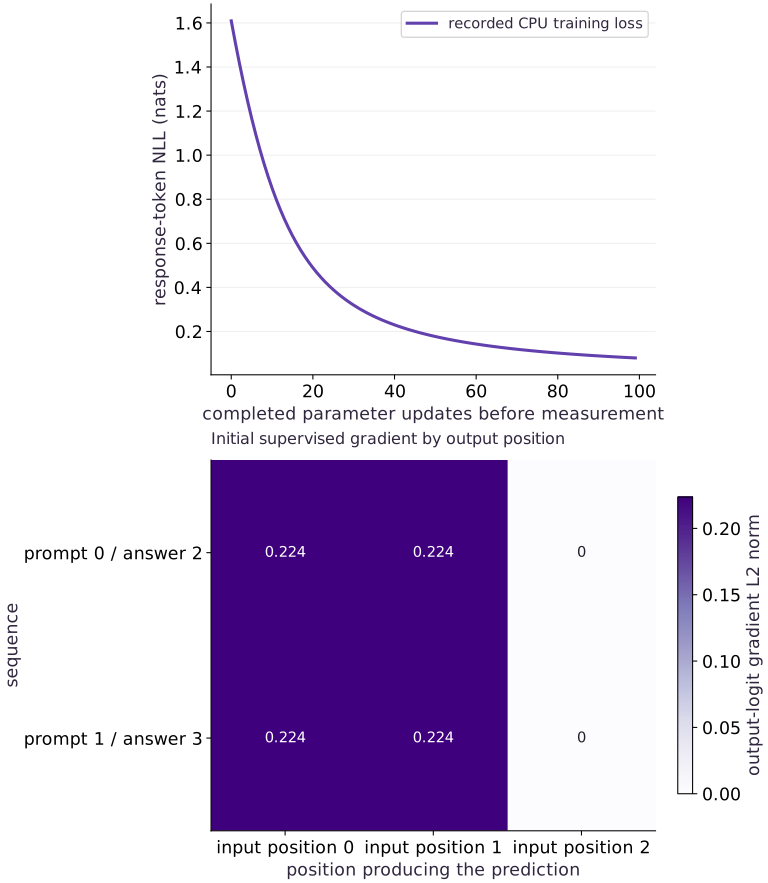
Read the figure
The curve shows response-token mean negative log likelihood before each update. Uniform predictions start at , then fall to about . It is the training loss of a five-token table, not a natural-language quality score.
The second panel is an initial-gradient audit, not another training curve. Rows are the two sequences and columns are positions producing logits. The first two columns have equal nonzero gradient norm because they predict answer and end tokens from uniform probabilities. The last column is zero because it has no next-token target. The first column belongs to a prompt input: its nonzero gradient is the evidence that the response mask was shifted with targets. This shows output-logit gradients, not all internal parameter gradients.
Connect it to the computation
The table learns prompt-to-answer and answer-to-end transitions. The independent gradient check confirms the intended target shift, and the mask exercise changes which target positions count without removing prompt context.
Open full-size figureDownload data and provenance
The notebook contains the data experiment, plotting code, and recorded figure output. Rerun it to test your changes.
Where to put & run this code: Work in phases/18-posttraining/01-sft/code/main.py (or downloaded exercises/posttraining-01.py / exercises/posttraining-01.ipynb) and execute from the repository root with python3 phases/18-posttraining/01-sft/code/main.py.
1 Define sequence log-probability sums
Create main.py in your activated course environment. Paste this block, then run python main.py; function definitions alone print nothing.
# Step 1 — 1. Define sequence log-probability sums: The slice removes the final logit and first token.
import jax
import jax.numpy as jnp
import numpy as np

def response_logps(logits, tokens, response_mask):
    # logits at t predict token t+1; the role mask belongs to the target token.
    logp = jax.nn.log_softmax(logits[:, :-1, :], axis=-1)
    selected = jnp.take_along_axis(logp, tokens[:, 1:, None], axis=-1)[..., 0]
    return jnp.sum(jnp.where(response_mask[:, 1:], selected, 0.0), axis=-1)

def validate_mask(selected, shape):
    # Convert `a` to a host NumPy array for inspection or verification.
    a = np.asarray(selected)
    # Guard input contract (`a.shape != shape or a.dtype != np.bool_ or (not a.any())`) and fail fast if violated.
    if a.shape != shape or a.dtype != np.bool_ or not a.any():
        raise ValueError('a nonempty Boolean mask of the target shape is required')
Code building blocks in this step
x.sum(axis=...) / x.mean(axis=..., keepdims=...)— Reduces values along the namedaxis(the axis you name is collapsed unlesskeepdims=True).
The slice removes the final logit and first token. The role mask is shifted with targets, preserving supervision of the first answer token.
2 Align prompt, response and target masks
Append this block to main.py and run python main.py again. Keep the earlier blocks above it.
# Token 0/1 is a prompt; 2/3 is its response; 4 marks the end.
tokens = jnp.array([[0, 2, 4], [1, 3, 4]], jnp.int32)
roles = jnp.array([[False, True, True]] * 2)
validate_mask(roles[:, 1:], tokens[:, 1:].shape)
p = jnp.zeros((5, 5))
history = []

def sft_objective(p):
    return -jnp.sum(response_logps(p[tokens], tokens, roles)) / jnp.sum(roles[:, 1:])

# Differentiate the objective to obtain `step` via automatic differentiation.
step = jax.jit(jax.value_and_grad(sft_objective))
Code building blocks in this step
jnp.array(values, dtype=...)— Constructs an immutable device-backed JAX array from Python/NumPy values.jnp.zeros / jnp.ones(shape, dtype=...)— Allocates a tensor of the givenshapeinitialized with constants.x.sum(axis=...) / x.mean(axis=..., keepdims=...)— Reduces values along the namedaxis(the axis you name is collapsed unlesskeepdims=True).jax.value_and_grad(loss_fn)(params, ...)— Evaluates both the scalar loss and its gradient PyTree(loss_val, grads)in a single forward+backward pass.
Inspect tokens and roles together. Every row has two valid next-token targets, so the loss denominator is four.
3 Fit the transition table and check the final position
Append this block to main.py and run python main.py again. Keep the earlier blocks above it.
# Step 3 — 3. Fit the transition table and check the final position: The table learns only local transitions.
for _ in range(100):
    value, g = step(p)
    history.append(float(value))
    p = p - 0.5 * g

np.testing.assert_allclose(history[0], np.log(5), atol=1e-6)
assert history[-1] < 0.15
assert np.array_equal(np.argmax(np.asarray(p)[[0, 1]], axis=1), [2, 3])
# The final position predicts nothing and has no contribution.
base_logits = p[tokens]
changed = base_logits.at[:, -1, :].set(100.0)
# Execute `np.testing.assert_allclose(`
np.testing.assert_allclose(
    response_logps(changed, tokens, roles),
    response_logps(base_logits, tokens, roles),
)
print('Response-only token NLL initial/final:', history[0], history[-1])
Code building blocks in this step
jnp.allclose(actual, expected, rtol=..., atol=...)— Checks that two arrays match elementwise within floating-point tolerance.
The table learns only local transitions. Its falling loss verifies these examples; the context-collision exercise exposes its architectural limit.
View the cumulative build in main.py
These blocks append in order to the same file.
# Step 1 — 1. Define sequence log-probability sums: The slice removes the final logit and first token.
import jax
import jax.numpy as jnp
import numpy as np

def response_logps(logits, tokens, response_mask):
    # logits at t predict token t+1; the role mask belongs to the target token.
    logp = jax.nn.log_softmax(logits[:, :-1, :], axis=-1)
    selected = jnp.take_along_axis(logp, tokens[:, 1:, None], axis=-1)[..., 0]
    return jnp.sum(jnp.where(response_mask[:, 1:], selected, 0.0), axis=-1)

def validate_mask(selected, shape):
    # Convert `a` to a host NumPy array for inspection or verification.
    a = np.asarray(selected)
    # Guard input contract (`a.shape != shape or a.dtype != np.bool_ or (not a.any())`) and fail fast if violated.
    if a.shape != shape or a.dtype != np.bool_ or not a.any():
        raise ValueError('a nonempty Boolean mask of the target shape is required')

# Token 0/1 is a prompt; 2/3 is its response; 4 marks the end.
tokens = jnp.array([[0, 2, 4], [1, 3, 4]], jnp.int32)
roles = jnp.array([[False, True, True]] * 2)
validate_mask(roles[:, 1:], tokens[:, 1:].shape)
p = jnp.zeros((5, 5))
history = []

def sft_objective(p):
    return -jnp.sum(response_logps(p[tokens], tokens, roles)) / jnp.sum(roles[:, 1:])

# Differentiate the objective to obtain `step` via automatic differentiation.
step = jax.jit(jax.value_and_grad(sft_objective))

# Step 3 — 3. Fit the transition table and check the final position: The table learns only local transitions.
for _ in range(100):
    value, g = step(p)
    history.append(float(value))
    p = p - 0.5 * g

np.testing.assert_allclose(history[0], np.log(5), atol=1e-6)
assert history[-1] < 0.15
assert np.array_equal(np.argmax(np.asarray(p)[[0, 1]], axis=1), [2, 3])
# The final position predicts nothing and has no contribution.
base_logits = p[tokens]
changed = base_logits.at[:, -1, :].set(100.0)
# Execute `np.testing.assert_allclose(`
np.testing.assert_allclose(
    response_logps(changed, tokens, roles),
    response_logps(base_logits, tokens, roles),
)
print('Response-only token NLL initial/final:', history[0], history[-1])
Run the example
python3 phases/18-posttraining/01-sft/code/main.pyAbout this command
This shortcut uses an activated macOS/Linux course environment in the repository folder. For Windows, use the explicit interpreter command in “Setup help” above. The script includes worked examples and reference solutions.
Inspect the complete assembled example
# Step 1 — 1. Define sequence log-probability sums: The slice removes the final logit and first token.
import jax
import jax.numpy as jnp
import numpy as np

def response_logps(logits, tokens, response_mask):
    # logits at t predict token t+1; the role mask belongs to the target token.
    logp = jax.nn.log_softmax(logits[:, :-1, :], axis=-1)
    selected = jnp.take_along_axis(logp, tokens[:, 1:, None], axis=-1)[..., 0]
    return jnp.sum(jnp.where(response_mask[:, 1:], selected, 0.0), axis=-1)

def validate_mask(selected, shape):
    # Convert `a` to a host NumPy array for inspection or verification.
    a = np.asarray(selected)
    # Guard input contract (`a.shape != shape or a.dtype != np.bool_ or (not a.any())`) and fail fast if violated.
    if a.shape != shape or a.dtype != np.bool_ or not a.any():
        raise ValueError('a nonempty Boolean mask of the target shape is required')

# Token 0/1 is a prompt; 2/3 is its response; 4 marks the end.
tokens = jnp.array([[0, 2, 4], [1, 3, 4]], jnp.int32)
roles = jnp.array([[False, True, True]] * 2)
validate_mask(roles[:, 1:], tokens[:, 1:].shape)
p = jnp.zeros((5, 5))
history = []

def sft_objective(p):
    return -jnp.sum(response_logps(p[tokens], tokens, roles)) / jnp.sum(roles[:, 1:])

# Differentiate the objective to obtain `step` via automatic differentiation.
step = jax.jit(jax.value_and_grad(sft_objective))

# Step 3 — 3. Fit the transition table and check the final position: The table learns only local transitions.
for _ in range(100):
    value, g = step(p)
    history.append(float(value))
    p = p - 0.5 * g

np.testing.assert_allclose(history[0], np.log(5), atol=1e-6)
assert history[-1] < 0.15
assert np.array_equal(np.argmax(np.asarray(p)[[0, 1]], axis=1), [2, 3])
# The final position predicts nothing and has no contribution.
base_logits = p[tokens]
changed = base_logits.at[:, -1, :].set(100.0)
# Execute `np.testing.assert_allclose(`
np.testing.assert_allclose(
    response_logps(changed, tokens, roles),
    response_logps(base_logits, tokens, roles),
)
print('Response-only token NLL initial/final:', history[0], history[-1])
Expected result: Response-only loss decreases from log(5) to below 0.15.
Recorded reference execution
Reference output captured from executing the complete lesson script (code/main.py) and its assertions in the course CPU environment.
Response-only token NLL initial/final: 1.6094379425048828 0.07985548675060272
Response-only token NLL initial/final: 1.6094379425048828 0.07985548675060272
Prompt rows learn to predict first answers; the final end-token row has no target.
Supervised targets per sequence: [2 3]
Two first-response targets: 0.07894014567136765
No-target SFT batch rejected
Identical final tokens force identical table predictions despite different contexts.
PASS: posttraining-01
Download execution record · The notebook includes executed cells and figure outputs. Compare your run with these values; timings depend on the machine.
Prove the target-mask shift
# Experiment — Prove the target-mask shift: The prediction made at the prompt position is supervised because...
# Differentiate the objective to obtain `g` via automatic differentiation.
g = jax.grad(sft_objective)(jnp.zeros((5, 5)))
assert np.linalg.norm(np.asarray(g)[0]) > 0 and np.linalg.norm(np.asarray(g)[1]) > 0
# Convert `` to a host NumPy array for inspection or verification.
np.testing.assert_array_equal(np.asarray(g)[4], 0.0)
print('Prompt rows learn to predict first answers; the final end-token row has no target.')
Expected: Rows for prompt IDs have nonzero gradients; the unused final-token row has zero gradient.
The prediction made at the prompt position is supervised because its target is an answer. Input-role masking would confuse context with target eligibility.
Check a ragged batch against a scalar loop
# Experiment — Check a ragged batch against a scalar loop: Padding and role masks affect the target after shifting.
ragged_tokens = jnp.array([[0, 2, 4, 4], [1, 3, 2, 4]])
ragged_roles = jnp.array([[False, True, True, False], [False, True, True, True]])
# Construct and reshape `ragged_logits` into the target tensor dimensions.
ragged_logits = jnp.arange(2 * 4 * 5, dtype=jnp.float32).reshape(2, 4, 5) / 19
observed = response_logps(ragged_logits, ragged_tokens, ragged_roles)
# Convert `arr` to a host NumPy array for inspection or verification.
arr = np.asarray(ragged_logits, dtype=np.float64)
expected = []
for row in range(2):
    total = 0.0
    for position in range(3):
        if ragged_roles[row, position + 1]:
            values = arr[row, position]
            log_normalizer = values.max() + np.log(np.exp(values - values.max()).sum())
            total += values[int(ragged_tokens[row, position + 1])] - log_normalizer
    expected.append(total)
np.testing.assert_allclose(observed, expected, atol=1e-6)
print('Supervised targets per sequence:', np.asarray(ragged_roles[:, 1:].sum(1)))
Expected: The target counts are two and three; scalar sequence sums match the vectorized implementation.
Padding and role masks affect the target after shifting. The host loop makes every included prediction explicit.
Make it yours
Where to put your code: Append your solution at the bottom of phases/18-posttraining/01-sft/code/main.py (or inside the Make it yours cell of exercises/posttraining-01.ipynb) and run python3 phases/18-posttraining/01-sft/code/main.py to verify your prediction before opening the reference solution.
Score only the first response token in each sequence and compare the resulting count and objective.
Show a writing guide and starter scaffold
How to write this exercise code: step-by-step recipe & starter scaffold
1. Key functions & syntax to use:
x.sum(axis=...) / x.mean(axis=..., keepdims=...)— Reduces values along the namedaxis(the axis you name is collapsed unlesskeepdims=True).jnp.isfinite(x)— Returns a boolean mask verifying that no element isNaNorInf.
2. Step-by-step implementation plan:
- Aggregate array values to compute
value. - Ensure all array elements remain finite:
np.isfinite(float(value))
# Exercise solution: Score only the first response token in each sequence and compare the...
first_only = ...  # TODO: compute first_only
# Aggregate array values to compute `value`.
value = ...  # TODO: compute value
    first_only[:, 1:]
)
assert int(jnp.sum(first_only[:, 1:]))  # TODO: complete assertion check
# Ensure all array elements remain finite: `np.isfinite(float(value))`
assert np.isfinite(float(value))  # TODO: complete assertion check
print('Two first-response targets:', float(value))
Reveal the reference solution
# Exercise solution: Score only the first response token in each sequence and compare the...
first_only = roles.at[:, 2].set(False)
# Aggregate array values to compute `value`.
value = -jnp.sum(response_logps(p[tokens], tokens, first_only)) / jnp.sum(
    first_only[:, 1:]
)
assert int(jnp.sum(first_only[:, 1:])) == 2
# Ensure all array elements remain finite: `np.isfinite(float(value))`
assert np.isfinite(float(value))
print('Two first-response targets:', float(value))
Reject a batch with no answer targets
Transfer
Validate an all-prompt batch before computing the token average.
Show a writing guide and starter scaffold
How to write this practice solution: step-by-step recipe & starter scaffold
1. Key functions & syntax to use:
targets(...)— Calltargetswith your updated parameters or inputs from this lesson's workspace.validate_mask(...)— Callvalidate_maskwith your updated parameters or inputs from this lesson's workspace.
2. Step-by-step implementation plan:
- Run the boundary check and catch the expected exception:
# Reject a batch with no answer targets (Transfer): An empty answer mask should trigger a clear skip/rejection...
# Run the boundary check and catch the expected exception:
try:
    validate_mask(jnp.zeros_like(roles[:, 1:]), tokens[:, 1:].shape)
except ValueError:
    print('No-target SFT batch rejected')
else:
    raise AssertionError('empty supervision accepted')
Show a hint
Use the shifted target mask, not the unshifted input mask.
Reveal reference solution and reasoning
# Reject a batch with no answer targets (Transfer): An empty answer mask should trigger a clear skip/rejection...
# Run the boundary check and catch the expected exception:
try:
    validate_mask(jnp.zeros_like(roles[:, 1:]), tokens[:, 1:].shape)
except ValueError:
    print('No-target SFT batch rejected')
else:
    raise AssertionError('empty supervision accepted')
An empty answer mask should trigger a clear skip/rejection policy before the update; a fabricated zero objective disguises lost training data.
Create a failure this model cannot fix
Challenge
Build two contexts ending in token zero but requiring different next tokens. Prove that the transition table gives identical distributions. Name the model capability needed to resolve the conflict.
Show a writing guide and starter scaffold
How to write this practice solution: step-by-step recipe & starter scaffold
1. Key functions & syntax to use:
jnp.array(values, dtype=...)— Constructs an immutable device-backed JAX array from Python/NumPy values.
2. Step-by-step implementation plan:
- Execute
np.testing.assert_array_equal(last_logits[0], last_logits[1]
# Create a failure this model cannot fix (Challenge): A model that conditions on the earlier context can represent...
contexts = jnp.array(...)  # TODO: compute contexts
last_logits = ...  # TODO: compute last_logits
# Execute `np.testing.assert_array_equal(last_logits[0], last_logits[1]`
np.testing.assert_array_equal(last_logits[0], last_logits[1])
conflicting_targets = jnp.array(...)  # TODO: compute conflicting_targets
assert conflicting_targets[0]  # TODO: complete assertion check
print('Identical final tokens force identical table predictions despite different contexts.')
Show a hint
Keep the final input token equal and change an earlier token.
Reveal reference solution and reasoning
# Create a failure this model cannot fix (Challenge): A model that conditions on the earlier context can represent...
contexts = jnp.array([[1, 0], [3, 0]])
last_logits = p[contexts[:, -1]]
# Execute `np.testing.assert_array_equal(last_logits[0], last_logits[1]`
np.testing.assert_array_equal(last_logits[0], last_logits[1])
conflicting_targets = jnp.array([2, 3])
assert conflicting_targets[0] != conflicting_targets[1]
print('Identical final tokens force identical table predictions despite different contexts.')
A model that conditions on the earlier context can represent this distinction. More iterations on the same transition-table architecture cannot.
Diagnose the result
When the first answer token fails to learn, inspect the shifted mask. When answer length changes the metric, compare token versus sequence weighting and retain valid target counts.
Carry forward
- Shift the role mask with target tokens so the prediction made at the last prompt position still supervises the first response token.
- Keep causal attention visibility separate from the response loss mask, and carry numerator and valid-target counts explicitly when answers have unequal lengths.
Keep your evidence
Keep shifted target/role masks, valid response-token counts, gradient support and the changed target-selection result.
Save your modified code, its output, and an explanation of your prediction. Checkpoint answers and exercise evidence are tracked separately.
Saved in this browser. Export or back up your portfolio anytime in My learning.
Verified on local CPU. Stage to a Cloud TPU VM via Cloud TPU setup to record accelerator execution receipts (TODO: add automated Cloud TPU CI execution receipts).