 JAX Pathways
Phase 17 / Self-supervised pretraining: masked and contrastive learning
Masked language modeling: predict hidden tokens
Revision v0.18.0 · Updated since your last visit. Review the changes; your progress is saved.
Lesson · about 105 minutes · CPU practice
Audit selected-token MLM loss and transfer a saved small encoder to held-out masks and a frozen representation probe.
Phase study guide: preparation, milestones and project evidence
Before you start
Before this: Transformers & language models
Hardware: CPU
Setup help: Python, notebook, or Cloud TPU VM
Use the tested CPU packages (the recorded environment uses Python 3.14.3). Other Python versions require separate checks. Hardware receipts apply only to their recorded source, environment, hardware, and cases; they do not qualify every lesson or TPU configuration. See the TPU performance and hardware evidence guide. The optional Cloud TPU specialization explains target-specific execution boundaries. Logical CPU devices practice partitioning; they do not simulate TPU performance.
Download the repository ZIP or use your existing checkout. Extract it and open a terminal in the folder containing requirements-cpu.txt. The beginner ZIP is separate; these lessons use the full repository folder.
python3 -m venv .venv
source .venv/bin/activate
python -m pip install -r requirements-cpu.txtpy -3 -m venv .venv
.\.venv\Scripts\python.exe -m pip install -r requirements-cpu.txtAfter activation, run the complete worked example from that same folder:
python phases/17-pretraining/01-mlm/code/main.py.\.venv\Scripts\python.exe phases/17-pretraining/01-mlm/code/main.pyFor an incremental build, create main.py in your own practice folder, append each build block in order, and run python main.py with this environment active. Keep that file separate from the downloaded reference solution.
Download this lesson’s notebook. Open it with a Python kernel using the course environment. Run cells from the top after restarting the kernel; experiments depend on earlier definitions.
For local Jupyter, first install the course requirements using the Local Python steps, then use your environment’s Python to start Jupyter:
python -m pip install jupyterlab
python -m jupyter lab.\.venv\Scripts\python.exe -m pip install jupyterlab
.\.venv\Scripts\python.exe -m jupyter labSelect the downloaded pretraining-01.ipynb file in JupyterLab. The notebook contains reference solutions; make your prediction and attempt each practice task before opening them. Restart the kernel before changing logical device setup.
The worked reference for this lesson is CPU-validated. Some references explicitly configure logical CPU devices; setting JAX_PLATFORMS does not adapt them to a TPU. Follow the execution matrix and reviewed multi-host example before attempting a target run.
For accelerator preparation, study TPU setup, observed runtime receipts, checkpointed jobs and precision and retained traces. Current receipts cover bounded v5e1 launch, resume, and precision checks; four single-device Pallas cases; and a four-device v5e collective fixture. Each receipt is limited to its recorded source, environment, cases, and hardware. It does not qualify all lessons or TPU configurations. Cloud provisioning is optional for CPU learning.
Check: Loss starts near 1.099 and ends below 0.02; an unseen mask position remains below 0.2.
Revisit the guided CPU setup · Open 19: TPU Setup. Package instructions are CPU instructions; Windows and accelerator environments need their own validation.
What you will be able to do
- Separate the clean targets from the corrupted input
- Normalize over selected target positions
- Verify the changed-condition exercise and explain the limits of this fixture.
- Save a small mask-aware encoder with its tokenizer and source-split identity, then evaluate a changed corruption condition and a frozen linear probe.
The problem
A text model can see a sentence but one word is hidden. What prevents it from copying the answer, and which positions should contribute to its loss? We will train a small bidirectional attention model and audit those two boundaries.
The idea
Masked language modeling removes selected token information from the model's input and asks it to predict the original tokens. The clean targets remain available to the loss, while the encoder receives only the corrupted sequence.
Hide the input without hiding the teaching target
A masked language model has two views of the same example: the clean sequence supplies answers, while a corrupted copy is the encoder input. In the diagram, follow each path to see where they meet: only selected-position logits are compared with clean labels in the loss. If a clean hidden token reaches the encoder, the model can copy its answer.
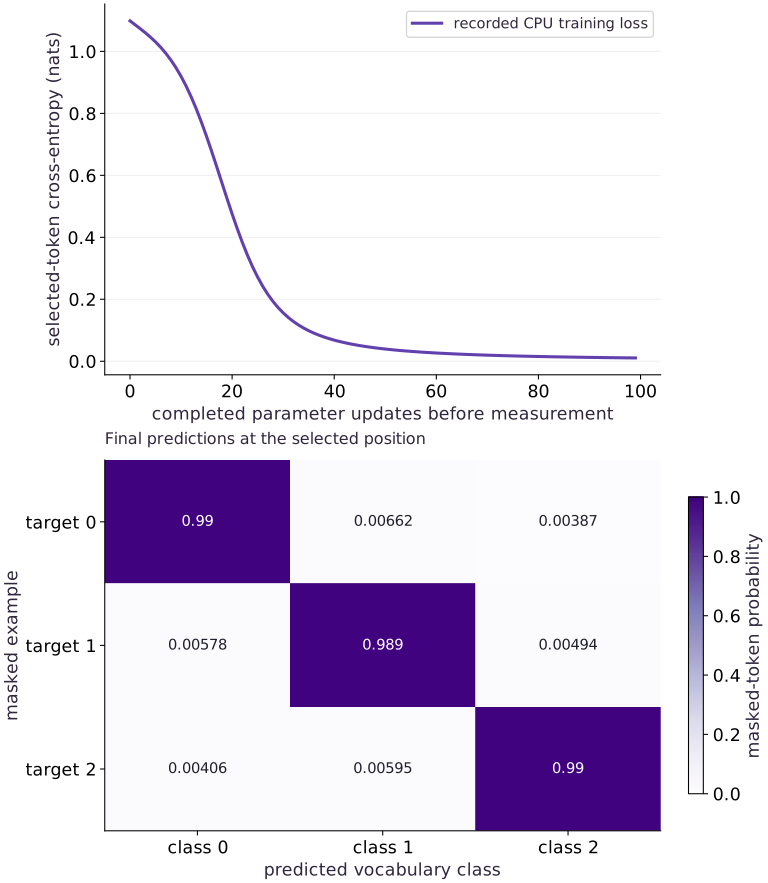
The loss curve falls on the repeated-token training fixture, and the probability panel shows the selected target gaining probability. Those pictures show optimization and a correct information boundary; they do not establish transfer. The recorded two-slot held-out check is a useful counterexample, read below.
Keep clean targets out of encoder inputs
Predict: If all visible tokens reveal the same class, what limit does that place on the experiment?
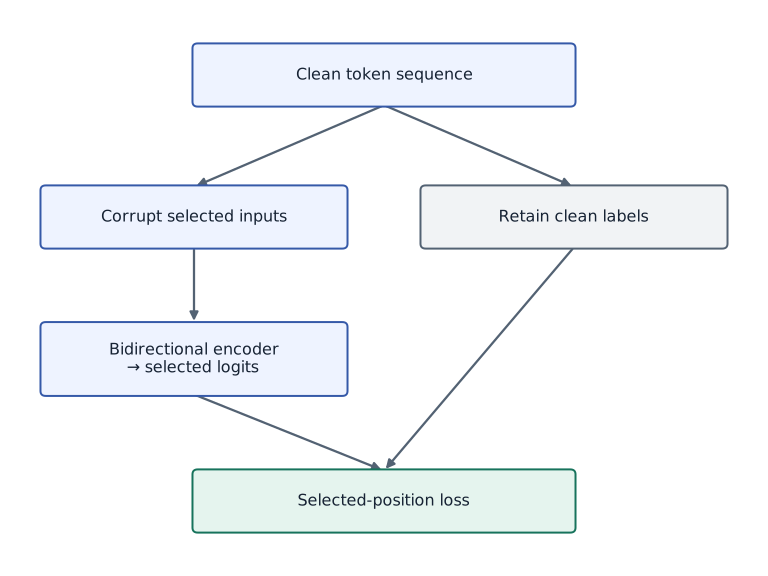
Clean tokens fork into labels and a corrupted-input path. Only corrupted inputs enter the encoder. Selected logits meet clean targets at the loss. This makes supervision available without leaking the hidden answer directly into the input.
Before coding: follow one hidden token
Take the first clean sequence, . If its second position is selected, replace only that input position to get ; keep the target at that position equal to . The ID means MASK and is not an output class. The visible zeros are context; the clean zero is the answer. Before training, write down the clean targets, corrupted input and Boolean selection mask separately.
Because every example repeats one token, visible context makes this exercise easy to inspect. It cannot tell us whether the model learned syntax, word order or meaning.
Separate the clean targets from the corrupted input
The selection mask answers which positions receive supervision. Corruption answers what the encoder sees at those positions. Keep the original IDs unchanged for labels, and replace selected input IDs with . Here the prediction classes remain . Inspect the arrays together: under this lesson’s always-MASK policy, replace the original value at each selected input position. Copies of that same token at unselected positions remain valid visible context. If an unselected target is scored, the loss mask is wrong.
Normalize over selected target positions
For each position, take log-softmax over the three vocabulary classes, gather the probability assigned to the original token, and average the negative log probabilities only where the selection mask is true. Uniform predictions give loss , whether one position or several are selected. The implementation rejects an empty mask because there is no selected-token mean to compute.
Trace the axes and the gradient
Trace the shapes to keep the two softmax operations distinct. Token embeddings have shape , attention scores have shape over query and key positions, and vocabulary logits have shape . Only the final axis of the logits is a choice among token classes.
In the derivative, is the number of selected targets. An unselected output has zero direct loss gradient. A visible input embedding can still receive gradient because attention uses it to predict a selected position.
Work out unequal masks before batching
Suppose one sequence has one selected-token loss of , and a second has three selected-token losses of each. Averaging selected tokens gives . Averaging the two sequence means gives . The second reduction weights examples equally; the first weights selected tokens equally. The code uses the latter, so distributed accumulation must combine loss sums and selected counts.
The audit also perturbs unselected logits. The loss and their direct gradients remain unchanged, as expected.
Use both sides without using the hidden value
Bidirectional attention lets a selected position use visible tokens on either side. There is no causal triangle in this encoder. That is useful for filling a missing word from both directions, but attention still sees only the corrupted input. This one-head model has no positional encoding, padding logic or tokenizer, so the fixture isolates information flow rather than a complete text encoder.
Distinguish selection from replacement policy
Selection and replacement are separate choices. This lab always writes MASK at selected positions, making the input path easy to inspect. Other MLM recipes may replace a selected token with MASK, a random token or leave it unchanged; each selected position still contributes its original clean token as the target. In a corpus, exclude padding and special tokens from selection and make the corruption schedule reproducible.
Test a different corruption before claiming progress
On the training fixture, loss moves from to . Moving the single mask to another slot without training gives , showing that this repeated-token task transfers across positions. The broader handoff changes to two selected positions and three held-out source groups: its loss is , above the uniform baseline , and the frozen probe reaches accuracy. That is a failure of this changed-condition transfer check, not evidence of general language ability.
Move from this fixture to a corpus deliberately
A useful next experiment is a document-separated corpus with a frozen tokenizer, explicit padding exclusion and a documented mask schedule. Compare random initialization and the trained checkpoint on the same held-out task, and report the summed token loss and selected-token count. Keep a failure example alongside the average so you can tell whether a bad prediction comes from the objective, a missing dependency or the data split. Moving a mask among these three repeated-token sequences is not a held-out-language test.
Route the bounded experiment into a frozen transfer check
Use this bounded CPU handoff to check whether the encoder survives saving and a stricter synthetic condition. It records vocabulary and source identity, saves and reloads the embedding and head with hashes, then evaluates two selected slots on groups g4–g6 against uniform loss . A ridge probe is fit only on g0–g2 and evaluated on g4–g6. The recorded two-slot loss is and probe accuracy is ; report these results as synthetic fixture evidence.
The project pilot files listed here are reading references. The public packet contains neither a loadable pilot checkpoint nor its tokenizer, and these synthetic groups are not SciFact or language-quality evidence.
Masked language modeling: predict hidden tokens — recorded experiment
Predict before looking: Which cell should dominate each row of final masked-token probabilities, and what would a bright wrong cell tell you?
Read the figure
The horizontal axis is the number of updates already applied; the vertical axis is selected-token cross-entropy in nats. The first value is about . It falls to about on the fixed synthetic sequences. This is training loss, not masked-token accuracy on natural text.
The second panel shows final class probabilities at the hidden position: rows are the three examples and columns are vocabulary classes. Read each row as a distribution that sums to one. The largest cell should lie at that row’s target class. This panel uses the parameters after the last update; the loss curve ends just before that update. Confident diagonal predictions establish this repetition task, not general language understanding.
Connect it to the computation
The zero vocabulary head makes initial predictions uniform. Falling loss shows the trained attention/embedding/head system can use the remaining repeated tokens. A held mask position is checked separately; the plot does not show a held-out corpus or establish transfer quality.
Figure data and execution details
Open full-size figureDownload data and provenance
The notebook contains the data experiment, plotting code, and recorded figure output. Rerun it to test your changes.
Your build: Create a separate main.py in your practice folder. Append each block in order and run python main.py in the lesson environment. The downloaded script is the complete reference, so keep it separate from your attempt.
1 Define corruption and the selected-token objective
Create main.py in your activated course environment. Paste this block, then run python main.py; function definitions alone print nothing.
# Step 1 — 1. Define corruption and the selected-token objective
import jax
import jax.numpy as jnp
import numpy as np

def masked_ce(logits, targets, selected):
    # Caller validates a nonempty mask before a transformed training step.
    logp = jax.nn.log_softmax(logits, axis=-1)
    nll = -jnp.take_along_axis(logp, targets[..., None], axis=-1)[..., 0]
    return jnp.sum(jnp.where(selected, nll, 0.0)) / jnp.sum(selected)

def validate_mask(selected, shape):
    # Transfer the device result to the host for an independent NumPy comparison.
    a = np.asarray(selected)
    if a.shape != shape or a.dtype != np.bool_ or not a.any():
        raise ValueError('a nonempty Boolean mask of the target shape is required')

def corrupt_tokens(tokens, selected, mask_id):
    validate_mask(selected, tokens.shape)
    return jnp.where(selected, mask_id, tokens)

def mlm_logits(p, corrupted):
    h = p['embedding'][corrupted]
    # Bidirectional single-head attention, deliberately no causal mask.
    scores = h @ jnp.swapaxes(h, -1, -2) / jnp.sqrt(h.shape[-1])
    context = jax.nn.softmax(scores, axis=-1) @ h
    return context @ p['head']
The functions separate the input boundary from the differentiable objective. Read masked_ce from vocabulary normalization to target gather to selected-count reduction.
Explain the APIs in this step
jnp.sum(x, axis=...): Adds JAX array values along the selected axis.
2 Construct a batch whose answers you can inspect
Append this block to main.py and run python main.py again. Keep the earlier blocks above it.
# Step 2 — 2. Construct a batch whose answers you can inspect
tokens = jnp.array([[0, 0, 0, 0], [1, 1, 1, 1], [2, 2, 2, 2]], jnp.int32)
selected = jnp.array([[False, True, False, False]] * 3)
corrupted = corrupt_tokens(tokens, selected, 3)
# Create or split explicit PRNG key(s) (`key`) for reproducible randomness.
key = jax.random.key(7)
# Sample deterministic random values into `p` using an explicit PRNG key.
p = {
    'embedding': jax.random.normal(key, (4, 6)) * 0.2,
    'head': jnp.zeros((6, 3)),
}
loss = lambda p: masked_ce(mlm_logits(p, corrupted), tokens, selected)
step = jax.jit(jax.value_and_grad(loss))
history = []
Before continuing, inspect corrupted: each row must contain mask ID at the second position. The zero head makes the initial vocabulary distribution uniform.
Explain the APIs in this step
jnp.array(values, dtype=...): Constructs a JAX array from Python/NumPy values.jax.random.key(seed): Creates a typed explicit PRNG key from a seed.jax.random.normal(key, shape, dtype=...): Draws normal random values using an explicit PRNG key.jnp.zeros(shape, dtype=...): Creates a JAX array of the requested shape filled with zeros.
3 Train, then change the corruption
Append this block to main.py and run python main.py again. Keep the earlier blocks above it.
# Step 3 — 3. Train, then change the corruption: The loop measures loss before each update.
for _ in range(100):
    value, g = step(p)
    history.append(float(value))
    p = jax.tree.map(lambda a, b: a - 0.4 * b, p, g)

assert history[-1] < history[0] * 0.15
np.testing.assert_allclose(history[0], np.log(3), atol=1e-6)
# Changing the clean target after constructing corrupted input cannot change the forward pass.
changed_targets = tokens.at[:, 1].set((tokens[:, 1] + 1) % 3)
assert not np.isclose(
    float(masked_ce(mlm_logits(p, corrupted), changed_targets, selected)),
    history[-1],
)
held_mask = jnp.array([[False, False, True, False]] * 3)
held_loss = float(
    masked_ce(mlm_logits(p, corrupt_tokens(tokens, held_mask, 3)), tokens, held_mask)
)
assert held_loss < 0.2
print('MLM initial/final/changed-mask:', history[0], history[-1], held_loss)
The loop measures loss before each update. The final held-mask test uses the updated parameters; do not compare it as if it were the final recorded pre-update point.
Explain the APIs in this step
jax.tree.map(fn, tree, ...): Applies a function leaf-by-leaf across matching PyTrees.np.testing.assert_allclose(actual, desired, rtol=..., atol=...): Checks a host-side numerical expectation and raisesAssertionErrorwhen values differ beyond tolerance.jnp.array(values, dtype=...): Constructs a JAX array from Python/NumPy values.
4 Save the encoder, change one condition, and probe it
Run the preceding build cells first, then continue with this saved-encoder handoff. Run this block in a fresh Python process. It starts by recreating this lesson’s canonical synthetic fixture, then saves/reloads it, changes one declared condition, and runs the transfer check. The duplicated setup is intentional because generated scripts place staged blocks before the main example.
# Changed condition + saved-encoder handoff + frozen probe (synthetic teaching fixture)
import hashlib, json, tempfile
from pathlib import Path

def digest_arrays(*arrays):
    h = hashlib.sha256()
    for a in arrays:
        h.update(np.ascontiguousarray(a).tobytes())
    return h.hexdigest()

# A changed corruption schedule selects two slots. Same clean targets and tokenizer.
changed_mask = jnp.array([[True, False, True, False]] * 3)
changed_input = corrupt_tokens(tokens, changed_mask, 3)
changed_loss = float(masked_ce(mlm_logits(p, changed_input), tokens, changed_mask))
uniform_baseline = float(np.log(3.0))
assert np.isfinite(changed_loss) and changed_mask.sum() == 6

# Source groups are explicit and disjoint; each held-out source repeats the frozen token map.
train_group_ids, heldout_group_ids = ['g0','g1','g2'], ['g4','g5','g6']
assert set(train_group_ids).isdisjoint(heldout_group_ids)
processor_id = 'lesson-vocab:0=zero,1=one,2=two,3=MASK'
source_split_id = 'synthetic-repeated-token-v1:g0-g2/g4-g6'
encoder_before = np.asarray(p['embedding']).copy()
head_before = np.asarray(p['head']).copy()
parameter_hash = digest_arrays(encoder_before, head_before)
manifest = {'model_id':'mlm-attention-4x6-v1','processor_id':processor_id,
            'source_split_id':source_split_id,'objective':'selected-token-CE',
            'mask_schedule':'two-of-four; positions 0 and 2','fit_group_ids':train_group_ids,'heldout_group_ids':['g4','g5','g6'],'seed':7,'parameter_sha256':parameter_hash}
output_dir = Path(tempfile.mkdtemp(prefix='jaxpathways-mlm-transfer-'))
artifact = output_dir / 'encoder.npz'

np.savez(artifact, embedding=encoder_before, head=head_before,
         manifest=np.array(json.dumps(manifest, sort_keys=True)))
with np.load(artifact, allow_pickle=False) as saved:
    loaded_manifest = json.loads(str(saved['manifest']))
    loaded_encoder = saved['embedding'].copy()
    loaded_head = saved['head'].copy()
assert loaded_manifest == manifest
assert digest_arrays(loaded_encoder, loaded_head) == manifest['parameter_sha256']
checkpoint_hash=hashlib.sha256(artifact.read_bytes()).hexdigest()
identity_path=output_dir/'identity.json'
identity={**manifest,'checkpoint_sha256':checkpoint_hash}
identity_path.write_text(json.dumps(identity,sort_keys=True))
assert hashlib.sha256(artifact.read_bytes()).hexdigest()==identity['checkpoint_sha256']
held_group_ids = ['g4','g5','g6']
assert set(train_group_ids).isdisjoint(held_group_ids)
held_tokens = jnp.array([[0,1,0,1],[1,2,1,2],[2,0,2,0]],jnp.int32)
held_input = corrupt_tokens(held_tokens, changed_mask, 3)
loaded_model = {'embedding':jnp.asarray(loaded_encoder),'head':jnp.asarray(loaded_head)}
changed_loss = float(masked_ce(mlm_logits(loaded_model,held_input),held_tokens,changed_mask))
# Frozen mean-token encoder representation. Fit probe weights on train groups only.
x = np.asarray(tokens)
features = loaded_encoder[x].mean(axis=1)
y = np.asarray([0,1,2])
design = np.c_[features, np.ones(len(features))]
probe = np.linalg.solve(design.T @ design + 1e-3*np.eye(design.shape[1]), design.T @ y)
held_tokens = np.asarray([[0,1,0,1],[1,2,1,2],[2,0,2,0]])
held_features = loaded_encoder[held_tokens].mean(axis=1)
held_pred = np.rint(np.c_[held_features, np.ones(3)] @ probe).astype(int)
held_accuracy = float(np.mean(held_pred == y))
assert np.allclose(loaded_encoder, encoder_before)
print('MLM changed-mask loss / uniform baseline / frozen held-out probe accuracy:',
      changed_loss, uniform_baseline, held_accuracy)
print('Artifact path:', artifact)
print('Identity sidecar:', identity_path)
print('Saved identity:', manifest['model_id'], manifest['processor_id'], manifest['source_split_id'])
This changed-condition run is deliberately a tiny synthetic extension of the lesson. The saved identity is checked before scoring. Only the probe coefficients are fit after load; the encoder arrays are compared byte-for-byte before and after.
Explain the APIs in this step
jnp.array(values, dtype=...): Constructs a JAX array from Python/NumPy values.np.isfinite(x): Returns a NumPy boolean array marking elements that are neitherNaNnor infinite.array.sum(axis=...): Adds values along the selected axis; that axis is removed unlesskeepdims=True.array.mean(axis=..., keepdims=...): Averages values along the selected axis; that axis is removed unlesskeepdims=True.
View the cumulative build in main.py
These blocks append in order to your separate practice file.
# Step 1 — 1. Define corruption and the selected-token objective
import jax
import jax.numpy as jnp
import numpy as np

def masked_ce(logits, targets, selected):
    # Caller validates a nonempty mask before a transformed training step.
    logp = jax.nn.log_softmax(logits, axis=-1)
    nll = -jnp.take_along_axis(logp, targets[..., None], axis=-1)[..., 0]
    return jnp.sum(jnp.where(selected, nll, 0.0)) / jnp.sum(selected)

def validate_mask(selected, shape):
    # Transfer the device result to the host for an independent NumPy comparison.
    a = np.asarray(selected)
    if a.shape != shape or a.dtype != np.bool_ or not a.any():
        raise ValueError('a nonempty Boolean mask of the target shape is required')

def corrupt_tokens(tokens, selected, mask_id):
    validate_mask(selected, tokens.shape)
    return jnp.where(selected, mask_id, tokens)

def mlm_logits(p, corrupted):
    h = p['embedding'][corrupted]
    # Bidirectional single-head attention, deliberately no causal mask.
    scores = h @ jnp.swapaxes(h, -1, -2) / jnp.sqrt(h.shape[-1])
    context = jax.nn.softmax(scores, axis=-1) @ h
    return context @ p['head']

# Step 2 — 2. Construct a batch whose answers you can inspect
tokens = jnp.array([[0, 0, 0, 0], [1, 1, 1, 1], [2, 2, 2, 2]], jnp.int32)
selected = jnp.array([[False, True, False, False]] * 3)
corrupted = corrupt_tokens(tokens, selected, 3)
# Create or split explicit PRNG key(s) (`key`) for reproducible randomness.
key = jax.random.key(7)
# Sample deterministic random values into `p` using an explicit PRNG key.
p = {
    'embedding': jax.random.normal(key, (4, 6)) * 0.2,
    'head': jnp.zeros((6, 3)),
}
loss = lambda p: masked_ce(mlm_logits(p, corrupted), tokens, selected)
step = jax.jit(jax.value_and_grad(loss))
history = []

# Step 3 — 3. Train, then change the corruption: The loop measures loss before each update.
for _ in range(100):
    value, g = step(p)
    history.append(float(value))
    p = jax.tree.map(lambda a, b: a - 0.4 * b, p, g)

assert history[-1] < history[0] * 0.15
np.testing.assert_allclose(history[0], np.log(3), atol=1e-6)
# Changing the clean target after constructing corrupted input cannot change the forward pass.
changed_targets = tokens.at[:, 1].set((tokens[:, 1] + 1) % 3)
assert not np.isclose(
    float(masked_ce(mlm_logits(p, corrupted), changed_targets, selected)),
    history[-1],
)
held_mask = jnp.array([[False, False, True, False]] * 3)
held_loss = float(
    masked_ce(mlm_logits(p, corrupt_tokens(tokens, held_mask, 3)), tokens, held_mask)
)
assert held_loss < 0.2
print('MLM initial/final/changed-mask:', history[0], history[-1], held_loss)

# Changed condition + saved-encoder handoff + frozen probe (synthetic teaching fixture)
import hashlib, json, tempfile
from pathlib import Path

def digest_arrays(*arrays):
    h = hashlib.sha256()
    for a in arrays:
        h.update(np.ascontiguousarray(a).tobytes())
    return h.hexdigest()

# A changed corruption schedule selects two slots. Same clean targets and tokenizer.
changed_mask = jnp.array([[True, False, True, False]] * 3)
changed_input = corrupt_tokens(tokens, changed_mask, 3)
changed_loss = float(masked_ce(mlm_logits(p, changed_input), tokens, changed_mask))
uniform_baseline = float(np.log(3.0))
assert np.isfinite(changed_loss) and changed_mask.sum() == 6

# Source groups are explicit and disjoint; each held-out source repeats the frozen token map.
train_group_ids, heldout_group_ids = ['g0','g1','g2'], ['g4','g5','g6']
assert set(train_group_ids).isdisjoint(heldout_group_ids)
processor_id = 'lesson-vocab:0=zero,1=one,2=two,3=MASK'
source_split_id = 'synthetic-repeated-token-v1:g0-g2/g4-g6'
encoder_before = np.asarray(p['embedding']).copy()
head_before = np.asarray(p['head']).copy()
parameter_hash = digest_arrays(encoder_before, head_before)
manifest = {'model_id':'mlm-attention-4x6-v1','processor_id':processor_id,
            'source_split_id':source_split_id,'objective':'selected-token-CE',
            'mask_schedule':'two-of-four; positions 0 and 2','fit_group_ids':train_group_ids,'heldout_group_ids':['g4','g5','g6'],'seed':7,'parameter_sha256':parameter_hash}
output_dir = Path(tempfile.mkdtemp(prefix='jaxpathways-mlm-transfer-'))
artifact = output_dir / 'encoder.npz'

np.savez(artifact, embedding=encoder_before, head=head_before,
         manifest=np.array(json.dumps(manifest, sort_keys=True)))
with np.load(artifact, allow_pickle=False) as saved:
    loaded_manifest = json.loads(str(saved['manifest']))
    loaded_encoder = saved['embedding'].copy()
    loaded_head = saved['head'].copy()
assert loaded_manifest == manifest
assert digest_arrays(loaded_encoder, loaded_head) == manifest['parameter_sha256']
checkpoint_hash=hashlib.sha256(artifact.read_bytes()).hexdigest()
identity_path=output_dir/'identity.json'
identity={**manifest,'checkpoint_sha256':checkpoint_hash}
identity_path.write_text(json.dumps(identity,sort_keys=True))
assert hashlib.sha256(artifact.read_bytes()).hexdigest()==identity['checkpoint_sha256']
held_group_ids = ['g4','g5','g6']
assert set(train_group_ids).isdisjoint(held_group_ids)
held_tokens = jnp.array([[0,1,0,1],[1,2,1,2],[2,0,2,0]],jnp.int32)
held_input = corrupt_tokens(held_tokens, changed_mask, 3)
loaded_model = {'embedding':jnp.asarray(loaded_encoder),'head':jnp.asarray(loaded_head)}
changed_loss = float(masked_ce(mlm_logits(loaded_model,held_input),held_tokens,changed_mask))
# Frozen mean-token encoder representation. Fit probe weights on train groups only.
x = np.asarray(tokens)
features = loaded_encoder[x].mean(axis=1)
y = np.asarray([0,1,2])
design = np.c_[features, np.ones(len(features))]
probe = np.linalg.solve(design.T @ design + 1e-3*np.eye(design.shape[1]), design.T @ y)
held_tokens = np.asarray([[0,1,0,1],[1,2,1,2],[2,0,2,0]])
held_features = loaded_encoder[held_tokens].mean(axis=1)
held_pred = np.rint(np.c_[held_features, np.ones(3)] @ probe).astype(int)
held_accuracy = float(np.mean(held_pred == y))
assert np.allclose(loaded_encoder, encoder_before)
print('MLM changed-mask loss / uniform baseline / frozen held-out probe accuracy:',
      changed_loss, uniform_baseline, held_accuracy)
print('Artifact path:', artifact)
print('Identity sidecar:', identity_path)
print('Saved identity:', manifest['model_id'], manifest['processor_id'], manifest['source_split_id'])
Run the example
python3 phases/17-pretraining/01-mlm/code/main.pyAbout this command
This shortcut uses an activated macOS/Linux course environment in the repository folder. For Windows, use the explicit interpreter command in “Setup help” above. The script includes worked examples and reference solutions.
Inspect the complete assembled example
# Step 1 — 1. Define corruption and the selected-token objective
import jax
import jax.numpy as jnp
import numpy as np

def masked_ce(logits, targets, selected):
    # Caller validates a nonempty mask before a transformed training step.
    logp = jax.nn.log_softmax(logits, axis=-1)
    nll = -jnp.take_along_axis(logp, targets[..., None], axis=-1)[..., 0]
    return jnp.sum(jnp.where(selected, nll, 0.0)) / jnp.sum(selected)

def validate_mask(selected, shape):
    # Transfer the device result to the host for an independent NumPy comparison.
    a = np.asarray(selected)
    if a.shape != shape or a.dtype != np.bool_ or not a.any():
        raise ValueError('a nonempty Boolean mask of the target shape is required')

def corrupt_tokens(tokens, selected, mask_id):
    validate_mask(selected, tokens.shape)
    return jnp.where(selected, mask_id, tokens)

def mlm_logits(p, corrupted):
    h = p['embedding'][corrupted]
    # Bidirectional single-head attention, deliberately no causal mask.
    scores = h @ jnp.swapaxes(h, -1, -2) / jnp.sqrt(h.shape[-1])
    context = jax.nn.softmax(scores, axis=-1) @ h
    return context @ p['head']

# Step 2 — 2. Construct a batch whose answers you can inspect
tokens = jnp.array([[0, 0, 0, 0], [1, 1, 1, 1], [2, 2, 2, 2]], jnp.int32)
selected = jnp.array([[False, True, False, False]] * 3)
corrupted = corrupt_tokens(tokens, selected, 3)
# Create or split explicit PRNG key(s) (`key`) for reproducible randomness.
key = jax.random.key(7)
# Sample deterministic random values into `p` using an explicit PRNG key.
p = {
    'embedding': jax.random.normal(key, (4, 6)) * 0.2,
    'head': jnp.zeros((6, 3)),
}
loss = lambda p: masked_ce(mlm_logits(p, corrupted), tokens, selected)
step = jax.jit(jax.value_and_grad(loss))
history = []

# Step 3 — 3. Train, then change the corruption: The loop measures loss before each update.
for _ in range(100):
    value, g = step(p)
    history.append(float(value))
    p = jax.tree.map(lambda a, b: a - 0.4 * b, p, g)

assert history[-1] < history[0] * 0.15
np.testing.assert_allclose(history[0], np.log(3), atol=1e-6)
# Changing the clean target after constructing corrupted input cannot change the forward pass.
changed_targets = tokens.at[:, 1].set((tokens[:, 1] + 1) % 3)
assert not np.isclose(
    float(masked_ce(mlm_logits(p, corrupted), changed_targets, selected)),
    history[-1],
)
held_mask = jnp.array([[False, False, True, False]] * 3)
held_loss = float(
    masked_ce(mlm_logits(p, corrupt_tokens(tokens, held_mask, 3)), tokens, held_mask)
)
assert held_loss < 0.2
print('MLM initial/final/changed-mask:', history[0], history[-1], held_loss)
Expected result: Loss starts near 1.099 and ends below 0.02; an unseen mask position remains below 0.2.
Recorded output and runtime details
Reference output captured from executing the complete lesson script (code/main.py) and its assertions in the course CPU environment.
MLM initial/final/changed-mask: 1.0986123085021973 0.010633035562932491 0.010457751341164112
MLM changed-mask loss / uniform baseline / frozen held-out probe accuracy: 3.571091890335083 1.0986122886681098 0.6666666666666666
Artifact path: /var/folders/mp/_mq7srqx2y10p5nhjz9m7hj40000gn/T/jaxpathways-mlm-transfer-9wnh3y8w/encoder.npz
Identity sidecar: /var/folders/mp/_mq7srqx2y10p5nhjz9m7hj40000gn/T/jaxpathways-mlm-transfer-9wnh3y8w/identity.json
Saved identity: mlm-attention-4x6-v1 lesson-vocab:0=zero,1=one,2=two,3=MASK synthetic-repeated-token-v1:g0-g2/g4-g6
MLM initial/final/changed-mask: 1.0986123085021973 0.010633035562932491 0.010457751341164112
Unselected output logits have zero direct loss gradient.
Token-weighted / sequence-weighted: 0.6577723026275635 0.51289606
MLM changed-mask loss / uniform baseline / frozen held-out probe accuracy: 3.571091890335083 1.0986122886681098 0.6666666666666666
Artifact path: /var/folders/mp/_mq7srqx2y10p5nhjz9m7hj40000gn/T/jaxpathways-mlm-transfer-pue6iqn6/encoder.npz
Identity sidecar: /var/folders/mp/_mq7srqx2y10p5nhjz9m7hj40000gn/T/jaxpathways-mlm-transfer-pue6iqn6/identity.json
Saved identity: mlm-attention-4x6-v1 lesson-vocab:0=zero,1=one,2=two,3=MASK synthetic-repeated-token-v1:g0-g2/g4-g6
Changed position loss: 0.010457751341164112
Empty mask rejected
Independent masked softmax gradient agrees.
PASS: pretraining-01
Download execution record · The notebook includes executed cells and figure outputs. Compare your run with these values; timings depend on the machine.
Show that unsupervised positions have no direct loss gradient
# Experiment — Show that unsupervised positions have no direct loss gradient
logits = mlm_logits(p, corrupted)
changed_logits = jnp.where(
    selected[..., None], logits, logits + jnp.array([100.0, -50.0, 7.0])
)
np.testing.assert_allclose(
    masked_ce(changed_logits, tokens, selected),
    masked_ce(logits, tokens, selected),
    atol=1e-6,
)
grad_logits = jax.grad(masked_ce)(logits, tokens, selected)
# Transfer the device result to the host for an independent NumPy comparison.
np.testing.assert_array_equal(np.asarray(grad_logits)[~np.asarray(selected)], 0.0)
print('Unselected output logits have zero direct loss gradient.')
Expected: Unselected logits do not affect the masked loss and have zero direct gradient.
Visible input tokens can still influence selected predictions through attention. Zero direct gradient at an unselected output is not a claim that visible-token embeddings never learn. The perturbation changes class differences; adding one common scalar to every class would leave softmax unchanged even at supervised positions and would be a weak masking check.
Use unequal selection counts and a host probability calculation
# Experiment — Use unequal selection counts and a host probability calculation: The second sequence supplies three of four selected tokens.
audit_probs = jnp.array([
    [[0.8, 0.1, 0.1], [0.2, 0.7, 0.1], [0.2, 0.3, 0.5]],
    [[0.1, 0.6, 0.3], [0.5, 0.2, 0.3], [0.3, 0.4, 0.3]],
])
audit_targets = jnp.array([[0, 1, 2], [1, 0, 2]])
audit_mask = jnp.array([[True, False, False], [True, True, True]])
audit_logits = jnp.log(audit_probs)
host_losses = -np.log(
    np.asarray(audit_probs)[
        np.arange(2)[:, None], np.arange(3)[None, :], np.asarray(audit_targets)
    ]
)
expected = host_losses[np.asarray(audit_mask)].mean()
observed = float(masked_ce(audit_logits, audit_targets, audit_mask))
np.testing.assert_allclose(observed, expected, atol=1e-6)
sequence_mean = np.mean(
    [host_losses[i][np.asarray(audit_mask[i])].mean() for i in range(2)]
)
assert not np.isclose(observed, sequence_mean)
print('Token-weighted / sequence-weighted:', observed, sequence_mean)
Expected: The independent selected-token mean agrees; the sequence-weighted mean differs.
The second sequence supplies three of four selected tokens. Equal sequence weighting gives the first sequence half of the influence instead of one quarter.
Change the corruption schedule, reload the encoder, and fit a frozen probe
# Changed condition + saved-encoder handoff + frozen probe (synthetic teaching fixture)
import hashlib, json, tempfile
from pathlib import Path

def digest_arrays(*arrays):
    h = hashlib.sha256()
    for a in arrays:
        h.update(np.ascontiguousarray(a).tobytes())
    return h.hexdigest()

# A changed corruption schedule selects two slots. Same clean targets and tokenizer.
changed_mask = jnp.array([[True, False, True, False]] * 3)
changed_input = corrupt_tokens(tokens, changed_mask, 3)
changed_loss = float(masked_ce(mlm_logits(p, changed_input), tokens, changed_mask))
uniform_baseline = float(np.log(3.0))
assert np.isfinite(changed_loss) and changed_mask.sum() == 6

# Source groups are explicit and disjoint; each held-out source repeats the frozen token map.
train_group_ids, heldout_group_ids = ['g0','g1','g2'], ['g4','g5','g6']
assert set(train_group_ids).isdisjoint(heldout_group_ids)
processor_id = 'lesson-vocab:0=zero,1=one,2=two,3=MASK'
source_split_id = 'synthetic-repeated-token-v1:g0-g2/g4-g6'
encoder_before = np.asarray(p['embedding']).copy()
head_before = np.asarray(p['head']).copy()
parameter_hash = digest_arrays(encoder_before, head_before)
manifest = {'model_id':'mlm-attention-4x6-v1','processor_id':processor_id,
            'source_split_id':source_split_id,'objective':'selected-token-CE',
            'mask_schedule':'two-of-four; positions 0 and 2','fit_group_ids':train_group_ids,'heldout_group_ids':['g4','g5','g6'],'seed':7,'parameter_sha256':parameter_hash}
output_dir = Path(tempfile.mkdtemp(prefix='jaxpathways-mlm-transfer-'))
artifact = output_dir / 'encoder.npz'

np.savez(artifact, embedding=encoder_before, head=head_before,
         manifest=np.array(json.dumps(manifest, sort_keys=True)))
with np.load(artifact, allow_pickle=False) as saved:
    loaded_manifest = json.loads(str(saved['manifest']))
    loaded_encoder = saved['embedding'].copy()
    loaded_head = saved['head'].copy()
assert loaded_manifest == manifest
assert digest_arrays(loaded_encoder, loaded_head) == manifest['parameter_sha256']
checkpoint_hash=hashlib.sha256(artifact.read_bytes()).hexdigest()
identity_path=output_dir/'identity.json'
identity={**manifest,'checkpoint_sha256':checkpoint_hash}
identity_path.write_text(json.dumps(identity,sort_keys=True))
assert hashlib.sha256(artifact.read_bytes()).hexdigest()==identity['checkpoint_sha256']
held_group_ids = ['g4','g5','g6']
assert set(train_group_ids).isdisjoint(held_group_ids)
held_tokens = jnp.array([[0,1,0,1],[1,2,1,2],[2,0,2,0]],jnp.int32)
held_input = corrupt_tokens(held_tokens, changed_mask, 3)
loaded_model = {'embedding':jnp.asarray(loaded_encoder),'head':jnp.asarray(loaded_head)}
changed_loss = float(masked_ce(mlm_logits(loaded_model,held_input),held_tokens,changed_mask))
# Frozen mean-token encoder representation. Fit probe weights on train groups only.
x = np.asarray(tokens)
features = loaded_encoder[x].mean(axis=1)
y = np.asarray([0,1,2])
design = np.c_[features, np.ones(len(features))]
probe = np.linalg.solve(design.T @ design + 1e-3*np.eye(design.shape[1]), design.T @ y)
held_tokens = np.asarray([[0,1,0,1],[1,2,1,2],[2,0,2,0]])
held_features = loaded_encoder[held_tokens].mean(axis=1)
held_pred = np.rint(np.c_[held_features, np.ones(3)] @ probe).astype(int)
held_accuracy = float(np.mean(held_pred == y))
assert np.allclose(loaded_encoder, encoder_before)
print('MLM changed-mask loss / uniform baseline / frozen held-out probe accuracy:',
      changed_loss, uniform_baseline, held_accuracy)
print('Artifact path:', artifact)
print('Identity sidecar:', identity_path)
print('Saved identity:', manifest['model_id'], manifest['processor_id'], manifest['source_split_id'])
Expected: The checkpoint and identity sidecar round-trip. The changed-mask held-out loss is compared with uniform log(3), and the frozen probe is evaluated without encoder updates.
In this run, changed-mask held-out loss is about 3.57 nats, above the uniform baseline of 1.10, and the three-row probe scores 2/3. These are clear failure signals for changed-condition transfer on this synthetic fixture. Do not summarize the low training loss as transfer success; a natural-language task needs its own split and baseline.
Make it yours
Where to put your code: Modify your own main.py, or use the Make it yours cell in your downloaded notebook. Run your attempt in the declared environment and verify your prediction before opening the reference solution.
Select the first position instead of the second and evaluate the trained model without updating it.
Show a writing guide and starter scaffold
How to write this exercise code
Learner-only inputs, outputs, checks and hints
Inputs
- A trained model apply function and parameters, token IDs, original target IDs, mask token ID, and a selection mask with the first position selected.
Outputs
- Predictions and selected-token loss at the first position, evaluated without changing parameters.
Invariants to check
- Only selected positions contribute to loss; clean target IDs are labels, not model inputs. Gradient from the selected loss may flow through shared attention into visible context representations.
Hints
- Corrupt the selected input position while keeping its clean target separate.
- Run the trained parameters in evaluation mode and do not apply an optimizer update.
import jax.numpy as jnp

def evaluate_alternate_mask(apply_model, params, tokens, targets, mask_id, selected):
    # TODO: corrupt the selected input, run the trained model, and score the selected clean target.
    raise NotImplementedError
Reveal the reference solution
# Exercise solution
first_mask = jnp.array([[True, False, False, False]] * 3)
first_loss = float(
    masked_ce(mlm_logits(p, corrupt_tokens(tokens, first_mask, 3)), tokens, first_mask)
)
assert first_loss < 0.2
print('Changed position loss:', first_loss)
Reject a missing learning signal
Transfer
Pass an empty selection mask through the public corruption boundary and require a clear failure.
Show a writing guide and starter scaffold
How to write this practice solution
Learner-only inputs, outputs, checks and hints
Inputs
- A token batch and an all-false Boolean selection mask.
Outputs
- A clear ValueError before any zero-count loss reduction.
Invariants to check
- A batch with no selected targets cannot silently produce NaN or a zero training signal.
Hints
- Validate the mask at the public corruption boundary.
- Check shape and selected count before entering a transformed loss.
import jax.numpy as jnp
import numpy as np

def require_selected_positions(tokens, selected, mask_id):
    # TODO: validate the mask and return a corrupted token batch.
    raise NotImplementedError
Show a hint
Validate outside the transformed objective before dividing by a count.
Reveal reference solution and reasoning
# Reject a missing learning signal (Transfer): A skipped batch requires an explicit training policy.
try:
    corrupt_tokens(tokens, jnp.zeros_like(tokens, dtype=bool), 3)
except ValueError:
    print('Empty mask rejected')
else:
    raise AssertionError('empty mask accepted')
A skipped batch requires an explicit training policy. It must not silently become a zero loss or a NaN update.
Derive the output gradient without autodiff
Challenge
Implement the probability-minus-one-hot formula for the unequal-mask fixture and compare every element with autodiff. Explain where visible context can still receive gradient.
Show a writing guide and starter scaffold
How to write this practice solution
Learner-only inputs, outputs, checks and hints
Inputs
- One logits tensor, integer target IDs, and a nonuniform selected mask.
Outputs
- The analytical softmax-cross-entropy gradient and an autodiff comparison.
Invariants to check
- Unselected token gradients are zero; selected token gradients sum to zero across vocabulary.
Hints
- For each selected row, start from probability minus one-hot target.
- Include the selected-count normalization and compare with autodiff.
import jax.numpy as jnp
import numpy as np

def compare_masked_logit_gradients(logits, targets, selected):
    # TODO: derive the masked gradient and compare it elementwise with autodiff.
    raise NotImplementedError
Show a hint
Broadcast the mask over vocabulary and divide by the selected count, not the batch size.
Reveal reference solution and reasoning
# Derive the output gradient without autodiff (Challenge)
# Reduce along axis=-1 to compute `analytic`.
analytic = (
    (jax.nn.softmax(audit_logits, axis=-1) - jax.nn.one_hot(audit_targets, 3))
    * audit_mask[..., None]
    / audit_mask.sum()
)
np.testing.assert_allclose(
    jax.grad(masked_ce)(audit_logits, audit_targets, audit_mask),
    analytic,
    atol=1e-6,
)
print('Independent masked softmax gradient agrees.')
This verifies the entire derivative tensor, including zeros at unsupervised outputs. It says nothing by itself about intermediate embedding gradients.
Diagnose the result
If loss is suspiciously perfect at initialization, inspect target leakage and the selection count. If loss becomes NaN, reject empty masks and inspect vocabulary indices before changing the optimizer.
Carry forward
- Keep the input-corruption boundary separate from the loss mask: corrupted inputs with shape enter the encoder, while clean targets meet vocabulary logits of shape only inside the selected-token cross-entropy.
- Normalize masked loss by the count of selected tokens , reject empty masks before entering a jitted step, and carry numerator and selected-token counts explicitly when accumulating across unequal batches.
- The lesson-level checkpoint is an auditable synthetic handoff, not the omitted final8 pilot weights. A held-out masked loss and frozen probe are separate measurements and neither overturns the pilot’s failed SciFact floors.
Keep your evidence
Keep clean/corrupted masks, selected-position denominators and independent gradients, plus saved encoder/processor identity, held-out loss versus uniform baseline, a frozen probe and honest changed-condition failures.
Save your modified code, its output, and an explanation of your prediction. Checkpoint answers and exercise evidence are tracked separately.
Saved in this browser. Export or back up your portfolio anytime in My learning.
Reference execution: CPU validation only. This worked reference is validated on CPU. Accelerator compatibility requires a separate source review and target execution receipt. Use the execution matrix to review device selection and data ownership before adapting a separate target program. Execution matrix and target qualification.