 JAX Pathways
Phase 17 / Self-supervised pretraining: masked and contrastive learning
Contrastive learning: views, positives and negatives
Revision v0.7.0 · Updated since your last visit. Review the changes; your progress is saved.
Lesson · about 105 minutes · CPU practice
Define the positive pair before augmenting. Normalize embeddings and introduce temperature.
Phase study guide: preparation, milestones and project evidence
Before you start
Before this: Masked image modeling: reconstruct missing patches
Hardware: CPU
Setup help: Python, notebook, or Cloud TPU VM
Use the tested CPU packages (the recorded environment uses Python 3.14.3). Other Python versions and accelerator environments require separate checks. The optional Cloud TPU specialization explains the target-specific execution boundaries. Logical CPU devices practice partitioning; they do not simulate TPU performance.
Download the repository ZIP or use your existing checkout. Extract it and open a terminal in the folder containing requirements-cpu.txt. The beginner ZIP is separate; these lessons use the full repository folder.
python3 -m venv .venv
source .venv/bin/activate
python -m pip install -r requirements-cpu.txtpy -3 -m venv .venv
.\.venv\Scripts\python.exe -m pip install -r requirements-cpu.txtAfter activation, run the complete worked example from that same folder:
python phases/17-pretraining/03-contrastive/code/main.py.\.venv\Scripts\python.exe phases/17-pretraining/03-contrastive/code/main.pyFor an incremental build, create main.py in your own practice folder, append each build block in order, and run python main.py with this environment active. Keep that file separate from the downloaded reference solution.
Download this lesson’s notebook. Open it with a Python kernel using the course environment. Run cells from the top after restarting the kernel; experiments depend on earlier definitions.
For local Jupyter, first install the course requirements using the Local Python steps, then use your environment’s Python to start Jupyter:
python -m pip install jupyterlab
python -m jupyter lab.\.venv\Scripts\python.exe -m pip install jupyterlab
.\.venv\Scripts\python.exe -m jupyter labSelect the downloaded pretraining-03.ipynb file in JupyterLab. The notebook contains reference solutions; make your prediction and attempt each practice task before opening them. Restart the kernel before changing logical device setup.
The worked reference for this lesson is CPU-validated. Some references explicitly configure logical CPU devices; setting JAX_PLATFORMS does not adapt them to a TPU. Follow the execution matrix and reviewed multi-host example before attempting a target run.
For accelerator preparation, study TPU setup, observed runtime receipts, checkpointed jobs and precision and retained traces. These target paths remain unqualified on physical TPU hardware until an actual receipt is recorded. Cloud provisioning is optional for CPU learning.
Check: Training loss decreases and all four paired views are nearest neighbors.
Revisit the guided CPU setup · Open 19: TPU Setup. Package instructions are CPU instructions; Windows and accelerator environments need their own validation.
What you will be able to do
- Define the positive pair before augmenting
- Normalize embeddings and introduce temperature
- Verify the changed-condition exercise and explain the limits of this fixture.
The problem
Two transformed views belong to the same source example. Can an encoder place them close together without mapping every input to the same point? We will inspect exactly which pairs the objective treats as positives.
The idea
Contrastive learning compares representations using declared positive and negative relationships. Encoders and normalization produce comparable vectors, but the pairing rule decides which similarities the objective rewards.
Define positive pairs before building the score matrix
Place one view on each score-matrix axis and mark the intended positive pairs. A diagonal positive mask assumes one matching pair per aligned index. If several examples share the same valid meaning, treating every off-diagonal entry as negative can create false negatives.
Temperature scales logits and changes concentration and gradient behavior; it does not change the underlying cosine values before scaling. Keep those two quantities on distinct labels.
Read both query directions when the objective trains both directions. A strong diagonal on a tiny fixture is separate from broad semantic retrieval. Inspect changed pairings and ambiguous cases, and avoid inventing a faithful two-dimensional picture of a higher-dimensional representation.
Before coding: make the retrieval problem explicit
Write four source IDs on cards and create two views of each. A row of the similarity matrix asks which right-hand card matches one left-hand card. A column asks the reverse. The diagonal is correct only while both lists have the same order. Source IDs, not array positions, define the positive relationship.
Our left and right views are short numeric vectors, and both pass through one shared linear encoder. CLIP uses separate image and text towers. The bookkeeping lesson transfers, but this four-pair exercise is not an image–text model. First learn how a correct pair competes with alternatives; only then replace the encoders and data.
Define the positive pair before augmenting
Keep stable source IDs through both view pipelines. The positive for row i must still be the matching source in the other view. Augmentations encode an invariance assumption: a transformation that changes the label can create a false positive. Here small fixed perturbations preserve four explicitly defined directions.
Normalize embeddings and introduce temperature
Unit-normalize embeddings, compute dot products, and divide by a positive temperature . Lower temperature sharpens the categorical comparison. It does not change which pair is correct, and it is not automatically better. A norm floor defines numerical behavior near zero, but zero embeddings are still a collapsed representation.
Calculate a two-pair objective by hand
For two orthogonal unit vectors paired with themselves, the cosine matrix has ones on the diagonal and zeros elsewhere. At temperature , the correct candidate receives probability . Both retrieval directions are identical, so the symmetric loss reduces to the expression below. A smaller temperature lowers this particular loss without changing which candidate ranks first.
Now swap only the right-hand order while retaining diagonal labels. The correct semantic match is off diagonal, but training is told to prefer the wrong card. Confident mistakes are penalized more strongly at low temperature. Lower training loss and better ranking are therefore related, but not interchangeable measurements.
Follow one row of the derivative
For logits , row cross-entropy contributes derivative before the symmetric half weight. The target logit is pushed up; competing logits are pushed down. The column objective adds another contribution. Unit normalization means the underlying encoder gradients also pass through the normalization Jacobian. A finite-difference check on an encoder weight tests that whole chain.
A collapsed representation has equal probabilities, but avoiding collapse on four training pairs does not prove semantics. Duplicate sources are especially revealing: they are indistinguishable candidates that diagonal-only supervision still treats as competitors.
Check both directions independently
A row asks which right-hand view belongs to a left-hand example; a column asks the reverse question. The code calculates both with a stable host log-sum-exp reference. Check that jointly permuting both views preserves the objective. Permuting only one view without remapping targets should change the task.
Understand collapse and false negatives
If every embedding is the same, every candidate has equal probability and the loss is . That is a useful baseline, not a proof that every gradient path can escape collapse. Distinct source examples may share semantics; treating duplicates as negatives can penalize useful similarity. The cross-modal harness adds a multi-positive objective for that case.
Separate pretraining evidence from downstream quality
The line records the four-pair training objective, and retrieval is checked on those same pairs. Neither is a linear-probe evaluation. A full representation study freezes the encoder, fits a small supervised probe using training labels and evaluates a held-out split; alternatively compare fine-tuning with random initialization under the same budget. Keep projection-head and encoder outputs distinct.
Design an evaluation that is not just training-pair lookup
Freeze source-group splits before augmentation. Fit any probe on the training split only; evaluate on unseen source groups. Keep a fixed candidate pool for retrieval and define multiple-positive judgments and ties. Enlarging the pool makes the ranking task harder and changes the loss baseline, even if encoder weights remain unchanged.
Retain both the encoder representation and projection-head choice when reporting results. A representation useful to a linear probe can differ from the vector used by the training objective. For the next project, compare random, frozen pretrained and adapted encoders under one evaluation protocol, then inspect at least one correctly retrieved example and one plausible false negative.
Contrastive learning: views, positives and negatives — recorded experiment
Predict before looking: Predict where the largest similarity should appear in each row. What would a one-sided permutation do?
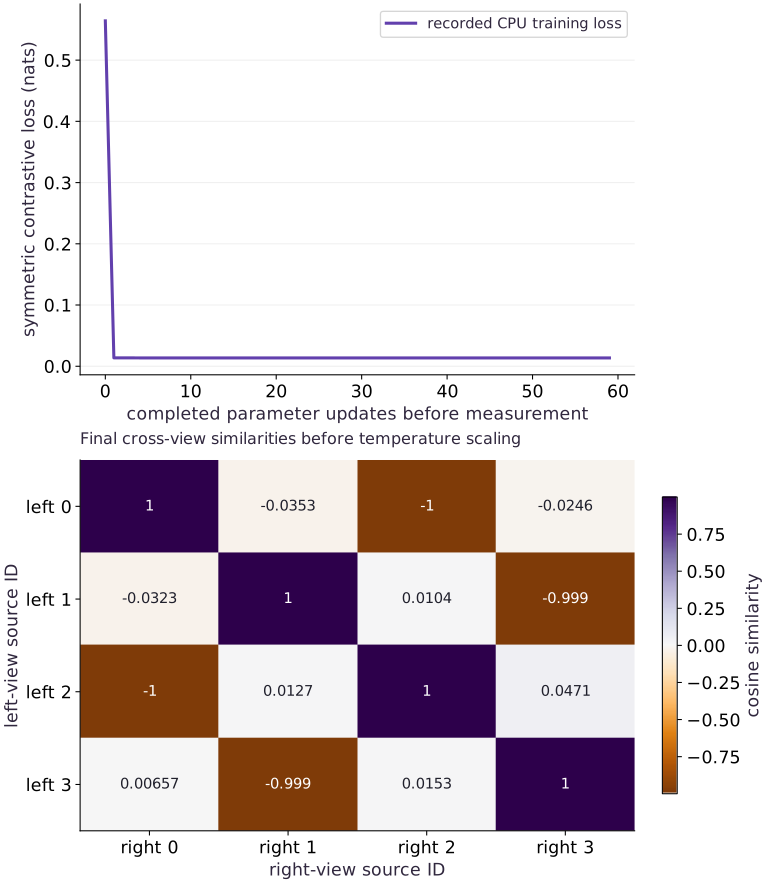
Read the figure
The line is symmetric cross-view training loss in nats before each update. It falls from about to . Lower values mean that the diagonal pair receives more probability among these four candidates, not that semantic accuracy is that number.
The second panel shows cosine similarity before division by temperature. A row is one left-view source and a column one right-view source. The row’s largest value lies at its matching ID on the diagonal; opposite directions can have negative similarity. Color encodes similarity, not a probability. Read both rows and columns because the loss trains both retrieval directions. A joint reorder moves the visible pattern without changing pair quality; an untracked one-sided reorder changes the labels.
Connect it to the computation
The shared encoder starts with poorly separated directions and learns an embedding where each view retrieves its paired source. The duplicate-pair exercise changes the denominator and reveals why a loss cannot be compared blindly across batch construction policies.
Open full-size figureDownload data and provenance
The notebook contains the data experiment, plotting code, and recorded figure output. Rerun it to test your changes.
Where to put & run this code: Work in phases/17-pretraining/03-contrastive/code/main.py (or downloaded exercises/pretraining-03.py / exercises/pretraining-03.ipynb) and execute from the repository root with python3 phases/17-pretraining/03-contrastive/code/main.py.
1 Define both retrieval directions
Create main.py in your activated course environment. Paste this block, then run python main.py; function definitions alone print nothing.
# Step 1 — 1. Define both retrieval directions: Row and column log-softmax share scores but normalize different...
import jax
import jax.numpy as jnp
import numpy as np

def paired_contrastive(left, right, temperature=0.2):
    left = left / jnp.maximum(jnp.linalg.norm(left, axis=-1, keepdims=True), 1e-6)
    right = right / jnp.maximum(jnp.linalg.norm(right, axis=-1, keepdims=True), 1e-6)
    scores = left @ right.T / temperature
    return -0.5 * (
        jnp.mean(jnp.diag(jax.nn.log_softmax(scores, axis=1)))
        + jnp.mean(jnp.diag(jax.nn.log_softmax(scores, axis=0)))
    )
Code building blocks in this step
x.sum(axis=...) / x.mean(axis=..., keepdims=...)— Reduces values along the namedaxis(the axis you name is collapsed unlesskeepdims=True).
Row and column log-softmax share scores but normalize different candidate axes. Draw which source each diagonal entry represents.
2 Construct paired views and an encoder
Append this block to main.py and run python main.py again. Keep the earlier blocks above it.
# Step 2 — 2. Construct paired views and an encoder: The fixed perturbations preserve source identity.
left = jnp.array(
    [[1.0, 0.0, 0.2], [0.0, 1.0, -0.2], [-1.0, 0.0, 0.1], [0.0, -1.0, -0.1]]
)
right = left + jnp.array(
    [[0.02, -0.01, 0.0], [-0.01, 0.02, 0.0], [0.01, 0.01, 0.0], [-0.02, -0.01, 0.0]]
)
w = jnp.array([[0.2, 0.1], [0.1, 0.1], [0.02, -0.01]])
history = []
# Differentiate the objective to obtain `step` via automatic differentiation.
step = jax.jit(
    jax.value_and_grad(lambda w: paired_contrastive(left @ w, right @ w, 0.2))
)
Code building blocks in this step
jnp.array(values, dtype=...)— Constructs an immutable device-backed JAX array from Python/NumPy values.jax.value_and_grad(loss_fn)(params, ...)— Evaluates both the scalar loss and its gradient PyTree(loss_val, grads)in a single forward+backward pass.jax.jit(fn) / @jax.jit— Tracesfnwith abstract shapes and compiles a fused XLA executable cached by input shape and dtype.
The fixed perturbations preserve source identity. Before training, list the four target column indices and predict the consequence of a one-sided permutation.
3 Train, then inspect identity and symmetry
Append this block to main.py and run python main.py again. Keep the earlier blocks above it.
# Step 3 — 3. Train, then inspect identity and symmetry: The host calculation checks both denominators.
for _ in range(60):
    value, g = step(w)
    history.append(float(value))
    w = w - 0.03 * g

assert history[-1] < history[0]
# Perform matrix / vector contraction (`@`) to compute `zi`.
zi = left @ w
# Perform matrix / vector contraction (`@`) to compute `zt`.
zt = right @ w
zi = zi / jnp.linalg.norm(zi, axis=1, keepdims=True)
zt = zt / jnp.linalg.norm(zt, axis=1, keepdims=True)
scores = zi @ zt.T / 0.2
# Convert `host` to a host NumPy array for inspection or verification.
host = np.asarray(scores, dtype=np.float64)

def host_ce(a):
    return np.mean(
        np.log(np.exp(a - a.max(1, keepdims=True)).sum(1)) + a.max(1) - np.diag(a)
    )

np.testing.assert_allclose(
    paired_contrastive(left @ w, right @ w, 0.2),
    0.5 * (host_ce(host) + host_ce(host.T)),
    atol=1e-6,
)
assert np.array_equal(np.argmax(host, axis=1), np.arange(4))
# Create device-backed JAX array `permutation`.
permutation = jnp.array([2, 0, 3, 1])
np.testing.assert_allclose(
    paired_contrastive(left @ w, right @ w),
    paired_contrastive((left @ w)[permutation], (right @ w)[permutation]),
    atol=1e-6,
)
print(
    'Paired contrastive initial/final:',
    history[0],
    history[-1],
    '; all four nearest pairs correct',
)
Code building blocks in this step
jnp.array(values, dtype=...)— Constructs an immutable device-backed JAX array from Python/NumPy values.x.sum(axis=...) / x.mean(axis=..., keepdims=...)— Reduces values along the namedaxis(the axis you name is collapsed unlesskeepdims=True).jnp.allclose(actual, expected, rtol=..., atol=...)— Checks that two arrays match elementwise within floating-point tolerance.
The host calculation checks both denominators. Joint permutation preserves the problem; the later one-sided permutation deliberately changes it.
View the cumulative build in main.py
These blocks append in order to the same file.
# Step 1 — 1. Define both retrieval directions: Row and column log-softmax share scores but normalize different...
import jax
import jax.numpy as jnp
import numpy as np

def paired_contrastive(left, right, temperature=0.2):
    left = left / jnp.maximum(jnp.linalg.norm(left, axis=-1, keepdims=True), 1e-6)
    right = right / jnp.maximum(jnp.linalg.norm(right, axis=-1, keepdims=True), 1e-6)
    scores = left @ right.T / temperature
    return -0.5 * (
        jnp.mean(jnp.diag(jax.nn.log_softmax(scores, axis=1)))
        + jnp.mean(jnp.diag(jax.nn.log_softmax(scores, axis=0)))
    )

# Step 2 — 2. Construct paired views and an encoder: The fixed perturbations preserve source identity.
left = jnp.array(
    [[1.0, 0.0, 0.2], [0.0, 1.0, -0.2], [-1.0, 0.0, 0.1], [0.0, -1.0, -0.1]]
)
right = left + jnp.array(
    [[0.02, -0.01, 0.0], [-0.01, 0.02, 0.0], [0.01, 0.01, 0.0], [-0.02, -0.01, 0.0]]
)
w = jnp.array([[0.2, 0.1], [0.1, 0.1], [0.02, -0.01]])
history = []
# Differentiate the objective to obtain `step` via automatic differentiation.
step = jax.jit(
    jax.value_and_grad(lambda w: paired_contrastive(left @ w, right @ w, 0.2))
)

# Step 3 — 3. Train, then inspect identity and symmetry: The host calculation checks both denominators.
for _ in range(60):
    value, g = step(w)
    history.append(float(value))
    w = w - 0.03 * g

assert history[-1] < history[0]
# Perform matrix / vector contraction (`@`) to compute `zi`.
zi = left @ w
# Perform matrix / vector contraction (`@`) to compute `zt`.
zt = right @ w
zi = zi / jnp.linalg.norm(zi, axis=1, keepdims=True)
zt = zt / jnp.linalg.norm(zt, axis=1, keepdims=True)
scores = zi @ zt.T / 0.2
# Convert `host` to a host NumPy array for inspection or verification.
host = np.asarray(scores, dtype=np.float64)

def host_ce(a):
    return np.mean(
        np.log(np.exp(a - a.max(1, keepdims=True)).sum(1)) + a.max(1) - np.diag(a)
    )

np.testing.assert_allclose(
    paired_contrastive(left @ w, right @ w, 0.2),
    0.5 * (host_ce(host) + host_ce(host.T)),
    atol=1e-6,
)
assert np.array_equal(np.argmax(host, axis=1), np.arange(4))
# Create device-backed JAX array `permutation`.
permutation = jnp.array([2, 0, 3, 1])
np.testing.assert_allclose(
    paired_contrastive(left @ w, right @ w),
    paired_contrastive((left @ w)[permutation], (right @ w)[permutation]),
    atol=1e-6,
)
print(
    'Paired contrastive initial/final:',
    history[0],
    history[-1],
    '; all four nearest pairs correct',
)
Run the example
python3 phases/17-pretraining/03-contrastive/code/main.pyAbout this command
This shortcut uses an activated macOS/Linux course environment in the repository folder. For Windows, use the explicit interpreter command in “Setup help” above. The script includes worked examples and reference solutions.
Inspect the complete assembled example
# Step 1 — 1. Define both retrieval directions: Row and column log-softmax share scores but normalize different...
import jax
import jax.numpy as jnp
import numpy as np

def paired_contrastive(left, right, temperature=0.2):
    left = left / jnp.maximum(jnp.linalg.norm(left, axis=-1, keepdims=True), 1e-6)
    right = right / jnp.maximum(jnp.linalg.norm(right, axis=-1, keepdims=True), 1e-6)
    scores = left @ right.T / temperature
    return -0.5 * (
        jnp.mean(jnp.diag(jax.nn.log_softmax(scores, axis=1)))
        + jnp.mean(jnp.diag(jax.nn.log_softmax(scores, axis=0)))
    )

# Step 2 — 2. Construct paired views and an encoder: The fixed perturbations preserve source identity.
left = jnp.array(
    [[1.0, 0.0, 0.2], [0.0, 1.0, -0.2], [-1.0, 0.0, 0.1], [0.0, -1.0, -0.1]]
)
right = left + jnp.array(
    [[0.02, -0.01, 0.0], [-0.01, 0.02, 0.0], [0.01, 0.01, 0.0], [-0.02, -0.01, 0.0]]
)
w = jnp.array([[0.2, 0.1], [0.1, 0.1], [0.02, -0.01]])
history = []
# Differentiate the objective to obtain `step` via automatic differentiation.
step = jax.jit(
    jax.value_and_grad(lambda w: paired_contrastive(left @ w, right @ w, 0.2))
)

# Step 3 — 3. Train, then inspect identity and symmetry: The host calculation checks both denominators.
for _ in range(60):
    value, g = step(w)
    history.append(float(value))
    w = w - 0.03 * g

assert history[-1] < history[0]
# Perform matrix / vector contraction (`@`) to compute `zi`.
zi = left @ w
# Perform matrix / vector contraction (`@`) to compute `zt`.
zt = right @ w
zi = zi / jnp.linalg.norm(zi, axis=1, keepdims=True)
zt = zt / jnp.linalg.norm(zt, axis=1, keepdims=True)
scores = zi @ zt.T / 0.2
# Convert `host` to a host NumPy array for inspection or verification.
host = np.asarray(scores, dtype=np.float64)

def host_ce(a):
    return np.mean(
        np.log(np.exp(a - a.max(1, keepdims=True)).sum(1)) + a.max(1) - np.diag(a)
    )

np.testing.assert_allclose(
    paired_contrastive(left @ w, right @ w, 0.2),
    0.5 * (host_ce(host) + host_ce(host.T)),
    atol=1e-6,
)
assert np.array_equal(np.argmax(host, axis=1), np.arange(4))
# Create device-backed JAX array `permutation`.
permutation = jnp.array([2, 0, 3, 1])
np.testing.assert_allclose(
    paired_contrastive(left @ w, right @ w),
    paired_contrastive((left @ w)[permutation], (right @ w)[permutation]),
    atol=1e-6,
)
print(
    'Paired contrastive initial/final:',
    history[0],
    history[-1],
    '; all four nearest pairs correct',
)
Expected result: Training loss decreases and all four paired views are nearest neighbors.
Recorded reference execution
Reference output captured from executing the complete lesson script (code/main.py) and its assertions in the course CPU environment.
Paired contrastive initial/final: 0.564157247543335 0.013556718826293945 ; all four nearest pairs correct
Paired contrastive initial/final: 0.564157247543335 0.013556718826293945 ; all four nearest pairs correct
Collapsed baseline: 1.3862943649291992
Temperature/loss: 0.2 0.006715348921716213
Temperature/loss: 1.0 0.31326162815093994
Temperature/loss: 2.0 0.4740769863128662
Incorrect pair mapping loss: 7.493563652038574
Duplicated diagonal-only penalty: 0.6931472215801477
Step / finite difference / autodiff: 0.001 -1.3803242444992065 -1.3803226947784424
Step / finite difference / autodiff: 0.0005 -1.3802646398544312 -1.3803226947784424
PASS: pretraining-03
Download execution record · The notebook includes executed cells and figure outputs. Compare your run with these values; timings depend on the machine.
Measure the collapsed baseline
# Experiment — Measure the collapsed baseline: Equal similarity gives each candidate probability one quarter.
collapsed = jnp.ones((4, 2))
collapse_loss = float(paired_contrastive(collapsed, collapsed))
np.testing.assert_allclose(collapse_loss, np.log(4), atol=1e-6)
print('Collapsed baseline:', collapse_loss)
Expected: The collapsed loss is log(4), approximately 1.386.
Equal similarity gives each candidate probability one quarter. This baseline catches objectives that reward only attraction and forget competing candidates.
Separate temperature from ranking
# Experiment — Separate temperature from ranking: The independent binary-softmax expression checks scale handling...
orthogonal = jnp.eye(2)
for tau in [0.2, 1.0, 2.0]:
    observed = float(paired_contrastive(orthogonal, orthogonal, tau))
    np.testing.assert_allclose(observed, np.logaddexp(0.0, -1.0 / tau), atol=1e-6)
    # Convert `` to a host NumPy array for inspection or verification.
    np.testing.assert_array_equal(
        np.argmax(np.asarray(orthogonal @ orthogonal.T) / tau, axis=1), [0, 1]
    )
    print('Temperature/loss:', tau, observed)
Expected: All three temperatures keep the same ranking while their losses differ.
The independent binary-softmax expression checks scale handling and demonstrates why loss comparisons require a fixed temperature and pool.
Make it yours
Where to put your code: Append your solution at the bottom of phases/17-pretraining/03-contrastive/code/main.py (or inside the Make it yours cell of exercises/pretraining-03.ipynb) and run python3 phases/17-pretraining/03-contrastive/code/main.py to verify your prediction before opening the reference solution.
Permute only the right-hand embeddings after training and demonstrate the effect of broken pair identity.
Show a writing guide and starter scaffold
How to write this exercise code: step-by-step recipe & starter scaffold
1. Key functions & syntax to use:
paired_contrastive(...)— Callpaired_contrastivewith your updated parameters or inputs from this lesson's workspace.assert condition— Verify that the observed output shape, status, or numerical value satisfies the contract.
2. Step-by-step implementation plan:
- Set up the changed input or configuration parameters requested in the prompt.
- Run the target function or transformation and assert that the output matches your prediction.
# Exercise solution: Permute only the right-hand embeddings after training and demonstrate...
wrong_pair_loss = float(...)  # TODO: compute wrong_pair_loss
assert wrong_pair_loss  # TODO: complete assertion check
print('Incorrect pair mapping loss:', wrong_pair_loss)
Reveal the reference solution
# Exercise solution: Permute only the right-hand embeddings after training and demonstrate...
wrong_pair_loss = float(paired_contrastive(left @ w, (right @ w)[permutation]))
assert wrong_pair_loss > float(paired_contrastive(left @ w, right @ w))
print('Incorrect pair mapping loss:', wrong_pair_loss)
Duplicate a source and inspect the objective
Transfer
Duplicate all four pairs while keeping diagonal-only positives. Calculate the change in loss and explain the false-negative effect.
Show a writing guide and starter scaffold
How to write this practice solution: step-by-step recipe & starter scaffold
1. Key functions & syntax to use:
jnp.allclose(actual, expected, rtol=..., atol=...)— Checks that two arrays match elementwise within floating-point tolerance.
2. Step-by-step implementation plan:
- Set up the changed input or configuration parameters requested in the prompt.
- Run the target function or transformation and assert that the output matches your prediction.
# Duplicate a source and inspect the objective (Transfer): The extra log(2) comes from duplicating each denominator...
duplicated = float(...)  # TODO: compute duplicated
    paired_contrastive(jnp.tile(left @ w, (2, 1)), jnp.tile(right @ w, (2, 1)))
)
original = float(...)  # TODO: compute original
np.testing.assert_allclose(duplicated - original, np.log(2), atol=1e-5)
print('Duplicated diagonal-only penalty:', duplicated - original)
Show a hint
Each original candidate appears twice, but only one copy is labeled positive.
Reveal reference solution and reasoning
# Duplicate a source and inspect the objective (Transfer): The extra log(2) comes from duplicating each denominator...
duplicated = float(
    paired_contrastive(jnp.tile(left @ w, (2, 1)), jnp.tile(right @ w, (2, 1)))
)
original = float(paired_contrastive(left @ w, right @ w))
np.testing.assert_allclose(duplicated - original, np.log(2), atol=1e-5)
print('Duplicated diagonal-only penalty:', duplicated - original)
The extra log(2) comes from duplicating each denominator candidate without adding the second copy to the positive set. Use source/semantic identity to define multi-positive supervision when appropriate.
Check the encoder gradient through normalization
Challenge
Perturb one encoder weight at the initial, noncollapsed matrix and compare centered differences with autodiff. Repeat with a second finite-difference step.
Show a writing guide and starter scaffold
How to write this practice solution: step-by-step recipe & starter scaffold
1. Key functions & syntax to use:
jnp.array(values, dtype=...)— Constructs an immutable device-backed JAX array from Python/NumPy values.jnp.allclose(actual, expected, rtol=..., atol=...)— Checks that two arrays match elementwise within floating-point tolerance.jax.grad(loss_fn)(params, ...)— Transforms a scalar-output function into a function returning the gradient PyTree with the same structure asparams.
2. Step-by-step implementation plan:
- Differentiate the objective to obtain
autovia automatic differentiation.
# Check the encoder gradient through normalization (Challenge): This checks the complete input-to-normalized-similarity chain.
audit_w = jnp.array(...)  # TODO: compute audit_w
objective = ...  # TODO: compute objective
# Differentiate the objective to obtain `auto` via automatic differentiation.
auto = float(...)  # TODO: compute auto
for epsilon in [1e-3, 5e-4]:
    delta = jnp.zeros_like(...)  # TODO: compute delta
    estimate = float(...)  # TODO: compute estimate
        (objective(audit_w + delta) - objective(audit_w - delta)) / (2 * epsilon)
    )
    np.testing.assert_allclose(estimate, auto, rtol = ...  # TODO: compute np.testing.assert_allclose(estimate, auto, rtol
    print('Step / finite difference / autodiff:', epsilon, estimate, auto)
Show a hint
Use a fresh matrix; a gradient near a trained optimum may be too small to diagnose accurately.
Reveal reference solution and reasoning
# Check the encoder gradient through normalization (Challenge): This checks the complete input-to-normalized-similarity chain.
audit_w = jnp.array([[0.2, 0.1], [0.1, 0.1], [0.02, -0.01]])
objective = lambda weights: paired_contrastive(left @ weights, right @ weights, 0.2)
# Differentiate the objective to obtain `auto` via automatic differentiation.
auto = float(jax.grad(objective)(audit_w)[0, 0])
for epsilon in [1e-3, 5e-4]:
    delta = jnp.zeros_like(audit_w).at[0, 0].set(epsilon)
    estimate = float(
        (objective(audit_w + delta) - objective(audit_w - delta)) / (2 * epsilon)
    )
    np.testing.assert_allclose(estimate, auto, rtol=3e-3, atol=1e-3)
    print('Step / finite difference / autodiff:', epsilon, estimate, auto)
This checks the complete input-to-normalized-similarity chain. Trying two step sizes helps distinguish truncation error from a broken derivative.
Diagnose the result
If training stalls near the collapsed baseline, inspect norms and pairing before reducing temperature. Unexpected loss jumps after batching changes can reflect false negatives or a different candidate set.
Carry forward
- Track source identity explicitly across both view pipelines: symmetric contrastive loss normalizes row and column retrieval probabilities over the candidate pool, and a collapsed representation sits at .
- Keep temperature and candidate-pool size fixed when comparing contrastive losses, and evaluate frozen representations on held-out source groups rather than training-pair lookup.
Keep your evidence
Keep source pairing, temperature, stable two-direction loss checks, collapse and duplicate baselines, training outputs and broken-pair diagnosis.
Save your modified code, its output, and an explanation of your prediction. Checkpoint answers and exercise evidence are tracked separately.
Saved in this browser. Export or back up your portfolio anytime in My learning.
Verified on local CPU. Stage to a Cloud TPU VM via Cloud TPU setup to record accelerator execution receipts (TODO: add automated Cloud TPU CI execution receipts).
Primary references
Phase 17 Integration Project
Bring this phase together: An audited pretraining and adaptation objective toolkit
Checkpoint to prove: Complete stages 1–3 of training-methods with independent loss references, real training curves, changed masks or pairs and explicit synthetic-data limits.
Copy projects/training-methods/starter/methods.py to projects/training-methods/my_methods.py and write your code in projects/training-methods/my_methods.py. Run python3 projects/training-methods/tests/check.py --implementation projects/training-methods/my_methods.py --stage 1 from the top-level folder to verify stages 1, 2, 3.