 JAX Pathways
Phase 03 / State, randomness & control flow
Branches with lax.cond
Revision v0.7.0 · Updated since your last visit. Review the changes; your progress is saved.
Lesson · about 60 minutes · CPU practice
Implement a data-dependent branch that works inside a compiled function.
Phase study guide: preparation, milestones and project evidence
Before you start
Before this: Compiled loops with lax.scan
Hardware: CPU
Setup help: Python, notebook, or Cloud TPU VM
Use the tested CPU packages (the recorded environment uses Python 3.14.3). Other Python versions and accelerator environments require separate checks. The optional Cloud TPU specialization explains the target-specific execution boundaries. Logical CPU devices practice partitioning; they do not simulate TPU performance.
Download the repository ZIP or use your existing checkout. Extract it and open a terminal in the folder containing requirements-cpu.txt. The beginner ZIP is separate; these lessons use the full repository folder.
python3 -m venv .venv
source .venv/bin/activate
python -m pip install -r requirements-cpu.txtpy -3 -m venv .venv
.\.venv\Scripts\python.exe -m pip install -r requirements-cpu.txtAfter activation, run the complete worked example from that same folder:
python phases/03-state/04-branches-with-lax-cond/code/main.py.\.venv\Scripts\python.exe phases/03-state/04-branches-with-lax-cond/code/main.pyFor an incremental build, create main.py in your own practice folder, append each build block in order, and run python main.py with this environment active. Keep that file separate from the downloaded reference solution.
Download this lesson’s notebook. Open it with a Python kernel using the course environment. Run cells from the top after restarting the kernel; experiments depend on earlier definitions.
For local Jupyter, first install the course requirements using the Local Python steps, then use your environment’s Python to start Jupyter:
python -m pip install jupyterlab
python -m jupyter lab.\.venv\Scripts\python.exe -m pip install jupyterlab
.\.venv\Scripts\python.exe -m jupyter labSelect the downloaded state-04.ipynb file in JupyterLab. The notebook contains reference solutions; make your prediction and attempt each practice task before opening them. Restart the kernel before changing logical device setup.
The worked reference for this lesson is CPU-validated. Some references explicitly configure logical CPU devices; setting JAX_PLATFORMS does not adapt them to a TPU. Follow the execution matrix and reviewed multi-host example before attempting a target run.
For accelerator preparation, study TPU setup, observed runtime receipts, checkpointed jobs and precision and retained traces. These target paths remain unqualified on physical TPU hardware until an actual receipt is recorded. Cloud provisioning is optional for CPU learning.
Check:
Revisit the guided CPU setup · Open 19: TPU Setup. Package instructions are CPU instructions; Windows and accelerator environments need their own validation.
What you will be able to do
- Locate the decision boundary
- Trace both branches and check their result types
- Choose cond or where by the shape of the question
- Inspect boundary behavior and derivatives
The problem
A Python branch can choose a path when it knows a value. Inside jit, that value may not be available yet. We’ll use lax.cond to make the choice at runtime, check what both branches must return, and compare a single decision with elementwise selection.
The idea
A data-dependent branch needs a control-flow operation that can represent both alternatives in a transformed program. With a scalar predicate, lax.cond selects the result of one branch while requiring compatible result structures from both.
Trace both possibilities, execute the selected rule
Consider an absolute-value rule: return the input when it is nonnegative and its negation otherwise. Both branches return the same shape and dtype, even though only one scalar case determines a particular result. The function is continuous at zero, but its mathematical derivative is not uniquely defined there.
The plot of magnitudes shows what the branch computes, not the tracing process. During tracing, Python code in both branch functions can be visited. Avoid using Python side effects as evidence that one numerical branch executed on the device.
After batching or other transformations, the implementation of control flow can change; for example, batching a conditional can turn it into selection. Keep claims about execution scope tied to the actual transformed program.
Locate the decision boundary
The predicate is numerical data when is a traced argument. A Python if must choose a branch while tracing, before that runtime value is available. lax.cond represents the choice inside the staged computation instead.
Its arguments are a scalar Boolean predicate, two pure branch functions and an operand. Each branch receives that operand; each must return the same kind of result. Read the contract as an ordinary state transition with two possible implementations, not as a magic exception to tracing.
predicate: x>=0
true:  operand x → x
false: operand x → −x
joined result: scalar float
Trace both branches and check their result types
For a scalar predicate, cond selects one branch at runtime, but both branches are traced when building the computation. Therefore an invalid operation in a branch can fail during tracing even if a particular test input would not choose it.
Both result pytrees must agree and corresponding array leaves must have compatible shapes and dtypes. A scalar in one branch and a vector in the other cannot be joined by this contract. This is different from numerical correctness: matching output types can still hide a wrong branch formula.
Choose cond or where by the shape of the question
cond makes one scalar decision for a computation. where chooses values elementwise from compatible arrays. A vector predicate naturally belongs to where or a deliberately batched conditional.
When cond is transformed with vmap over predicates, it can become selection. Do not use a branch as a promise that side effects or invalid arithmetic will never be evaluated under transformations. Keep functions pure and design numerical expressions that are valid in the relevant domain.
Inspect boundary behavior and derivatives
Our magnitude function equals absolute value. Away from zero its derivative is + for positive inputs and for negative inputs. At zero the mathematical function is not differentiable; a selected branch rule is a convention rather than proof of a derivative.
Test negative, positive and exact-boundary inputs because a > versus >= change can alter boundary behavior in other functions. Keep a separate argument about mathematical smoothness when differentiating conditional computations.
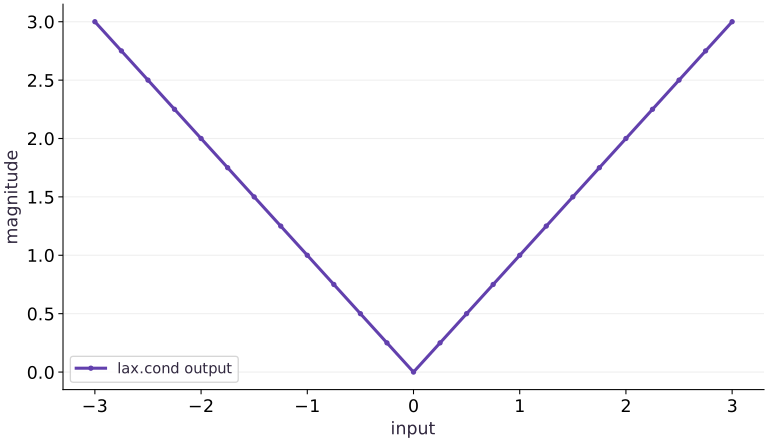
Both branches form one magnitude function
Predict before looking: What happens on each side of zero?
Read the figure
The horizontal axis varies the input and the vertical axis gives the returned magnitude. The V-shaped line passes through , , and . Equal distances to the left and right of zero produce equal outputs.
The left arm comes from negating a negative input. The right arm comes from returning a nonnegative input unchanged. At zero the two values meet, so there is no jump in the output.
Connect it to the computation
The branches together implement . Moving right along the negative side decreases the result with slope ; moving right along the positive side increases it with slope . The sharp corner records that change of rule.
Continuity at the join does not imply differentiability: the classical derivative is undefined at zero because the two slopes disagree. A branch-selected autodiff value there must not be confused with a derivative of a smooth curve. The picture helps separate correct branch outputs from assumptions about gradients.
Open full-size figureDownload data and provenance
The notebook contains the data experiment, plotting code, and recorded figure output. Rerun it to test your changes.
Where to put & run this code: Work in phases/03-state/04-branches-with-lax-cond/code/main.py (or downloaded exercises/state-04.py / exercises/state-04.ipynb) and execute from the repository root with python3 phases/03-state/04-branches-with-lax-cond/code/main.py.
1 Prepare the inputs
Create main.py in your lesson workspace. Add this first block; use the environment from setup.
# Step 1 — Prepare the inputs: These explicit inputs define the case that the later checks will...
import jax
import jax.numpy as jnp
These explicit inputs define the case that the later checks will verify.
2 Build the computation
Append this block below the inputs in the same file.
# Step 2 — Build the computation: Both branches return the same scalar type.
# Define and JIT-compile `magnitude(x)` so XLA traces and fuses the operations:
@jax.jit
def magnitude(x):
    return jax.lax.cond(x >= 0., lambda v: v, lambda v: -v, x)
Code building blocks in this step
jax.jit(fn) / @jax.jit— Tracesfnwith abstract shapes and compiles a fused XLA executable cached by input shape and dtype.
Both branches return the same scalar type. cond takes the runtime predicate and passes to the selected numerical branch.
3 Run and check the result
Append the checks, save main.py, and run python main.py from this folder using your course environment.
# Step 3 — Run and check the result: Compare the output to the expected result below before making the...
print(float(magnitude(-3.)))
assert jnp.allclose(magnitude(-3.), 3.)
assert jnp.allclose(magnitude(2.), 2.)
Code building blocks in this step
jnp.allclose(actual, expected, rtol=..., atol=...)— Checks that two arrays match elementwise within floating-point tolerance.
Compare the output to the expected result below before making the exercise change.
View the cumulative build in main.py
These blocks append in order to the same file.
# Step 1 — Prepare the inputs: These explicit inputs define the case that the later checks will...
import jax
import jax.numpy as jnp

# Step 2 — Build the computation: Both branches return the same scalar type.
# Define and JIT-compile `magnitude(x)` so XLA traces and fuses the operations:
@jax.jit
def magnitude(x):
    return jax.lax.cond(x >= 0., lambda v: v, lambda v: -v, x)

# Step 3 — Run and check the result: Compare the output to the expected result below before making the...
print(float(magnitude(-3.)))
assert jnp.allclose(magnitude(-3.), 3.)
assert jnp.allclose(magnitude(2.), 2.)
Run the example
python3 phases/03-state/04-branches-with-lax-cond/code/main.pyAbout this command
This shortcut uses an activated macOS/Linux course environment in the repository folder. For Windows, use the explicit interpreter command in “Setup help” above. The script includes worked examples and reference solutions.
Inspect the complete assembled example
# Step 1 — Prepare the inputs: These explicit inputs define the case that the later checks will...
import jax
import jax.numpy as jnp
# Step 2 — Build the computation: Both branches return the same scalar type.
# Define and JIT-compile `magnitude(x)` so XLA traces and fuses the operations:
@jax.jit
def magnitude(x):
    return jax.lax.cond(x >= 0., lambda v: v, lambda v: -v, x)
# Step 3 — Run and check the result: Compare the output to the expected result below before making the...
print(float(magnitude(-3.)))
assert jnp.allclose(magnitude(-3.), 3.)
assert jnp.allclose(magnitude(2.), 2.)
Expected result:
Recorded reference execution
Reference output captured from executing the complete lesson script (code/main.py) and its assertions in the course CPU environment.
3.0
3.0
Expected traced Python Boolean failure
Expected branch shape mismatch
PASS: state-04
Download execution record · The notebook includes executed cells and figure outputs. Compare your run with these values; timings depend on the machine.
Reproduce the Python truth-test failure
# Experiment — Reproduce the Python truth-test failure: The repair changes where the decision is represented.
def eager_branch(v):
    if v>=0.:
        return v
    return -v
assert eager_branch(-3.)==3.
# Run the boundary check and catch the expected exception:
try:
    jax.jit(eager_branch)(jnp.array(-3.))
except jax.errors.TracerBoolConversionError:
    print("Expected traced Python Boolean failure")
else:
    raise AssertionError("Expected branch error")
for v in [-3.,0.,2.]:
    assert jnp.allclose(magnitude(v),abs(v))
Expected: The traced Python branch fails; cond gives the correct values for all three cases.
The repair changes where the decision is represented. It does not make static or remove the negative case.
Check a batched numerical selection
# Experiment — Check a batched numerical selection: Correct values under batching do not imply a conditional branch...
values=jnp.array([-3.,-1.,2.,4.])
assert jnp.allclose(jax.vmap(magnitude)(values),jnp.abs(values))
assert jnp.allclose(jax.vmap(jax.grad(magnitude))(values),jnp.array([-1.,-1.,1.,1.]))
Expected: Magnitudes and slopes .
Correct values under batching do not imply a conditional branch remains lazy after every transformation.
Make it yours
Where to put your code: Append your solution at the bottom of phases/03-state/04-branches-with-lax-cond/code/main.py (or inside the Make it yours cell of exercises/state-04.ipynb) and run python3 phases/03-state/04-branches-with-lax-cond/code/main.py to verify your prediction before opening the reference solution.
Write a compiled function that applies when is positive and otherwise. Check positive, negative, and zero inputs.
Show a writing guide and starter scaffold
How to write this exercise code: step-by-step recipe & starter scaffold
1. Key functions & syntax to use:
jnp.allclose(actual, expected, rtol=..., atol=...)— Checks that two arrays match elementwise within floating-point tolerance.jax.jit(fn) / @jax.jit— Tracesfnwith abstract shapes and compiles a fused XLA executable cached by input shape and dtype.
2. Step-by-step implementation plan:
- Define and JIT-compile
choose_update(x)so XLA traces and fuses the operations:
# Exercise solution: Write a compiled function that applies 2x when x is positive and x-2...
# Define and JIT-compile `choose_update(x)` so XLA traces and fuses the operations:
@jax.jit
def choose_update(x):
    return ...  # TODO: return computed result
assert jnp.allclose(choose_update(3.), 6.)  # TODO: complete assertion check
assert jnp.allclose(choose_update(-3.), -5.)  # TODO: complete assertion check
assert jnp.allclose(choose_update(0.), -2.)  # TODO: complete assertion check
Reveal the reference solution
# Exercise solution: Write a compiled function that applies 2x when x is positive and x-2...
# Define and JIT-compile `choose_update(x)` so XLA traces and fuses the operations:
@jax.jit
def choose_update(x):
    return jax.lax.cond(x > 0., lambda v: v * 2., lambda v: v - 2., x)
assert jnp.allclose(choose_update(3.), 6.)
assert jnp.allclose(choose_update(-3.), -5.)
assert jnp.allclose(choose_update(0.), -2.)
Match a changed piecewise rule
Practice
Implement for and otherwise. Derive outputs at ,, and derivatives away from .
Show a writing guide and starter scaffold
How to write this practice solution: step-by-step recipe & starter scaffold
1. Key functions & syntax to use:
jnp.array(values, dtype=...)— Constructs an immutable device-backed JAX array from Python/NumPy values.jnp.allclose(actual, expected, rtol=..., atol=...)— Checks that two arrays match elementwise within floating-point tolerance.jax.grad(loss_fn)(params, ...)— Transforms a scalar-output function into a function returning the gradient PyTree with the same structure asparams.jax.vmap(fn, in_axes=..., out_axes=...)— Vectorizes a single-example function across a batch axis without writing a Python loop.
2. Step-by-step implementation plan:
- Set up the changed input or configuration parameters requested in the prompt.
- Run the target function or transformation and assert that the output matches your prediction.
# Match a changed piecewise rule (Practice): The values check the exact boundary and both formulas; the...
def piecewise(v):
    return ...  # TODO: return computed result
assert jnp.allclose(jax.vmap(piecewise)(jnp.array([-1.,1.,2.])),jnp.array([-2.,2.,4.]))  # TODO: complete assertion check
assert jnp.allclose(jax.grad(piecewise)(-1.),2.)  # TODO: complete assertion check
assert jnp.allclose(jax.grad(piecewise)(2.),4.)  # TODO: complete assertion check
Show a hint
At the false branch is selected.
Reveal reference solution and reasoning
# Match a changed piecewise rule (Practice): The values check the exact boundary and both formulas; the...
def piecewise(v):
    return jax.lax.cond(v>1.,lambda z:z*z,lambda z:2*z,v)
assert jnp.allclose(jax.vmap(piecewise)(jnp.array([-1.,1.,2.])),jnp.array([-2.,2.,4.]))
assert jnp.allclose(jax.grad(piecewise)(-1.),2.)
assert jnp.allclose(jax.grad(piecewise)(2.),4.)
The values check the exact boundary and both formulas; the derivatives are checked only at smooth points.
Repair incompatible branch shapes
Challenge
Return a scalar in one branch and a length-two vector in the other, reproduce the error, then define a consistent two-value result.
Show a writing guide and starter scaffold
How to write this practice solution: step-by-step recipe & starter scaffold
1. Key functions & syntax to use:
jnp.array(values, dtype=...)— Constructs an immutable device-backed JAX array from Python/NumPy values.jnp.allclose(actual, expected, rtol=..., atol=...)— Checks that two arrays match elementwise within floating-point tolerance.
2. Step-by-step implementation plan:
- Run the boundary check and catch the expected exception:
# Repair incompatible branch shapes (Challenge): A branch mismatch is a result-contract error even when the...
# Run the boundary check and catch the expected exception:
try:
    jax.lax.cond(True,lambda x:x,lambda x:jnp.stack([x,x]),jnp.array(2.))
except TypeError:
    print("Expected branch shape mismatch")
else:
    raise AssertionError("Expected result type error")
def pair(v):
    return ...  # TODO: return computed result
assert jnp.allclose(pair(jnp.array(-2.)),jnp.array([2.,4.]))  # TODO: complete assertion check
Show a hint
Decide what each output component means before padding.
Reveal reference solution and reasoning
# Repair incompatible branch shapes (Challenge): A branch mismatch is a result-contract error even when the...
# Run the boundary check and catch the expected exception:
try:
    jax.lax.cond(True,lambda x:x,lambda x:jnp.stack([x,x]),jnp.array(2.))
except TypeError:
    print("Expected branch shape mismatch")
else:
    raise AssertionError("Expected result type error")
def pair(v):
    return jax.lax.cond(v>=0.,lambda x:jnp.stack([x,x*x]),lambda x:jnp.stack([-x,x*x]),v)
assert jnp.allclose(pair(jnp.array(-2.)),jnp.array([2.,4.]))
A branch mismatch is a result-contract error even when the current predicate is known. Here the repaired output explicitly means [magnitude,square].
Diagnose the result
A branch mismatch is a result-contract error even when the current predicate is known. Here the repaired output explicitly means [magnitude,square].
Carry forward
- The repair changes where the decision is represented. It does not make static or remove the negative case.
- Correct values under batching do not imply a conditional branch remains lazy after every transformation.
Keep your evidence
Keep the branch-contract diagram, eager/jit failure and repair, boundary cases, batched values and off-boundary derivatives, and the shape-mismatch diagnosis.
Save your modified code, its output, and an explanation of your prediction. Checkpoint answers and exercise evidence are tracked separately.
Saved in this browser. Export or back up your portfolio anytime in My learning.
Verified on local CPU. Stage to a Cloud TPU VM via Cloud TPU setup to record accelerator execution receipts (TODO: add automated Cloud TPU CI execution receipts).
Primary references
Phase 03 Integration Project
Bring this phase together: A deterministic batched simulation
Checkpoint to prove: Replay the same experiment with saved state and keys; explain the update order.
Copy projects/foundation-toolkit/starter/toolkit.py to projects/foundation-toolkit/my_toolkit.py and write your code in projects/foundation-toolkit/my_toolkit.py. Run python3 projects/foundation-toolkit/tests/check.py --implementation projects/foundation-toolkit/my_toolkit.py --stage 4 from the top-level folder to verify stage 4.