 JAX Pathways
Phase 09 / Distributed training
A sharded training step
Revision v0.7.0 · Updated since your last visit. Review the changes; your progress is saved.
Lesson · about 90 minutes · Logical CPU devices
Run a training step with explicit data and parameter placement.
Phase study guide: preparation, milestones and project evidence
Before you start
Before this: Arrays, meshes, and sharding
Hardware: 4 logical CPU devices on one host
Setup help: Python, notebook, or Cloud TPU VM
Use the tested CPU packages (the recorded environment uses Python 3.14.3). Other Python versions and accelerator environments require separate checks. The optional Cloud TPU specialization explains the target-specific execution boundaries. Logical CPU devices practice partitioning; they do not simulate TPU performance.
Download the repository ZIP or use your existing checkout. Extract it and open a terminal in the folder containing requirements-cpu.txt. The beginner ZIP is separate; these lessons use the full repository folder.
python3 -m venv .venv
source .venv/bin/activate
python -m pip install -r requirements-cpu.txtpy -3 -m venv .venv
.\.venv\Scripts\python.exe -m pip install -r requirements-cpu.txtAfter activation, run the complete worked example from that same folder:
python phases/09-distributed/02-a-sharded-training-step/code/main.py.\.venv\Scripts\python.exe phases/09-distributed/02-a-sharded-training-step/code/main.pyFor an incremental build, create main.py in your own practice folder, append each build block in order, and run python main.py with this environment active. Keep that file separate from the downloaded reference solution.
Download this lesson’s notebook. Open it with a Python kernel using the course environment. Run cells from the top after restarting the kernel; experiments depend on earlier definitions.
For local Jupyter, first install the course requirements using the Local Python steps, then use your environment’s Python to start Jupyter:
python -m pip install jupyterlab
python -m jupyter lab.\.venv\Scripts\python.exe -m pip install jupyterlab
.\.venv\Scripts\python.exe -m jupyter labSelect the downloaded distributed-02.ipynb file in JupyterLab. The notebook contains reference solutions; make your prediction and attempt each practice task before opening them. Restart the kernel before changing logical device setup.
The worked reference for this lesson is CPU-validated. Some references explicitly configure logical CPU devices; setting JAX_PLATFORMS does not adapt them to a TPU. Follow the execution matrix and reviewed multi-host example before attempting a target run.
For accelerator preparation, study TPU setup, observed runtime receipts, checkpointed jobs and precision and retained traces. These target paths remain unqualified on physical TPU hardware until an actual receipt is recorded. Cloud provisioning is optional for CPU learning.
Check: Initial loss ; gradient ; weights ; updated loss is lower. Small float32 printing differences are expected.
Revisit the guided CPU setup · Open 19: TPU Setup. Package instructions are CPU instructions; Windows and accelerator environments need their own validation.
What you will be able to do
- Derive the global mean loss and gradient.
- Specify aligned data and replicated parameter placement.
- Verify sharded updates against independent host arithmetic.
- Diagnose normalization errors in equal and unequal local batches.
The problem
If we split a batch across four devices, should the model learn four times as much in one step? It should still follow the same global loss. We’ll compare a sharded regression update with a formula we can check on the host, then reproduce the scaling mistake caused by summing local mean gradients.
The idea
A sharded training step must preserve the intended global objective. Local reductions and collective operations should produce the same normalized gradient as an unsharded reference on the same examples.
Derive the global denominator
One shard has two examples with mean gradient ; another has one example with gradient . The global mean is . Averaging the local means gives , overweighting the small shard.
Carry contributions and counts so the final denominator matches the objective. With masked sequence losses, count valid targets rather than automatically counting devices or sequences.
The matching gradient bars are an important check on the current fixture. Add unequal valid counts to expose a weighting rule that balanced shards could hide. Numerical agreement should be tested where the implementation's assumptions are most vulnerable.
Write the objective before splitting the data
Our model predicts with two weights and no bias. The synthetic labels use true weights , but the initial weights are zero. The squared-error loss averages eight residuals. Its gradient is , where and . This host formula is independent of JAX autodiff and supplies a useful reference for the first update.
At the targets are . Squared targets sum to , so initial loss is . , so the gradient is . With learning rate the new weights are . Check these values before looking at a training curve.
Give batch and parameters different placements
The feature matrix has shape and uses P("data",None); each of four devices owns two examples. Labels have shape and use P("data"), so their shards align with the feature rows. Parameters have shape and use P(), giving every device both weights.
The input sharding tree supplied to jit has one entry per argument. Outputs are weights, scalar loss and a two-element gradient; all three are replicated in this small example. Replication does not mean four independently trained models. The replicas represent the same global parameters and must receive the same global update.
CPU 0: X rows 0:2, y rows 0:2, full w
CPU 1: X rows 2:4, y rows 2:4, full w
CPU 2: X rows 4:6, y rows 4:6, full w
CPU 3: X rows 6:8, y rows 6:8, full w
partial contributions → global gradient → same w_next
Differentiate the global function rather than inventing a local objective
loss operates on global JAX arrays. value_and_grad evaluates the objective and obtains its parameter derivative together. jit compiles that function with explicit placement contracts; you do not call a Python training loop separately on each device. Combining contributions is necessary because each local batch alone cannot determine the global mean gradient.
This lesson uses automatic global-array parallelization, not manual shard_map or an explicit pmean. The compiler arranges required operations. Do not add an extra collective to an already global reduction merely because the input is sharded. If you later implement a manual local program, you must derive its aggregation and normalization from the same objective.
A correct first update is stronger evidence than a falling curve — on CPU and on a 4-chip TPU VM
A loss curve can decrease even with a normalization bug, especially at a small learning rate. Compare the initial loss, every gradient component and updated weights with NumPy. Then change the batch contents and order: a correct global mean should not depend on which device receives a row. Check replicated weight shards separately.
A ten-step loop is included as a transfer experiment, but this is not a complete resilient training system. It has no data pipeline, optimizer moments, checkpoint or multi-host failure handling. CPU virtual devices demonstrate placement and numerical equivalence; to verify the same sharded train_step across four physical TPU chips (v5litepod-4 or v6e-4), upload the lesson script to your TPU VM and target jax.devices()[:4] with JAX_PLATFORMS=tpu. Float32 reduction order may differ slightly across hardware, so use stated tolerances instead of bitwise comparisons.
Run the sharded training step across four physical TPU chips
gcloud compute tpus tpu-vm scp exercises/distributed-02.py $TPU_NAME:~/jax-tpu-lab/ --zone=$ZONE
gcloud compute tpus tpu-vm ssh $TPU_NAME --zone=$ZONE \
  --command="sed 's/jax.config.update(\"jax_platforms\", \"cpu\")/# use default TPU backend/; s/jax.devices(\"cpu\")/jax.devices()[:4]/' ~/jax-tpu-lab/distributed-02.py > ~/jax-tpu-lab/distributed-02-tpu.py && JAX_PLATFORMS=tpu ~/jax-tpu-lab/.venv/bin/python ~/jax-tpu-lab/distributed-02-tpu.py"
Expected:
Executes the sharded value_and_grad update across 4 TPU devices and verifies that the initial loss (4.875), global gradient ([-5.25, -0.75]), and updated weights ([0.525, 0.075]) match the host reference within tolerance.
Sharded differentiation matches the global reference
Predict before looking: Should placing examples on different devices change the gradient?
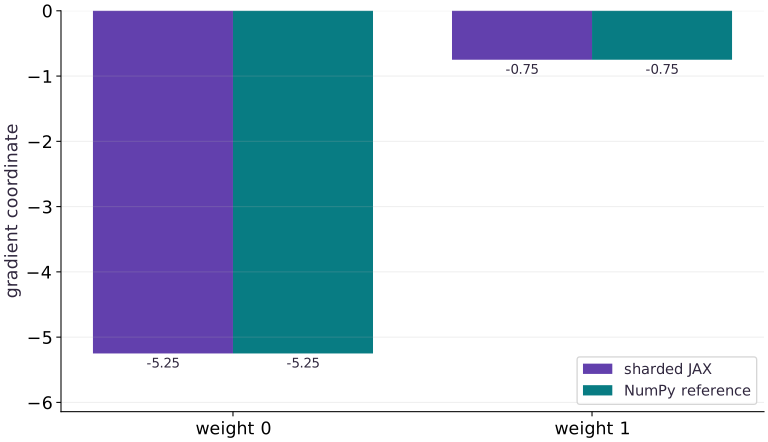
Read the figure
For each weight coordinate, compare the sharded JAX gradient with the NumPy reference gradient beside it. Both methods give approximately , so the paired bars have equal heights. They remain separate bars even where their edges touch.
The bars extend below zero because the derivatives are negative. This is not a plot of negative loss. The larger magnitude for weight indicates a stronger local sensitivity of the loss to that coordinate.
Connect it to the computation
A gradient descent step subtracts these values. From zero weights with rate , the next weights would be . This connects the signs in the picture to an actual update rather than treating taller or shorter bars as inherently better.
Agreement with the global reference checks that sharding and reduction preserved the intended gradient on this batch. It is separate from a speedup, or imply that a coordinate’s current gradient sign reveals its final optimal weight. Input correlations and subsequent updates can change that sign.
Open full-size figureDownload data and provenance
The notebook contains the data experiment, plotting code, and recorded figure output. Rerun it to test your changes.
Where to put & run this code: Work in phases/09-distributed/02-a-sharded-training-step/code/main.py (or downloaded exercises/distributed-02.py / exercises/distributed-02.ipynb) and execute from the repository root with python3 phases/09-distributed/02-a-sharded-training-step/code/main.py.
1 Start a fresh CPU runtime
Create main.py in your course workspace. Paste this block first. If using a notebook, restart its kernel before running any cell.
# Step 1 — Start a fresh CPU runtime: Configuration happens before devices() or array creation...
import jax
# Run this file in a fresh process; in a notebook restart the kernel first.
jax.config.update("jax_platforms", "cpu")
# Update state in place with the new values.
jax.config.update("jax_num_cpu_devices", 4)
import jax.numpy as jnp
import numpy as np
from jax.sharding import Mesh, NamedSharding, PartitionSpec as P
# Query the active JAX devices into `devices`.
devices = jax.devices("cpu")
# Guard input contract (`len(devices) != 4`) and fail fast if violated.
if len(devices) != 4:
    raise RuntimeError("Expected four CPU devices. Restart the notebook kernel, then Run all; do not run an earlier JAX cell first.")
# Configure multi-device placement / sharding specification (`mesh`).
mesh = Mesh(np.array(devices), ("data",))
# Configure multi-device placement / sharding specification (`rows`).
rows = NamedSharding(mesh, P("data", None))
# Configure multi-device placement / sharding specification (`replicated`).
replicated = NamedSharding(mesh, P())
Code building blocks in this step
Mesh + PartitionSpec + NamedSharding— Maps logical tensor axes onto physical device mesh axes for SPMD data, tensor, or pipeline parallelism.
Configuration happens before devices() or array creation initializes a backend. This file explicitly chooses CPU even on a GPU machine.
2 Place and compute
Append this block in the same file. Predict the shapes and values before running.
# Step 2 — Place and compute: Mesh axis names describe placement.
host_x = np.array([[1,0],[0,1],[1,1],[2,0],[0,2],[2,1],[1,2],[2,2]],dtype=np.float32)
true_w = np.array([2.,-1.],dtype=np.float32)
# Perform matrix / vector contraction (`@`) to compute `host_y`.
host_y = host_x @ true_w
# Configure multi-device placement / sharding specification (`labels_sharding`).
labels_sharding = NamedSharding(mesh,P("data"))
# Place `x` explicitly onto the target JAX device.
x = jax.device_put(host_x, rows)
# Place `y` explicitly onto the target JAX device.
y = jax.device_put(host_y, labels_sharding)
# Place `w` explicitly onto the target JAX device.
w = jax.device_put(np.zeros(2,dtype=np.float32),replicated)
def loss(weights, features, labels):
    return jnp.mean((features @ weights-labels)**2)
# Define `update(weights, features, labels)` to evaluate the objective and its automatic derivatives:
def update(weights, features, labels):
    # Differentiate the objective to obtain `(value, gradient)` via automatic differentiation.
    value, gradient = jax.value_and_grad(loss)(weights,features,labels)
    return weights - 0.1*gradient, value, gradient
# Wrap with `jax.jit` (`train_step`) so XLA traces and compiles the function.
train_step = jax.jit(update, in_shardings=(replicated,rows,labels_sharding),out_shardings=(replicated,replicated,replicated))
new_w, before, gradient = train_step(w,x,y)
Code building blocks in this step
x.sum(axis=...) / x.mean(axis=..., keepdims=...)— Reduces values along the namedaxis(the axis you name is collapsed unlesskeepdims=True).jax.value_and_grad(loss_fn)(params, ...)— Evaluates both the scalar loss and its gradient PyTree(loss_val, grads)in a single forward+backward pass.jax.jit(fn) / @jax.jit— Tracesfnwith abstract shapes and compiles a fused XLA executable cached by input shape and dtype.Mesh + PartitionSpec + NamedSharding— Maps logical tensor axes onto physical device mesh axes for SPMD data, tensor, or pipeline parallelism.
Mesh axis names describe placement. They are separate from the numerical array dimensions.
3 Inspect and verify
Append the checks, save the file and run python main.py with the setup lesson environment.
# Step 3 — Inspect and verify: Assertions compare against host calculations or hand-derived...
expected_gradient = 2 * host_x.T @ (-host_y) / len(host_y)
# Convert `` to a host NumPy array for inspection or verification.
np.testing.assert_allclose(np.asarray(gradient),expected_gradient,rtol=1e-6,atol=1e-6)
# Convert `` to a host NumPy array for inspection or verification.
np.testing.assert_allclose(np.asarray(new_w),-0.1*expected_gradient,rtol=1e-6,atol=1e-6)
# Aggregate array values to compute `expected_loss`.
expected_loss = np.mean(host_y**2)
# Convert `` to a host NumPy array for inspection or verification.
np.testing.assert_allclose(np.asarray(before), expected_loss,rtol=1e-6)
assert float(loss(new_w,x,y)) < float(before)
for shard in new_w.addressable_shards:
    # Convert `` to a host NumPy array for inspection or verification.
    np.testing.assert_allclose(np.asarray(shard.data),np.asarray(new_w))
print("Initial loss:",float(before))
print("Gradient:",np.asarray(gradient),"updated weights:",np.asarray(new_w))
print("Updated loss:",float(loss(new_w,x,y)))
Code building blocks in this step
x.sum(axis=...) / x.mean(axis=..., keepdims=...)— Reduces values along the namedaxis(the axis you name is collapsed unlesskeepdims=True).jnp.allclose(actual, expected, rtol=..., atol=...)— Checks that two arrays match elementwise within floating-point tolerance.
Assertions compare against host calculations or hand-derived values; printing a sharding object alone is separate from correctness.
View the cumulative build in main.py
These blocks append in order to the same file.
# Step 1 — Start a fresh CPU runtime: Configuration happens before devices() or array creation...
import jax
# Run this file in a fresh process; in a notebook restart the kernel first.
jax.config.update("jax_platforms", "cpu")
# Update state in place with the new values.
jax.config.update("jax_num_cpu_devices", 4)
import jax.numpy as jnp
import numpy as np
from jax.sharding import Mesh, NamedSharding, PartitionSpec as P
# Query the active JAX devices into `devices`.
devices = jax.devices("cpu")
# Guard input contract (`len(devices) != 4`) and fail fast if violated.
if len(devices) != 4:
    raise RuntimeError("Expected four CPU devices. Restart the notebook kernel, then Run all; do not run an earlier JAX cell first.")
# Configure multi-device placement / sharding specification (`mesh`).
mesh = Mesh(np.array(devices), ("data",))
# Configure multi-device placement / sharding specification (`rows`).
rows = NamedSharding(mesh, P("data", None))
# Configure multi-device placement / sharding specification (`replicated`).
replicated = NamedSharding(mesh, P())

# Step 2 — Place and compute: Mesh axis names describe placement.
host_x = np.array([[1,0],[0,1],[1,1],[2,0],[0,2],[2,1],[1,2],[2,2]],dtype=np.float32)
true_w = np.array([2.,-1.],dtype=np.float32)
# Perform matrix / vector contraction (`@`) to compute `host_y`.
host_y = host_x @ true_w
# Configure multi-device placement / sharding specification (`labels_sharding`).
labels_sharding = NamedSharding(mesh,P("data"))
# Place `x` explicitly onto the target JAX device.
x = jax.device_put(host_x, rows)
# Place `y` explicitly onto the target JAX device.
y = jax.device_put(host_y, labels_sharding)
# Place `w` explicitly onto the target JAX device.
w = jax.device_put(np.zeros(2,dtype=np.float32),replicated)
def loss(weights, features, labels):
    return jnp.mean((features @ weights-labels)**2)
# Define `update(weights, features, labels)` to evaluate the objective and its automatic derivatives:
def update(weights, features, labels):
    # Differentiate the objective to obtain `(value, gradient)` via automatic differentiation.
    value, gradient = jax.value_and_grad(loss)(weights,features,labels)
    return weights - 0.1*gradient, value, gradient
# Wrap with `jax.jit` (`train_step`) so XLA traces and compiles the function.
train_step = jax.jit(update, in_shardings=(replicated,rows,labels_sharding),out_shardings=(replicated,replicated,replicated))
new_w, before, gradient = train_step(w,x,y)

# Step 3 — Inspect and verify: Assertions compare against host calculations or hand-derived...
expected_gradient = 2 * host_x.T @ (-host_y) / len(host_y)
# Convert `` to a host NumPy array for inspection or verification.
np.testing.assert_allclose(np.asarray(gradient),expected_gradient,rtol=1e-6,atol=1e-6)
# Convert `` to a host NumPy array for inspection or verification.
np.testing.assert_allclose(np.asarray(new_w),-0.1*expected_gradient,rtol=1e-6,atol=1e-6)
# Aggregate array values to compute `expected_loss`.
expected_loss = np.mean(host_y**2)
# Convert `` to a host NumPy array for inspection or verification.
np.testing.assert_allclose(np.asarray(before), expected_loss,rtol=1e-6)
assert float(loss(new_w,x,y)) < float(before)
for shard in new_w.addressable_shards:
    # Convert `` to a host NumPy array for inspection or verification.
    np.testing.assert_allclose(np.asarray(shard.data),np.asarray(new_w))
print("Initial loss:",float(before))
print("Gradient:",np.asarray(gradient),"updated weights:",np.asarray(new_w))
print("Updated loss:",float(loss(new_w,x,y)))
Run the example
python3 phases/09-distributed/02-a-sharded-training-step/code/main.pyAbout this command
This shortcut uses an activated macOS/Linux course environment in the repository folder. For Windows, use the explicit interpreter command in “Setup help” above. The script includes worked examples and reference solutions.
Inspect the complete assembled example
# Step 1 — Start a fresh CPU runtime: Configuration happens before devices() or array creation...
import jax
# Run this file in a fresh process; in a notebook restart the kernel first.
jax.config.update("jax_platforms", "cpu")
# Update state in place with the new values.
jax.config.update("jax_num_cpu_devices", 4)
import jax.numpy as jnp
import numpy as np
from jax.sharding import Mesh, NamedSharding, PartitionSpec as P
# Query the active JAX devices into `devices`.
devices = jax.devices("cpu")
# Guard input contract (`len(devices) != 4`) and fail fast if violated.
if len(devices) != 4:
    raise RuntimeError("Expected four CPU devices. Restart the notebook kernel, then Run all; do not run an earlier JAX cell first.")
# Configure multi-device placement / sharding specification (`mesh`).
mesh = Mesh(np.array(devices), ("data",))
# Configure multi-device placement / sharding specification (`rows`).
rows = NamedSharding(mesh, P("data", None))
# Configure multi-device placement / sharding specification (`replicated`).
replicated = NamedSharding(mesh, P())

# Step 2 — Place and compute: Mesh axis names describe placement.
host_x = np.array([[1,0],[0,1],[1,1],[2,0],[0,2],[2,1],[1,2],[2,2]],dtype=np.float32)
true_w = np.array([2.,-1.],dtype=np.float32)
# Perform matrix / vector contraction (`@`) to compute `host_y`.
host_y = host_x @ true_w
# Configure multi-device placement / sharding specification (`labels_sharding`).
labels_sharding = NamedSharding(mesh,P("data"))
# Place `x` explicitly onto the target JAX device.
x = jax.device_put(host_x, rows)
# Place `y` explicitly onto the target JAX device.
y = jax.device_put(host_y, labels_sharding)
# Place `w` explicitly onto the target JAX device.
w = jax.device_put(np.zeros(2,dtype=np.float32),replicated)
def loss(weights, features, labels):
    return jnp.mean((features @ weights-labels)**2)
# Define `update(weights, features, labels)` to evaluate the objective and its automatic derivatives:
def update(weights, features, labels):
    # Differentiate the objective to obtain `(value, gradient)` via automatic differentiation.
    value, gradient = jax.value_and_grad(loss)(weights,features,labels)
    return weights - 0.1*gradient, value, gradient
# Wrap with `jax.jit` (`train_step`) so XLA traces and compiles the function.
train_step = jax.jit(update, in_shardings=(replicated,rows,labels_sharding),out_shardings=(replicated,replicated,replicated))
new_w, before, gradient = train_step(w,x,y)

# Step 3 — Inspect and verify: Assertions compare against host calculations or hand-derived...
expected_gradient = 2 * host_x.T @ (-host_y) / len(host_y)
# Convert `` to a host NumPy array for inspection or verification.
np.testing.assert_allclose(np.asarray(gradient),expected_gradient,rtol=1e-6,atol=1e-6)
# Convert `` to a host NumPy array for inspection or verification.
np.testing.assert_allclose(np.asarray(new_w),-0.1*expected_gradient,rtol=1e-6,atol=1e-6)
# Aggregate array values to compute `expected_loss`.
expected_loss = np.mean(host_y**2)
# Convert `` to a host NumPy array for inspection or verification.
np.testing.assert_allclose(np.asarray(before), expected_loss,rtol=1e-6)
assert float(loss(new_w,x,y)) < float(before)
for shard in new_w.addressable_shards:
    # Convert `` to a host NumPy array for inspection or verification.
    np.testing.assert_allclose(np.asarray(shard.data),np.asarray(new_w))
print("Initial loss:",float(before))
print("Gradient:",np.asarray(gradient),"updated weights:",np.asarray(new_w))
print("Updated loss:",float(loss(new_w,x,y)))
Expected result: Initial loss ; gradient ; weights ; updated loss is lower. Small float32 printing differences are expected.
Recorded reference execution
Reference output captured from executing the complete lesson script (code/main.py) and its assertions in the course CPU environment.
Initial loss: 4.875
Gradient: [-5.25 -0.75] updated weights: [0.52500004 0.075     ]
Updated loss: 2.6784372329711914
Initial loss: 4.875
Gradient: [-5.25 -0.75] updated weights: [0.52500004 0.075     ]
Updated loss: 2.6784372329711914
Permutation preserves the global update
Ten-step weights: [ 1.704636  -0.7047408]
Summed local means are four times too large; weighted aggregation repaired
Summed local means are four times too large; weighted aggregation repaired
PASS: distributed-02
Download execution record · The notebook includes executed cells and figure outputs. Compare your run with these values; timings depend on the machine.
Permutation across shards
# Experiment — Permutation across shards: The global mean is invariant to row order.
reverse_x = jax.device_put(host_x[::-1].copy(),rows)
# Place `reverse_y` explicitly onto the target JAX device.
reverse_y = jax.device_put(host_y[::-1].copy(),labels_sharding)
reverse_w,reverse_loss,reverse_gradient = train_step(w,reverse_x,reverse_y)
# Convert `` to a host NumPy array for inspection or verification.
np.testing.assert_allclose(np.asarray(reverse_gradient),expected_gradient,rtol=1e-6,atol=1e-6)
# Convert `` to a host NumPy array for inspection or verification.
np.testing.assert_allclose(np.asarray(reverse_w),np.asarray(new_w),rtol=1e-6,atol=1e-6)
print("Permutation preserves the global update")
Expected: Gradient and update agree within .
The global mean is invariant to row order. This check exposes accidental dependence on a particular local subset.
Ten updates against a host training loop
# Experiment — Ten updates against a host training loop: Checking every update catches transient mismatches that a single...
cpu_weights = w
# Allocate initialized array `reference_weights` with the specified shape and dtype.
reference_weights = np.zeros(2,dtype=np.float32)
for step_index in range(10):
    cpu_weights,_,_ = train_step(cpu_weights,x,y)
    residual = host_x @ reference_weights-host_y
    # Accumulate the next contribution into `reference_weights`.
    reference_weights -= 0.1*(2*host_x.T @ residual/len(host_y))
    # Convert `` to a host NumPy array for inspection or verification.
    np.testing.assert_allclose(np.asarray(cpu_weights),reference_weights,rtol=1e-5,atol=1e-6)
print("Ten-step weights:",np.asarray(cpu_weights))
Expected: Each of ten parameter updates agrees with the independent host loop within the stated tolerance.
Checking every update catches transient mismatches that a single final loss comparison could hide.
Make it yours
Where to put your code: Append your solution at the bottom of phases/09-distributed/02-a-sharded-training-step/code/main.py (or inside the Make it yours cell of exercises/distributed-02.ipynb) and run python3 phases/09-distributed/02-a-sharded-training-step/code/main.py to verify your prediction before opening the reference solution.
Run a changed target/initial-state update, then diagnose the factor-of-four local-mean bug and repair uneven-batch aggregation.
Show a writing guide and starter scaffold
How to write this exercise code: step-by-step recipe & starter scaffold
1. Key functions & syntax to use:
x.sum(axis=...) / x.mean(axis=..., keepdims=...)— Reduces values along the namedaxis(the axis you name is collapsed unlesskeepdims=True).jnp.allclose(actual, expected, rtol=..., atol=...)— Checks that two arrays match elementwise within floating-point tolerance.jax.grad(loss_fn)(params, ...)— Transforms a scalar-output function into a function returning the gradient PyTree with the same structure asparams.jax.jit(fn) / @jax.jit— Tracesfnwith abstract shapes and compiles a fused XLA executable cached by input shape and dtype.
2. Step-by-step implementation plan:
- Define
changed_update(weights, features, labels)to evaluate the objective and its automatic derivatives: - Wrap with
jax.jit(changed_step) so XLA traces and compiles the function. - Place
resultexplicitly onto the target JAX device. - Convert
to a host NumPy array for inspection or verification. - Reduce along axis=0 to compute
wrong.
# Exercise solution: Run a changed target/initial-state update, then diagnose the...
changed_y = ...  # TODO: compute changed_y
start = np.array(...)  # TODO: compute start
# Define `changed_update(weights, features, labels)` to evaluate the objective and its automatic derivatives:
def changed_update(weights,features,labels):
    return ...  # TODO: return computed result
# Wrap with `jax.jit` (`changed_step`) so XLA traces and compiles the function.
changed_step = jax.jit(...)  # TODO: compute changed_step
# Place `result` explicitly onto the target JAX device.
result = changed_step(...)  # TODO: compute result
reference_gradient = ...  # TODO: compute reference_gradient
# Convert `` to a host NumPy array for inspection or verification.
np.testing.assert_allclose(np.asarray(result),start-0.05*reference_gradient,rtol=1e-6,atol=1e-6)

local_gradients = ...  # TODO: compute local_gradients
for features,labels in zip(np.split(host_x,4),np.split(host_y,4)):
    local_gradients.append(2*features.T @ (-labels)/len(labels))
# Reduce along axis=0 to compute `wrong`.
wrong = np.sum(...)  # TODO: compute wrong
# Reduce along axis=0 to compute `right`.
right = np.mean(...)  # TODO: compute right
np.testing.assert_allclose(wrong,4*expected_gradient,rtol=1e-6)
np.testing.assert_allclose(right,expected_gradient,rtol = ...  # TODO: compute np.testing.assert_allclose(right,expected_gradient,rtol
# Unequal partitions: weight local mean gradients by their observation counts.
parts = ...  # TODO: compute parts
weighted = sum(...)  # TODO: compute weighted
np.testing.assert_allclose(weighted,expected_gradient,rtol = ...  # TODO: compute np.testing.assert_allclose(weighted,expected_gradient,rtol
print("Summed local means are four times too large; weighted aggregation repaired")
Reveal the reference solution
# Exercise solution: Run a changed target/initial-state update, then diagnose the...
changed_y = host_x @ np.array([-1.,3.],dtype=np.float32)
start = np.array([0.2,-0.1],dtype=np.float32)
# Define `changed_update(weights, features, labels)` to evaluate the objective and its automatic derivatives:
def changed_update(weights,features,labels):
    return weights-0.05*jax.grad(loss)(weights,features,labels)
# Wrap with `jax.jit` (`changed_step`) so XLA traces and compiles the function.
changed_step = jax.jit(changed_update,in_shardings=(replicated,rows,labels_sharding),out_shardings=replicated)
# Place `result` explicitly onto the target JAX device.
result = changed_step(jax.device_put(start,replicated),x,jax.device_put(changed_y,labels_sharding))
reference_gradient = 2*host_x.T @ (host_x@start-changed_y)/len(changed_y)
# Convert `` to a host NumPy array for inspection or verification.
np.testing.assert_allclose(np.asarray(result),start-0.05*reference_gradient,rtol=1e-6,atol=1e-6)

local_gradients = []
for features,labels in zip(np.split(host_x,4),np.split(host_y,4)):
    local_gradients.append(2*features.T @ (-labels)/len(labels))
# Reduce along axis=0 to compute `wrong`.
wrong = np.sum(local_gradients,axis=0)
# Reduce along axis=0 to compute `right`.
right = np.mean(local_gradients,axis=0)
np.testing.assert_allclose(wrong,4*expected_gradient,rtol=1e-6)
np.testing.assert_allclose(right,expected_gradient,rtol=1e-6)
# Unequal partitions: weight local mean gradients by their observation counts.
parts = [(host_x[:3],host_y[:3]),(host_x[3:],host_y[3:])]
weighted = sum(len(b)*(2*a.T @ (-b)/len(b)) for a,b in parts)/len(host_y)
np.testing.assert_allclose(weighted,expected_gradient,rtol=1e-6)
print("Summed local means are four times too large; weighted aggregation repaired")
Transfer to a different target model
Challenge
Change true weights to , start at and use learning rate . Derive and check the new update without reusing the original numeric answer.
Show a writing guide and starter scaffold
How to write this practice solution: step-by-step recipe & starter scaffold
1. Key functions & syntax to use:
jnp.allclose(actual, expected, rtol=..., atol=...)— Checks that two arrays match elementwise within floating-point tolerance.jax.grad(loss_fn)(params, ...)— Transforms a scalar-output function into a function returning the gradient PyTree with the same structure asparams.jax.jit(fn) / @jax.jit— Tracesfnwith abstract shapes and compiles a fused XLA executable cached by input shape and dtype.Mesh + PartitionSpec + NamedSharding— Maps logical tensor axes onto physical device mesh axes for SPMD data, tensor, or pipeline parallelism.
2. Step-by-step implementation plan:
- Define
changed_update(weights, features, labels)to evaluate the objective and its automatic derivatives: - Wrap with
jax.jit(changed_step) so XLA traces and compiles the function. - Place
resultexplicitly onto the target JAX device. - Convert
to a host NumPy array for inspection or verification.
# Transfer to a different target model (Challenge): The independent formula follows the new target, initial...
changed_y = ...  # TODO: compute changed_y
start = np.array(...)  # TODO: compute start
# Define `changed_update(weights, features, labels)` to evaluate the objective and its automatic derivatives:
def changed_update(weights,features,labels):
    return ...  # TODO: return computed result
# Wrap with `jax.jit` (`changed_step`) so XLA traces and compiles the function.
changed_step = jax.jit(...)  # TODO: compute changed_step
# Place `result` explicitly onto the target JAX device.
result = changed_step(...)  # TODO: compute result
reference_gradient = ...  # TODO: compute reference_gradient
# Convert `` to a host NumPy array for inspection or verification.
np.testing.assert_allclose(np.asarray(result),start-0.05*reference_gradient,rtol=1e-6,atol=1e-6)
Show a hint
The original train_step hardcodes ; define a new step with the changed rate.
Reveal reference solution and reasoning
# Transfer to a different target model (Challenge): The independent formula follows the new target, initial...
changed_y = host_x @ np.array([-1.,3.],dtype=np.float32)
start = np.array([0.2,-0.1],dtype=np.float32)
# Define `changed_update(weights, features, labels)` to evaluate the objective and its automatic derivatives:
def changed_update(weights,features,labels):
    return weights-0.05*jax.grad(loss)(weights,features,labels)
# Wrap with `jax.jit` (`changed_step`) so XLA traces and compiles the function.
changed_step = jax.jit(changed_update,in_shardings=(replicated,rows,labels_sharding),out_shardings=replicated)
# Place `result` explicitly onto the target JAX device.
result = changed_step(jax.device_put(start,replicated),x,jax.device_put(changed_y,labels_sharding))
reference_gradient = 2*host_x.T @ (host_x@start-changed_y)/len(changed_y)
# Convert `` to a host NumPy array for inspection or verification.
np.testing.assert_allclose(np.asarray(result),start-0.05*reference_gradient,rtol=1e-6,atol=1e-6)
The independent formula follows the new target, initial state and learning rate. Reusing a hard-coded expected weight vector would not test transfer.
Diagnose summed local means
Challenge
Compute four host local mean gradients. Show why summing them gives four times the global mean, then repair the aggregation. Also explain the unequal-batch generalization.
Show a writing guide and starter scaffold
How to write this practice solution: step-by-step recipe & starter scaffold
1. Key functions & syntax to use:
x.sum(axis=...) / x.mean(axis=..., keepdims=...)— Reduces values along the namedaxis(the axis you name is collapsed unlesskeepdims=True).jnp.allclose(actual, expected, rtol=..., atol=...)— Checks that two arrays match elementwise within floating-point tolerance.
2. Step-by-step implementation plan:
- Reduce along axis=0 to compute
wrong. - Reduce along axis=0 to compute
right. - Unequal partitions: weight local mean gradients by their observation counts.
# Diagnose summed local means (Challenge): Each local gradient already divides by its local count.
local_gradients = ...  # TODO: compute local_gradients
for features,labels in zip(np.split(host_x,4),np.split(host_y,4)):
    local_gradients.append(2*features.T @ (-labels)/len(labels))
# Reduce along axis=0 to compute `wrong`.
wrong = np.sum(...)  # TODO: compute wrong
# Reduce along axis=0 to compute `right`.
right = np.mean(...)  # TODO: compute right
np.testing.assert_allclose(wrong,4*expected_gradient,rtol=1e-6)
np.testing.assert_allclose(right,expected_gradient,rtol = ...  # TODO: compute np.testing.assert_allclose(right,expected_gradient,rtol
# Unequal partitions: weight local mean gradients by their observation counts.
parts = ...  # TODO: compute parts
weighted = sum(...)  # TODO: compute weighted
np.testing.assert_allclose(weighted,expected_gradient,rtol = ...  # TODO: compute np.testing.assert_allclose(weighted,expected_gradient,rtol
print("Summed local means are four times too large; weighted aggregation repaired")
Show a hint
A mean of equal-size local means works; unequal sizes require weighting by local counts.
Reveal reference solution and reasoning
# Diagnose summed local means (Challenge): Each local gradient already divides by its local count.
local_gradients = []
for features,labels in zip(np.split(host_x,4),np.split(host_y,4)):
    local_gradients.append(2*features.T @ (-labels)/len(labels))
# Reduce along axis=0 to compute `wrong`.
wrong = np.sum(local_gradients,axis=0)
# Reduce along axis=0 to compute `right`.
right = np.mean(local_gradients,axis=0)
np.testing.assert_allclose(wrong,4*expected_gradient,rtol=1e-6)
np.testing.assert_allclose(right,expected_gradient,rtol=1e-6)
# Unequal partitions: weight local mean gradients by their observation counts.
parts = [(host_x[:3],host_y[:3]),(host_x[3:],host_y[3:])]
weighted = sum(len(b)*(2*a.T @ (-b)/len(b)) for a,b in parts)/len(host_y)
np.testing.assert_allclose(weighted,expected_gradient,rtol=1e-6)
print("Summed local means are four times too large; weighted aggregation repaired")
Each local gradient already divides by its local count. Summing four equal local means omits division by four. For unequal counts, an unweighted mean also misrepresents examples; sum count-weighted local means and divide by total count.
Diagnose the result
Each local gradient already divides by its local count. Summing four equal local means omits division by four. For unequal counts, an unweighted mean also misrepresents examples; sum count-weighted local means and divide by total count.
Carry forward
- Write the objective before splitting the data
- Give batch and parameters different placements
- Differentiate the global function rather than inventing a local objective
- A correct first update is stronger evidence than a falling curve
Keep your evidence
Each local gradient already divides by its local count. Summing four equal local means omits division by four. For unequal counts, an unweighted mean also misrepresents examples; sum count-weighted local means and divide by total count.
Save your modified code, its output, and an explanation of your prediction. Checkpoint answers and exercise evidence are tracked separately.
Saved in this browser. Export or back up your portfolio anytime in My learning.
Verified on local CPU. Stage to a Cloud TPU VM via Cloud TPU setup to record accelerator execution receipts (TODO: add automated Cloud TPU CI execution receipts).