 JAX Pathways
Phase 14 / Autodiff & JAX internals
Lowering, compilation, and a tiny transformation
Revision v0.7.0 · Updated since your last visit. Review the changes; your progress is saved.
Lesson · about 130 minutes · CPU practice
Interpret literals, captured constants and variables in a supported flat jaxpr. Implement actual forward derivative rules without calling jax.jvp inside the interpreter.
Phase study guide: preparation, milestones and project evidence
Before you start
Before this: Custom derivative rules
Hardware: CPU
Setup help: Python, notebook, or Cloud TPU VM
Use the tested CPU packages (the recorded environment uses Python 3.14.3). Other Python versions and accelerator environments require separate checks. The optional Cloud TPU specialization explains the target-specific execution boundaries. Logical CPU devices practice partitioning; they do not simulate TPU performance.
Download the repository ZIP or use your existing checkout. Extract it and open a terminal in the folder containing requirements-cpu.txt. The beginner ZIP is separate; these lessons use the full repository folder.
python3 -m venv .venv
source .venv/bin/activate
python -m pip install -r requirements-cpu.txtpy -3 -m venv .venv
.\.venv\Scripts\python.exe -m pip install -r requirements-cpu.txtAfter activation, run the complete worked example from that same folder:
python phases/14-internals/04-lowering-compilation-and-a-tiny-transformation/code/main.py.\.venv\Scripts\python.exe phases/14-internals/04-lowering-compilation-and-a-tiny-transformation/code/main.pyFor an incremental build, create main.py in your own practice folder, append each build block in order, and run python main.py with this environment active. Keep that file separate from the downloaded reference solution.
Download this lesson’s notebook. Open it with a Python kernel using the course environment. Run cells from the top after restarting the kernel; experiments depend on earlier definitions.
For local Jupyter, first install the course requirements using the Local Python steps, then use your environment’s Python to start Jupyter:
python -m pip install jupyterlab
python -m jupyter lab.\.venv\Scripts\python.exe -m pip install jupyterlab
.\.venv\Scripts\python.exe -m jupyter labSelect the downloaded internals-04.ipynb file in JupyterLab. The notebook contains reference solutions; make your prediction and attempt each practice task before opening them. Restart the kernel before changing logical device setup.
The worked reference for this lesson is CPU-validated. Some references explicitly configure logical CPU devices; setting JAX_PLATFORMS does not adapt them to a TPU. Follow the execution matrix and reviewed multi-host example before attempting a target run.
For accelerator preparation, study TPU setup, observed runtime receipts, checkpointed jobs and precision and retained traces. These target paths remain unqualified on physical TPU hardware until an actual receipt is recorded. Cloud provisioning is optional for CPU learning.
Check: The program contains sin, mul, add and reduce_sum. Interpreted and compiled primal/tangent values match analytic and JAX references; a changed compiled shape is rejected.
Revisit the guided CPU setup · Open 19: TPU Setup. Package instructions are CPU instructions; Windows and accelerator environments need their own validation.
What you will be able to do
- Interpret literals, captured constants and variables in a supported flat jaxpr.
- Implement actual forward derivative rules without calling jax.jvp inside the interpreter.
- Reject unsupported operations and mismatched signatures explicitly.
- Compare interpreted, JAX, analytic and compiled transformed results.
The problem
Reading a jaxpr tells you what operations exist, but implementing one small transformation makes its rules concrete. Can we propagate a value and a directional derivative through a traced program, compile that transformed computation, and clearly reject programs we do not support?
The idea
A small interpreter makes program transformations concrete: read operations and propagate additional information through them. Keep tracing, interpretation, lowering and compilation as distinct stages so the exercise's scope stays clear.
Locate your transformation in the compilation pipeline
Imagine an interpreter carrying a value and a directional derivative through each supported operation. Addition combines both pairs; multiplication applies the product rule. The interpreter must explicitly define behavior for every primitive it accepts.
Reject unsupported operations instead of silently passing them through with a made-up derivative. Compare the transformed result with an analytic or independently calculated direction on a small composition.
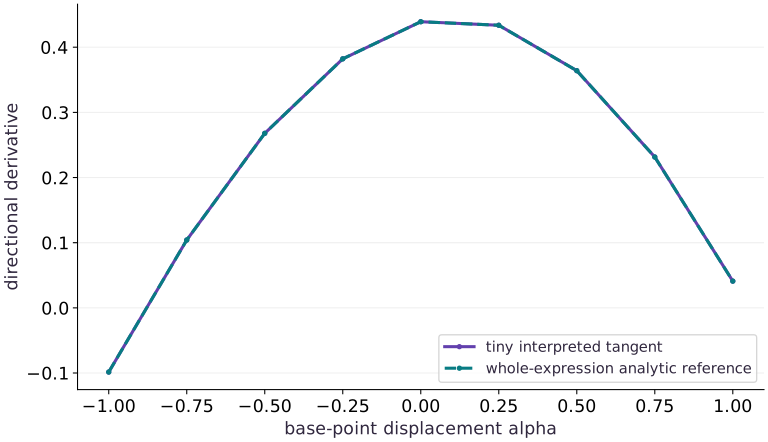
The directional-derivative curve checks the bounded interpreter example. It is separate from a general-purpose compiler or support for all JAX primitives. Identify which stage your code implements and which later stages JAX supplies.
Treat a jaxpr as a typed data-flow program
A closed jaxpr contains input variables, captured constants, equations and output variables. Each equation reads already-defined values and writes new values. Its variable names are presentation details; the object identities and data dependencies carry meaning. We use the public extension namespace for the Literal type, and inspect the installed JAX representation rather than matching printed variable names. The executed environment is JAX 0.9.2, where the closed trace exposes .jaxpr and .consts separately. Newer documentation may describe a unified representation; inspect the installed version and rerun these contracts when upgrading.
Attach a tangent to every value
For addition, add both primals and tangents. For multiplication, the tangent is , not the product of the tangents. For sine, multiply the incoming tangent by the cosine of the primal. Reduction sums both values over the same axes. Literals and captured constants have zero tangent with respect to the explicit input. That last qualifier matters: making a formerly captured parameter an input changes the derivative contract.
A small supported subset is an enforceable boundary
The interpreter supports add, multiply, negate, sine and sum-reduction. It rejects effects, unsupported primitives, multiple-result primitives, explicit reduction placement, integer inputs and signature mismatches. It does not interpret nested jit calls, conditionals, scan, random state, complex differentiation or custom derivatives. Silent fallback to executing an unknown primitive would produce a value without a justified derivative, so the explicit exception is essential.
Verify a complete transformed program
Our example is , with captured offset . Its analytic directional derivative is . The interpreter implements that derivative through local primitive rules, while the reference derives it from the whole expression. Comparing those approaches checks both the local rules and how they are composed.
Trace, lower and compile are separate stages
make_jaxpr exposes a JAX-level program. Lowering converts a traced computation toward compiler input, and compile produces an executable specialized to the signature and target. We lower the transformed interpreter, not just the original function. The interpreter’s Python loop runs during tracing; its arithmetic becomes the program that executes later. StableHLO text is useful for inspection, but its length or equation count is not a runtime measurement.
Specialization is part of the artifact contract
The ahead-of-time executable accepts the same array shapes and dtypes used for lowering. A changed shape requires retracing and recompilation; the compiled callable does not automatically create a new specialization. We deliberately test rejection rather than assuming shape polymorphism. Numeric input values may change within the same signature, and we test those changed values separately. Compiled artifact portability across devices or JAX versions is not established here.
A composed interpreter tracks the analytic directional derivative
Predict before looking: As the base point moves along a line, should its directional derivative remain constant?
Read the figure
The horizontal axis is a scalar displacement of the base point . The vertical axis is the directional derivative of the scalar program along the fixed direction . Each point comes from a new evaluation of the same supported trace at a shape-compatible input.
The interpreter and analytic curves overlap. Their derivative is about at , rises to a sampled peak of about at the original point , then falls to about at . The sign change and nonmonotone shape reflect a changing Jacobian, not disagreement between the two methods.
Connect it to the computation
The interpreter obtains each value by composing local tangent rules; the reference directly evaluates at . The code also checks the middle point against JAX’s JVP and checks the lowered, compiled transformed program.
Agreement applies to this primitive subset and tested inputs. It does not validate an unsupported operation, nested control flow, compiler performance or device portability. Those require new rules and new evidence rather than extrapolation from this plot.
Open full-size figureDownload data and provenance
The notebook contains the data experiment, plotting code, and recorded figure output. Rerun it to test your changes.
Where to put & run this code: Work in phases/14-internals/04-lowering-compilation-and-a-tiny-transformation/code/main.py (or downloaded exercises/internals-04.py / exercises/internals-04.ipynb) and execute from the repository root with python3 phases/14-internals/04-lowering-compilation-and-a-tiny-transformation/code/main.py.
1 Define a deliberately small derivative interpreter
Create main.py for the first block, then append subsequent blocks in order using your course CPU environment.
# Step 1 — Define a deliberately small derivative interpreter: Each environment entry stores a primal and its tangent.
import jax
# Update state in place with the new values.
jax.config.update("jax_enable_x64", True)
import jax.numpy as jnp
import numpy as np

from jax.extend import core

def tiny_jvp(closed,primals,tangents):
    """Interpret a pure flat jaxpr with floating inputs and explicit tangent rules."""
    program=closed.jaxpr
    # Guard input contract (`program.effects`) and fail fast if violated.
    if program.effects:
        raise NotImplementedError("effects are outside this interpreter")
    # Guard input contract (`len(primals) != len(program.invars) or len(tangents) != len(primals)`) and fail fast if violated.
    if len(primals)!=len(program.invars) or len(tangents)!=len(primals):
        raise ValueError("one primal and tangent per input variable required")
    values={}
    directions={}
    def put(var,value,tangent):
        values[var]=value
        directions[var]=tangent
    for var,constant in zip(program.constvars,closed.consts):
        # Allocate initialized array `` with the specified shape and dtype.
        put(var,constant,jnp.zeros_like(constant))
    for var,value,tangent in zip(program.invars,primals,tangents):
        # Guard input contract (`value.shape != var.aval.shape or value.dtype != var.aval.dtype`) and fail fast if violated.
        if value.shape!=var.aval.shape or value.dtype!=var.aval.dtype:
            raise ValueError("primal shape/dtype differs from traced signature")
        # Guard input contract (`tangent.shape != value.shape or tangent.dtype != value.dtype`) and fail fast if violated.
        if tangent.shape!=value.shape or tangent.dtype!=value.dtype:
            raise ValueError("tangent shape/dtype must match its primal")
        # Guard input contract (`not jnp.issubdtype(value.dtype, jnp.floating)`) and fail fast if violated.
        if not jnp.issubdtype(value.dtype,jnp.floating):
            raise ValueError("this teaching interpreter requires real floating inputs")
        put(var,value,tangent)
    def read(atom):
        if isinstance(atom,core.Literal):
            return atom.val,jnp.zeros_like(atom.val)
        return values[atom],directions[atom]
    for equation in program.eqns:
        name=equation.primitive.name
        # Guard input contract (`name not in {'add', 'mul', 'neg', 'sin', 'reduce_sum'}`) and fail fast if violated.
        if name not in {"add","mul","neg","sin","reduce_sum"}:
            raise NotImplementedError("unsupported primitive: "+name)
        # Guard input contract (`len(equation.outvars) != 1`) and fail fast if violated.
        if len(equation.outvars)!=1:
            raise NotImplementedError("multiple-result primitives are outside this interpreter")
        operands=[read(atom) for atom in equation.invars]
        a,da=operands[0]
        if name=="add":
            b,db=operands[1]
            result,tangent=a+b,da+db
        elif name=="mul":
            b,db=operands[1]
            result,tangent=a*b,da*b+a*db
        elif name=="neg":result,tangent=-a,-da
        elif name=="sin":result,tangent=jnp.sin(a),jnp.cos(a)*da
        else:
            if equation.params.get("out_sharding") is not None:
                raise NotImplementedError("explicit reduction placement is outside this interpreter")
            axes=equation.params["axes"]
            result,tangent=jnp.sum(a,axis=axes),jnp.sum(da,axis=axes)
        put(equation.outvars[0],result,tangent)
    output=[read(var) for var in program.outvars]
    return tuple(v for v,_ in output),tuple(t for _,t in output)
Code building blocks in this step
x.sum(axis=...) / x.mean(axis=..., keepdims=...)— Reduces values along the namedaxis(the axis you name is collapsed unlesskeepdims=True).
Each environment entry stores a primal and its tangent. Constants and literals receive zero tangents. Every supported primitive has a written derivative rule; unknown operations fail explicitly.
2 Trace a program and verify the transformed result
Create main.py for the first block, then append subsequent blocks in order using your course CPU environment.
# Step 2 — Trace a program and verify the transformed result: The traced closed constant contributes to the primal but not the...
offset=jnp.array([0.1,0.2,0.3])
def program(x):
    return jnp.sum(jnp.sin(x)*x+offset)
x=jnp.array([-0.8,0.4,1.1])
direction=jnp.array([0.3,-0.2,0.7])
# Trace or lower the function to inspect its compiler representation (`closed`).
closed=jax.make_jaxpr(program)(x)
primal_outputs,tangent_outputs=tiny_jvp(closed,(x,),(direction,))
# Aggregate array values to compute `reference_value`.
reference_value=np.sum(np.sin(np.asarray(x))*np.asarray(x)+np.asarray(offset))
# Convert `reference_tangent` to a host NumPy array for inspection or verification.
reference_tangent=np.dot(np.sin(np.asarray(x))+np.asarray(x)*np.cos(np.asarray(x)),np.asarray(direction))
np.testing.assert_allclose(primal_outputs[0],reference_value,rtol=1e-12)
np.testing.assert_allclose(tangent_outputs[0],reference_tangent,rtol=1e-12)
np.testing.assert_allclose(tangent_outputs[0],jax.jvp(program,(x,),(direction,))[1],rtol=1e-12)
print("Supported primitives:",[e.primitive.name for e in closed.jaxpr.eqns])
print("Interpreted primal and tangent:",float(primal_outputs[0]),float(tangent_outputs[0]))
Code building blocks in this step
jnp.array(values, dtype=...)— Constructs an immutable device-backed JAX array from Python/NumPy values.x.sum(axis=...) / x.mean(axis=..., keepdims=...)— Reduces values along the namedaxis(the axis you name is collapsed unlesskeepdims=True).jnp.allclose(actual, expected, rtol=..., atol=...)— Checks that two arrays match elementwise within floating-point tolerance.jax.jvp / jax.vjp / jax.jacfwd / jax.hessian— Computes exact forward-mode JVP, reverse-mode VJP, full Jacobians, or second-order curvature.
The traced closed constant contributes to the primal but not the input derivative. The interpreter performs genuine forward derivative propagation rather than delegating to jax.jvp.
3 Lower and compile the transformation itself
Create main.py for the first block, then append subsequent blocks in order using your course CPU environment.
# Step 3 — Lower and compile the transformation itself: The Python interpreter runs while tracing the transformed...
transformed=lambda value,tangent:tiny_jvp(closed,(value,),(tangent,))
# Wrap with `jax.jit` (`lowered`) so XLA traces and compiles the function.
lowered=jax.jit(transformed).lower(x,direction)
# Trace or lower the function to inspect its compiler representation (`stablehlo`).
stablehlo=str(lowered.compiler_ir(dialect="stablehlo"))
assert len(stablehlo)>0
# Trace or lower the function to inspect its compiler representation (`compiled`).
compiled=lowered.compile()
compiled_primal,compiled_tangent=compiled(x,direction)
np.testing.assert_allclose(compiled_primal[0],reference_value,rtol=1e-12)
np.testing.assert_allclose(compiled_tangent[0],reference_tangent,rtol=1e-12)
shape_rejected=False
# Run the boundary check and catch the expected exception:
try:
    compiled(jnp.ones(4),jnp.ones(4))
except TypeError:
    shape_rejected=True
assert shape_rejected
print("Lowered IR characters:",len(stablehlo))
print("Compiled transformed outputs match; changed shape explicitly rejected")
Code building blocks in this step
jnp.zeros / jnp.ones(shape, dtype=...)— Allocates a tensor of the givenshapeinitialized with constants.jnp.allclose(actual, expected, rtol=..., atol=...)— Checks that two arrays match elementwise within floating-point tolerance.jax.jit(fn) / @jax.jit— Tracesfnwith abstract shapes and compiles a fused XLA executable cached by input shape and dtype.
The Python interpreter runs while tracing the transformed function; its JAX arithmetic becomes a new compiled program. The ahead-of-time executable is specialized to the recorded input signature.
View the cumulative build in main.py
These blocks append in order to the same file.
# Step 1 — Define a deliberately small derivative interpreter: Each environment entry stores a primal and its tangent.
import jax
# Update state in place with the new values.
jax.config.update("jax_enable_x64", True)
import jax.numpy as jnp
import numpy as np

from jax.extend import core

def tiny_jvp(closed,primals,tangents):
    """Interpret a pure flat jaxpr with floating inputs and explicit tangent rules."""
    program=closed.jaxpr
    # Guard input contract (`program.effects`) and fail fast if violated.
    if program.effects:
        raise NotImplementedError("effects are outside this interpreter")
    # Guard input contract (`len(primals) != len(program.invars) or len(tangents) != len(primals)`) and fail fast if violated.
    if len(primals)!=len(program.invars) or len(tangents)!=len(primals):
        raise ValueError("one primal and tangent per input variable required")
    values={}
    directions={}
    def put(var,value,tangent):
        values[var]=value
        directions[var]=tangent
    for var,constant in zip(program.constvars,closed.consts):
        # Allocate initialized array `` with the specified shape and dtype.
        put(var,constant,jnp.zeros_like(constant))
    for var,value,tangent in zip(program.invars,primals,tangents):
        # Guard input contract (`value.shape != var.aval.shape or value.dtype != var.aval.dtype`) and fail fast if violated.
        if value.shape!=var.aval.shape or value.dtype!=var.aval.dtype:
            raise ValueError("primal shape/dtype differs from traced signature")
        # Guard input contract (`tangent.shape != value.shape or tangent.dtype != value.dtype`) and fail fast if violated.
        if tangent.shape!=value.shape or tangent.dtype!=value.dtype:
            raise ValueError("tangent shape/dtype must match its primal")
        # Guard input contract (`not jnp.issubdtype(value.dtype, jnp.floating)`) and fail fast if violated.
        if not jnp.issubdtype(value.dtype,jnp.floating):
            raise ValueError("this teaching interpreter requires real floating inputs")
        put(var,value,tangent)
    def read(atom):
        if isinstance(atom,core.Literal):
            return atom.val,jnp.zeros_like(atom.val)
        return values[atom],directions[atom]
    for equation in program.eqns:
        name=equation.primitive.name
        # Guard input contract (`name not in {'add', 'mul', 'neg', 'sin', 'reduce_sum'}`) and fail fast if violated.
        if name not in {"add","mul","neg","sin","reduce_sum"}:
            raise NotImplementedError("unsupported primitive: "+name)
        # Guard input contract (`len(equation.outvars) != 1`) and fail fast if violated.
        if len(equation.outvars)!=1:
            raise NotImplementedError("multiple-result primitives are outside this interpreter")
        operands=[read(atom) for atom in equation.invars]
        a,da=operands[0]
        if name=="add":
            b,db=operands[1]
            result,tangent=a+b,da+db
        elif name=="mul":
            b,db=operands[1]
            result,tangent=a*b,da*b+a*db
        elif name=="neg":result,tangent=-a,-da
        elif name=="sin":result,tangent=jnp.sin(a),jnp.cos(a)*da
        else:
            if equation.params.get("out_sharding") is not None:
                raise NotImplementedError("explicit reduction placement is outside this interpreter")
            axes=equation.params["axes"]
            result,tangent=jnp.sum(a,axis=axes),jnp.sum(da,axis=axes)
        put(equation.outvars[0],result,tangent)
    output=[read(var) for var in program.outvars]
    return tuple(v for v,_ in output),tuple(t for _,t in output)

# Step 2 — Trace a program and verify the transformed result: The traced closed constant contributes to the primal but not the...
offset=jnp.array([0.1,0.2,0.3])
def program(x):
    return jnp.sum(jnp.sin(x)*x+offset)
x=jnp.array([-0.8,0.4,1.1])
direction=jnp.array([0.3,-0.2,0.7])
# Trace or lower the function to inspect its compiler representation (`closed`).
closed=jax.make_jaxpr(program)(x)
primal_outputs,tangent_outputs=tiny_jvp(closed,(x,),(direction,))
# Aggregate array values to compute `reference_value`.
reference_value=np.sum(np.sin(np.asarray(x))*np.asarray(x)+np.asarray(offset))
# Convert `reference_tangent` to a host NumPy array for inspection or verification.
reference_tangent=np.dot(np.sin(np.asarray(x))+np.asarray(x)*np.cos(np.asarray(x)),np.asarray(direction))
np.testing.assert_allclose(primal_outputs[0],reference_value,rtol=1e-12)
np.testing.assert_allclose(tangent_outputs[0],reference_tangent,rtol=1e-12)
np.testing.assert_allclose(tangent_outputs[0],jax.jvp(program,(x,),(direction,))[1],rtol=1e-12)
print("Supported primitives:",[e.primitive.name for e in closed.jaxpr.eqns])
print("Interpreted primal and tangent:",float(primal_outputs[0]),float(tangent_outputs[0]))

# Step 3 — Lower and compile the transformation itself: The Python interpreter runs while tracing the transformed...
transformed=lambda value,tangent:tiny_jvp(closed,(value,),(tangent,))
# Wrap with `jax.jit` (`lowered`) so XLA traces and compiles the function.
lowered=jax.jit(transformed).lower(x,direction)
# Trace or lower the function to inspect its compiler representation (`stablehlo`).
stablehlo=str(lowered.compiler_ir(dialect="stablehlo"))
assert len(stablehlo)>0
# Trace or lower the function to inspect its compiler representation (`compiled`).
compiled=lowered.compile()
compiled_primal,compiled_tangent=compiled(x,direction)
np.testing.assert_allclose(compiled_primal[0],reference_value,rtol=1e-12)
np.testing.assert_allclose(compiled_tangent[0],reference_tangent,rtol=1e-12)
shape_rejected=False
# Run the boundary check and catch the expected exception:
try:
    compiled(jnp.ones(4),jnp.ones(4))
except TypeError:
    shape_rejected=True
assert shape_rejected
print("Lowered IR characters:",len(stablehlo))
print("Compiled transformed outputs match; changed shape explicitly rejected")
Run the example
python3 phases/14-internals/04-lowering-compilation-and-a-tiny-transformation/code/main.pyAbout this command
This shortcut uses an activated macOS/Linux course environment in the repository folder. For Windows, use the explicit interpreter command in “Setup help” above. The script includes worked examples and reference solutions.
Inspect the complete assembled example
# Step 1 — Define a deliberately small derivative interpreter: Each environment entry stores a primal and its tangent.
import jax
# Update state in place with the new values.
jax.config.update("jax_enable_x64", True)
import jax.numpy as jnp
import numpy as np

from jax.extend import core

def tiny_jvp(closed,primals,tangents):
    """Interpret a pure flat jaxpr with floating inputs and explicit tangent rules."""
    program=closed.jaxpr
    # Guard input contract (`program.effects`) and fail fast if violated.
    if program.effects:
        raise NotImplementedError("effects are outside this interpreter")
    # Guard input contract (`len(primals) != len(program.invars) or len(tangents) != len(primals)`) and fail fast if violated.
    if len(primals)!=len(program.invars) or len(tangents)!=len(primals):
        raise ValueError("one primal and tangent per input variable required")
    values={}
    directions={}
    def put(var,value,tangent):
        values[var]=value
        directions[var]=tangent
    for var,constant in zip(program.constvars,closed.consts):
        # Allocate initialized array `` with the specified shape and dtype.
        put(var,constant,jnp.zeros_like(constant))
    for var,value,tangent in zip(program.invars,primals,tangents):
        # Guard input contract (`value.shape != var.aval.shape or value.dtype != var.aval.dtype`) and fail fast if violated.
        if value.shape!=var.aval.shape or value.dtype!=var.aval.dtype:
            raise ValueError("primal shape/dtype differs from traced signature")
        # Guard input contract (`tangent.shape != value.shape or tangent.dtype != value.dtype`) and fail fast if violated.
        if tangent.shape!=value.shape or tangent.dtype!=value.dtype:
            raise ValueError("tangent shape/dtype must match its primal")
        # Guard input contract (`not jnp.issubdtype(value.dtype, jnp.floating)`) and fail fast if violated.
        if not jnp.issubdtype(value.dtype,jnp.floating):
            raise ValueError("this teaching interpreter requires real floating inputs")
        put(var,value,tangent)
    def read(atom):
        if isinstance(atom,core.Literal):
            return atom.val,jnp.zeros_like(atom.val)
        return values[atom],directions[atom]
    for equation in program.eqns:
        name=equation.primitive.name
        # Guard input contract (`name not in {'add', 'mul', 'neg', 'sin', 'reduce_sum'}`) and fail fast if violated.
        if name not in {"add","mul","neg","sin","reduce_sum"}:
            raise NotImplementedError("unsupported primitive: "+name)
        # Guard input contract (`len(equation.outvars) != 1`) and fail fast if violated.
        if len(equation.outvars)!=1:
            raise NotImplementedError("multiple-result primitives are outside this interpreter")
        operands=[read(atom) for atom in equation.invars]
        a,da=operands[0]
        if name=="add":
            b,db=operands[1]
            result,tangent=a+b,da+db
        elif name=="mul":
            b,db=operands[1]
            result,tangent=a*b,da*b+a*db
        elif name=="neg":result,tangent=-a,-da
        elif name=="sin":result,tangent=jnp.sin(a),jnp.cos(a)*da
        else:
            if equation.params.get("out_sharding") is not None:
                raise NotImplementedError("explicit reduction placement is outside this interpreter")
            axes=equation.params["axes"]
            result,tangent=jnp.sum(a,axis=axes),jnp.sum(da,axis=axes)
        put(equation.outvars[0],result,tangent)
    output=[read(var) for var in program.outvars]
    return tuple(v for v,_ in output),tuple(t for _,t in output)

# Step 2 — Trace a program and verify the transformed result: The traced closed constant contributes to the primal but not the...
offset=jnp.array([0.1,0.2,0.3])
def program(x):
    return jnp.sum(jnp.sin(x)*x+offset)
x=jnp.array([-0.8,0.4,1.1])
direction=jnp.array([0.3,-0.2,0.7])
# Trace or lower the function to inspect its compiler representation (`closed`).
closed=jax.make_jaxpr(program)(x)
primal_outputs,tangent_outputs=tiny_jvp(closed,(x,),(direction,))
# Aggregate array values to compute `reference_value`.
reference_value=np.sum(np.sin(np.asarray(x))*np.asarray(x)+np.asarray(offset))
# Convert `reference_tangent` to a host NumPy array for inspection or verification.
reference_tangent=np.dot(np.sin(np.asarray(x))+np.asarray(x)*np.cos(np.asarray(x)),np.asarray(direction))
np.testing.assert_allclose(primal_outputs[0],reference_value,rtol=1e-12)
np.testing.assert_allclose(tangent_outputs[0],reference_tangent,rtol=1e-12)
np.testing.assert_allclose(tangent_outputs[0],jax.jvp(program,(x,),(direction,))[1],rtol=1e-12)
print("Supported primitives:",[e.primitive.name for e in closed.jaxpr.eqns])
print("Interpreted primal and tangent:",float(primal_outputs[0]),float(tangent_outputs[0]))

# Step 3 — Lower and compile the transformation itself: The Python interpreter runs while tracing the transformed...
transformed=lambda value,tangent:tiny_jvp(closed,(value,),(tangent,))
# Wrap with `jax.jit` (`lowered`) so XLA traces and compiles the function.
lowered=jax.jit(transformed).lower(x,direction)
# Trace or lower the function to inspect its compiler representation (`stablehlo`).
stablehlo=str(lowered.compiler_ir(dialect="stablehlo"))
assert len(stablehlo)>0
# Trace or lower the function to inspect its compiler representation (`compiled`).
compiled=lowered.compile()
compiled_primal,compiled_tangent=compiled(x,direction)
np.testing.assert_allclose(compiled_primal[0],reference_value,rtol=1e-12)
np.testing.assert_allclose(compiled_tangent[0],reference_tangent,rtol=1e-12)
shape_rejected=False
# Run the boundary check and catch the expected exception:
try:
    compiled(jnp.ones(4),jnp.ones(4))
except TypeError:
    shape_rejected=True
assert shape_rejected
print("Lowered IR characters:",len(stablehlo))
print("Compiled transformed outputs match; changed shape explicitly rejected")
Expected result: The program contains sin, mul, add and reduce_sum. Interpreted and compiled primal/tangent values match analytic and JAX references; a changed compiled shape is rejected.
Recorded reference execution
Reference output captured from executing the complete lesson script (code/main.py) and its assertions in the course CPU environment.
Supported primitives: ['sin', 'mul', 'add', 'reduce_sum']
Interpreted primal and tangent: 2.3099803057106576 0.4391291800455618
Lowered IR characters: 1421
Compiled transformed outputs match; changed shape explicitly rejected
Supported primitives: ['sin', 'mul', 'add', 'reduce_sum']
Interpreted primal and tangent: 2.3099803057106576 0.4391291800455618
Lowered IR characters: 1421
Compiled transformed outputs match; changed shape explicitly rejected
Expected unsupported primitive: unsupported primitive: exp
Changed-value compiled tangent: 0.5640324983393596
Changed polynomial transformed and compiled
Explicit offset tangent contribution: -0.09999999999999998
Multiple output contract and malformed tangent rejection verified
PASS: internals-04
Download execution record · The notebook includes executed cells and figure outputs. Compare your run with these values; timings depend on the machine.
Exercise an unsupported primitive
# Experiment — Exercise an unsupported primitive: A numerical result without a supported tangent rule would...
# Trace or lower the function to inspect its compiler representation (`unsupported`).
unsupported=jax.make_jaxpr(lambda z:jnp.sum(jnp.exp(z)))(x)
rejected=False
# Run the boundary check and catch the expected exception:
try:
    tiny_jvp(unsupported,(x,),(direction,))
except NotImplementedError as error:
    rejected=True
    assert "exp" in str(error)
    print("Expected unsupported primitive:",error)
assert rejected
Expected: An explicit unsupported primitive: exp error is raised.
A numerical result without a supported tangent rule would falsely advertise derivative coverage. Add and verify a rule before accepting the new program.
Change values while preserving the compiled signature
# Experiment — Change values while preserving the compiled signature: Specialization constrains abstract shape/dtype contracts.
changed=x+jnp.array([0.1,-0.4,0.2])
cp,ct=compiled(changed,direction)
# Aggregate array values to compute `expected`.
expected=np.sum(np.sin(np.asarray(changed))*np.asarray(changed)+np.asarray(offset))
# Convert `expected_d` to a host NumPy array for inspection or verification.
expected_d=np.dot(np.sin(np.asarray(changed))+np.asarray(changed)*np.cos(np.asarray(changed)),np.asarray(direction))
np.testing.assert_allclose(cp[0],expected,rtol=1e-12)
np.testing.assert_allclose(ct[0],expected_d,rtol=1e-12)
print("Changed-value compiled tangent:",float(ct[0]))
Expected: Both compiled outputs agree on a new point without changing the signature.
Specialization constrains abstract shape/dtype contracts. It does not mean every input number is frozen into the program; captured constants are a separate matter.
Make it yours
Where to put your code: Append your solution at the bottom of phases/14-internals/04-lowering-compilation-and-a-tiny-transformation/code/main.py (or inside the Make it yours cell of exercises/internals-04.ipynb) and run python3 phases/14-internals/04-lowering-compilation-and-a-tiny-transformation/code/main.py to verify your prediction before opening the reference solution.
Trace a new polynomial using only supported primitives, verify its interpreted derivative at two points, and compile that transformed computation independently.
Show a writing guide and starter scaffold
How to write this exercise code: step-by-step recipe & starter scaffold
1. Key functions & syntax to use:
x.sum(axis=...) / x.mean(axis=..., keepdims=...)— Reduces values along the namedaxis(the axis you name is collapsed unlesskeepdims=True).jnp.allclose(actual, expected, rtol=..., atol=...)— Checks that two arrays match elementwise within floating-point tolerance.jax.jit(fn) / @jax.jit— Tracesfnwith abstract shapes and compiles a fused XLA executable cached by input shape and dtype.
2. Step-by-step implementation plan:
- Trace or lower the function to inspect its compiler representation (
poly_closed). - Wrap with
jax.jit(poly_transform) so XLA traces and compiles the function. - Convert
to a host NumPy array for inspection or verification. - Convert
to a host NumPy array for inspection or verification.
# Exercise solution: Trace a new polynomial using only supported primitives, verify its...
def polynomial(z):
    return ...  # TODO: return computed result
# Trace or lower the function to inspect its compiler representation (`poly_closed`).
poly_closed = jax.make_jaxpr(...)  # TODO: compute poly_closed
# Wrap with `jax.jit` (`poly_transform`) so XLA traces and compiles the function.
poly_transform = jax.jit(...)  # TODO: compute poly_transform
for point in (x,x+0.6):
    pv,pt = poly_transform(...)  # TODO: compute pv,pt
    # Convert `` to a host NumPy array for inspection or verification.
    np.testing.assert_allclose(pv[0],np.sum(np.asarray(point)**2-2*np.asarray(point)),rtol=1e-12)
    # Convert `` to a host NumPy array for inspection or verification.
    np.testing.assert_allclose(pt[0],np.dot(2*np.asarray(point)-2,np.asarray(direction)),rtol=1e-12)
print("Changed polynomial transformed and compiled")
Reveal the reference solution
# Exercise solution: Trace a new polynomial using only supported primitives, verify its...
def polynomial(z):
    return jnp.sum(z*z+(-2.0)*z)
# Trace or lower the function to inspect its compiler representation (`poly_closed`).
poly_closed=jax.make_jaxpr(polynomial)(x)
# Wrap with `jax.jit` (`poly_transform`) so XLA traces and compiles the function.
poly_transform=jax.jit(lambda point,seed:tiny_jvp(poly_closed,(point,),(seed,)))
for point in (x,x+0.6):
    pv,pt=poly_transform(point,direction)
    # Convert `` to a host NumPy array for inspection or verification.
    np.testing.assert_allclose(pv[0],np.sum(np.asarray(point)**2-2*np.asarray(point)),rtol=1e-12)
    # Convert `` to a host NumPy array for inspection or verification.
    np.testing.assert_allclose(pt[0],np.dot(2*np.asarray(point)-2,np.asarray(direction)),rtol=1e-12)
print("Changed polynomial transformed and compiled")
Make a constant into a differentiable input
Practice
Replace the captured offset by an explicit argument, seed that argument with a nonzero direction, and verify its contribution to the total tangent.
Show a writing guide and starter scaffold
How to write this practice solution: step-by-step recipe & starter scaffold
1. Key functions & syntax to use:
jnp.array(values, dtype=...)— Constructs an immutable device-backed JAX array from Python/NumPy values.x.sum(axis=...) / x.mean(axis=..., keepdims=...)— Reduces values along the namedaxis(the axis you name is collapsed unlesskeepdims=True).jnp.allclose(actual, expected, rtol=..., atol=...)— Checks that two arrays match elementwise within floating-point tolerance.
2. Step-by-step implementation plan:
- Trace or lower the function to inspect its compiler representation (
explicit_closed). - Convert
to a host NumPy array for inspection or verification.
# Make a constant into a differentiable input (Practice): Zero tangent belonged to a captured constant relative to the...
def explicit(z,c):
    return ...  # TODO: return computed result
# Trace or lower the function to inspect its compiler representation (`explicit_closed`).
explicit_closed = jax.make_jaxpr(...)  # TODO: compute explicit_closed
constant_direction = jnp.array(...)  # TODO: compute constant_direction
ev,et = tiny_jvp(...)  # TODO: compute ev,et
# Convert `` to a host NumPy array for inspection or verification.
np.testing.assert_allclose(et[0],reference_tangent+np.sum(np.asarray(constant_direction)),rtol=1e-12)
print("Explicit offset tangent contribution:",float(jnp.sum(constant_direction)))
Show a hint
The new program has two input variables and needs two tangent arguments.
Reveal reference solution and reasoning
# Make a constant into a differentiable input (Practice): Zero tangent belonged to a captured constant relative to the...
def explicit(z,c):
    return jnp.sum(jnp.sin(z)*z+c)
# Trace or lower the function to inspect its compiler representation (`explicit_closed`).
explicit_closed=jax.make_jaxpr(explicit)(x,offset)
constant_direction=jnp.array([.2,.1,-.4])
ev,et=tiny_jvp(explicit_closed,(x,offset),(direction,constant_direction))
# Convert `` to a host NumPy array for inspection or verification.
np.testing.assert_allclose(et[0],reference_tangent+np.sum(np.asarray(constant_direction)),rtol=1e-12)
print("Explicit offset tangent contribution:",float(jnp.sum(constant_direction)))
Zero tangent belonged to a captured constant relative to the old input signature. An explicit input is allowed to vary, so its seed must propagate.
Verify multiple outputs and negation
Challenge
Trace a supported function returning both a scalar sum and a negated vector. Check the tuple of primal/tangent outputs and reject a mismatched tangent shape.
Show a writing guide and starter scaffold
How to write this practice solution: step-by-step recipe & starter scaffold
1. Key functions & syntax to use:
jnp.zeros / jnp.ones(shape, dtype=...)— Allocates a tensor of the givenshapeinitialized with constants.x.sum(axis=...) / x.mean(axis=..., keepdims=...)— Reduces values along the namedaxis(the axis you name is collapsed unlesskeepdims=True).jnp.allclose(actual, expected, rtol=..., atol=...)— Checks that two arrays match elementwise within floating-point tolerance.
2. Step-by-step implementation plan:
- Aggregate array values to compute
multi. - Trace or lower the function to inspect its compiler representation (
multi_closed). - Convert
to a host NumPy array for inspection or verification. - Convert
to a host NumPy array for inspection or verification. - Convert
to a host NumPy array for inspection or verification.
# Verify multiple outputs and negation (Challenge): Output structure and primitive result structure are distinct.
# Aggregate array values to compute `multi`.
multi = ...  # TODO: compute multi
# Trace or lower the function to inspect its compiler representation (`multi_closed`).
multi_closed = jax.make_jaxpr(...)  # TODO: compute multi_closed
mp,mt = tiny_jvp(...)  # TODO: compute mp,mt
# Convert `` to a host NumPy array for inspection or verification.
np.testing.assert_allclose(mp[0],np.sum(np.asarray(x)**2),rtol=1e-12)
# Convert `` to a host NumPy array for inspection or verification.
np.testing.assert_allclose(mp[1],-np.asarray(x),rtol=1e-12)
# Convert `` to a host NumPy array for inspection or verification.
np.testing.assert_allclose(mt[0],2*np.dot(np.asarray(x),np.asarray(direction)),rtol=1e-12)
# Convert `` to a host NumPy array for inspection or verification.
np.testing.assert_allclose(mt[1],-np.asarray(direction),rtol=1e-12)
rejected = ...  # TODO: compute rejected
# Run the boundary check and catch the expected exception:
try:tiny_jvp(multi_closed,(x,),(jnp.ones(2),))
except ValueError:rejected=True
assert rejected  # TODO: complete assertion check
print("Multiple output contract and malformed tangent rejection verified")
Show a hint
Multiple program outputs are supported even though each supported primitive returns one result.
Reveal reference solution and reasoning
# Verify multiple outputs and negation (Challenge): Output structure and primitive result structure are distinct.
# Aggregate array values to compute `multi`.
multi=lambda z:(jnp.sum(z*z),-z)
# Trace or lower the function to inspect its compiler representation (`multi_closed`).
multi_closed=jax.make_jaxpr(multi)(x)
mp,mt=tiny_jvp(multi_closed,(x,),(direction,))
# Convert `` to a host NumPy array for inspection or verification.
np.testing.assert_allclose(mp[0],np.sum(np.asarray(x)**2),rtol=1e-12)
# Convert `` to a host NumPy array for inspection or verification.
np.testing.assert_allclose(mp[1],-np.asarray(x),rtol=1e-12)
# Convert `` to a host NumPy array for inspection or verification.
np.testing.assert_allclose(mt[0],2*np.dot(np.asarray(x),np.asarray(direction)),rtol=1e-12)
# Convert `` to a host NumPy array for inspection or verification.
np.testing.assert_allclose(mt[1],-np.asarray(direction),rtol=1e-12)
rejected=False
# Run the boundary check and catch the expected exception:
try:tiny_jvp(multi_closed,(x,),(jnp.ones(2),))
except ValueError:rejected=True
assert rejected
print("Multiple output contract and malformed tangent rejection verified")
Output structure and primitive result structure are distinct. The interpreter returns a flat tuple matching the jaxpr outputs, not an arbitrary original Python pytree.
Diagnose the result
If primals match but tangents fail, audit multiplication’s two terms and zero tangents for constants. If an unknown primitive appears, stop and inspect its semantics instead of bypassing the error. If compilation rejects a changed shape, rebuild the trace and executable for that signature. Do not infer speed or optimization quality from IR text length.
Carry forward
- Treat a jaxpr as a typed data-flow program
- Attach a tangent to every value
- A small supported subset is an enforceable boundary
- Verify a complete transformed program
- Trace, lower and compile are separate stages
- Specialization is part of the artifact contract
Keep your evidence
Annotated primitive rules, constant/literal handling, independent expression oracles, changed compiled values and explicit unsupported/signature errors. Keep the environment, observed outputs and your explanation of the figure.
Save your modified code, its output, and an explanation of your prediction. Checkpoint answers and exercise evidence are tracked separately.
Saved in this browser. Export or back up your portfolio anytime in My learning.
Verified on local CPU. Stage to a Cloud TPU VM via Cloud TPU setup to record accelerator execution receipts (TODO: add automated Cloud TPU CI execution receipts).
Primary references
- JAX automatic differentiation cookbook ↗
- Custom JVP and VJP rules ↗
- Ahead-of-time lowering and compilation ↗
- The jaxpr language ↗
Phase 14 Integration Project
Bring this phase together: Audit derivatives and a tiny transformation
Checkpoint to prove: Explain tracing and verify the derivative rule numerically.
Copy projects/derivative-audit/starter/model.py to projects/derivative-audit/my_model.py and write your code in projects/derivative-audit/my_model.py. Run python3 projects/derivative-audit/tests/check.py --implementation projects/derivative-audit/my_model.py --stage 1 from the top-level folder to verify all 3 stages.