 JAX Pathways
Phase 12 / Reinforcement learning
Policy gradients and PPO
Revision v0.7.0 · Updated since your last visit. Review the changes; your progress is saved.
Lesson · about 110 minutes · CPU practice
Derive and implement the score-function policy gradient for complete episodes. Train with fresh stochastic rollouts and a fixed behavior policy per PPO batch.
Phase study guide: preparation, milestones and project evidence
Before you start
Before this: Batch environments and scan rollouts
Hardware: CPU
Setup help: Python, notebook, or Cloud TPU VM
Use the tested CPU packages (the recorded environment uses Python 3.14.3). Other Python versions and accelerator environments require separate checks. The optional Cloud TPU specialization explains the target-specific execution boundaries. Logical CPU devices practice partitioning; they do not simulate TPU performance.
Download the repository ZIP or use your existing checkout. Extract it and open a terminal in the folder containing requirements-cpu.txt. The beginner ZIP is separate; these lessons use the full repository folder.
python3 -m venv .venv
source .venv/bin/activate
python -m pip install -r requirements-cpu.txtpy -3 -m venv .venv
.\.venv\Scripts\python.exe -m pip install -r requirements-cpu.txtAfter activation, run the complete worked example from that same folder:
python phases/12-rl/03-policy-gradients-and-ppo/code/main.py.\.venv\Scripts\python.exe phases/12-rl/03-policy-gradients-and-ppo/code/main.pyFor an incremental build, create main.py in your own practice folder, append each build block in order, and run python main.py with this environment active. Keep that file separate from the downloaded reference solution.
Download this lesson’s notebook. Open it with a Python kernel using the course environment. Run cells from the top after restarting the kernel; experiments depend on earlier definitions.
For local Jupyter, first install the course requirements using the Local Python steps, then use your environment’s Python to start Jupyter:
python -m pip install jupyterlab
python -m jupyter lab.\.venv\Scripts\python.exe -m pip install jupyterlab
.\.venv\Scripts\python.exe -m jupyter labSelect the downloaded rl-03.ipynb file in JupyterLab. The notebook contains reference solutions; make your prediction and attempt each practice task before opening them. Restart the kernel before changing logical device setup.
The worked reference for this lesson is CPU-validated. Some references explicitly configure logical CPU devices; setting JAX_PLATFORMS does not adapt them to a TPU. Follow the execution matrix and reviewed multi-host example before attempting a target run.
For accelerator preparation, study TPU setup, observed runtime receipts, checkpointed jobs and precision and retained traces. These target paths remain unqualified on physical TPU hardware until an actual receipt is recorded. Cloud provisioning is optional for CPU learning.
Check: The reference seed improves exact expected return from to approximately with REINFORCE and with the clipped updates after rollout batches.
Revisit the guided CPU setup · Open 19: TPU Setup. Package instructions are CPU instructions; Windows and accelerator environments need their own validation.
What you will be able to do
- Derive and implement the score-function policy gradient for complete episodes.
- Train with fresh stochastic rollouts and a fixed behavior policy per PPO batch.
- Explain both signs of the clipping objective and verify improvement against exact expected return.
The problem
The collector produces experiences, but which parameter change makes useful actions more likely? We will train an actual stochastic policy from freshly sampled episodes, first with REINFORCE and then with repeated clipped policy updates. An exact calculation in this tiny environment will tell us whether the policy improved, independently of its noisy training rewards.
The idea
A policy gradient increases the likelihood of actions with favorable estimated advantage. PPO compares a current policy with the rollout-time policy and clips part of the surrogate objective. The sign of the advantage determines which changes the clipping discourages.
The clipped objective depends on the advantage sign
Let be the current-to-old action-probability ratio. With positive advantage, making much larger than the upper clipping threshold stops improving the clipped surrogate. With negative advantage, moving below the lower threshold has the corresponding saturation.
This does not impose a hard bound on the new policy probabilities. Shared parameters, multiple updates and other loss terms can still move the policy beyond the threshold. Inspect the ratio distribution and KL behavior rather than claiming clipping guarantees a trust region.
Keep old probabilities and advantage estimates fixed for the intended inner updates. The training-return curve reports the particular sampled runs; use the same evaluator and multiple seeds before concluding one procedure reliably performs better.
The derivative does not pass through the sampled action
Let denote the three position logits. We maximize expected episode return . The score-function identity gives the expectation below. Rewards before an action do not depend on that action, so reward-to-go is a valid credit signal. Our baseline is zero; we do not fit a critic or use generalized advantage estimation. We freeze sampled actions and targets with stop_gradient. Trying to differentiate through Bernoulli sampling is a different, inappropriate estimator for this exercise.
Normalize by the object you promised to optimize
The objective is return per episode. We sum live action terms and divide by the number of episodes , not the number of live transitions. Dividing by live transitions changes the batch-dependent scale as the policy learns to finish sooner. Each REINFORCE update uses a fresh on-policy rollout once. The learning rate is for this tabular fixture; that value is not a recommendation for neural agents.
Freeze the policy that collected the batch
For PPO, store old log probabilities at collection time and keep them fixed through all optimization epochs. The ratio is computed by subtracting log probabilities before exponentiating. At the first epoch the ratio is . It changes as the candidate policy changes; overwriting old probabilities each epoch would erase the reference point and defeat clipping. Our target is reward-to-go with zero baseline, a noisy but valid first-epoch policy-gradient estimator.
The minimum matters for negative advantages
We maximize the minimum of the ordinary ratio-weighted target and its clipped alternative, with . For a positive target and ratio , the clipped objective is : extra probability gets no extra reward. For a negative target and ratio , it is : reducing probability further gets no extra reward. The opposite directions remain penalized. Clipping a ratio inside every term without the minimum is not the same objective.
Clipping is not a guaranteed trust region
The surrogate has flat regions for particular sampled actions; it does not constrain every probability or guarantee improvement in true return. Several parameters share data in a neural model, unseen states are absent, and multiple gradient steps can move the policy substantially. Our complete learning loop repeatedly collects fresh episodes and optimizes the frozen batch. It is a small clipped policy-gradient agent, not a production PPO stack: no critic, entropy bonus, observation normalization or minibatch scheduler is included.
Calculate expected return without sampling
This environment has only three unfinished positions, so dynamic programming can average left and right outcomes exactly for each remaining step budget. Start from zero remaining reward, back up the transition expectation times, and average the values at initial positions and . This evaluator does not use rollout samples. An always-left policy earns , the uniform policy earns , and always-right earns . It is an unusually strong diagnostic available in a tiny fixture, not a scalable evaluator for arbitrary environments.
Two sampled training procedures, one exact evaluator
Predict before looking: Must the exact return rise at every update?
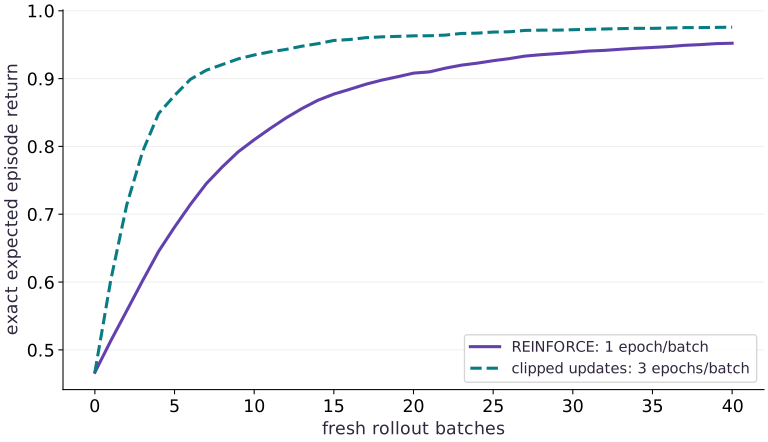
Read the figure
The horizontal axis counts freshly collected rollout batches; zero is the untrained policy. Each later point is the exact expected finite-horizon return of the updated policy. Both lines begin at . In this seed the REINFORCE line ends near , while the clipped-update line ends near . The curves measure return, not the optimization surrogate.
Connect it to the computation
The clipped method takes three gradient steps per collection, while REINFORCE takes one. This is therefore not a compute-matched algorithm comparison. The always-right ceiling in this environment is ; approaching it shows that the policy has learned this corridor task. Small non-monotonic changes are compatible with stochastic updates, and one seed is distinct from which method is better on other tasks.
Open full-size figureDownload data and provenance
The notebook contains the data experiment, plotting code, and recorded figure output. Rerun it to test your changes.
Where to put & run this code: Work in phases/12-rl/03-policy-gradients-and-ppo/code/main.py (or downloaded exercises/rl-03.py / exercises/rl-03.ipynb) and execute from the repository root with python3 phases/12-rl/03-policy-gradients-and-ppo/code/main.py.
1 Reuse the environment and collector
Create main.py with this block. Run python3 main.py in the course CPU environment.
# Step 1: Reuse the environment and collector
"""Finite-horizon tabular policy training. CPU teaching environment, not a benchmark."""
from functools import partial
from typing import NamedTuple
import jax
import jax.numpy as jnp
import numpy as np


# Define `State` module / container with explicit state and forward pass:
class State(NamedTuple):
    # Execute `position: jax.Array`
    position: jax.Array
    # Execute `elapsed: jax.Array`
    elapsed: jax.Array
    # Execute `done: jax.Array`
    done: jax.Array


def reset(key):
    """Start uniformly at position 0 or 1; goal is position 3."""
    return State(jax.random.randint(key, (), 0, 2), jnp.int32(0), jnp.bool_(False))


def step(state, action, horizon=8):
    """Action 0: left, 1: right. Caller supplies binary action and positive horizon.

    Returns next state, reward, termination event, truncation event. Finished
    states absorb without more rewards/events. No implicit reset or lost final observation.
    """
    active = ~state.done
    # Combine or mask array elements to form `proposed`.
    proposed = jnp.clip(state.position + 2 * action - 1, 0, 3)
    # Combine or mask array elements to form `position`.
    position = jnp.where(active, proposed, state.position)
    elapsed = state.elapsed + active.astype(jnp.int32)
    terminated = active & (position == 3)
    truncated = active & ~terminated & (elapsed >= horizon)
    # Combine or mask array elements to form `reward`.
    reward = jnp.where(active, jnp.where(terminated, 1., -.01), 0.)
    return State(position, elapsed, state.done | terminated | truncated), reward, terminated, truncated

def log_probability(theta, observations, actions):
    logits = theta[jnp.minimum(observations, 2)]
    return jnp.where(actions == 1, jax.nn.log_sigmoid(logits), jax.nn.log_sigmoid(-logits))


# Define and JIT-compile `rollout(theta, key, batch_size, horizon)` so XLA traces and fuses the operations:
@partial(jax.jit, static_argnames=('batch_size', 'horizon'))
def rollout(theta, key, batch_size=256, horizon=8):
    # Create or split explicit PRNG key(s) (`(reset_key, action_key)`) for reproducible randomness.
    reset_key, action_key = jax.random.split(key)
    # Create or split explicit PRNG key(s) (`states`) for reproducible randomness.
    states = jax.vmap(reset)(jax.random.split(reset_key, batch_size))
    # Create or split explicit PRNG key(s) (`time_keys`) for reproducible randomness.
    time_keys = jax.random.split(action_key, horizon)
    def body(states, time_key):
        observations = states.position
        # Split the PRNG key deterministically into independent subkeys (`keys`).
        keys = jax.random.split(time_key, batch_size)
        probabilities = jax.nn.sigmoid(theta[jnp.minimum(observations, 2)])
        # Draw pseudorandom samples for `actions` using the explicit RNG state.
        actions = jax.vmap(jax.random.bernoulli)(keys, probabilities).astype(jnp.int32)
        # Vectorize across the batch dimension without a Python loop (`(next_states, rewards, terminated, truncated)`).
        next_states, rewards, terminated, truncated = jax.vmap(
            lambda s, a: step(s, a, horizon))(states, actions)
        record = dict(observation=observations, action=actions, reward=rewards,
                      active=~states.done, terminated=terminated, truncated=truncated,
                      old_logp=log_probability(theta, observations, actions))
        return next_states, record
    # Run a compiled sequential scan over the time/step axis (`(final, records)`).
    final, records = jax.lax.scan(body, states, time_keys)
    return final, records


def returns_to_go(rewards):
    """Undiscounted finite-episode objective; rewards after done are already zero."""
    return jnp.cumsum(rewards[::-1], axis=0)[::-1]
Code building blocks in this step
jax.vmap(fn, in_axes=..., out_axes=...)— Vectorizes a single-example function across a batch axis without writing a Python loop.jax.jit(fn) / @jax.jit— Tracesfnwith abstract shapes and compiles a fused XLA executable cached by input shape and dtype.jax.lax.scan(step_fn, init_carry, xs, length=...)— Compiles a sequential loop wherestep_fn(carry, x)returns(next_carry, y), returning(final_carry, stacked_ys).jax.random.PRNGKey(seed) & jax.random.split(key)— Manages explicit, stateless PRNG keys—always split a key before passing subkeys into independent random draws.
These functions generate genuine trajectories. The policy update will not differentiate through their sampled actions.
2 Add objectives and the repeated training loop
Append this block to main.py. Run python3 main.py in the course CPU environment.
# Step 2 — Add objectives and the repeated training loop: Keep a frozen rollout per update, then collect again using a fresh...
# Define `policy_loss(theta, records, method, clip)` to evaluate the objective and its automatic derivatives:
def policy_loss(theta, records, method='ppo', clip=.2):
    """Normalize by episodes, not live transitions. Freeze behavior data/returns."""
    advantage = jax.lax.stop_gradient(returns_to_go(records['reward']))
    old_logp = jax.lax.stop_gradient(records['old_logp'])
    new_logp = log_probability(theta, records['observation'], records['action'])
    if method == 'reinforce':
        terms = new_logp * advantage
    elif method == 'ppo':
        ratio = jnp.exp(new_logp - old_logp)
        terms = jnp.minimum(ratio * advantage, jnp.clip(ratio, 1-clip, 1+clip) * advantage)
    else:
        raise ValueError('method must be reinforce or ppo')
    return -jnp.sum(jnp.where(records['active'], terms, 0.)) / records['reward'].shape[1]


# Define and JIT-compile `exact_return(theta, horizon)` so XLA traces and fuses the operations:
@partial(jax.jit, static_argnames=('horizon',))
def exact_return(theta, horizon=8):
    """Dynamic programming over states, independent of sampled rollouts."""
    p = jax.nn.sigmoid(theta)
    states = jnp.arange(3)
    left = jnp.maximum(states-1, 0)
    right = states+1
    def backup(_, values):
        q_left = -.01 + values[left]
        # Combine or mask array elements to form `q_right`.
        q_right = jnp.where(right == 3, 1., -.01 + values[right])
        return jnp.concatenate(((1-p)*q_left+p*q_right, jnp.zeros(1)))
    # Allocate initialized array `values` with the specified shape and dtype.
    values = jax.lax.fori_loop(0, horizon, backup, jnp.zeros(4))
    return jnp.mean(values[:2])


# Define and JIT-compile `_train(seed, updates, batch_size, horizon...)` so XLA traces and fuses the operations:
@partial(jax.jit, static_argnames=('updates', 'batch_size', 'horizon', 'method', 'epochs'))
def _train(seed, updates, batch_size, horizon, method, epochs, learning_rate):
    # Create or split explicit PRNG key(s) (`key`) for reproducible randomness.
    key = jax.random.key(seed)
    theta = jnp.zeros(3)
    # Define `update(carry, _)` to evaluate the objective and its automatic derivatives:
    def update(carry, _):
        theta, key = carry
        # Create or split explicit PRNG key(s) (`(key, sample_key)`) for reproducible randomness.
        key, sample_key = jax.random.split(key)
        _, records = rollout(theta, sample_key, batch_size, horizon)
        # Define `epoch(_, candidate)` to evaluate the objective and its automatic derivatives:
        def epoch(_, candidate):
            # Differentiate the objective to obtain `grad` via automatic differentiation.
            grad = jax.grad(policy_loss)(candidate, records, method)
            return candidate - learning_rate * grad
        theta = jax.lax.fori_loop(0, epochs, epoch, theta)
        return (theta, key), exact_return(theta, horizon)
    # Run a compiled sequential scan over the time/step axis (`((theta, _), history)`).
    (theta, _), history = jax.lax.scan(update, (theta, key), None, length=updates)
    return theta, jnp.concatenate((exact_return(jnp.zeros(3), horizon)[None], history))


def train(seed=0, updates=40, batch_size=256, horizon=8, method='ppo', epochs=3, learning_rate=.5):
    # Guard input contract (`updates < 1 or batch_size < 1 or horizon < 1 or (epochs < 1) or (learning_rate <= 0)`) and fail fast if violated.
    if updates < 1 or batch_size < 1 or horizon < 1 or epochs < 1 or learning_rate <= 0:
        raise ValueError('positive updates, batch_size, horizon, epochs and learning_rate required')
    # Guard input contract (`method not in ('ppo', 'reinforce')`) and fail fast if violated.
    if method not in ('ppo', 'reinforce'):
        raise ValueError('unknown method')
    # Guard input contract (`method == 'reinforce' and epochs != 1`) and fail fast if violated.
    if method == 'reinforce' and epochs != 1:
        raise ValueError('REINFORCE uses one update per fresh on-policy rollout')
    return _train(seed, updates, batch_size, horizon, method, epochs, learning_rate)
Code building blocks in this step
jnp.arange(n, dtype=...)— Creates a 1-D JAX array of evenly spaced values[0, 1, ..., n-1]on the target device.jnp.zeros / jnp.ones(shape, dtype=...)— Allocates a tensor of the givenshapeinitialized with constants.x.sum(axis=...) / x.mean(axis=..., keepdims=...)— Reduces values along the namedaxis(the axis you name is collapsed unlesskeepdims=True).jax.grad(loss_fn)(params, ...)— Transforms a scalar-output function into a function returning the gradient PyTree with the same structure asparams.
Keep a frozen rollout per update, then collect again using a fresh key. The exact evaluator is separate from the training targets.
3 Train and compare to a derivative reference
Append this block to main.py. Run python3 main.py in the course CPU environment.
# Step 3 — Train and compare to a derivative reference: The seed-specific return is measured after actual interaction and...
theta_pg, history_pg = train(seed=0, method='reinforce', epochs=1)
theta_ppo, history_ppo = train(seed=0, method='ppo', epochs=3)
assert history_pg[-1] > .9 and history_ppo[-1] > .9
assert jnp.allclose(history_pg[0], .466875, atol=1e-6)
print('REINFORCE initial/final exact return:', history_pg[0], history_pg[-1])
print('PPO initial/final exact return:', history_ppo[0], history_ppo[-1])
# Compare a derivative of exact expectation with central differences.
z = jnp.array([-.2, .3, .7])
eps = 1e-3
d = jnp.array([0., 1., 0.])
fd = (exact_return(z+eps*d)-exact_return(z-eps*d))/(2*eps)
assert jnp.allclose(fd, jax.grad(exact_return)(z)[1], atol=1e-4)
Code building blocks in this step
jnp.array(values, dtype=...)— Constructs an immutable device-backed JAX array from Python/NumPy values.jnp.allclose(actual, expected, rtol=..., atol=...)— Checks that two arrays match elementwise within floating-point tolerance.jax.grad(loss_fn)(params, ...)— Transforms a scalar-output function into a function returning the gradient PyTree with the same structure asparams.
The seed-specific return is measured after actual interaction and updates, while the derivative check uses deterministic expectations.
View the cumulative build in main.py
These blocks append in order to the same file.
# Step 1: Reuse the environment and collector
"""Finite-horizon tabular policy training. CPU teaching environment, not a benchmark."""
from functools import partial
from typing import NamedTuple
import jax
import jax.numpy as jnp
import numpy as np


# Define `State` module / container with explicit state and forward pass:
class State(NamedTuple):
    # Execute `position: jax.Array`
    position: jax.Array
    # Execute `elapsed: jax.Array`
    elapsed: jax.Array
    # Execute `done: jax.Array`
    done: jax.Array


def reset(key):
    """Start uniformly at position 0 or 1; goal is position 3."""
    return State(jax.random.randint(key, (), 0, 2), jnp.int32(0), jnp.bool_(False))


def step(state, action, horizon=8):
    """Action 0: left, 1: right. Caller supplies binary action and positive horizon.

    Returns next state, reward, termination event, truncation event. Finished
    states absorb without more rewards/events. No implicit reset or lost final observation.
    """
    active = ~state.done
    # Combine or mask array elements to form `proposed`.
    proposed = jnp.clip(state.position + 2 * action - 1, 0, 3)
    # Combine or mask array elements to form `position`.
    position = jnp.where(active, proposed, state.position)
    elapsed = state.elapsed + active.astype(jnp.int32)
    terminated = active & (position == 3)
    truncated = active & ~terminated & (elapsed >= horizon)
    # Combine or mask array elements to form `reward`.
    reward = jnp.where(active, jnp.where(terminated, 1., -.01), 0.)
    return State(position, elapsed, state.done | terminated | truncated), reward, terminated, truncated

def log_probability(theta, observations, actions):
    logits = theta[jnp.minimum(observations, 2)]
    return jnp.where(actions == 1, jax.nn.log_sigmoid(logits), jax.nn.log_sigmoid(-logits))


# Define and JIT-compile `rollout(theta, key, batch_size, horizon)` so XLA traces and fuses the operations:
@partial(jax.jit, static_argnames=('batch_size', 'horizon'))
def rollout(theta, key, batch_size=256, horizon=8):
    # Create or split explicit PRNG key(s) (`(reset_key, action_key)`) for reproducible randomness.
    reset_key, action_key = jax.random.split(key)
    # Create or split explicit PRNG key(s) (`states`) for reproducible randomness.
    states = jax.vmap(reset)(jax.random.split(reset_key, batch_size))
    # Create or split explicit PRNG key(s) (`time_keys`) for reproducible randomness.
    time_keys = jax.random.split(action_key, horizon)
    def body(states, time_key):
        observations = states.position
        # Split the PRNG key deterministically into independent subkeys (`keys`).
        keys = jax.random.split(time_key, batch_size)
        probabilities = jax.nn.sigmoid(theta[jnp.minimum(observations, 2)])
        # Draw pseudorandom samples for `actions` using the explicit RNG state.
        actions = jax.vmap(jax.random.bernoulli)(keys, probabilities).astype(jnp.int32)
        # Vectorize across the batch dimension without a Python loop (`(next_states, rewards, terminated, truncated)`).
        next_states, rewards, terminated, truncated = jax.vmap(
            lambda s, a: step(s, a, horizon))(states, actions)
        record = dict(observation=observations, action=actions, reward=rewards,
                      active=~states.done, terminated=terminated, truncated=truncated,
                      old_logp=log_probability(theta, observations, actions))
        return next_states, record
    # Run a compiled sequential scan over the time/step axis (`(final, records)`).
    final, records = jax.lax.scan(body, states, time_keys)
    return final, records


def returns_to_go(rewards):
    """Undiscounted finite-episode objective; rewards after done are already zero."""
    return jnp.cumsum(rewards[::-1], axis=0)[::-1]

# Step 2 — Add objectives and the repeated training loop: Keep a frozen rollout per update, then collect again using a fresh...
# Define `policy_loss(theta, records, method, clip)` to evaluate the objective and its automatic derivatives:
def policy_loss(theta, records, method='ppo', clip=.2):
    """Normalize by episodes, not live transitions. Freeze behavior data/returns."""
    advantage = jax.lax.stop_gradient(returns_to_go(records['reward']))
    old_logp = jax.lax.stop_gradient(records['old_logp'])
    new_logp = log_probability(theta, records['observation'], records['action'])
    if method == 'reinforce':
        terms = new_logp * advantage
    elif method == 'ppo':
        ratio = jnp.exp(new_logp - old_logp)
        terms = jnp.minimum(ratio * advantage, jnp.clip(ratio, 1-clip, 1+clip) * advantage)
    else:
        raise ValueError('method must be reinforce or ppo')
    return -jnp.sum(jnp.where(records['active'], terms, 0.)) / records['reward'].shape[1]


# Define and JIT-compile `exact_return(theta, horizon)` so XLA traces and fuses the operations:
@partial(jax.jit, static_argnames=('horizon',))
def exact_return(theta, horizon=8):
    """Dynamic programming over states, independent of sampled rollouts."""
    p = jax.nn.sigmoid(theta)
    states = jnp.arange(3)
    left = jnp.maximum(states-1, 0)
    right = states+1
    def backup(_, values):
        q_left = -.01 + values[left]
        # Combine or mask array elements to form `q_right`.
        q_right = jnp.where(right == 3, 1., -.01 + values[right])
        return jnp.concatenate(((1-p)*q_left+p*q_right, jnp.zeros(1)))
    # Allocate initialized array `values` with the specified shape and dtype.
    values = jax.lax.fori_loop(0, horizon, backup, jnp.zeros(4))
    return jnp.mean(values[:2])


# Define and JIT-compile `_train(seed, updates, batch_size, horizon...)` so XLA traces and fuses the operations:
@partial(jax.jit, static_argnames=('updates', 'batch_size', 'horizon', 'method', 'epochs'))
def _train(seed, updates, batch_size, horizon, method, epochs, learning_rate):
    # Create or split explicit PRNG key(s) (`key`) for reproducible randomness.
    key = jax.random.key(seed)
    theta = jnp.zeros(3)
    # Define `update(carry, _)` to evaluate the objective and its automatic derivatives:
    def update(carry, _):
        theta, key = carry
        # Create or split explicit PRNG key(s) (`(key, sample_key)`) for reproducible randomness.
        key, sample_key = jax.random.split(key)
        _, records = rollout(theta, sample_key, batch_size, horizon)
        # Define `epoch(_, candidate)` to evaluate the objective and its automatic derivatives:
        def epoch(_, candidate):
            # Differentiate the objective to obtain `grad` via automatic differentiation.
            grad = jax.grad(policy_loss)(candidate, records, method)
            return candidate - learning_rate * grad
        theta = jax.lax.fori_loop(0, epochs, epoch, theta)
        return (theta, key), exact_return(theta, horizon)
    # Run a compiled sequential scan over the time/step axis (`((theta, _), history)`).
    (theta, _), history = jax.lax.scan(update, (theta, key), None, length=updates)
    return theta, jnp.concatenate((exact_return(jnp.zeros(3), horizon)[None], history))


def train(seed=0, updates=40, batch_size=256, horizon=8, method='ppo', epochs=3, learning_rate=.5):
    # Guard input contract (`updates < 1 or batch_size < 1 or horizon < 1 or (epochs < 1) or (learning_rate <= 0)`) and fail fast if violated.
    if updates < 1 or batch_size < 1 or horizon < 1 or epochs < 1 or learning_rate <= 0:
        raise ValueError('positive updates, batch_size, horizon, epochs and learning_rate required')
    # Guard input contract (`method not in ('ppo', 'reinforce')`) and fail fast if violated.
    if method not in ('ppo', 'reinforce'):
        raise ValueError('unknown method')
    # Guard input contract (`method == 'reinforce' and epochs != 1`) and fail fast if violated.
    if method == 'reinforce' and epochs != 1:
        raise ValueError('REINFORCE uses one update per fresh on-policy rollout')
    return _train(seed, updates, batch_size, horizon, method, epochs, learning_rate)

# Step 3 — Train and compare to a derivative reference: The seed-specific return is measured after actual interaction and...
theta_pg, history_pg = train(seed=0, method='reinforce', epochs=1)
theta_ppo, history_ppo = train(seed=0, method='ppo', epochs=3)
assert history_pg[-1] > .9 and history_ppo[-1] > .9
assert jnp.allclose(history_pg[0], .466875, atol=1e-6)
print('REINFORCE initial/final exact return:', history_pg[0], history_pg[-1])
print('PPO initial/final exact return:', history_ppo[0], history_ppo[-1])
# Compare a derivative of exact expectation with central differences.
z = jnp.array([-.2, .3, .7])
eps = 1e-3
d = jnp.array([0., 1., 0.])
fd = (exact_return(z+eps*d)-exact_return(z-eps*d))/(2*eps)
assert jnp.allclose(fd, jax.grad(exact_return)(z)[1], atol=1e-4)
Run the example
python3 phases/12-rl/03-policy-gradients-and-ppo/code/main.pyAbout this command
This shortcut uses an activated macOS/Linux course environment in the repository folder. For Windows, use the explicit interpreter command in “Setup help” above. The script includes worked examples and reference solutions.
Inspect the complete assembled example
# Complete runnable example (rl-03)
"""Finite-horizon tabular policy training. CPU teaching environment, not a benchmark."""
from functools import partial
from typing import NamedTuple
import jax
import jax.numpy as jnp
import numpy as np


# Define `State` module / container with explicit state and forward pass:
class State(NamedTuple):
    # Execute `position: jax.Array`
    position: jax.Array
    # Execute `elapsed: jax.Array`
    elapsed: jax.Array
    # Execute `done: jax.Array`
    done: jax.Array


def reset(key):
    """Start uniformly at position 0 or 1; goal is position 3."""
    return State(jax.random.randint(key, (), 0, 2), jnp.int32(0), jnp.bool_(False))


def step(state, action, horizon=8):
    """Action 0: left, 1: right. Caller supplies binary action and positive horizon.

    Returns next state, reward, termination event, truncation event. Finished
    states absorb without more rewards/events. No implicit reset or lost final observation.
    """
    active = ~state.done
    # Combine or mask array elements to form `proposed`.
    proposed = jnp.clip(state.position + 2 * action - 1, 0, 3)
    # Combine or mask array elements to form `position`.
    position = jnp.where(active, proposed, state.position)
    elapsed = state.elapsed + active.astype(jnp.int32)
    terminated = active & (position == 3)
    truncated = active & ~terminated & (elapsed >= horizon)
    # Combine or mask array elements to form `reward`.
    reward = jnp.where(active, jnp.where(terminated, 1., -.01), 0.)
    return State(position, elapsed, state.done | terminated | truncated), reward, terminated, truncated

def log_probability(theta, observations, actions):
    logits = theta[jnp.minimum(observations, 2)]
    return jnp.where(actions == 1, jax.nn.log_sigmoid(logits), jax.nn.log_sigmoid(-logits))


# Define and JIT-compile `rollout(theta, key, batch_size, horizon)` so XLA traces and fuses the operations:
@partial(jax.jit, static_argnames=('batch_size', 'horizon'))
def rollout(theta, key, batch_size=256, horizon=8):
    # Create or split explicit PRNG key(s) (`(reset_key, action_key)`) for reproducible randomness.
    reset_key, action_key = jax.random.split(key)
    # Create or split explicit PRNG key(s) (`states`) for reproducible randomness.
    states = jax.vmap(reset)(jax.random.split(reset_key, batch_size))
    # Create or split explicit PRNG key(s) (`time_keys`) for reproducible randomness.
    time_keys = jax.random.split(action_key, horizon)
    def body(states, time_key):
        observations = states.position
        # Split the PRNG key deterministically into independent subkeys (`keys`).
        keys = jax.random.split(time_key, batch_size)
        probabilities = jax.nn.sigmoid(theta[jnp.minimum(observations, 2)])
        # Draw pseudorandom samples for `actions` using the explicit RNG state.
        actions = jax.vmap(jax.random.bernoulli)(keys, probabilities).astype(jnp.int32)
        # Vectorize across the batch dimension without a Python loop (`(next_states, rewards, terminated, truncated)`).
        next_states, rewards, terminated, truncated = jax.vmap(
            lambda s, a: step(s, a, horizon))(states, actions)
        record = dict(observation=observations, action=actions, reward=rewards,
                      active=~states.done, terminated=terminated, truncated=truncated,
                      old_logp=log_probability(theta, observations, actions))
        return next_states, record
    # Run a compiled sequential scan over the time/step axis (`(final, records)`).
    final, records = jax.lax.scan(body, states, time_keys)
    return final, records


def returns_to_go(rewards):
    """Undiscounted finite-episode objective; rewards after done are already zero."""
    return jnp.cumsum(rewards[::-1], axis=0)[::-1]

# Step 2 — Add objectives and the repeated training loop: Keep a frozen rollout per update, then collect again using a fresh...
# Define `policy_loss(theta, records, method, clip)` to evaluate the objective and its automatic derivatives:
def policy_loss(theta, records, method='ppo', clip=.2):
    """Normalize by episodes, not live transitions. Freeze behavior data/returns."""
    advantage = jax.lax.stop_gradient(returns_to_go(records['reward']))
    old_logp = jax.lax.stop_gradient(records['old_logp'])
    new_logp = log_probability(theta, records['observation'], records['action'])
    if method == 'reinforce':
        terms = new_logp * advantage
    elif method == 'ppo':
        ratio = jnp.exp(new_logp - old_logp)
        terms = jnp.minimum(ratio * advantage, jnp.clip(ratio, 1-clip, 1+clip) * advantage)
    else:
        raise ValueError('method must be reinforce or ppo')
    return -jnp.sum(jnp.where(records['active'], terms, 0.)) / records['reward'].shape[1]


# Define and JIT-compile `exact_return(theta, horizon)` so XLA traces and fuses the operations:
@partial(jax.jit, static_argnames=('horizon',))
def exact_return(theta, horizon=8):
    """Dynamic programming over states, independent of sampled rollouts."""
    p = jax.nn.sigmoid(theta)
    states = jnp.arange(3)
    left = jnp.maximum(states-1, 0)
    right = states+1
    def backup(_, values):
        q_left = -.01 + values[left]
        # Combine or mask array elements to form `q_right`.
        q_right = jnp.where(right == 3, 1., -.01 + values[right])
        return jnp.concatenate(((1-p)*q_left+p*q_right, jnp.zeros(1)))
    # Allocate initialized array `values` with the specified shape and dtype.
    values = jax.lax.fori_loop(0, horizon, backup, jnp.zeros(4))
    return jnp.mean(values[:2])


# Define and JIT-compile `_train(seed, updates, batch_size, horizon...)` so XLA traces and fuses the operations:
@partial(jax.jit, static_argnames=('updates', 'batch_size', 'horizon', 'method', 'epochs'))
def _train(seed, updates, batch_size, horizon, method, epochs, learning_rate):
    # Create or split explicit PRNG key(s) (`key`) for reproducible randomness.
    key = jax.random.key(seed)
    theta = jnp.zeros(3)
    # Define `update(carry, _)` to evaluate the objective and its automatic derivatives:
    def update(carry, _):
        theta, key = carry
        # Create or split explicit PRNG key(s) (`(key, sample_key)`) for reproducible randomness.
        key, sample_key = jax.random.split(key)
        _, records = rollout(theta, sample_key, batch_size, horizon)
        # Define `epoch(_, candidate)` to evaluate the objective and its automatic derivatives:
        def epoch(_, candidate):
            # Differentiate the objective to obtain `grad` via automatic differentiation.
            grad = jax.grad(policy_loss)(candidate, records, method)
            return candidate - learning_rate * grad
        theta = jax.lax.fori_loop(0, epochs, epoch, theta)
        return (theta, key), exact_return(theta, horizon)
    # Run a compiled sequential scan over the time/step axis (`((theta, _), history)`).
    (theta, _), history = jax.lax.scan(update, (theta, key), None, length=updates)
    return theta, jnp.concatenate((exact_return(jnp.zeros(3), horizon)[None], history))


def train(seed=0, updates=40, batch_size=256, horizon=8, method='ppo', epochs=3, learning_rate=.5):
    # Guard input contract (`updates < 1 or batch_size < 1 or horizon < 1 or (epochs < 1) or (learning_rate <= 0)`) and fail fast if violated.
    if updates < 1 or batch_size < 1 or horizon < 1 or epochs < 1 or learning_rate <= 0:
        raise ValueError('positive updates, batch_size, horizon, epochs and learning_rate required')
    # Guard input contract (`method not in ('ppo', 'reinforce')`) and fail fast if violated.
    if method not in ('ppo', 'reinforce'):
        raise ValueError('unknown method')
    # Guard input contract (`method == 'reinforce' and epochs != 1`) and fail fast if violated.
    if method == 'reinforce' and epochs != 1:
        raise ValueError('REINFORCE uses one update per fresh on-policy rollout')
    return _train(seed, updates, batch_size, horizon, method, epochs, learning_rate)

# Step 3 — Train and compare to a derivative reference: The seed-specific return is measured after actual interaction and...
theta_pg, history_pg = train(seed=0, method='reinforce', epochs=1)
theta_ppo, history_ppo = train(seed=0, method='ppo', epochs=3)
assert history_pg[-1] > .9 and history_ppo[-1] > .9
assert jnp.allclose(history_pg[0], .466875, atol=1e-6)
print('REINFORCE initial/final exact return:', history_pg[0], history_pg[-1])
print('PPO initial/final exact return:', history_ppo[0], history_ppo[-1])
# Compare a derivative of exact expectation with central differences.
z = jnp.array([-.2, .3, .7])
eps = 1e-3
d = jnp.array([0., 1., 0.])
fd = (exact_return(z+eps*d)-exact_return(z-eps*d))/(2*eps)
assert jnp.allclose(fd, jax.grad(exact_return)(z)[1], atol=1e-4)
Expected result: The reference seed improves exact expected return from to approximately with REINFORCE and with the clipped updates after rollout batches.
Recorded reference execution
Reference output captured from executing the complete lesson script (code/main.py) and its assertions in the course CPU environment.
REINFORCE initial/final exact return: 0.46687505 0.9521624
PPO initial/final exact return: 0.46687505 0.97578394
REINFORCE initial/final exact return: 0.46687505 0.9521624
PPO initial/final exact return: 0.46687505 0.97578394
positive / negative targets: [0.6 1.  1.2] [-0.8 -1.  -1.4]
sampled / exact gradient: [0.12067959 0.21948992 0.13326262] [0.12001554 0.21822323 0.13327113]
changed seed final exact return: 0.9501661
PASS: rl-03
Download execution record · The notebook includes executed cells and figure outputs. Compare your run with these values; timings depend on the machine.
Check clipping on both signs
# Experiment — Check clipping on both signs: The minimum prevents an update from gaining unlimited credit for...
ratio = jnp.array([.6,1.,1.4])
positive = jnp.minimum(ratio,jnp.clip(ratio,.8,1.2))
negative = jnp.minimum(-ratio,-jnp.clip(ratio,.8,1.2))
assert jnp.allclose(positive,jnp.array([.6,1.,1.2]))
assert jnp.allclose(negative,jnp.array([-.8,-1.,-1.4]))
print('positive / negative targets:', positive, negative)
Expected: Positive and negative targets flatten on opposite sides.
The minimum prevents an update from gaining unlimited credit for pushing a sampled action in an already beneficial direction.
Compare sampled and exact gradients
# Experiment — Compare sampled and exact gradients: The large batch reduces Monte Carlo noise.
# Create or split explicit PRNG key(s) (`(_, batch)`) for reproducible randomness.
_, batch = rollout(z,jax.random.key(902),32768,8)
# Differentiate the objective to obtain `sampled` via automatic differentiation.
sampled = -jax.grad(policy_loss)(z,batch,'reinforce')
# Differentiate the objective to obtain `exact` via automatic differentiation.
exact = jax.grad(exact_return)(z)
assert jnp.allclose(sampled,exact,atol=.012,rtol=.04)
print('sampled / exact gradient:', sampled, exact)
Expected: The gradients agree within the declared sampling tolerance, not bit for bit.
The large batch reduces Monte Carlo noise. The exact evaluator and the sampled score-function estimator compute the same objective by different paths.
Make it yours
Where to put your code: Append your solution at the bottom of phases/12-rl/03-policy-gradients-and-ppo/code/main.py (or inside the Make it yours cell of exercises/rl-03.ipynb) and run python3 phases/12-rl/03-policy-gradients-and-ppo/code/main.py to verify your prediction before opening the reference solution.
Run REINFORCE with a different training seed and retain the initial and final exact return. Verify that the final policy improves on the uniform baseline without requiring every intermediate point to improve.
Show a writing guide and starter scaffold
How to write this exercise code: step-by-step recipe & starter scaffold
1. Key functions & syntax to use:
train(...)— Calltrainwith your updated parameters or inputs from this lesson's workspace.jnp.array_equal(...)— Calljnp.array_equalwith your updated parameters or inputs from this lesson's workspace.assert condition— Verify that the observed output shape, status, or numerical value satisfies the contract.
2. Step-by-step implementation plan:
- Set up the changed input or configuration parameters requested in the prompt.
- Run the target function or transformation and assert that the output matches your prediction.
# Exercise solution: Run REINFORCE with a different training seed and retain the initial...
other_theta, other_history = train(...)  # TODO: compute other_theta, other_history
assert other_history[-1]  # TODO: complete assertion check
assert other_history[-1]  # TODO: complete assertion check
assert not jnp.array_equal(other_theta,theta_pg)  # TODO: complete assertion check
print('changed seed final exact return:', other_history[-1])
Reveal the reference solution
# Exercise solution: Run REINFORCE with a different training seed and retain the initial...
other_theta, other_history = train(seed=11,method='reinforce',epochs=1)
assert other_history[-1] > other_history[0] + .35
assert other_history[-1] > .9
assert not jnp.array_equal(other_theta,theta_pg)
print('changed seed final exact return:', other_history[-1])
Inspect a frozen behavior reference
Transfer / diagnosis
Collect at zero logits, then increase all logits to . Verify that stored old log probabilities do not change and that live-action ratios include values on both sides of .
Show a writing guide and starter scaffold
How to write this practice solution: step-by-step recipe & starter scaffold
1. Key functions & syntax to use:
jnp.zeros / jnp.ones(shape, dtype=...)— Allocates a tensor of the givenshapeinitialized with constants.jax.grad(loss_fn)(params, ...)— Transforms a scalar-output function into a function returning the gradient PyTree with the same structure asparams.jax.random.PRNGKey(seed) & jax.random.split(key)— Manages explicit, stateless PRNG keys—always split a key before passing subkeys into independent random draws.
2. Step-by-step implementation plan:
- Create or split explicit PRNG key(s) (
(_, b)) for reproducible randomness. - Differentiate the objective to obtain
old_gradvia automatic differentiation.
# Inspect a frozen behavior reference (Transfer / diagnosis): The candidate changes while the behavior policy remains the...
# Create or split explicit PRNG key(s) (`(_, b)`) for reproducible randomness.
_, b = rollout(...)  # TODO: compute _, b
old = ...  # TODO: compute old
newlog = log_probability(...)  # TODO: compute newlog
ratios = jnp.exp(...)  # TODO: compute ratios
assert jnp.array_equal(old,b['old_logp'])  # TODO: complete assertion check
assert float(jnp.min(ratios))  # TODO: complete assertion check
# Differentiate the objective to obtain `old_grad` via automatic differentiation.
old_grad = jax.grad(...)  # TODO: compute old_grad
assert jnp.all(old_grad  # TODO: complete assertion check
Show a hint
Compute new probabilities from changed parameters, leaving the rollout dictionary untouched.
Reveal reference solution and reasoning
# Inspect a frozen behavior reference (Transfer / diagnosis): The candidate changes while the behavior policy remains the...
# Create or split explicit PRNG key(s) (`(_, b)`) for reproducible randomness.
_, b = rollout(jnp.zeros(3),jax.random.key(77),128,8)
old = b['old_logp'].copy()
newlog = log_probability(jnp.ones(3),b['observation'],b['action'])
ratios = jnp.exp(newlog-old)
assert jnp.array_equal(old,b['old_logp'])
assert float(jnp.min(ratios)) < 1 < float(jnp.max(ratios))
# Differentiate the objective to obtain `old_grad` via automatic differentiation.
old_grad = jax.grad(lambda lp: policy_loss(jnp.ones(3),dict(b,old_logp=lp)))(old)
assert jnp.all(old_grad == 0)
The candidate changes while the behavior policy remains the fixed denominator. A zero derivative through old probabilities enforces that distinction.
Change the time budget
Transfer / diagnosis
For horizon , compute the always-right expected return before running code. Only one initial position can reach the goal.
Show a writing guide and starter scaffold
How to write this practice solution: step-by-step recipe & starter scaffold
1. Key functions & syntax to use:
jnp.zeros / jnp.ones(shape, dtype=...)— Allocates a tensor of the givenshapeinitialized with constants.jnp.allclose(actual, expected, rtol=..., atol=...)— Checks that two arrays match elementwise within floating-point tolerance.
2. Step-by-step implementation plan:
- Set up the changed input or configuration parameters requested in the prompt.
- Run the target function or transformation and assert that the output matches your prediction.
# Change the time budget (Transfer / diagnosis): Changing the horizon changes the task itself.
short = exact_return(...)  # TODO: compute short
assert jnp.allclose(short,(-.02+.99)/2,atol=1e-6)  # TODO: complete assertion check
assert short  # TODO: complete assertion check
Show a hint
From position , two moves earn . From position , they earn .
Reveal reference solution and reasoning
# Change the time budget (Transfer / diagnosis): Changing the horizon changes the task itself.
short = exact_return(jnp.full(3,100.),horizon=2)
assert jnp.allclose(short,(-.02+.99)/2,atol=1e-6)
assert short < exact_return(jnp.full(3,100.),horizon=8)
Changing the horizon changes the task itself. A lower return need not indicate a broken gradient.
Diagnose the result
If loss falls while exact return fails to improve, first inspect the sign of the loss, the active mask and the frozen behavior probabilities. A ratio stuck at one on every epoch suggests the old policy was overwritten. If returns improve only on collection samples, evaluate independently before changing the optimizer.
Carry forward
- A complete policy update alternates new interaction data with optimization.
- Clipping modifies an objective; it does not prove monotonic improvement or constrain every policy probability.
Keep your evidence
Keep the exact small-state policy-gradient comparison, actual training curves and frozen PPO reference quantities. Diagnose changed clipping signs and distinguish Monte Carlo variation from an incorrect objective.
Save your modified code, its output, and an explanation of your prediction. Checkpoint answers and exercise evidence are tracked separately.
Saved in this browser. Export or back up your portfolio anytime in My learning.
Verified on local CPU. Stage to a Cloud TPU VM via Cloud TPU setup to record accelerator execution receipts (TODO: add automated Cloud TPU CI execution receipts).