 JAX Pathways
Phase 12 / Reinforcement learning
Evaluate agents across seeds
Revision v0.7.0 · Updated since your last visit. Review the changes; your progress is saved.
Lesson · about 90 minutes · CPU practice
Separate training seeds, evaluation streams and individual episodes. Report per-agent means and variability with an explicit aggregation unit.
Phase study guide: preparation, milestones and project evidence
Before you start
Before this: Policy gradients and PPO
Hardware: CPU
Setup help: Python, notebook, or Cloud TPU VM
Use the tested CPU packages (the recorded environment uses Python 3.14.3). Other Python versions and accelerator environments require separate checks. The optional Cloud TPU specialization explains the target-specific execution boundaries. Logical CPU devices practice partitioning; they do not simulate TPU performance.
Download the repository ZIP or use your existing checkout. Extract it and open a terminal in the folder containing requirements-cpu.txt. The beginner ZIP is separate; these lessons use the full repository folder.
python3 -m venv .venv
source .venv/bin/activate
python -m pip install -r requirements-cpu.txtpy -3 -m venv .venv
.\.venv\Scripts\python.exe -m pip install -r requirements-cpu.txtAfter activation, run the complete worked example from that same folder:
python phases/12-rl/04-evaluate-agents-across-seeds/code/main.py.\.venv\Scripts\python.exe phases/12-rl/04-evaluate-agents-across-seeds/code/main.pyFor an incremental build, create main.py in your own practice folder, append each build block in order, and run python main.py with this environment active. Keep that file separate from the downloaded reference solution.
Download this lesson’s notebook. Open it with a Python kernel using the course environment. Run cells from the top after restarting the kernel; experiments depend on earlier definitions.
For local Jupyter, first install the course requirements using the Local Python steps, then use your environment’s Python to start Jupyter:
python -m pip install jupyterlab
python -m jupyter lab.\.venv\Scripts\python.exe -m pip install jupyterlab
.\.venv\Scripts\python.exe -m jupyter labSelect the downloaded rl-04.ipynb file in JupyterLab. The notebook contains reference solutions; make your prediction and attempt each practice task before opening them. Restart the kernel before changing logical device setup.
The worked reference for this lesson is CPU-validated. Some references explicitly configure logical CPU devices; setting JAX_PLATFORMS does not adapt them to a TPU. Follow the execution matrix and reviewed multi-host example before attempting a target run.
For accelerator preparation, study TPU setup, observed runtime receipts, checkpointed jobs and precision and retained traces. These target paths remain unqualified on physical TPU hardware until an actual receipt is recorded. Cloud provisioning is optional for CPU learning.
Check: All five independently trained agents outperform the held-out uniform baseline. The printed per-agent values preserve variability instead of hiding it in one pooled number.
Revisit the guided CPU setup · Open 19: TPU Setup. Package instructions are CPU instructions; Windows and accelerator environments need their own validation.
What you will be able to do
- Separate training seeds, evaluation streams and individual episodes.
- Report per-agent means and variability with an explicit aggregation unit.
- Compare a trained policy to uniform and known deterministic baselines without mutating it.
The problem
A single training run looks excellent. Would another random seed learn the same behavior, and did the evaluation quietly reuse the training data? We will separate randomness used to fit an agent from randomness used to test it, retain per-agent results and compare with policies whose behavior we already understand.
The idea
A policy's result can vary because training produced a different policy and because evaluation sampled different episodes. A useful comparison records both sources instead of pooling every episode as though it came from one independent training run.
Separate training randomness from evaluation randomness
Train several agents with distinct training seeds. Evaluate each on a declared set of held-out conditions. First summarize within-agent episode variability; then compare the results across independently trained agents.
When methods share evaluation conditions, paired comparisons can make differences easier to interpret. Preserve that pairing rather than mixing episode identities. A large number of episodes from one trained agent does not replace multiple training seeds.
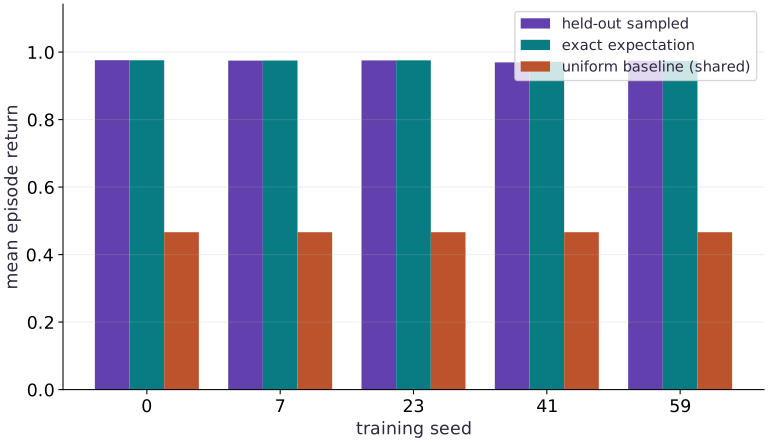
The mean-return bars summarize the fixture. Inspect individual seed results before trusting a small average difference. If you add an uncertainty interval, state its unit of resampling and method rather than attaching an unexplained error bar.
Write the protocol before inspecting results
Fix the environment, horizon, training budget and evaluation procedure before seeing the held-out metrics. We use training seeds and evaluation seeds . These seed identifiers are part of this protocol, not proof of statistical independence by themselves. The generator receives separate keys for fitting and testing. Do not change the learning rate after inspecting final test results and still call the same results held out.
Name the experimental unit
Within an agent, averaging evaluation episodes reduces uncertainty about that particular policy. Across five independently trained agents, differences reveal sensitivity to training randomness. A large episode count does not make the number of trained agents large. We retain all episode returns and stream means, then summarize the five agent means with their sample standard deviation. That standard deviation describes variability; it is not a confidence interval.
Pair the comparison deliberately
Using the same evaluation seed set across agents and baselines keeps the reset draws aligned and may reduce comparison noise. Actions still depend on the policy, so trajectories diverge. Shared evaluation randomness means the agent estimates are not wholly independent measurement errors. Preserve paired differences when comparing methods; do not pool every episode and pretend there were thousands of independent training runs. A broader study would use more training seeds, predeclared metrics and uncertainty estimates suited to its dependence structure.
A baseline can catch a broken evaluator
The uniform policy has exact expected return . Always-left earns , because it never reaches the goal and receives eight costs. Always-right earns , averaged over the two starts. If the sampled evaluator places these in the wrong order, inspect masks, reward sums and horizon before celebrating the learned policy. Test a changed horizon too: it should change the known returns in predictable ways.
Evaluation must leave training state alone
The policy array is passed to the evaluator as a value. We copy it before evaluation and compare afterward. Evaluation creates its own keys and never calls an optimizer. In a neural model this contract also includes running statistics, dropout mode and any other mutable model state. The tabular example cannot certify that a future network implementation handles those correctly.
Keep a report another learner can challenge
Retain source revision, package versions, policy parameters, train/evaluation seeds, horizon, step budget, raw episode returns and per-agent means. Add an exact-versus-sampled comparison, a failure diagnosis, and the limits: one small deterministic-transition environment, a randomized start distribution, stationary tabular policies, CPU execution and no hyperparameter search. High return here demonstrates a correct teaching harness, not general control capability.
Held-out returns for independently trained agents
Predict before looking: Will measured and exact means coincide for every agent?
Read the figure
The horizontal categories identify the five training seeds. Each group compares sampled held-out episode return with that policy’s exact expectation. The third bar is the uniform-policy baseline, repeated as a shared reference. Taller bars mean better return in this fixed corridor task; they do not mean higher accuracy or greater statistical confidence. Seed has the lowest sampled mean, about , and exact mean, about . Seed is around sampled and exact. The visible spread is small compared with the roughly improvement over the uniform baseline.
Connect it to the computation
The trained policies cluster close to the always-right limit of , while the uniform baseline remains around . Small gaps between sampled and exact bars are evaluation noise. Differences among exact bars reflect differences in the trained policies. The plot has no confidence intervals: five training runs and shared evaluation streams support a descriptive comparison here, not a broad claim about PPO.
Open full-size figureDownload data and provenance
The notebook contains the data experiment, plotting code, and recorded figure output. Rerun it to test your changes.
Where to put & run this code: Work in phases/12-rl/04-evaluate-agents-across-seeds/code/main.py (or downloaded exercises/rl-04.py / exercises/rl-04.ipynb) and execute from the repository root with python3 phases/12-rl/04-evaluate-agents-across-seeds/code/main.py.
1 Assemble the verified learning system
Create main.py with this block. Run python3 main.py in the course CPU environment.
# Step 1: Assemble the verified learning system
"""Finite-horizon tabular policy training. CPU teaching environment, not a benchmark."""
from functools import partial
from typing import NamedTuple
import jax
import jax.numpy as jnp
import numpy as np


# Define `State` module / container with explicit state and forward pass:
class State(NamedTuple):
    # Execute `position: jax.Array`
    position: jax.Array
    # Execute `elapsed: jax.Array`
    elapsed: jax.Array
    # Execute `done: jax.Array`
    done: jax.Array


def reset(key):
    """Start uniformly at position 0 or 1; goal is position 3."""
    return State(jax.random.randint(key, (), 0, 2), jnp.int32(0), jnp.bool_(False))


def step(state, action, horizon=8):
    """Action 0: left, 1: right. Caller supplies binary action and positive horizon.

    Returns next state, reward, termination event, truncation event. Finished
    states absorb without more rewards/events. No implicit reset or lost final observation.
    """
    active = ~state.done
    # Combine or mask array elements to form `proposed`.
    proposed = jnp.clip(state.position + 2 * action - 1, 0, 3)
    # Combine or mask array elements to form `position`.
    position = jnp.where(active, proposed, state.position)
    elapsed = state.elapsed + active.astype(jnp.int32)
    terminated = active & (position == 3)
    truncated = active & ~terminated & (elapsed >= horizon)
    # Combine or mask array elements to form `reward`.
    reward = jnp.where(active, jnp.where(terminated, 1., -.01), 0.)
    return State(position, elapsed, state.done | terminated | truncated), reward, terminated, truncated

def log_probability(theta, observations, actions):
    logits = theta[jnp.minimum(observations, 2)]
    return jnp.where(actions == 1, jax.nn.log_sigmoid(logits), jax.nn.log_sigmoid(-logits))


# Define and JIT-compile `rollout(theta, key, batch_size, horizon)` so XLA traces and fuses the operations:
@partial(jax.jit, static_argnames=('batch_size', 'horizon'))
def rollout(theta, key, batch_size=256, horizon=8):
    # Create or split explicit PRNG key(s) (`(reset_key, action_key)`) for reproducible randomness.
    reset_key, action_key = jax.random.split(key)
    # Create or split explicit PRNG key(s) (`states`) for reproducible randomness.
    states = jax.vmap(reset)(jax.random.split(reset_key, batch_size))
    # Create or split explicit PRNG key(s) (`time_keys`) for reproducible randomness.
    time_keys = jax.random.split(action_key, horizon)
    def body(states, time_key):
        observations = states.position
        # Split the PRNG key deterministically into independent subkeys (`keys`).
        keys = jax.random.split(time_key, batch_size)
        probabilities = jax.nn.sigmoid(theta[jnp.minimum(observations, 2)])
        # Draw pseudorandom samples for `actions` using the explicit RNG state.
        actions = jax.vmap(jax.random.bernoulli)(keys, probabilities).astype(jnp.int32)
        # Vectorize across the batch dimension without a Python loop (`(next_states, rewards, terminated, truncated)`).
        next_states, rewards, terminated, truncated = jax.vmap(
            lambda s, a: step(s, a, horizon))(states, actions)
        record = dict(observation=observations, action=actions, reward=rewards,
                      active=~states.done, terminated=terminated, truncated=truncated,
                      old_logp=log_probability(theta, observations, actions))
        return next_states, record
    # Run a compiled sequential scan over the time/step axis (`(final, records)`).
    final, records = jax.lax.scan(body, states, time_keys)
    return final, records


def returns_to_go(rewards):
    """Undiscounted finite-episode objective; rewards after done are already zero."""
    return jnp.cumsum(rewards[::-1], axis=0)[::-1]

# Define `policy_loss(theta, records, method, clip)` to evaluate the objective and its automatic derivatives:
def policy_loss(theta, records, method='ppo', clip=.2):
    """Normalize by episodes, not live transitions. Freeze behavior data/returns."""
    advantage = jax.lax.stop_gradient(returns_to_go(records['reward']))
    old_logp = jax.lax.stop_gradient(records['old_logp'])
    new_logp = log_probability(theta, records['observation'], records['action'])
    if method == 'reinforce':
        terms = new_logp * advantage
    elif method == 'ppo':
        ratio = jnp.exp(new_logp - old_logp)
        terms = jnp.minimum(ratio * advantage, jnp.clip(ratio, 1-clip, 1+clip) * advantage)
    else:
        raise ValueError('method must be reinforce or ppo')
    return -jnp.sum(jnp.where(records['active'], terms, 0.)) / records['reward'].shape[1]


# Define and JIT-compile `exact_return(theta, horizon)` so XLA traces and fuses the operations:
@partial(jax.jit, static_argnames=('horizon',))
def exact_return(theta, horizon=8):
    """Dynamic programming over states, independent of sampled rollouts."""
    p = jax.nn.sigmoid(theta)
    states = jnp.arange(3)
    left = jnp.maximum(states-1, 0)
    right = states+1
    def backup(_, values):
        q_left = -.01 + values[left]
        # Combine or mask array elements to form `q_right`.
        q_right = jnp.where(right == 3, 1., -.01 + values[right])
        return jnp.concatenate(((1-p)*q_left+p*q_right, jnp.zeros(1)))
    # Allocate initialized array `values` with the specified shape and dtype.
    values = jax.lax.fori_loop(0, horizon, backup, jnp.zeros(4))
    return jnp.mean(values[:2])


# Define and JIT-compile `_train(seed, updates, batch_size, horizon...)` so XLA traces and fuses the operations:
@partial(jax.jit, static_argnames=('updates', 'batch_size', 'horizon', 'method', 'epochs'))
def _train(seed, updates, batch_size, horizon, method, epochs, learning_rate):
    # Create or split explicit PRNG key(s) (`key`) for reproducible randomness.
    key = jax.random.key(seed)
    theta = jnp.zeros(3)
    # Define `update(carry, _)` to evaluate the objective and its automatic derivatives:
    def update(carry, _):
        theta, key = carry
        # Create or split explicit PRNG key(s) (`(key, sample_key)`) for reproducible randomness.
        key, sample_key = jax.random.split(key)
        _, records = rollout(theta, sample_key, batch_size, horizon)
        # Define `epoch(_, candidate)` to evaluate the objective and its automatic derivatives:
        def epoch(_, candidate):
            # Differentiate the objective to obtain `grad` via automatic differentiation.
            grad = jax.grad(policy_loss)(candidate, records, method)
            return candidate - learning_rate * grad
        theta = jax.lax.fori_loop(0, epochs, epoch, theta)
        return (theta, key), exact_return(theta, horizon)
    # Run a compiled sequential scan over the time/step axis (`((theta, _), history)`).
    (theta, _), history = jax.lax.scan(update, (theta, key), None, length=updates)
    return theta, jnp.concatenate((exact_return(jnp.zeros(3), horizon)[None], history))


def train(seed=0, updates=40, batch_size=256, horizon=8, method='ppo', epochs=3, learning_rate=.5):
    # Guard input contract (`updates < 1 or batch_size < 1 or horizon < 1 or (epochs < 1) or (learning_rate <= 0)`) and fail fast if violated.
    if updates < 1 or batch_size < 1 or horizon < 1 or epochs < 1 or learning_rate <= 0:
        raise ValueError('positive updates, batch_size, horizon, epochs and learning_rate required')
    # Guard input contract (`method not in ('ppo', 'reinforce')`) and fail fast if violated.
    if method not in ('ppo', 'reinforce'):
        raise ValueError('unknown method')
    # Guard input contract (`method == 'reinforce' and epochs != 1`) and fail fast if violated.
    if method == 'reinforce' and epochs != 1:
        raise ValueError('REINFORCE uses one update per fresh on-policy rollout')
    return _train(seed, updates, batch_size, horizon, method, epochs, learning_rate)
Code building blocks in this step
jnp.arange(n, dtype=...)— Creates a 1-D JAX array of evenly spaced values[0, 1, ..., n-1]on the target device.jnp.zeros / jnp.ones(shape, dtype=...)— Allocates a tensor of the givenshapeinitialized with constants.x.sum(axis=...) / x.mean(axis=..., keepdims=...)— Reduces values along the namedaxis(the axis you name is collapsed unlesskeepdims=True).jax.grad(loss_fn)(params, ...)— Transforms a scalar-output function into a function returning the gradient PyTree with the same structure asparams.
Use the same training protocol for every seed. Changing budgets between agents would confound the comparison.
2 Add a read-only evaluator
Append this block to main.py. Run python3 main.py in the course CPU environment.
# Step 2 — Add a read-only evaluator: The evaluator retains raw returns, reports its seed set and...
def evaluate(theta, seeds, batch_size=512, horizon=8):
    """One mean per evaluation stream; preserve raw episode returns too."""
    # Create device-backed JAX array `theta`.
    theta = jnp.asarray(theta)
    # Guard input contract (`theta.shape != (3,) or not bool(jnp.all(jnp.isfinite(theta)))`) and fail fast if violated.
    if theta.shape != (3,) or not bool(jnp.all(jnp.isfinite(theta))):
        raise ValueError('theta must contain three finite logits')
    seeds = tuple(seeds)
    # Guard input contract (`len(seeds) < 2 or len(set(seeds)) != len(seeds) or batch_size < 1 or (horizon < 1)`) and fail fast if violated.
    if len(seeds) < 2 or len(set(seeds)) != len(seeds) or batch_size < 1 or horizon < 1:
        raise ValueError('provide at least two distinct evaluation seeds and positive sizes')
    # Create or split explicit PRNG key(s) (`returns`) for reproducible randomness.
    returns = np.stack([np.asarray(rollout(theta, jax.random.key(s), batch_size, horizon)[1]['reward'].sum(0)) for s in seeds])
    return {'seeds': list(seeds), 'episode_returns': returns, 'stream_means': returns.mean(1),
            'mean': float(returns.mean()), 'exact': float(exact_return(theta, horizon))}
Code building blocks in this step
x.sum(axis=...) / x.mean(axis=..., keepdims=...)— Reduces values along the namedaxis(the axis you name is collapsed unlesskeepdims=True).jnp.isfinite(x)— Returns a boolean mask verifying that no element isNaNorInf.jax.random.PRNGKey(seed) & jax.random.split(key)— Manages explicit, stateless PRNG keys—always split a key before passing subkeys into independent random draws.
The evaluator retains raw returns, reports its seed set and rejects malformed policies or repeated seed identifiers.
3 Train several agents and retain every result
Append this block to main.py. Run python3 main.py in the course CPU environment.
# Step 3 — Train several agents and retain every result: Each agent receives a separate training key; all use the declared...
training_seeds = [0,7,23,41,59]
evaluation_seeds = [1000,1001,1002,1003]
policies, histories, reports = [], [], []
for seed in training_seeds:
    policy, history = train(seed=seed)
    policies.append(policy)
    histories.append(history)
    reports.append(evaluate(policy,evaluation_seeds))
trained_means = np.array([r['mean'] for r in reports])
exact_means = np.array([r['exact'] for r in reports])
baseline = evaluate(jnp.zeros(3),evaluation_seeds)
assert np.all(trained_means > baseline['mean'] + .4)
assert np.all(np.abs(trained_means-exact_means) < .03)
print('training seeds:', training_seeds)
print('held-out mean per agent:', trained_means)
print('exact mean per agent:', exact_means)
print('uniform baseline mean:', baseline['mean'])
print('across-agent mean / sample sd:', trained_means.mean(),trained_means.std(ddof=1))
Code building blocks in this step
jnp.zeros / jnp.ones(shape, dtype=...)— Allocates a tensor of the givenshapeinitialized with constants.x.sum(axis=...) / x.mean(axis=..., keepdims=...)— Reduces values along the namedaxis(the axis you name is collapsed unlesskeepdims=True).
Each agent receives a separate training key; all use the declared held-out evaluation streams.
View the cumulative build in main.py
These blocks append in order to the same file.
# Step 1: Assemble the verified learning system
"""Finite-horizon tabular policy training. CPU teaching environment, not a benchmark."""
from functools import partial
from typing import NamedTuple
import jax
import jax.numpy as jnp
import numpy as np


# Define `State` module / container with explicit state and forward pass:
class State(NamedTuple):
    # Execute `position: jax.Array`
    position: jax.Array
    # Execute `elapsed: jax.Array`
    elapsed: jax.Array
    # Execute `done: jax.Array`
    done: jax.Array


def reset(key):
    """Start uniformly at position 0 or 1; goal is position 3."""
    return State(jax.random.randint(key, (), 0, 2), jnp.int32(0), jnp.bool_(False))


def step(state, action, horizon=8):
    """Action 0: left, 1: right. Caller supplies binary action and positive horizon.

    Returns next state, reward, termination event, truncation event. Finished
    states absorb without more rewards/events. No implicit reset or lost final observation.
    """
    active = ~state.done
    # Combine or mask array elements to form `proposed`.
    proposed = jnp.clip(state.position + 2 * action - 1, 0, 3)
    # Combine or mask array elements to form `position`.
    position = jnp.where(active, proposed, state.position)
    elapsed = state.elapsed + active.astype(jnp.int32)
    terminated = active & (position == 3)
    truncated = active & ~terminated & (elapsed >= horizon)
    # Combine or mask array elements to form `reward`.
    reward = jnp.where(active, jnp.where(terminated, 1., -.01), 0.)
    return State(position, elapsed, state.done | terminated | truncated), reward, terminated, truncated

def log_probability(theta, observations, actions):
    logits = theta[jnp.minimum(observations, 2)]
    return jnp.where(actions == 1, jax.nn.log_sigmoid(logits), jax.nn.log_sigmoid(-logits))


# Define and JIT-compile `rollout(theta, key, batch_size, horizon)` so XLA traces and fuses the operations:
@partial(jax.jit, static_argnames=('batch_size', 'horizon'))
def rollout(theta, key, batch_size=256, horizon=8):
    # Create or split explicit PRNG key(s) (`(reset_key, action_key)`) for reproducible randomness.
    reset_key, action_key = jax.random.split(key)
    # Create or split explicit PRNG key(s) (`states`) for reproducible randomness.
    states = jax.vmap(reset)(jax.random.split(reset_key, batch_size))
    # Create or split explicit PRNG key(s) (`time_keys`) for reproducible randomness.
    time_keys = jax.random.split(action_key, horizon)
    def body(states, time_key):
        observations = states.position
        # Split the PRNG key deterministically into independent subkeys (`keys`).
        keys = jax.random.split(time_key, batch_size)
        probabilities = jax.nn.sigmoid(theta[jnp.minimum(observations, 2)])
        # Draw pseudorandom samples for `actions` using the explicit RNG state.
        actions = jax.vmap(jax.random.bernoulli)(keys, probabilities).astype(jnp.int32)
        # Vectorize across the batch dimension without a Python loop (`(next_states, rewards, terminated, truncated)`).
        next_states, rewards, terminated, truncated = jax.vmap(
            lambda s, a: step(s, a, horizon))(states, actions)
        record = dict(observation=observations, action=actions, reward=rewards,
                      active=~states.done, terminated=terminated, truncated=truncated,
                      old_logp=log_probability(theta, observations, actions))
        return next_states, record
    # Run a compiled sequential scan over the time/step axis (`(final, records)`).
    final, records = jax.lax.scan(body, states, time_keys)
    return final, records


def returns_to_go(rewards):
    """Undiscounted finite-episode objective; rewards after done are already zero."""
    return jnp.cumsum(rewards[::-1], axis=0)[::-1]

# Define `policy_loss(theta, records, method, clip)` to evaluate the objective and its automatic derivatives:
def policy_loss(theta, records, method='ppo', clip=.2):
    """Normalize by episodes, not live transitions. Freeze behavior data/returns."""
    advantage = jax.lax.stop_gradient(returns_to_go(records['reward']))
    old_logp = jax.lax.stop_gradient(records['old_logp'])
    new_logp = log_probability(theta, records['observation'], records['action'])
    if method == 'reinforce':
        terms = new_logp * advantage
    elif method == 'ppo':
        ratio = jnp.exp(new_logp - old_logp)
        terms = jnp.minimum(ratio * advantage, jnp.clip(ratio, 1-clip, 1+clip) * advantage)
    else:
        raise ValueError('method must be reinforce or ppo')
    return -jnp.sum(jnp.where(records['active'], terms, 0.)) / records['reward'].shape[1]


# Define and JIT-compile `exact_return(theta, horizon)` so XLA traces and fuses the operations:
@partial(jax.jit, static_argnames=('horizon',))
def exact_return(theta, horizon=8):
    """Dynamic programming over states, independent of sampled rollouts."""
    p = jax.nn.sigmoid(theta)
    states = jnp.arange(3)
    left = jnp.maximum(states-1, 0)
    right = states+1
    def backup(_, values):
        q_left = -.01 + values[left]
        # Combine or mask array elements to form `q_right`.
        q_right = jnp.where(right == 3, 1., -.01 + values[right])
        return jnp.concatenate(((1-p)*q_left+p*q_right, jnp.zeros(1)))
    # Allocate initialized array `values` with the specified shape and dtype.
    values = jax.lax.fori_loop(0, horizon, backup, jnp.zeros(4))
    return jnp.mean(values[:2])


# Define and JIT-compile `_train(seed, updates, batch_size, horizon...)` so XLA traces and fuses the operations:
@partial(jax.jit, static_argnames=('updates', 'batch_size', 'horizon', 'method', 'epochs'))
def _train(seed, updates, batch_size, horizon, method, epochs, learning_rate):
    # Create or split explicit PRNG key(s) (`key`) for reproducible randomness.
    key = jax.random.key(seed)
    theta = jnp.zeros(3)
    # Define `update(carry, _)` to evaluate the objective and its automatic derivatives:
    def update(carry, _):
        theta, key = carry
        # Create or split explicit PRNG key(s) (`(key, sample_key)`) for reproducible randomness.
        key, sample_key = jax.random.split(key)
        _, records = rollout(theta, sample_key, batch_size, horizon)
        # Define `epoch(_, candidate)` to evaluate the objective and its automatic derivatives:
        def epoch(_, candidate):
            # Differentiate the objective to obtain `grad` via automatic differentiation.
            grad = jax.grad(policy_loss)(candidate, records, method)
            return candidate - learning_rate * grad
        theta = jax.lax.fori_loop(0, epochs, epoch, theta)
        return (theta, key), exact_return(theta, horizon)
    # Run a compiled sequential scan over the time/step axis (`((theta, _), history)`).
    (theta, _), history = jax.lax.scan(update, (theta, key), None, length=updates)
    return theta, jnp.concatenate((exact_return(jnp.zeros(3), horizon)[None], history))


def train(seed=0, updates=40, batch_size=256, horizon=8, method='ppo', epochs=3, learning_rate=.5):
    # Guard input contract (`updates < 1 or batch_size < 1 or horizon < 1 or (epochs < 1) or (learning_rate <= 0)`) and fail fast if violated.
    if updates < 1 or batch_size < 1 or horizon < 1 or epochs < 1 or learning_rate <= 0:
        raise ValueError('positive updates, batch_size, horizon, epochs and learning_rate required')
    # Guard input contract (`method not in ('ppo', 'reinforce')`) and fail fast if violated.
    if method not in ('ppo', 'reinforce'):
        raise ValueError('unknown method')
    # Guard input contract (`method == 'reinforce' and epochs != 1`) and fail fast if violated.
    if method == 'reinforce' and epochs != 1:
        raise ValueError('REINFORCE uses one update per fresh on-policy rollout')
    return _train(seed, updates, batch_size, horizon, method, epochs, learning_rate)

# Step 2 — Add a read-only evaluator: The evaluator retains raw returns, reports its seed set and...
def evaluate(theta, seeds, batch_size=512, horizon=8):
    """One mean per evaluation stream; preserve raw episode returns too."""
    # Create device-backed JAX array `theta`.
    theta = jnp.asarray(theta)
    # Guard input contract (`theta.shape != (3,) or not bool(jnp.all(jnp.isfinite(theta)))`) and fail fast if violated.
    if theta.shape != (3,) or not bool(jnp.all(jnp.isfinite(theta))):
        raise ValueError('theta must contain three finite logits')
    seeds = tuple(seeds)
    # Guard input contract (`len(seeds) < 2 or len(set(seeds)) != len(seeds) or batch_size < 1 or (horizon < 1)`) and fail fast if violated.
    if len(seeds) < 2 or len(set(seeds)) != len(seeds) or batch_size < 1 or horizon < 1:
        raise ValueError('provide at least two distinct evaluation seeds and positive sizes')
    # Create or split explicit PRNG key(s) (`returns`) for reproducible randomness.
    returns = np.stack([np.asarray(rollout(theta, jax.random.key(s), batch_size, horizon)[1]['reward'].sum(0)) for s in seeds])
    return {'seeds': list(seeds), 'episode_returns': returns, 'stream_means': returns.mean(1),
            'mean': float(returns.mean()), 'exact': float(exact_return(theta, horizon))}

# Step 3 — Train several agents and retain every result: Each agent receives a separate training key; all use the declared...
training_seeds = [0,7,23,41,59]
evaluation_seeds = [1000,1001,1002,1003]
policies, histories, reports = [], [], []
for seed in training_seeds:
    policy, history = train(seed=seed)
    policies.append(policy)
    histories.append(history)
    reports.append(evaluate(policy,evaluation_seeds))
trained_means = np.array([r['mean'] for r in reports])
exact_means = np.array([r['exact'] for r in reports])
baseline = evaluate(jnp.zeros(3),evaluation_seeds)
assert np.all(trained_means > baseline['mean'] + .4)
assert np.all(np.abs(trained_means-exact_means) < .03)
print('training seeds:', training_seeds)
print('held-out mean per agent:', trained_means)
print('exact mean per agent:', exact_means)
print('uniform baseline mean:', baseline['mean'])
print('across-agent mean / sample sd:', trained_means.mean(),trained_means.std(ddof=1))
Run the example
python3 phases/12-rl/04-evaluate-agents-across-seeds/code/main.pyAbout this command
This shortcut uses an activated macOS/Linux course environment in the repository folder. For Windows, use the explicit interpreter command in “Setup help” above. The script includes worked examples and reference solutions.
Inspect the complete assembled example
# Complete runnable example (rl-04)
"""Finite-horizon tabular policy training. CPU teaching environment, not a benchmark."""
from functools import partial
from typing import NamedTuple
import jax
import jax.numpy as jnp
import numpy as np


# Define `State` module / container with explicit state and forward pass:
class State(NamedTuple):
    # Execute `position: jax.Array`
    position: jax.Array
    # Execute `elapsed: jax.Array`
    elapsed: jax.Array
    # Execute `done: jax.Array`
    done: jax.Array


def reset(key):
    """Start uniformly at position 0 or 1; goal is position 3."""
    return State(jax.random.randint(key, (), 0, 2), jnp.int32(0), jnp.bool_(False))


def step(state, action, horizon=8):
    """Action 0: left, 1: right. Caller supplies binary action and positive horizon.

    Returns next state, reward, termination event, truncation event. Finished
    states absorb without more rewards/events. No implicit reset or lost final observation.
    """
    active = ~state.done
    # Combine or mask array elements to form `proposed`.
    proposed = jnp.clip(state.position + 2 * action - 1, 0, 3)
    # Combine or mask array elements to form `position`.
    position = jnp.where(active, proposed, state.position)
    elapsed = state.elapsed + active.astype(jnp.int32)
    terminated = active & (position == 3)
    truncated = active & ~terminated & (elapsed >= horizon)
    # Combine or mask array elements to form `reward`.
    reward = jnp.where(active, jnp.where(terminated, 1., -.01), 0.)
    return State(position, elapsed, state.done | terminated | truncated), reward, terminated, truncated

def log_probability(theta, observations, actions):
    logits = theta[jnp.minimum(observations, 2)]
    return jnp.where(actions == 1, jax.nn.log_sigmoid(logits), jax.nn.log_sigmoid(-logits))


# Define and JIT-compile `rollout(theta, key, batch_size, horizon)` so XLA traces and fuses the operations:
@partial(jax.jit, static_argnames=('batch_size', 'horizon'))
def rollout(theta, key, batch_size=256, horizon=8):
    # Create or split explicit PRNG key(s) (`(reset_key, action_key)`) for reproducible randomness.
    reset_key, action_key = jax.random.split(key)
    # Create or split explicit PRNG key(s) (`states`) for reproducible randomness.
    states = jax.vmap(reset)(jax.random.split(reset_key, batch_size))
    # Create or split explicit PRNG key(s) (`time_keys`) for reproducible randomness.
    time_keys = jax.random.split(action_key, horizon)
    def body(states, time_key):
        observations = states.position
        # Split the PRNG key deterministically into independent subkeys (`keys`).
        keys = jax.random.split(time_key, batch_size)
        probabilities = jax.nn.sigmoid(theta[jnp.minimum(observations, 2)])
        # Draw pseudorandom samples for `actions` using the explicit RNG state.
        actions = jax.vmap(jax.random.bernoulli)(keys, probabilities).astype(jnp.int32)
        # Vectorize across the batch dimension without a Python loop (`(next_states, rewards, terminated, truncated)`).
        next_states, rewards, terminated, truncated = jax.vmap(
            lambda s, a: step(s, a, horizon))(states, actions)
        record = dict(observation=observations, action=actions, reward=rewards,
                      active=~states.done, terminated=terminated, truncated=truncated,
                      old_logp=log_probability(theta, observations, actions))
        return next_states, record
    # Run a compiled sequential scan over the time/step axis (`(final, records)`).
    final, records = jax.lax.scan(body, states, time_keys)
    return final, records


def returns_to_go(rewards):
    """Undiscounted finite-episode objective; rewards after done are already zero."""
    return jnp.cumsum(rewards[::-1], axis=0)[::-1]

# Define `policy_loss(theta, records, method, clip)` to evaluate the objective and its automatic derivatives:
def policy_loss(theta, records, method='ppo', clip=.2):
    """Normalize by episodes, not live transitions. Freeze behavior data/returns."""
    advantage = jax.lax.stop_gradient(returns_to_go(records['reward']))
    old_logp = jax.lax.stop_gradient(records['old_logp'])
    new_logp = log_probability(theta, records['observation'], records['action'])
    if method == 'reinforce':
        terms = new_logp * advantage
    elif method == 'ppo':
        ratio = jnp.exp(new_logp - old_logp)
        terms = jnp.minimum(ratio * advantage, jnp.clip(ratio, 1-clip, 1+clip) * advantage)
    else:
        raise ValueError('method must be reinforce or ppo')
    return -jnp.sum(jnp.where(records['active'], terms, 0.)) / records['reward'].shape[1]


# Define and JIT-compile `exact_return(theta, horizon)` so XLA traces and fuses the operations:
@partial(jax.jit, static_argnames=('horizon',))
def exact_return(theta, horizon=8):
    """Dynamic programming over states, independent of sampled rollouts."""
    p = jax.nn.sigmoid(theta)
    states = jnp.arange(3)
    left = jnp.maximum(states-1, 0)
    right = states+1
    def backup(_, values):
        q_left = -.01 + values[left]
        # Combine or mask array elements to form `q_right`.
        q_right = jnp.where(right == 3, 1., -.01 + values[right])
        return jnp.concatenate(((1-p)*q_left+p*q_right, jnp.zeros(1)))
    # Allocate initialized array `values` with the specified shape and dtype.
    values = jax.lax.fori_loop(0, horizon, backup, jnp.zeros(4))
    return jnp.mean(values[:2])


# Define and JIT-compile `_train(seed, updates, batch_size, horizon...)` so XLA traces and fuses the operations:
@partial(jax.jit, static_argnames=('updates', 'batch_size', 'horizon', 'method', 'epochs'))
def _train(seed, updates, batch_size, horizon, method, epochs, learning_rate):
    # Create or split explicit PRNG key(s) (`key`) for reproducible randomness.
    key = jax.random.key(seed)
    theta = jnp.zeros(3)
    # Define `update(carry, _)` to evaluate the objective and its automatic derivatives:
    def update(carry, _):
        theta, key = carry
        # Create or split explicit PRNG key(s) (`(key, sample_key)`) for reproducible randomness.
        key, sample_key = jax.random.split(key)
        _, records = rollout(theta, sample_key, batch_size, horizon)
        # Define `epoch(_, candidate)` to evaluate the objective and its automatic derivatives:
        def epoch(_, candidate):
            # Differentiate the objective to obtain `grad` via automatic differentiation.
            grad = jax.grad(policy_loss)(candidate, records, method)
            return candidate - learning_rate * grad
        theta = jax.lax.fori_loop(0, epochs, epoch, theta)
        return (theta, key), exact_return(theta, horizon)
    # Run a compiled sequential scan over the time/step axis (`((theta, _), history)`).
    (theta, _), history = jax.lax.scan(update, (theta, key), None, length=updates)
    return theta, jnp.concatenate((exact_return(jnp.zeros(3), horizon)[None], history))


def train(seed=0, updates=40, batch_size=256, horizon=8, method='ppo', epochs=3, learning_rate=.5):
    # Guard input contract (`updates < 1 or batch_size < 1 or horizon < 1 or (epochs < 1) or (learning_rate <= 0)`) and fail fast if violated.
    if updates < 1 or batch_size < 1 or horizon < 1 or epochs < 1 or learning_rate <= 0:
        raise ValueError('positive updates, batch_size, horizon, epochs and learning_rate required')
    # Guard input contract (`method not in ('ppo', 'reinforce')`) and fail fast if violated.
    if method not in ('ppo', 'reinforce'):
        raise ValueError('unknown method')
    # Guard input contract (`method == 'reinforce' and epochs != 1`) and fail fast if violated.
    if method == 'reinforce' and epochs != 1:
        raise ValueError('REINFORCE uses one update per fresh on-policy rollout')
    return _train(seed, updates, batch_size, horizon, method, epochs, learning_rate)

# Step 2 — Add a read-only evaluator: The evaluator retains raw returns, reports its seed set and...
def evaluate(theta, seeds, batch_size=512, horizon=8):
    """One mean per evaluation stream; preserve raw episode returns too."""
    # Create device-backed JAX array `theta`.
    theta = jnp.asarray(theta)
    # Guard input contract (`theta.shape != (3,) or not bool(jnp.all(jnp.isfinite(theta)))`) and fail fast if violated.
    if theta.shape != (3,) or not bool(jnp.all(jnp.isfinite(theta))):
        raise ValueError('theta must contain three finite logits')
    seeds = tuple(seeds)
    # Guard input contract (`len(seeds) < 2 or len(set(seeds)) != len(seeds) or batch_size < 1 or (horizon < 1)`) and fail fast if violated.
    if len(seeds) < 2 or len(set(seeds)) != len(seeds) or batch_size < 1 or horizon < 1:
        raise ValueError('provide at least two distinct evaluation seeds and positive sizes')
    # Create or split explicit PRNG key(s) (`returns`) for reproducible randomness.
    returns = np.stack([np.asarray(rollout(theta, jax.random.key(s), batch_size, horizon)[1]['reward'].sum(0)) for s in seeds])
    return {'seeds': list(seeds), 'episode_returns': returns, 'stream_means': returns.mean(1),
            'mean': float(returns.mean()), 'exact': float(exact_return(theta, horizon))}

# Step 3 — Train several agents and retain every result: Each agent receives a separate training key; all use the declared...
training_seeds = [0,7,23,41,59]
evaluation_seeds = [1000,1001,1002,1003]
policies, histories, reports = [], [], []
for seed in training_seeds:
    policy, history = train(seed=seed)
    policies.append(policy)
    histories.append(history)
    reports.append(evaluate(policy,evaluation_seeds))
trained_means = np.array([r['mean'] for r in reports])
exact_means = np.array([r['exact'] for r in reports])
baseline = evaluate(jnp.zeros(3),evaluation_seeds)
assert np.all(trained_means > baseline['mean'] + .4)
assert np.all(np.abs(trained_means-exact_means) < .03)
print('training seeds:', training_seeds)
print('held-out mean per agent:', trained_means)
print('exact mean per agent:', exact_means)
print('uniform baseline mean:', baseline['mean'])
print('across-agent mean / sample sd:', trained_means.mean(),trained_means.std(ddof=1))
Expected result: All five independently trained agents outperform the held-out uniform baseline. The printed per-agent values preserve variability instead of hiding it in one pooled number.
Recorded reference execution
Reference output captured from executing the complete lesson script (code/main.py) and its assertions in the course CPU environment.
training seeds: [0, 7, 23, 41, 59]
held-out mean per agent: [0.9759717  0.97472161 0.97537106 0.96944821 0.97455072]
exact mean per agent: [0.97578394 0.9749347  0.97562152 0.97113729 0.97404611]
uniform baseline mean: 0.46628910303115845
across-agent mean / sample sd: 0.9740126609802247 0.0026129212275767476
left / random / right: -0.07999999821186066 0.46628910303115845 0.9850389361381531
paired improvements: [0.5096826  0.50843251 0.50908196 0.50315911 0.50826162]
mean improvement across trained agents: 0.5077235579490662
sample sd / independence-assuming SE: 0.09999999999999998 0.05773502691896257
PASS: rl-04
Download execution record · The notebook includes executed cells and figure outputs. Compare your run with these values; timings depend on the machine.
Check baselines with known returns
# Experiment — Check baselines with known returns: The baseline check can fail an evaluator even when the learned...
left = evaluate(jnp.full(3,-100.),evaluation_seeds)
right = evaluate(jnp.full(3,100.),evaluation_seeds)
assert abs(left['mean']+.08) < 1e-6
assert abs(right['mean']-.985) < .002
assert left['mean'] < baseline['mean'] < right['mean']
assert abs(baseline['mean']-.466875) < .04
print('left / random / right:', left['mean'], baseline['mean'], right['mean'])
Expected: The means follow the known order and agree with the exact values within the declared sampling tolerances.
The baseline check can fail an evaluator even when the learned policy appears successful.
Prove isolation and replay
# Experiment — Prove isolation and replay: Repeatability is useful for debugging.
before = np.array(policies[0],copy=True)
a = evaluate(policies[0],evaluation_seeds)
b = evaluate(policies[0],evaluation_seeds)
# Execute `np.testing.assert_array_equal(before,policies[0])`
np.testing.assert_array_equal(before,policies[0])
# Execute `np.testing.assert_array_equal(a['episode_returns'],b['episod`
np.testing.assert_array_equal(a['episode_returns'],b['episode_returns'])
c = evaluate(policies[0],[2000,2001,2002,2003])
assert not np.array_equal(a['episode_returns'],c['episode_returns'])
Expected: The same stream reproduces the report; new streams change sampled episodes while preserving the policy.
Repeatability is useful for debugging. It does not convert a reused test stream into fresh evidence.
Make it yours
Where to put your code: Append your solution at the bottom of phases/12-rl/04-evaluate-agents-across-seeds/code/main.py (or inside the Make it yours cell of exercises/rl-04.ipynb) and run python3 phases/12-rl/04-evaluate-agents-across-seeds/code/main.py to verify your prediction before opening the reference solution.
Compute the paired held-out improvement over the uniform baseline for each trained agent. Report all differences and their mean, keeping the training run as the unit.
Show a writing guide and starter scaffold
How to write this exercise code: step-by-step recipe & starter scaffold
1. Key functions & syntax to use:
x.sum(axis=...) / x.mean(axis=..., keepdims=...)— Reduces values along the namedaxis(the axis you name is collapsed unlesskeepdims=True).
2. Step-by-step implementation plan:
- Check tensor shape invariant:
deltas.shape == (5,)
# Exercise solution: Compute the paired held-out improvement over the uniform baseline for...
deltas = ...  # TODO: compute deltas
# Check tensor shape invariant: `deltas.shape == (5,)`
assert deltas.shape  # TODO: complete assertion check
assert np.all(deltas  # TODO: complete assertion check
print('paired improvements:', deltas)
print('mean improvement across trained agents:', deltas.mean())
Reveal the reference solution
# Exercise solution: Compute the paired held-out improvement over the uniform baseline for...
deltas = trained_means - baseline['mean']
# Check tensor shape invariant: `deltas.shape == (5,)`
assert deltas.shape == (5,)
assert np.all(deltas > .4)
print('paired improvements:', deltas)
print('mean improvement across trained agents:', deltas.mean())
Expose an unequal-batch averaging bug
Transfer / diagnosis
One evaluation shard contains one episode with return ; another contains nine episodes with return . Compare the unweighted mean of shard means with the true episode mean.
Show a writing guide and starter scaffold
How to write this practice solution: step-by-step recipe & starter scaffold
1. Key functions & syntax to use:
x.sum(axis=...) / x.mean(axis=..., keepdims=...)— Reduces values along the namedaxis(the axis you name is collapsed unlesskeepdims=True).
2. Step-by-step implementation plan:
- Aggregate array values to compute
wrong.
# Expose an unequal-batch averaging bug (Transfer / diagnosis): Equal shard weighting changes the unit from episode to shard.
means = np.array(...)  # TODO: compute means
counts = np.array(...)  # TODO: compute counts
# Aggregate array values to compute `wrong`.
wrong = means.mean(...)  # TODO: compute wrong
right = np.average(...)  # TODO: compute right
assert wrong  # TODO: complete assertion check
Show a hint
Weight each shard mean by its episode count.
Reveal reference solution and reasoning
# Expose an unequal-batch averaging bug (Transfer / diagnosis): Equal shard weighting changes the unit from episode to shard.
means = np.array([1.,0.])
counts = np.array([1,9])
# Aggregate array values to compute `wrong`.
wrong = means.mean()
right = np.average(means,weights=counts)
assert wrong == .5 and right == .1
Equal shard weighting changes the unit from episode to shard. Our equal-size streams avoid the discrepancy, but exported raw episode counts make the contract explicit.
Distinguish spread from standard error
Transfer / diagnosis
For agent means , compute sample standard deviation and the naive standard error assuming independent agent measurements. Explain why neither automatically describes our shared-stream protocol.
Show a writing guide and starter scaffold
How to write this practice solution: step-by-step recipe & starter scaffold
1. Key functions & syntax to use:
error(...)— Callerrorwith your updated parameters or inputs from this lesson's workspace.np.array(...)— Callnp.arraywith your updated parameters or inputs from this lesson's workspace.assert condition— Verify that the observed output shape, status, or numerical value satisfies the contract.
2. Step-by-step implementation plan:
- Aggregate array values to compute
sd.
# Distinguish spread from standard error (Transfer / diagnosis): The numerical formula is separate from its sampling...
values = np.array(...)  # TODO: compute values
# Aggregate array values to compute `sd`.
sd = values.std(...)  # TODO: compute sd
naive_se = ...  # TODO: compute naive_se
assert abs(sd-.1)  # TODO: complete assertion check
assert abs(naive_se-.0577350269)  # TODO: complete assertion check
print('sample sd / independence-assuming SE:',sd,naive_se)
Show a hint
Use sample standard deviation with ddof=1; a standard error divides by the square root of the number of independent units.
Reveal reference solution and reasoning
# Distinguish spread from standard error (Transfer / diagnosis): The numerical formula is separate from its sampling...
values = np.array([.8,.9,1.])
# Aggregate array values to compute `sd`.
sd = values.std(ddof=1)
naive_se = sd/np.sqrt(3)
assert abs(sd-.1) < 1e-12
assert abs(naive_se-.0577350269) < 1e-9
print('sample sd / independence-assuming SE:',sd,naive_se)
The numerical formula is separate from its sampling assumptions. Shared evaluation streams and only five training runs warrant a descriptive report, not a confident general claim.
Diagnose the result
If a result changes after evaluation, compare model state and random-key ownership before inspecting the optimizer. If a reported uncertainty is implausibly tiny, check whether episodes were incorrectly counted as independent training runs. If a baseline is unexpectedly strong, recompute its known return under the exact horizon and reward contract.
Carry forward
- Separate randomness for fitting from randomness for evaluation.
- Report per-agent results, known baselines and explicit limits before making general claims.
Keep your evidence
Keep multiple trained seeds, fixed held-out streams, exact versus sampled returns and failed trajectories. Explain uncertainty and demonstrate evaluation leaves the policy unchanged.
Save your modified code, its output, and an explanation of your prediction. Checkpoint answers and exercise evidence are tracked separately.
Saved in this browser. Export or back up your portfolio anytime in My learning.
Verified on local CPU. Stage to a Cloud TPU VM via Cloud TPU setup to record accelerator execution receipts (TODO: add automated Cloud TPU CI execution receipts).
Primary references
- JAX: explicit pseudorandom keys ↗
- JAX scan: fixed-shape carry ↗
- Schulman et al.: Proximal Policy Optimization Algorithms ↗
- Gymnasium: termination and truncation ↗
Phase 12 Integration Project
Bring this phase together: An evaluated policy in a functional environment
Checkpoint to prove: Compare a trained policy to a baseline across several seeds and report variability.
Copy projects/policy-evaluation/starter/model.py to projects/policy-evaluation/my_model.py and write your code in projects/policy-evaluation/my_model.py. Run python3 projects/policy-evaluation/tests/check.py --implementation projects/policy-evaluation/my_model.py --stage 1 from the top-level folder to verify all 4 stages.