 JAX Pathways
Phase 12 / Reinforcement learning
Learn value functions and generalized advantage estimation
Revision v0.18.1 · Updated since your last visit. Review the changes; your progress is saved.
Lesson · about 45 minutes · CPU practice
Fit sampled discounted return targets at gamma=0.9 over at most eight actions, then estimate GAE at gamma=0.9 and lambda=0.95 with terminal and collector-cutoff semantics explicit.
Phase study guide: preparation, milestones and project evidence
Before you start
Before this: Evaluate agents across seeds
Hardware: CPU
Setup help: Python, notebook, or Cloud TPU VM
Use the tested CPU packages (the recorded environment uses Python 3.14.3). Other Python versions require separate checks. Hardware receipts apply only to their recorded source, environment, hardware, and cases; they do not qualify every lesson or TPU configuration. See the TPU performance and hardware evidence guide. The optional Cloud TPU specialization explains target-specific execution boundaries. Logical CPU devices practice partitioning; they do not simulate TPU performance.
Download the repository ZIP or use your existing checkout. Extract it and open a terminal in the folder containing requirements-cpu.txt. The beginner ZIP is separate; these lessons use the full repository folder.
python3 -m venv .venv
source .venv/bin/activate
python -m pip install -r requirements-cpu.txtpy -3 -m venv .venv
.\.venv\Scripts\python.exe -m pip install -r requirements-cpu.txtAfter activation, run the complete worked example from that same folder:
python phases/12-rl/05-learn-values-and-gae/code/main.py.\.venv\Scripts\python.exe phases/12-rl/05-learn-values-and-gae/code/main.pyFor an incremental build, create main.py in your own practice folder, append each build block in order, and run python main.py with this environment active. Keep that file separate from the downloaded reference solution.
Download this lesson’s notebook. Open it with a Python kernel using the course environment. Run cells from the top after restarting the kernel; experiments depend on earlier definitions.
For local Jupyter, first install the course requirements using the Local Python steps, then use your environment’s Python to start Jupyter:
python -m pip install jupyterlab
python -m jupyter lab.\.venv\Scripts\python.exe -m pip install jupyterlab
.\.venv\Scripts\python.exe -m jupyter labSelect the downloaded rl-05.ipynb file in JupyterLab. The notebook contains reference solutions; make your prediction and attempt each practice task before opening them. Restart the kernel before changing logical device setup.
The worked reference for this lesson is CPU-validated. Some references explicitly configure logical CPU devices; setting JAX_PLATFORMS does not adapt them to a TPU. Follow the execution matrix and reviewed multi-host example before attempting a target run.
For accelerator preparation, study TPU setup, observed runtime receipts, checkpointed jobs and precision and retained traces. Current receipts cover bounded v5e1 launch, resume, and precision checks; four single-device Pallas cases; and a four-device v5e collective fixture. Each receipt is limited to its recorded source, environment, cases, and hardware. It does not qualify all lessons or TPU configurations. Cloud provisioning is optional for CPU learning.
Check: A four-entry value table, its retained masked-MSE history, and time-major GAE advantages from one sampled finite-horizon rollout.
Revisit the guided CPU setup · Open 19: TPU Setup. Package instructions are CPU instructions; Windows and accelerator environments need their own validation.
What you will be able to do
- Fit a tabular value function to sampled discounted returns using gamma=0.9 over the finite horizon of at most eight actions, and report its error before and after optimization.
- Compute generalized advantages with a reverse scan over time and an independently hand-calculated multi-step example.
- Use the retained final observation to bootstrap a continuing task cutoff while stopping the trace across episode resets.
- Explain why the existing finite-horizon REINFORCE/PPO objective opts out of time-limit bootstrapping.
The problem
For a finite task lasting at most eight actions, how can a tabular critic estimate the expected discounted return with gamma=0.9 from sampled trajectories? We will fit the table to those same discounted targets, then compute GAE with the same discount. At a true terminal there is no bootstrap; a collector cutoff in a continuing task can bootstrap from the final pre-reset observation while stopping the trace.
The idea
The table minimizes masked squared error to sampled discounted returns G_t = r_t + 0.9 r_(t+1) + ... through the episode end, over at most eight actions. GAE uses gamma=0.9 and lambda=0.95. This critic target matches that discount. The position-only table remains an approximation because position omits remaining time and sampled stochastic returns vary. A lower critic loss describes fit to these targets; by itself it says nothing about policy improvement.
One retained transition has two observations
A transition records the state used to choose the action and the actual next state returned by step. At an external cutoff, the collector may next reset to position 0 even though the cutoff transition ended at position 3; keep that final pre-reset next_observation for a continuing-task bootstrap.
Keep four quantities distinct: reward is one transition's ; return is the future reward sum (here discounted with ); value is the expected return from a state; advantage estimates how much better this action's outcome was than that state baseline. The fitted four-position table approximates expected discounted return from sampled live rows, so noisy targets and omitted time remaining leave residual error. Padding remains in the fixed array but contributes no loss.
A cutoff bootstraps value but stops reverse GAE
Predict: If the collector cutoff is the task’s true finite deadline, which bootstrap term and advantage values change?
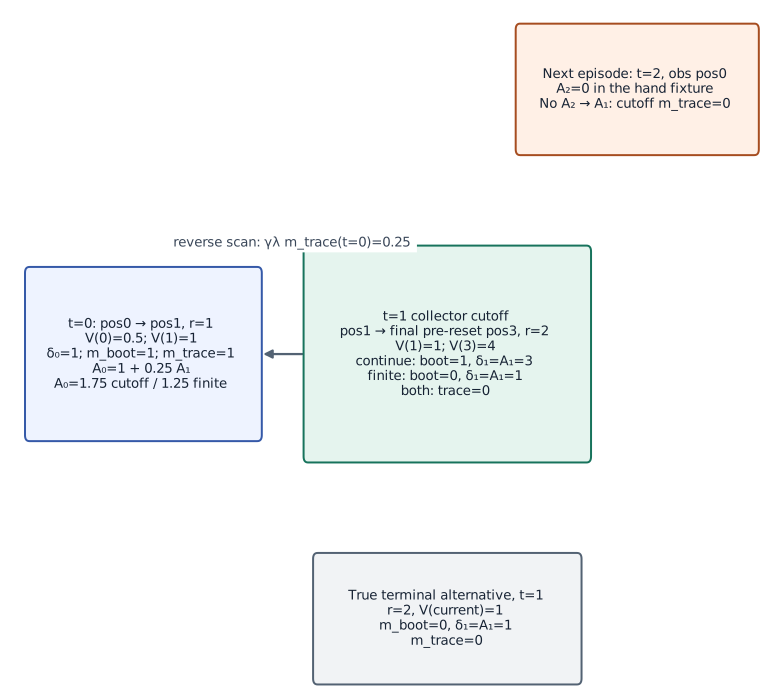
Read the graph left to right as then ; the reverse arrow points from the second residual back to the first with coefficient . For this diagram only, : continuing cutoff gives , then ; making it the finite deadline removes , giving and . The trace mask is zero in both cases, isolating reset episode . A true terminal also has bootstrap mask zero. Predict which number changes if the collector cutoff is reclassified as the task deadline: the bootstrap contribution changes, while the trace boundary stays closed. The critic-fit plot elsewhere uses gamma=0.9.
Bootstrapping and trace continuation answer different questions
A bootstrap mask answers whether the next state has future value; a trace mask answers whether reverse GAE may carry later residuals across this transition. A true terminal has bootstrap mask 0. A continuing collector cutoff has bootstrap mask 1 from the final pre-reset observation, but trace mask 0 so the next episode cannot leak backward. The finite task's own eight-action deadline has no objective beyond it, so its bootstrap mask is also 0. Reset only after saving the final observation.
Work the reverse scan by hand
Use the diagram's separate hand fixture, with , , and values , , . The first transition has reward 1, so . The cutoff transition has reward 2: for a continuing collector, , and the trace stops at that boundary, so and . At a finite deadline, remove the bootstrap term: and . A reset episode's advantage never flows into this reverse scan. This is not the separate critic-fit rollout.
A lower fit error is evidence of optimization, not policy quality
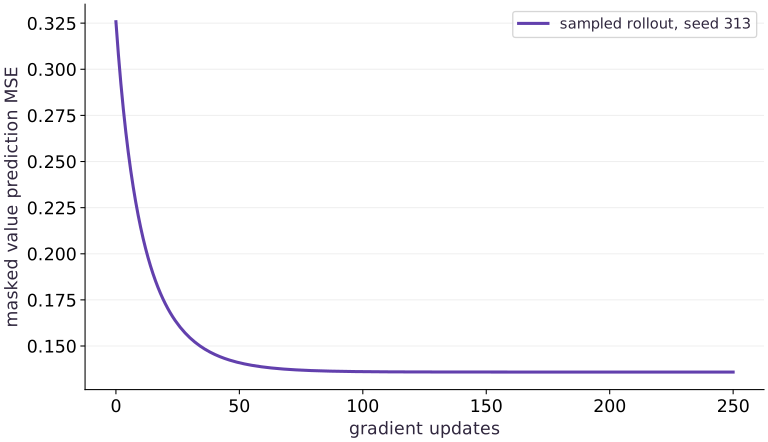
The critic-fit plot measures masked mean-squared error on gamma=0.9 discounted returns. The four position values cannot encode remaining time, and sampled returns differ, so a decreasing loss need not reach zero. A value estimate is not the realized return; an advantage is a return or TD-based estimate minus a value baseline. Fitting that baseline may reduce policy-gradient estimator variance, but this lesson does not add an actor update. To claim policy improvement, update an actor and evaluate it on held-out episodes.
Value error falls while the table learns sampled returns
Predict before looking: Will the error reach zero, and does a decreasing critic loss prove that the policy improved?
Read the figure
The x-axis is value-table gradient update; the y-axis is masked mean-squared error on 512 retained episodes (seed 313). For discounted targets with , the plotted training error falls from about 0.3258 to 0.1359. Compare the first and last points to predict the direction of change; the remaining error is plausible because the four-entry position table omits time remaining and sampled returns vary. This curve measures critic fit, not episode return or policy quality.
Connect it to the computation
Each plotted point is produced by fit_value_function on the retained rollout and its gamma=0.9 targets. The separate hand-computed diagram uses gamma=0.5 and lambda=0.5 to expose bootstrap and trace masks; do not transfer its numerical advantages to this plot. Lower fit error says the table follows its training targets more closely, not that an actor improved. The existing policy objectives and exact-return evaluation remain separate.
Figure data and execution details
Open full-size figureDownload data and provenance
The notebook contains the data experiment, plotting code, and recorded figure output. Rerun it to test your changes.
Your build: Create a separate main.py in your practice folder. Append each block in order and run python main.py in the lesson environment. The downloaded script is the complete reference, so keep it separate from your attempt.
1 Define the rollout and return target
Import the local CPU dependencies, define the fixed-shape collector, and retain each transition’s actual next observation. Add the finite-horizon discounted-return helper with gamma=0.9.
import jax
import jax.numpy as jnp
import numpy as np

def rollout(theta, key, batch_size=512, horizon=8):
    """Collect fixed-shape trajectories and retain each pre-reset next state."""
    reset_key, action_key = jax.random.split(key)
    position = jax.vmap(lambda subkey: jax.random.randint(subkey, (), 0, 2))(jax.random.split(reset_key, batch_size))
    elapsed = jnp.zeros((batch_size,), dtype=jnp.int32)
    done = jnp.zeros((batch_size,), dtype=jnp.bool_)
    time_keys = jax.random.split(action_key, horizon)

    def collect(carry, time_key):
        position, elapsed, done = carry
        observation = position
        active = ~done
        keys = jax.random.split(time_key, batch_size)
        probability = jax.nn.sigmoid(theta[jnp.minimum(position, 2)])
        action = jax.vmap(jax.random.bernoulli)(keys, probability).astype(jnp.int32)
        proposed = jnp.clip(position + 2 * action - 1, 0, 3)
        next_position = jnp.where(active, proposed, position)
        next_elapsed = elapsed + active.astype(jnp.int32)
        terminated = active & (next_position == 3)
        truncated = active & ~terminated & (next_elapsed >= horizon)
        reward = jnp.where(active, jnp.where(terminated, 1., -.01), 0.)
        next_done = done | terminated | truncated
        record = {
            "observation": observation,
            "next_observation": next_position,
            "reward": reward,
            "active": active,
            "terminated": terminated,
            "truncated": truncated,
        }
        return (next_position, next_elapsed, next_done), record

    final_state, records = jax.lax.scan(collect, (position, elapsed, done), time_keys)
    return final_state, records

def discounted_returns_to_go(rewards, gamma):
    """Compute finite-horizon discounted returns along the time axis."""
    discounts = gamma ** jnp.arange(rewards.shape[0], dtype=rewards.dtype)
    weighted = rewards * discounts.reshape((-1,) + (1,) * (rewards.ndim - 1))
    return jnp.cumsum(weighted[::-1], axis=0)[::-1] / discounts.reshape((-1,) + (1,) * (rewards.ndim - 1))
The collector stores next_observation before any reset and returns time-major records. No repository module is needed.
Explain the APIs in this step
jax.random.split(key, num=...): Derives new keys for independent random operations; using the same key again repeats its random stream.jax.vmap(fn, in_axes=..., out_axes=...): Vectorizes a single-example function across mapped array axes without a Python loop.jax.random.randint(key, shape, minval, maxval): Draws integer samples from a half-open interval using an explicit PRNG key.jnp.zeros(shape, dtype=...): Creates a JAX array of the requested shape filled with zeros.
2 Define and fit the tabular value function
Define a masked mean-squared objective and its gradient-update scan. Padded rows are sanitized before residual arithmetic and do not affect the denominator.
def value_loss(value_table, records, targets):
    """Masked MSE with fixed targets and padding sanitized before arithmetic."""
    active = jnp.asarray(records["active"], dtype=jnp.bool_)
    predictions = value_table[jnp.clip(records["observation"], 0, 3)]
    targets = jax.lax.stop_gradient(jnp.asarray(targets))
    safe_targets = jnp.where(active, targets, jnp.zeros_like(targets))
    residual = jnp.where(active, predictions - safe_targets, jnp.zeros_like(predictions))
    return jnp.sum(jnp.square(residual)) / jnp.maximum(jnp.sum(active), 1)


def fit_value_function(records, targets, updates=250, learning_rate=.1):
    """Fit one scalar per state and retain the initial and updated losses."""
    table = jnp.zeros((4,), dtype=jnp.float32)
    loss_fn = lambda candidate: value_loss(candidate, records, targets)
    initial = loss_fn(table)

    def update(candidate, _):
        _, gradient = jax.value_and_grad(loss_fn)(candidate)
        next_table = candidate - learning_rate * gradient
        return next_table, loss_fn(next_table)

    table, history = jax.lax.scan(update, table, None, length=updates)
    return table, jnp.concatenate((initial[None], history))
The four table entries correspond to positions. The target is fixed rollout reward-to-go; the optimizer changes the table through gradient descent.
Explain the APIs in this step
jnp.sum(x, axis=...): Adds JAX array values along the selected axis.jnp.zeros(shape, dtype=...): Creates a JAX array of the requested shape filled with zeros.jax.value_and_grad(loss_fn)(params, ...): Transforms a pure function to return its value and gradient(value, grads)from the same evaluation.jax.lax.scan(step_fn, init_carry, xs, length=...): Compiles a sequential loop whose step returns(next_carry, y), yielding(final_carry, stacked_ys).
3 Define GAE and choose the reproducible policy
Implement reverse GAE with separate bootstrap and trace-continuation masks, then set the policy logits used by the example.
def generalized_advantage_estimate(records, value_table, gamma=.9, lam=.95,
                                   bootstrap_on_truncation=False):
    """Reverse GAE; bootstrap mask and trace-continuation mask stay separate."""
    observations = records["observation"]
    next_observations = records["next_observation"]
    active = records["active"].astype(jnp.bool_)
    terminated = records["terminated"].astype(jnp.bool_)
    truncated = records["truncated"].astype(jnp.bool_)
    values = value_table[jnp.clip(observations, 0, 3)]
    next_values = value_table[jnp.clip(next_observations, 0, 3)]
    bootstrap = ~(terminated | (truncated & ~jnp.asarray(bootstrap_on_truncation)))
    delta = records["reward"] + gamma * bootstrap.astype(values.dtype) * next_values - values
    delta = jnp.where(active, delta, 0.)
    next_active = jnp.concatenate((active[1:], jnp.zeros_like(active[:1])), axis=0)
    trace = active & ~(terminated | truncated) & next_active

    def reverse_step(carry, inputs):
        residual, continues = inputs
        advantage = residual + gamma * lam * continues.astype(residual.dtype) * carry
        return advantage, advantage

    reverse_values = jnp.zeros(observations.shape[1:], dtype=values.dtype)
    _, reverse_advantages = jax.lax.scan(
        reverse_step, reverse_values, (delta[::-1], trace[::-1]))
    return jnp.where(active, reverse_advantages[::-1], 0.)

theta = jnp.array([-.7, .3, 1.1])
A terminal or cutoff can stop the trace while a continuing-task cutoff may still bootstrap from its retained final observation. This finite-horizon example selects no bootstrap beyond its deadline.
Explain the APIs in this step
jnp.zeros(shape, dtype=...): Creates a JAX array of the requested shape filled with zeros.jax.lax.scan(step_fn, init_carry, xs, length=...): Compiles a sequential loop whose step returns(next_carry, y), yielding(final_carry, stacked_ys).jnp.array(values, dtype=...): Constructs a JAX array from Python/NumPy values.
4 Collect a rollout and fit values
Collect seed 313 data, compute return targets, fit the table for 250 updates, and retain the full loss history.
_, rollout_records = rollout(theta, jax.random.key(313), batch_size=512, horizon=8)
targets = discounted_returns_to_go(rollout_records["reward"], gamma=.9)

value_table, loss_history = fit_value_function(rollout_records, targets)

print("initial / final masked value MSE:", float(loss_history[0]), float(loss_history[-1]))
print("fitted V(position 0..3):", np.asarray(value_table).round(4))
Both the initial and updated errors are retained so the exercise can inspect actual learning rather than a hard-coded expected answer.
Explain the APIs in this step
jax.random.key(seed): Creates a typed explicit PRNG key from a seed.
5 Estimate GAE and prepare the learning plot
Estimate advantages with the finite-horizon setting, check their shape and finiteness, and build plot data from the retained loss history.
advantages = generalized_advantage_estimate(
    rollout_records, value_table, gamma=.9, lam=.95,
    bootstrap_on_truncation=False)
print("initial / final masked value MSE:", float(loss_history[0]), float(loss_history[-1]))
print("fitted V(position 0..3):", np.asarray(value_table).round(4))
print("GAE shape:", advantages.shape, "all finite:", bool(jnp.all(jnp.isfinite(advantages))))

visual_data = {
    "kind": "line",
    "x": list(range(len(loss_history))),
    "xlabel": "gradient updates",
    "ylabel": "masked value prediction MSE",
    "series": [{"label": "sampled rollout targets, seed 313", "y": np.asarray(loss_history).tolist()}],
}
Every plotted point is a measured masked-MSE value from this run. The four-state critic and finite corridor do not demonstrate actor improvement or continuous control.
Explain the APIs in this step
jnp.isfinite(x): Returns a JAX boolean array marking elements that are neitherNaNnor infinite.
View the cumulative build in main.py
These blocks append in order to your separate practice file.
import jax
import jax.numpy as jnp
import numpy as np

def rollout(theta, key, batch_size=512, horizon=8):
    """Collect fixed-shape trajectories and retain each pre-reset next state."""
    reset_key, action_key = jax.random.split(key)
    position = jax.vmap(lambda subkey: jax.random.randint(subkey, (), 0, 2))(jax.random.split(reset_key, batch_size))
    elapsed = jnp.zeros((batch_size,), dtype=jnp.int32)
    done = jnp.zeros((batch_size,), dtype=jnp.bool_)
    time_keys = jax.random.split(action_key, horizon)

    def collect(carry, time_key):
        position, elapsed, done = carry
        observation = position
        active = ~done
        keys = jax.random.split(time_key, batch_size)
        probability = jax.nn.sigmoid(theta[jnp.minimum(position, 2)])
        action = jax.vmap(jax.random.bernoulli)(keys, probability).astype(jnp.int32)
        proposed = jnp.clip(position + 2 * action - 1, 0, 3)
        next_position = jnp.where(active, proposed, position)
        next_elapsed = elapsed + active.astype(jnp.int32)
        terminated = active & (next_position == 3)
        truncated = active & ~terminated & (next_elapsed >= horizon)
        reward = jnp.where(active, jnp.where(terminated, 1., -.01), 0.)
        next_done = done | terminated | truncated
        record = {
            "observation": observation,
            "next_observation": next_position,
            "reward": reward,
            "active": active,
            "terminated": terminated,
            "truncated": truncated,
        }
        return (next_position, next_elapsed, next_done), record

    final_state, records = jax.lax.scan(collect, (position, elapsed, done), time_keys)
    return final_state, records

def discounted_returns_to_go(rewards, gamma):
    """Compute finite-horizon discounted returns along the time axis."""
    discounts = gamma ** jnp.arange(rewards.shape[0], dtype=rewards.dtype)
    weighted = rewards * discounts.reshape((-1,) + (1,) * (rewards.ndim - 1))
    return jnp.cumsum(weighted[::-1], axis=0)[::-1] / discounts.reshape((-1,) + (1,) * (rewards.ndim - 1))

def value_loss(value_table, records, targets):
    """Masked MSE with fixed targets and padding sanitized before arithmetic."""
    active = jnp.asarray(records["active"], dtype=jnp.bool_)
    predictions = value_table[jnp.clip(records["observation"], 0, 3)]
    targets = jax.lax.stop_gradient(jnp.asarray(targets))
    safe_targets = jnp.where(active, targets, jnp.zeros_like(targets))
    residual = jnp.where(active, predictions - safe_targets, jnp.zeros_like(predictions))
    return jnp.sum(jnp.square(residual)) / jnp.maximum(jnp.sum(active), 1)


def fit_value_function(records, targets, updates=250, learning_rate=.1):
    """Fit one scalar per state and retain the initial and updated losses."""
    table = jnp.zeros((4,), dtype=jnp.float32)
    loss_fn = lambda candidate: value_loss(candidate, records, targets)
    initial = loss_fn(table)

    def update(candidate, _):
        _, gradient = jax.value_and_grad(loss_fn)(candidate)
        next_table = candidate - learning_rate * gradient
        return next_table, loss_fn(next_table)

    table, history = jax.lax.scan(update, table, None, length=updates)
    return table, jnp.concatenate((initial[None], history))

def generalized_advantage_estimate(records, value_table, gamma=.9, lam=.95,
                                   bootstrap_on_truncation=False):
    """Reverse GAE; bootstrap mask and trace-continuation mask stay separate."""
    observations = records["observation"]
    next_observations = records["next_observation"]
    active = records["active"].astype(jnp.bool_)
    terminated = records["terminated"].astype(jnp.bool_)
    truncated = records["truncated"].astype(jnp.bool_)
    values = value_table[jnp.clip(observations, 0, 3)]
    next_values = value_table[jnp.clip(next_observations, 0, 3)]
    bootstrap = ~(terminated | (truncated & ~jnp.asarray(bootstrap_on_truncation)))
    delta = records["reward"] + gamma * bootstrap.astype(values.dtype) * next_values - values
    delta = jnp.where(active, delta, 0.)
    next_active = jnp.concatenate((active[1:], jnp.zeros_like(active[:1])), axis=0)
    trace = active & ~(terminated | truncated) & next_active

    def reverse_step(carry, inputs):
        residual, continues = inputs
        advantage = residual + gamma * lam * continues.astype(residual.dtype) * carry
        return advantage, advantage

    reverse_values = jnp.zeros(observations.shape[1:], dtype=values.dtype)
    _, reverse_advantages = jax.lax.scan(
        reverse_step, reverse_values, (delta[::-1], trace[::-1]))
    return jnp.where(active, reverse_advantages[::-1], 0.)

theta = jnp.array([-.7, .3, 1.1])

_, rollout_records = rollout(theta, jax.random.key(313), batch_size=512, horizon=8)
targets = discounted_returns_to_go(rollout_records["reward"], gamma=.9)

value_table, loss_history = fit_value_function(rollout_records, targets)

print("initial / final masked value MSE:", float(loss_history[0]), float(loss_history[-1]))
print("fitted V(position 0..3):", np.asarray(value_table).round(4))

advantages = generalized_advantage_estimate(
    rollout_records, value_table, gamma=.9, lam=.95,
    bootstrap_on_truncation=False)
print("initial / final masked value MSE:", float(loss_history[0]), float(loss_history[-1]))
print("fitted V(position 0..3):", np.asarray(value_table).round(4))
print("GAE shape:", advantages.shape, "all finite:", bool(jnp.all(jnp.isfinite(advantages))))

visual_data = {
    "kind": "line",
    "x": list(range(len(loss_history))),
    "xlabel": "gradient updates",
    "ylabel": "masked value prediction MSE",
    "series": [{"label": "sampled rollout targets, seed 313", "y": np.asarray(loss_history).tolist()}],
}
Run the example
python3 phases/12-rl/05-learn-values-and-gae/code/main.pyAbout this command
This shortcut uses an activated macOS/Linux course environment in the repository folder. For Windows, use the explicit interpreter command in “Setup help” above. The script includes worked examples and reference solutions.
Inspect the complete assembled example
"""Self-contained CPU example: tabular value fitting and masked GAE."""

import jax
import jax.numpy as jnp
import numpy as np

def rollout(theta, key, batch_size=512, horizon=8):
    """Collect fixed-shape trajectories and retain each pre-reset next state."""
    reset_key, action_key = jax.random.split(key)
    position = jax.vmap(lambda subkey: jax.random.randint(subkey, (), 0, 2))(jax.random.split(reset_key, batch_size))
    elapsed = jnp.zeros((batch_size,), dtype=jnp.int32)
    done = jnp.zeros((batch_size,), dtype=jnp.bool_)
    time_keys = jax.random.split(action_key, horizon)

    def collect(carry, time_key):
        position, elapsed, done = carry
        observation = position
        active = ~done
        keys = jax.random.split(time_key, batch_size)
        probability = jax.nn.sigmoid(theta[jnp.minimum(position, 2)])
        action = jax.vmap(jax.random.bernoulli)(keys, probability).astype(jnp.int32)
        proposed = jnp.clip(position + 2 * action - 1, 0, 3)
        next_position = jnp.where(active, proposed, position)
        next_elapsed = elapsed + active.astype(jnp.int32)
        terminated = active & (next_position == 3)
        truncated = active & ~terminated & (next_elapsed >= horizon)
        reward = jnp.where(active, jnp.where(terminated, 1., -.01), 0.)
        next_done = done | terminated | truncated
        record = {
            "observation": observation,
            "next_observation": next_position,
            "reward": reward,
            "active": active,
            "terminated": terminated,
            "truncated": truncated,
        }
        return (next_position, next_elapsed, next_done), record

    final_state, records = jax.lax.scan(collect, (position, elapsed, done), time_keys)
    return final_state, records

def discounted_returns_to_go(rewards, gamma):
    """Compute finite-horizon discounted returns along the time axis."""
    discounts = gamma ** jnp.arange(rewards.shape[0], dtype=rewards.dtype)
    weighted = rewards * discounts.reshape((-1,) + (1,) * (rewards.ndim - 1))
    return jnp.cumsum(weighted[::-1], axis=0)[::-1] / discounts.reshape((-1,) + (1,) * (rewards.ndim - 1))

def value_loss(value_table, records, targets):
    """Masked MSE with fixed targets and padding sanitized before arithmetic."""
    active = jnp.asarray(records["active"], dtype=jnp.bool_)
    predictions = value_table[jnp.clip(records["observation"], 0, 3)]
    targets = jax.lax.stop_gradient(jnp.asarray(targets))
    safe_targets = jnp.where(active, targets, jnp.zeros_like(targets))
    residual = jnp.where(active, predictions - safe_targets, jnp.zeros_like(predictions))
    return jnp.sum(jnp.square(residual)) / jnp.maximum(jnp.sum(active), 1)


def fit_value_function(records, targets, updates=250, learning_rate=.1):
    """Fit one scalar per state and retain the initial and updated losses."""
    table = jnp.zeros((4,), dtype=jnp.float32)
    loss_fn = lambda candidate: value_loss(candidate, records, targets)
    initial = loss_fn(table)

    def update(candidate, _):
        _, gradient = jax.value_and_grad(loss_fn)(candidate)
        next_table = candidate - learning_rate * gradient
        return next_table, loss_fn(next_table)

    table, history = jax.lax.scan(update, table, None, length=updates)
    return table, jnp.concatenate((initial[None], history))

def generalized_advantage_estimate(records, value_table, gamma=.9, lam=.95,
                                   bootstrap_on_truncation=False):
    """Reverse GAE; bootstrap mask and trace-continuation mask stay separate."""
    observations = records["observation"]
    next_observations = records["next_observation"]
    active = records["active"].astype(jnp.bool_)
    terminated = records["terminated"].astype(jnp.bool_)
    truncated = records["truncated"].astype(jnp.bool_)
    values = value_table[jnp.clip(observations, 0, 3)]
    next_values = value_table[jnp.clip(next_observations, 0, 3)]
    bootstrap = ~(terminated | (truncated & ~jnp.asarray(bootstrap_on_truncation)))
    delta = records["reward"] + gamma * bootstrap.astype(values.dtype) * next_values - values
    delta = jnp.where(active, delta, 0.)
    next_active = jnp.concatenate((active[1:], jnp.zeros_like(active[:1])), axis=0)
    trace = active & ~(terminated | truncated) & next_active

    def reverse_step(carry, inputs):
        residual, continues = inputs
        advantage = residual + gamma * lam * continues.astype(residual.dtype) * carry
        return advantage, advantage

    reverse_values = jnp.zeros(observations.shape[1:], dtype=values.dtype)
    _, reverse_advantages = jax.lax.scan(
        reverse_step, reverse_values, (delta[::-1], trace[::-1]))
    return jnp.where(active, reverse_advantages[::-1], 0.)

theta = jnp.array([-.7, .3, 1.1])

_, rollout_records = rollout(theta, jax.random.key(313), batch_size=512, horizon=8)
targets = discounted_returns_to_go(rollout_records["reward"], gamma=.9)

value_table, loss_history = fit_value_function(rollout_records, targets)

print("initial / final masked value MSE:", float(loss_history[0]), float(loss_history[-1]))
print("fitted V(position 0..3):", np.asarray(value_table).round(4))

advantages = generalized_advantage_estimate(
    rollout_records, value_table, gamma=.9, lam=.95,
    bootstrap_on_truncation=False)
print("initial / final masked value MSE:", float(loss_history[0]), float(loss_history[-1]))
print("fitted V(position 0..3):", np.asarray(value_table).round(4))
print("GAE shape:", advantages.shape, "all finite:", bool(jnp.all(jnp.isfinite(advantages))))

visual_data = {
    "kind": "line",
    "x": list(range(len(loss_history))),
    "xlabel": "gradient updates",
    "ylabel": "masked value prediction MSE",
    "series": [{"label": "sampled rollout targets, seed 313", "y": np.asarray(loss_history).tolist()}],
}
Expected result: A four-entry value table, its retained masked-MSE history, and time-major GAE advantages from one sampled finite-horizon rollout.
Recorded output and runtime details
Reference output captured from executing the complete lesson script (code/main.py) and its assertions in the course CPU environment.
initial / final masked value MSE: 0.3257838487625122 0.13587723672389984
fitted V(position 0..3): [0.1953 0.4592 0.8403 0.    ]
initial / final masked value MSE: 0.3257838487625122 0.13587723672389984
fitted V(position 0..3): [0.1953 0.4592 0.8403 0.    ]
GAE shape: (8, 512) all finite: True
initial / final masked value MSE: 0.3257838487625122 0.13587723672389984
fitted V(position 0..3): [0.1953 0.4592 0.8403 0.    ]
initial / final masked value MSE: 0.3257838487625122 0.13587723672389984
fitted V(position 0..3): [0.1953 0.4592 0.8403 0.    ]
GAE shape: (8, 512) all finite: True
undiscounted / matched / terminal / continuing-cutoff: [np.float64(-0.10000000000000009), np.float64(0.0), np.float64(0.0), 4.6]
cutoff residual: 3.0
initial / final MSE: 0.3257838487625122 0.13587723672389984
V table: [0.19529999792575836, 0.459199994802475, 0.8403000235557556, 0.0]
seed 313 initial/final MSE: 0.3257838487625122 0.13587723672389984
seed 313 fitted table: [0.19529999792575836, 0.459199994802475, 0.8403000235557556, 0.0]
seed 314 initial/final MSE: 0.33639785647392273 0.13899469375610352
seed 314 fitted table: [0.20389999449253082, 0.45910000801086426, 0.8177000284194946, 0.0]
continuing cutoff GAE: [1.75, 3.0, 0.0]
finite-horizon GAE: [1.25, 1.0, 0.0]
cutoff / reset / terminal residual: 3.0 1.25 1.0
finite-horizon/cutoff GAE at first transition: 1.25 1.75
PASS: rl-05
Download execution record · The notebook includes executed cells and figure outputs. Compare your run with these values; timings depend on the machine.
Match value targets to the GAE discount
gamma = .9
rewards = np.array([1., 1.])
undiscounted_v = np.array([2., 1., 0.])
discounted_v = np.array([1.9, 1., 0.])
undiscounted_delta = rewards[0] + gamma * undiscounted_v[1] - undiscounted_v[0]
discounted_delta = rewards[0] + gamma * discounted_v[1] - discounted_v[0]
terminal_delta = rewards[1] + gamma * 0. - discounted_v[1]
cutoff_delta = 2. + gamma * 4. - 1.
np.testing.assert_allclose([undiscounted_delta, terminal_delta], [-.1, 0.])
np.testing.assert_allclose([discounted_delta, terminal_delta], [0., 0.])
np.testing.assert_allclose(cutoff_delta, 4.6)
print("undiscounted / matched / terminal / continuing-cutoff:", [undiscounted_delta, discounted_delta, terminal_delta, cutoff_delta])
Expected: Undiscounted-target residuals [-0.1, 0]; matched discounted-target residuals [0, 0]; continuing cutoff residual 4.6. A true terminal uses zero bootstrap.
The TD target uses the same gamma as the value objective. At a true terminal the bootstrap is zero. At an external cutoff of a continuing task, use the retained final pre-reset value; the GAE trace still stops at that boundary.
Predict the time-limit target
gamma = .5
reward, current_value, final_value = 2., 1., 4.
delta = reward + gamma * final_value - current_value
assert delta == 3.
print('cutoff residual:', delta)
Expected: cutoff residual: 3.0
The old episode's final observation supplies the next value. The reset state in the following row is excluded from this transition.
Train the value table on a retained rollout
_, value_records = rollout(jnp.array([-.7,.3,1.1]), jax.random.key(313), 512, 8)
value_targets = discounted_returns_to_go(value_records['reward'], gamma=.9)
value_table, value_history = fit_value_function(value_records, value_targets, 250, .1)
assert value_history[-1] < value_history[0] * .7
print('initial / final MSE:', float(value_history[0]), float(value_history[-1]))
print('V table:', np.asarray(value_table).round(4).tolist())
Expected: CPU JAX 0.9.2, seed 313: initial MSE 0.325784; final MSE 0.135877; fitted values [0.1953, 0.4592, 0.8403, 0.0].
The loss falls through gradient updates on actual sampled episodes. It remains positive because a four-state table cannot predict the stochastic return of every individual trajectory.
Make it yours
Where to put your code: Modify your own main.py, or use the Make it yours cell in your downloaded notebook. Run your attempt in the declared environment and verify your prediction before opening the reference solution.
The task lasts at most eight actions and the value target is discounted return with gamma=0.9, matching GAE gamma. Change the collection key from 313 to 314. Before running, predict which of the fitted values and final MSE should remain identical. Then retain both error histories and explain why changed trajectories should change the fitted table.
Show a writing guide and starter scaffold
How to write this exercise code
Learner-only inputs, outputs, checks and hints
Inputs
- A policy, an explicit collection key, and a retained rollout with
observation,next_observation, andactive. - A changed collection key 314 after the recorded seed 313 run.
- The gamma=0.9 discounted-return and value-fit functions.
Outputs
- The fitted four-state value table and initial/per-update masked-MSE history for discounted targets.
- A comparison that keeps both seed-specific fits visible.
Invariants to check
- Only active transitions contribute to value loss.
- The value target discounts rewards with gamma=0.9, the same discount used by GAE.
- The fit uses sampled rollout targets and reports real optimization error.
- Different collection keys can produce different trajectories and fitted values.
Hints
- Build targets from the collected reward array.
- Use gamma=.9 in both the discounted return targets and the GAE call.
- Keep the retained
next_observationfor the later GAE step. - Compare final errors without expecting stochastic targets to produce zero error.
import jax
import jax.numpy as jnp

def fit_changed_rollout(theta, seed, rollout, discounted_returns_to_go, fit_value_function):
    # TODO: collect a new rollout using the supplied seed
    final_state, records = ...
    # TODO: form targets and fit the state-value table
    targets = ...
    value_table, loss_history = ...
    # TODO: return the learned table and retained error history
    raise NotImplementedError
Reveal the reference solution
# Refit from a changed collection key and retain both complete learning records.
seed313_records = rollout_records
seed313_targets = targets
seed313_table = value_table
seed313_history = loss_history
seed314_final_state, seed314_records = rollout(
    theta, jax.random.key(314), batch_size=512, horizon=8
)
seed314_targets = discounted_returns_to_go(seed314_records["reward"], gamma=.9)
seed314_table, seed314_history = fit_value_function(
    seed314_records, seed314_targets, updates=250, learning_rate=.1
)


def independent_numpy_masked_mse(table, records, target_values):
    active = np.asarray(records["active"], dtype=bool)
    observation = np.asarray(records["observation"], dtype=np.int64)
    prediction = np.asarray(table)[np.clip(observation, 0, 3)]
    target_values = np.asarray(target_values)
    safe_targets = np.where(active, target_values, 0.0)
    residual = np.where(active, prediction - safe_targets, 0.0)
    return float(np.square(residual).sum() / max(int(active.sum()), 1))


# Independently audit the initial zero table and the returned fitted table for each seed.
for records, targets_for_run, table, history in (
    (seed313_records, seed313_targets, seed313_table, seed313_history),
    (seed314_records, seed314_targets, seed314_table, seed314_history),
):
    initial_numpy_mse = independent_numpy_masked_mse(
        np.zeros((4,), dtype=np.float32), records, targets_for_run
    )
    final_numpy_mse = independent_numpy_masked_mse(table, records, targets_for_run)
    np.testing.assert_allclose(initial_numpy_mse, float(history[0]), rtol=1e-6, atol=1e-7)
    np.testing.assert_allclose(final_numpy_mse, float(history[-1]), rtol=1e-6, atol=1e-7)
    assert float(history[-1]) < float(history[0])

assert not np.array_equal(
    np.asarray(seed313_records["observation"]),
    np.asarray(seed314_records["observation"]),
)
assert not np.allclose(np.asarray(seed313_table), np.asarray(seed314_table))
print("seed 313 initial/final MSE:", float(seed313_history[0]), float(seed313_history[-1]))
print("seed 313 fitted table:", np.asarray(seed313_table).round(4).tolist())
print("seed 314 initial/final MSE:", float(seed314_history[0]), float(seed314_history[-1]))
print("seed 314 fitted table:", np.asarray(seed314_table).round(4).tolist())

# Exact two-transition discount-mismatch example and boundary bootstrap check.
gamma = .9
rewards_np = np.array([1., 1.])
undiscounted_v = np.array([2., 1., 0.])
discounted_v = np.array([1.9, 1., 0.])
undiscounted_deltas = np.array([
    rewards_np[0] + gamma * undiscounted_v[1] - undiscounted_v[0],
    rewards_np[1] + gamma * undiscounted_v[2] - undiscounted_v[1],
])
matched_deltas = np.array([
    rewards_np[0] + gamma * discounted_v[1] - discounted_v[0],
    rewards_np[1] + gamma * discounted_v[2] - discounted_v[1],
])
np.testing.assert_allclose(undiscounted_deltas, [-.1, 0.])
np.testing.assert_allclose(matched_deltas, [0., 0.])
terminal_delta = 2. + gamma * 0. - 1.
continuing_cutoff_delta = 2. + gamma * 4. - 1.
np.testing.assert_allclose([terminal_delta, continuing_cutoff_delta], [1., 4.6])
terminal_records = {
    "observation": jnp.array([[1]], dtype=jnp.int32),
    "next_observation": jnp.array([[3]], dtype=jnp.int32),
    "reward": jnp.array([[2.]]),
    "active": jnp.array([[True]]),
    "terminated": jnp.array([[True]]),
    "truncated": jnp.array([[False]]),
}
terminal_advantage = generalized_advantage_estimate(
    terminal_records, jnp.array([.5, 1., 2., 4.]), gamma=.9, lam=.95,
    bootstrap_on_truncation=True
)
np.testing.assert_allclose(np.asarray(terminal_advantage), [[1.]], atol=1e-6)

# Hand-check a two-transition episode followed by a reset observation.
hand_table = jnp.array([.5, 1., 2., 4.])
hand_records = {
    "observation": jnp.array([[0], [1], [0]], dtype=jnp.int32),
    "next_observation": jnp.array([[1], [3], [1]], dtype=jnp.int32),
    "reward": jnp.array([[1.], [2.], [0.]]),
    "active": jnp.array([[True], [True], [True]]),
    "terminated": jnp.array([[False], [False], [False]]),
    "truncated": jnp.array([[False], [True], [False]]),
}
continuing_cutoff_advantages = generalized_advantage_estimate(
    hand_records, hand_table, gamma=.5, lam=.5, bootstrap_on_truncation=True
)
np.testing.assert_allclose(
    np.asarray(continuing_cutoff_advantages[:, 0]), np.array([1.75, 3., 0.]), atol=1e-6
)
reset_used_as_bootstrap = {
    **hand_records,
    "next_observation": hand_records["next_observation"].at[1, 0].set(0),
}
wrong_reset_advantages = generalized_advantage_estimate(
    reset_used_as_bootstrap, hand_table, gamma=.5, lam=.5, bootstrap_on_truncation=True
)
assert not np.allclose(
    np.asarray(wrong_reset_advantages[:2]), np.asarray(continuing_cutoff_advantages[:2])
)
finite_horizon_advantages = generalized_advantage_estimate(
    hand_records, hand_table, gamma=.5, lam=.5, bootstrap_on_truncation=False
)
np.testing.assert_allclose(
    np.asarray(finite_horizon_advantages[:, 0]), np.array([1.25, 1., 0.]), atol=1e-6
)
print("continuing cutoff GAE:", np.asarray(continuing_cutoff_advantages[:, 0]).tolist())
print("finite-horizon GAE:", np.asarray(finite_horizon_advantages[:, 0]).tolist())
Find a reset leak
Transfer / diagnosis
A collector resets immediately after a time limit. The previous transition stores the reset observation as next_observation; its value is large. What failed, and what should the record preserve?
Show a writing guide and starter scaffold
How to write this practice solution
Learner-only inputs, outputs, checks and hints
Inputs
- A continuing-task transition ending at a collection cutoff.
- A retained final pre-reset observation that differs from the next episode’s reset observation.
Outputs
- A target using the final transition observation and a trace that stops at reset.
Invariants to check
- The reset observation cannot replace the saved transition result.
- The bootstrap mask and trace mask are checked independently.
Hints
- Inspect both
next_observationon the cutoff row andobservationon the following row. - Change a later-episode reward to see whether the prior trace leaks across reset.
import jax.numpy as jnp

def inspect_cutoff(records, value_table, gae):
    # TODO: calculate advantages for the retained cutoff record
    advantages = ...
    # TODO: perturb a following-episode reward and compare earlier advantages
    raise NotImplementedError
Show a hint
Compare the environment's transition result before reset with the observation used to start the next episode.
Reveal reference solution and reasoning
# The continuing cutoff bootstraps from the recorded final observation, not reset position zero.
tiny_table = jnp.array([.5, 1., 2., 4.])
reward, current_value, final_value, reset_value, gamma = 2., 1., 4., .5, .5
cutoff_residual = reward + gamma * final_value - current_value
wrong_reset_residual = reward + gamma * reset_value - current_value
terminal_residual = reward - current_value
assert cutoff_residual == 3.
assert wrong_reset_residual == 1.25
assert terminal_residual == 1.
print("cutoff / reset / terminal residual:", cutoff_residual, wrong_reset_residual, terminal_residual)
Bootstrapping and trace continuation are separate masks. A correct trace mask cannot repair a next-observation value that already points to the wrong episode.
Choose the finite-horizon contract
Transfer / application
The corridor objective ends after exactly eight actions, even if the agent has not reached the goal. Should its horizon row bootstrap from a hypothetical next value? Explain which GAE argument to set.
Show a writing guide and starter scaffold
How to write this practice solution
Learner-only inputs, outputs, checks and hints
Inputs
- A task whose objective ends after exactly eight actions.
- A rollout with a truncation flag at its finite-horizon deadline.
Outputs
- GAE advantages under the declared finite-horizon contract.
Invariants to check
- There is no future objective value beyond the true task deadline.
- The caller explicitly chooses the no-bootstrap truncation setting.
Hints
- Distinguish the end of a task from the end of a data-collection window.
- Inspect the helper’s default and the call site.
import jax.numpy as jnp

def finite_horizon_advantages(records, value_table, gae):
    # TODO: call the estimator with the finite-horizon bootstrap contract
    raise NotImplementedError
Show a hint
Ask whether the task itself continues after the deadline or whether only data collection stopped.
Reveal reference solution and reasoning
# The finite eight-action objective ends at its deadline and does not bootstrap beyond it.
finite_horizon_advantage = generalized_advantage_estimate(
    hand_records, hand_table, gamma=.5, lam=.5, bootstrap_on_truncation=False
)
continuing_task_advantage = generalized_advantage_estimate(
    hand_records, hand_table, gamma=.5, lam=.5, bootstrap_on_truncation=True
)
np.testing.assert_allclose(np.asarray(finite_horizon_advantage[:, 0]), [1.25, 1., 0.], atol=1e-6)
np.testing.assert_allclose(np.asarray(continuing_task_advantage[:, 0]), [1.75, 3., 0.], atol=1e-6)
assert not np.allclose(np.asarray(finite_horizon_advantage), np.asarray(continuing_task_advantage))
print("finite-horizon/cutoff GAE at first transition:", float(finite_horizon_advantage[0, 0]), float(continuing_task_advantage[0, 0]))
A boolean flag is not a substitute for declaring the task semantics; it chooses between two different objectives. In this three-row hand fixture, the last row starts the next episode and has reward zero, current value and next value . At discount its own residual is . It cannot propagate across the preceding reset boundary. The earlier row at the deadline uses no bootstrap under the finite-horizon contract.
Diagnose the result
If the timeout target changes when the reset state changes, inspect whether the collector overwrote next_observation. If advantages cross episode boundaries, inspect the trace mask separately from the bootstrap mask. If the fitted error is flat, verify active rows and target gradients; padding should neither train the table nor count in the denominator.
Carry forward
- Fit value predictions on live transitions to sampled discounted returns using the same gamma as GAE, and keep targets fixed during each critic update.
- Use the actual final observation for an external cutoff bootstrap, then stop the reverse trace at the reset boundary.
- A true terminal suppresses bootstrap; a true finite-horizon deadline also has no future objective beyond the task horizon.
Keep your evidence
Keep the discounted target definition, seed-313/314 value tables and fit histories, independent two-transition TD residuals, terminal-versus-cutoff bootstrap/trace checks and a note on the position-only approximation. Critic-fit loss is not policy-improvement evidence.
Save your modified code, its output, and an explanation of your prediction. Checkpoint answers and exercise evidence are tracked separately.
Saved in this browser. Export or back up your portfolio anytime in My learning.
Reference execution: CPU validation only. This worked reference is validated on CPU. Accelerator compatibility requires a separate source review and target execution receipt. Use the execution matrix to review device selection and data ownership before adapting a separate target program. Execution matrix and target qualification.
Primary references
- JAX: scan over a leading axis ↗
- JAX: value and gradient ↗
- Schulman et al.: High-Dimensional Continuous Control Using Generalized Advantage Estimation ↗
- Gymnasium: handling time limits ↗
Phase 12 Integration Project
Bring this phase together: An evaluated policy in a functional environment
Checkpoint to prove: Compare a trained policy to baselines across independent seeds, then defend a learned value estimate and a hand-computed GAE trace at terminal and collector-cutoff boundaries.
Copy projects/policy-evaluation/starter/model.py to projects/policy-evaluation/my_model.py and implement the stage functions there. From the workspace root, run python3 projects/policy-evaluation/tests/check.py --implementation projects/policy-evaluation/my_model.py --stage 1, then advance through --stage 5. Stage 5 is cumulative and adds a separate tabular critic and GAE; it does not replace the actor training targets.