 JAX Pathways
Phase 15 / Deployment, interoperability & edge AI
Adapt a pretrained model and choose a post-training objective
Revision v0.18.1 · Updated since your last visit. Review the changes; your progress is saved.
Lesson · about 130 minutes · CPU practice
Pretrain and reload an artifact with recorded data and checkpoint hashes Compare supervised adaptation and teacher distillation from the same starting weights
Phase study guide: preparation, milestones and project evidence
Before you start
Before this: Data & checkpoint recovery; Performance diagnosis
Hardware: CPU
Setup help: Python, notebook, or Cloud TPU VM
Use the tested CPU packages (the recorded environment uses Python 3.14.3). Other Python versions require separate checks. Hardware receipts apply only to their recorded source, environment, hardware, and cases; they do not qualify every lesson or TPU configuration. See the TPU performance and hardware evidence guide. The optional Cloud TPU specialization explains target-specific execution boundaries. Logical CPU devices practice partitioning; they do not simulate TPU performance.
Download the repository ZIP or use your existing checkout. Extract it and open a terminal in the folder containing requirements-cpu.txt. The beginner ZIP is separate; these lessons use the full repository folder.
python3 -m venv .venv
source .venv/bin/activate
python -m pip install -r requirements-cpu.txtpy -3 -m venv .venv
.\.venv\Scripts\python.exe -m pip install -r requirements-cpu.txtAfter activation, run the complete worked example from that same folder:
python phases/15-deployment/02-adapt-a-pretrained-model-and-choose-a-post-training-objective/code/main.py.\.venv\Scripts\python.exe phases/15-deployment/02-adapt-a-pretrained-model-and-choose-a-post-training-objective/code/main.pyFor an incremental build, create main.py in your own practice folder, append each build block in order, and run python main.py with this environment active. Keep that file separate from the downloaded reference solution.
Download this lesson’s notebook. Open it with a Python kernel using the course environment. Run cells from the top after restarting the kernel; experiments depend on earlier definitions.
For local Jupyter, first install the course requirements using the Local Python steps, then use your environment’s Python to start Jupyter:
python -m pip install jupyterlab
python -m jupyter lab.\.venv\Scripts\python.exe -m pip install jupyterlab
.\.venv\Scripts\python.exe -m jupyter labSelect the downloaded deployment-02.ipynb file in JupyterLab. The notebook contains reference solutions; make your prediction and attempt each practice task before opening them. Restart the kernel before changing logical device setup.
The worked reference for this lesson is CPU-validated. Some references explicitly configure logical CPU devices; setting JAX_PLATFORMS does not adapt them to a TPU. Follow the execution matrix and reviewed multi-host example before attempting a target run.
For accelerator preparation, study TPU setup, observed runtime receipts, checkpointed jobs and precision and retained traces. Current receipts cover bounded v5e1 launch, resume, and precision checks; four single-device Pallas cases; and a four-device v5e collective fixture. Each receipt is limited to its recorded source, environment, cases, and hardware. It does not qualify all lessons or TPU configurations. Cloud provisioning is optional for CPU learning.
Check: Both adapted branches reduce the common held-out target cross-entropy relative to the reloaded source model. The printed table also reports probability error and source-task retention; inspect all three quantities.
Revisit the guided CPU setup · Open 19: TPU Setup. Package instructions are CPU instructions; Windows and accelerator environments need their own validation.
What you will be able to do
- Pretrain and reload an artifact with recorded data and checkpoint hashes
- Compare supervised adaptation and teacher distillation from the same starting weights
- Verify both objective gradients independently
- Report target-task gains and source-task retention without leaking held-out data
The problem
A model already learned one task. You now have a small adaptation set and a teacher that supplies probabilities. Should you optimize the observed labels or imitate the teacher? We will actually pretrain, save and reload a tiny model, adapt it both ways, and compare the resulting predictions on an untouched evaluation split. The model is deliberately small so every objective and derivative can be inspected.
The idea
Adaptation starts with the behavior you want to change and the evidence you have. Supervised labels and teacher distributions supply different targets. Their objectives can use the same model while asking it to learn different things.
Choose the target before choosing the adaptation method
A hard target identifies one class. A teacher distribution can assign mass to several alternatives, preserving information about relative preferences. Matching that distribution does not guarantee the teacher is correct for your deployment population.
Keep the evaluation target fixed when comparing adaptation methods. A lower training loss under one objective cannot be compared directly with a differently defined loss under another objective.
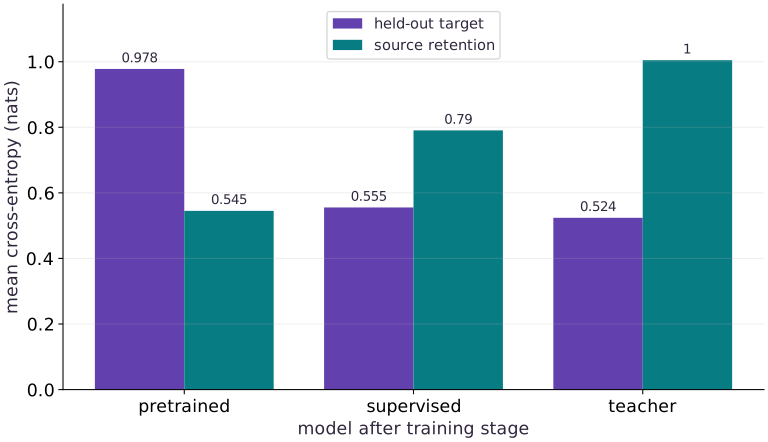
The held-out cross-entropy bars compare the lesson's two procedures under a common scoring rule. Explain that rule and inspect changed examples before choosing a method. This experiment is a bounded adaptation comparison; reward modeling and policy optimization require their own distinct data and update contracts.
Define the tasks before choosing an objective
The input has two measured features plus a constant intercept feature. The source task uses one synthetic probability rule; the target task uses another. Source training sees rows. Adaptation sees only different rows. The final target report uses separately generated rows. These are disjoint generated splits with separate keys, not a real benchmark. Binary adaptation labels are sampled from the target probabilities; the teacher supplies the probabilities themselves. That privileged teacher is declared explicitly rather than presented as a generally superior model.
Understand hard labels and soft targets
For logit , cross-entropy is , where is either a binary observed label or a teacher probability between zero and one. Differentiating gives . Averaging over rows gives the gradient in our host reference. A soft target contains uncertainty that a single sampled binary label does not. If the teacher is wrong, faithfully matching that uncertainty can also preserve its mistakes.
Make pretrained mean previously trained
We start from zero, optimize the source objective for updates and check that the source loss falls. We save those resulting weights, hash the checkpoint bytes and record the source-array hash, objective, dtype, version and training recipe. Adaptation uses only the reloaded artifact. This establishes a small reproducibly pretrained fixture; it is not a foundation model, a downloaded checkpoint or a random frozen feature masquerading as pretraining. The artifact omits optimizer state, so no exact-resume claim is made.
Choose a fair comparison
Both adaptation branches receive identical initial weights, adaptation inputs, update count and rate. Their training losses are not directly a competition because their targets differ. We evaluate both on one common target cross-entropy and probability squared error, using held-out generating probabilities unavailable to training. We also evaluate source loss to expose forgetting. Do not select a learning rate using this final report; add a separate validation split for model selection. One seeded synthetic result is separate from which objective will win on another task.
Locate preference and reinforcement objectives
A pairwise preference objective asks which of two responses is preferred; its supervision consists of prompt, chosen response and rejected response, with a defined sampling and reference policy. A teacher cross-entropy uses distributions over labels or tokens and does not require preference pairs. An RL objective uses a reward and a policy whose generated actions affect the training samples. This lab executes supervised adaptation and distillation only. Renaming teacher probabilities “rewards” would not create an RL experiment.
Carry the contract to a real pretrained model
Choose an actual model checkpoint under its license, record repository and exact revision, tokenizer or feature preprocessing, architecture configuration, file hashes and base precision. First verify a golden inference example before changing weights. Build disjoint training, validation and final evaluation sets, with no overlap from teacher-generation or calibration data. Start with a small controlled adapter or declared trainable parameter subset; record what remains frozen and save adapter/base identities together. Define the task and source-retention criteria before optimization. Recheck export, precision and target-runtime parity after adaptation. This extension is an execution plan, not a claim that a large external model ran in this CPU lesson.
Turn task tradeoffs into a release decision
A lower target loss can be useful while still causing an unacceptable regression on an older task. Decide how much source-task degradation is allowed before inspecting the candidate results. Let denote source evaluation loss and let . Positive means worse retention. A retention budget is a product decision expressed in the same loss units, not a universal constant.
In this synthetic exercise the source evaluation reuses the source inputs, so it is only a retention proxy. A real release needs a separate held-out source set as well as a held-out target set. Record every candidate, including candidates rejected by the gate. If none satisfies the predeclared budget, keep the base or change the training recipe; do not quietly relax the budget after seeing the answer.
In the recorded run, baseline held target cross-entropy is 0.978 nats and source loss is 0.545. Supervised adaptation reaches 0.555 target loss with source loss 0.790; teacher distillation reaches 0.524 target loss with source loss 1.005. The declared retention gate accepts the supervised increase of 0.245 but rejects the teacher increase of 0.459, so the selected candidate is supervised despite its slightly higher target loss. These are results for this seeded synthetic fixture, not a general ranking.
Two adaptation objectives evaluated on the same held-out target
Predict before looking: Will improving the new task necessarily preserve performance on the source task?
Read the figure
The horizontal axis lists pretrained, supervised, and teacher candidates; the vertical axis is mean cross-entropy in nats, with lower better. On held-out target data the bars are about 0.978, 0.555, and 0.524; on source data they are 0.545, 0.790, and 1.005. Teacher gives the lowest target loss but largest source regression. Apply the predeclared source-retention gate before choosing: this run accepts supervised and rejects teacher.
Connect it to the computation
The teacher exactly matches this synthetic target generator, which makes distillation unusually favorable. Even so, its source loss rises by about 0.459 from baseline, beyond the declared budget; supervised rises by about 0.245 and passes. The plotted metrics share evaluation definitions, while the branches’ training objectives do not. Next vary the teacher quality or target sample and rerun the same fixed gate before generalizing.
Figure data and execution details
Open full-size figureDownload data and provenance
The notebook contains the data experiment, plotting code, and recorded figure output. Rerun it to test your changes.
Your build: Create a separate main.py in your practice folder. Append each block in order and run python main.py in the lesson environment. The downloaded script is the complete reference, so keep it separate from your attempt.
1 Pretrain a small model and retain its source data identity
Create main.py in the CPU environment. These are explicit synthetic classification tasks; the source model is genuinely optimized before it is saved.
# Step 1 — 1. Pretrain a small model and retain its source data identity
import hashlib
import json
import tempfile
from pathlib import Path
import numpy as np
import jax
import jax.numpy as jnp

def design(key,n):
    # Sample deterministic random values into `features` using an explicit PRNG key.
    features=jax.random.normal(key,(n,2))
    return jnp.concatenate([features,jnp.ones((n,1))],axis=1)
# Create or split explicit PRNG key(s) (`source_X`) for reproducible randomness.
source_X=design(jax.random.key(10),256)
source_targets=jax.nn.sigmoid(source_X@jnp.array([1.2,-.8,.2]))
# Create or split explicit PRNG key(s) (`adapt_X`) for reproducible randomness.
adapt_X=design(jax.random.key(11),48)
# Create or split explicit PRNG key(s) (`held_X`) for reproducible randomness.
held_X=design(jax.random.key(12),512)
teacher=jnp.array([.6,1.4,-.3])
soft_targets=jax.nn.sigmoid(adapt_X@teacher)
# Create or split explicit PRNG key(s) (`hard_targets`) for reproducible randomness.
hard_targets=jax.random.bernoulli(jax.random.key(13),soft_targets).astype(jnp.float32)
held_prob=jax.nn.sigmoid(held_X@teacher)
def objective(w,X,targets):
    logits=X@w
    return jnp.mean(jnp.logaddexp(0.,logits)-targets*logits)
def train(initial,X,targets,steps=300,rate=.15):
    def step(w,_):
        loss,grad=jax.value_and_grad(objective)(w,X,targets)
        return w-rate*grad,loss
    return jax.lax.scan(step,initial,None,length=steps)
base,pretrain_history=train(jnp.zeros(3),source_X,source_targets)
assert pretrain_history[-1]<pretrain_history[0]-.1
# Transfer the device result to the host for an independent NumPy comparison.
source_hash=hashlib.sha256(np.asarray(source_X).tobytes()+np.asarray(source_targets).tobytes()).hexdigest()
The same stable cross-entropy accepts binary labels or teacher probabilities. Those targets express different supervision, even though the algebra is shared.
Explain the APIs in this step
jax.random.normal(key, shape, dtype=...): Draws normal random values using an explicit PRNG key.jnp.ones(shape, dtype=...): Creates a JAX array of the requested shape filled with ones.jax.random.key(seed): Creates a typed explicit PRNG key from a seed.jnp.array(values, dtype=...): Constructs a JAX array from Python/NumPy values.
2 Save and reload before adapting
Append this artifact boundary. The manifest names the model, synthetic source split, objective and training recipe; adaptation starts from reloaded weights.
# Step 2 — 2. Save and reload before adapting
# Keep this run’s database and artifacts in a scratch directory removed on exit.
with tempfile.TemporaryDirectory() as directory:
    checkpoint=Path(directory)/'pretrained.npz'
    # Transfer the device result to the host for an independent NumPy comparison.
    np.savez(checkpoint,weights=np.asarray(base))
    digest=hashlib.sha256(checkpoint.read_bytes()).hexdigest()
    manifest={'model':'three-parameter logistic synthetic fixture','source_data_sha256':source_hash,
              'weights_sha256':digest,'source_seed':10,'pretrain_steps':300,'learning_rate':.15,
              'objective':'binary cross entropy with synthetic source probabilities',
              'jax':jax.__version__,'dtype':'float32','optimizer_state_included':False}
    manifest_path=Path(directory)/'manifest.json'
    # Write the serialized artifact payload to disk.
    manifest_path.write_text(json.dumps(manifest))
    recorded=json.loads(manifest_path.read_text())
    assert hashlib.sha256(checkpoint.read_bytes()).hexdigest()==recorded['weights_sha256']
    with np.load(checkpoint,allow_pickle=False) as saved:
        restored=jnp.asarray(saved['weights'])
np.testing.assert_array_equal(restored,base)
frozen=np.array(restored,copy=True)
sft,sft_history=train(restored,adapt_X,hard_targets,steps=200)
distilled,distill_history=train(restored,adapt_X,soft_targets,steps=200)
np.testing.assert_array_equal(restored,frozen)
Both branches begin with identical pretrained parameters and a fresh stateless SGD update rule. This is adaptation, not exact optimizer-state resumption.
3 Compare on a held-out criterion shared by both objectives
Append the independent derivative and final evaluation. Neither optimization branch receives held_X or held_prob.
# Step 3 — 3. Compare on a held-out criterion shared by both objectives
w_check=jnp.array([.2,-.3,.1])
# Transfer the device result to the host for an independent NumPy comparison.
host_X=np.asarray(adapt_X,dtype=np.float64)
# Transfer the device result to the host for an independent NumPy comparison.
host_w=np.asarray(w_check,dtype=np.float64)
host_p=1/(1+np.exp(-(host_X@host_w)))
for targets in (hard_targets,soft_targets):
    # Transfer the device result to the host for an independent NumPy comparison.
    expected=host_X.T@(host_p-np.asarray(targets))/len(host_X)
    np.testing.assert_allclose(jax.grad(objective)(w_check,adapt_X,targets),expected,rtol=1e-5,atol=1e-6)
metrics={}
for name,weights in [('pretrained',restored),('supervised',sft),('teacher',distilled)]:
    metrics[name]={'held_cross_entropy':float(objective(weights,held_X,held_prob)),
                   'held_brier':float(jnp.mean((jax.nn.sigmoid(held_X@weights)-held_prob)**2)),
                   'source_cross_entropy':float(objective(weights,source_X,source_targets))}
assert metrics['supervised']['held_cross_entropy']<metrics['pretrained']['held_cross_entropy']
assert metrics['teacher']['held_cross_entropy']<metrics['pretrained']['held_cross_entropy']
print(json.dumps(metrics,indent=2))
print('checkpoint source hash:',source_hash)
The teacher is the known generating rule in this fixture, so matching it is an especially favorable distillation setting. Report source retention as well as target-task improvement.
Explain the APIs in this step
jnp.array(values, dtype=...): Constructs a JAX array from Python/NumPy values.np.testing.assert_allclose(actual, desired, rtol=..., atol=...): Checks a host-side numerical expectation and raisesAssertionErrorwhen values differ beyond tolerance.jax.grad(loss_fn)(params, ...): Transforms a scalar-output function into one returning the gradient PyTree with the same structure asparams.jnp.mean(x, axis=..., keepdims=...): Averages JAX array values along the selected axis.
View the cumulative build in main.py
These blocks append in order to your separate practice file.
# Step 1 — 1. Pretrain a small model and retain its source data identity
import hashlib
import json
import tempfile
from pathlib import Path
import numpy as np
import jax
import jax.numpy as jnp

def design(key,n):
    # Sample deterministic random values into `features` using an explicit PRNG key.
    features=jax.random.normal(key,(n,2))
    return jnp.concatenate([features,jnp.ones((n,1))],axis=1)
# Create or split explicit PRNG key(s) (`source_X`) for reproducible randomness.
source_X=design(jax.random.key(10),256)
source_targets=jax.nn.sigmoid(source_X@jnp.array([1.2,-.8,.2]))
# Create or split explicit PRNG key(s) (`adapt_X`) for reproducible randomness.
adapt_X=design(jax.random.key(11),48)
# Create or split explicit PRNG key(s) (`held_X`) for reproducible randomness.
held_X=design(jax.random.key(12),512)
teacher=jnp.array([.6,1.4,-.3])
soft_targets=jax.nn.sigmoid(adapt_X@teacher)
# Create or split explicit PRNG key(s) (`hard_targets`) for reproducible randomness.
hard_targets=jax.random.bernoulli(jax.random.key(13),soft_targets).astype(jnp.float32)
held_prob=jax.nn.sigmoid(held_X@teacher)
def objective(w,X,targets):
    logits=X@w
    return jnp.mean(jnp.logaddexp(0.,logits)-targets*logits)
def train(initial,X,targets,steps=300,rate=.15):
    def step(w,_):
        loss,grad=jax.value_and_grad(objective)(w,X,targets)
        return w-rate*grad,loss
    return jax.lax.scan(step,initial,None,length=steps)
base,pretrain_history=train(jnp.zeros(3),source_X,source_targets)
assert pretrain_history[-1]<pretrain_history[0]-.1
# Transfer the device result to the host for an independent NumPy comparison.
source_hash=hashlib.sha256(np.asarray(source_X).tobytes()+np.asarray(source_targets).tobytes()).hexdigest()

# Step 2 — 2. Save and reload before adapting
# Keep this run’s database and artifacts in a scratch directory removed on exit.
with tempfile.TemporaryDirectory() as directory:
    checkpoint=Path(directory)/'pretrained.npz'
    # Transfer the device result to the host for an independent NumPy comparison.
    np.savez(checkpoint,weights=np.asarray(base))
    digest=hashlib.sha256(checkpoint.read_bytes()).hexdigest()
    manifest={'model':'three-parameter logistic synthetic fixture','source_data_sha256':source_hash,
              'weights_sha256':digest,'source_seed':10,'pretrain_steps':300,'learning_rate':.15,
              'objective':'binary cross entropy with synthetic source probabilities',
              'jax':jax.__version__,'dtype':'float32','optimizer_state_included':False}
    manifest_path=Path(directory)/'manifest.json'
    # Write the serialized artifact payload to disk.
    manifest_path.write_text(json.dumps(manifest))
    recorded=json.loads(manifest_path.read_text())
    assert hashlib.sha256(checkpoint.read_bytes()).hexdigest()==recorded['weights_sha256']
    with np.load(checkpoint,allow_pickle=False) as saved:
        restored=jnp.asarray(saved['weights'])
np.testing.assert_array_equal(restored,base)
frozen=np.array(restored,copy=True)
sft,sft_history=train(restored,adapt_X,hard_targets,steps=200)
distilled,distill_history=train(restored,adapt_X,soft_targets,steps=200)
np.testing.assert_array_equal(restored,frozen)

# Step 3 — 3. Compare on a held-out criterion shared by both objectives
w_check=jnp.array([.2,-.3,.1])
# Transfer the device result to the host for an independent NumPy comparison.
host_X=np.asarray(adapt_X,dtype=np.float64)
# Transfer the device result to the host for an independent NumPy comparison.
host_w=np.asarray(w_check,dtype=np.float64)
host_p=1/(1+np.exp(-(host_X@host_w)))
for targets in (hard_targets,soft_targets):
    # Transfer the device result to the host for an independent NumPy comparison.
    expected=host_X.T@(host_p-np.asarray(targets))/len(host_X)
    np.testing.assert_allclose(jax.grad(objective)(w_check,adapt_X,targets),expected,rtol=1e-5,atol=1e-6)
metrics={}
for name,weights in [('pretrained',restored),('supervised',sft),('teacher',distilled)]:
    metrics[name]={'held_cross_entropy':float(objective(weights,held_X,held_prob)),
                   'held_brier':float(jnp.mean((jax.nn.sigmoid(held_X@weights)-held_prob)**2)),
                   'source_cross_entropy':float(objective(weights,source_X,source_targets))}
assert metrics['supervised']['held_cross_entropy']<metrics['pretrained']['held_cross_entropy']
assert metrics['teacher']['held_cross_entropy']<metrics['pretrained']['held_cross_entropy']
print(json.dumps(metrics,indent=2))
print('checkpoint source hash:',source_hash)
Run the example
python3 phases/15-deployment/02-adapt-a-pretrained-model-and-choose-a-post-training-objective/code/main.pyAbout this command
This shortcut uses an activated macOS/Linux course environment in the repository folder. For Windows, use the explicit interpreter command in “Setup help” above. The script includes worked examples and reference solutions.
Inspect the complete assembled example
# Step 1 — 1. Pretrain a small model and retain its source data identity
import hashlib
import json
import tempfile
from pathlib import Path
import numpy as np
import jax
import jax.numpy as jnp

def design(key,n):
    # Sample deterministic random values into `features` using an explicit PRNG key.
    features=jax.random.normal(key,(n,2))
    return jnp.concatenate([features,jnp.ones((n,1))],axis=1)
# Create or split explicit PRNG key(s) (`source_X`) for reproducible randomness.
source_X=design(jax.random.key(10),256)
source_targets=jax.nn.sigmoid(source_X@jnp.array([1.2,-.8,.2]))
# Create or split explicit PRNG key(s) (`adapt_X`) for reproducible randomness.
adapt_X=design(jax.random.key(11),48)
# Create or split explicit PRNG key(s) (`held_X`) for reproducible randomness.
held_X=design(jax.random.key(12),512)
teacher=jnp.array([.6,1.4,-.3])
soft_targets=jax.nn.sigmoid(adapt_X@teacher)
# Create or split explicit PRNG key(s) (`hard_targets`) for reproducible randomness.
hard_targets=jax.random.bernoulli(jax.random.key(13),soft_targets).astype(jnp.float32)
held_prob=jax.nn.sigmoid(held_X@teacher)
def objective(w,X,targets):
    logits=X@w
    return jnp.mean(jnp.logaddexp(0.,logits)-targets*logits)
def train(initial,X,targets,steps=300,rate=.15):
    def step(w,_):
        loss,grad=jax.value_and_grad(objective)(w,X,targets)
        return w-rate*grad,loss
    return jax.lax.scan(step,initial,None,length=steps)
base,pretrain_history=train(jnp.zeros(3),source_X,source_targets)
assert pretrain_history[-1]<pretrain_history[0]-.1
# Transfer the device result to the host for an independent NumPy comparison.
source_hash=hashlib.sha256(np.asarray(source_X).tobytes()+np.asarray(source_targets).tobytes()).hexdigest()

# Step 2 — 2. Save and reload before adapting
# Keep this run’s database and artifacts in a scratch directory removed on exit.
with tempfile.TemporaryDirectory() as directory:
    checkpoint=Path(directory)/'pretrained.npz'
    # Transfer the device result to the host for an independent NumPy comparison.
    np.savez(checkpoint,weights=np.asarray(base))
    digest=hashlib.sha256(checkpoint.read_bytes()).hexdigest()
    manifest={'model':'three-parameter logistic synthetic fixture','source_data_sha256':source_hash,
              'weights_sha256':digest,'source_seed':10,'pretrain_steps':300,'learning_rate':.15,
              'objective':'binary cross entropy with synthetic source probabilities',
              'jax':jax.__version__,'dtype':'float32','optimizer_state_included':False}
    manifest_path=Path(directory)/'manifest.json'
    # Write the serialized artifact payload to disk.
    manifest_path.write_text(json.dumps(manifest))
    recorded=json.loads(manifest_path.read_text())
    assert hashlib.sha256(checkpoint.read_bytes()).hexdigest()==recorded['weights_sha256']
    with np.load(checkpoint,allow_pickle=False) as saved:
        restored=jnp.asarray(saved['weights'])
np.testing.assert_array_equal(restored,base)
frozen=np.array(restored,copy=True)
sft,sft_history=train(restored,adapt_X,hard_targets,steps=200)
distilled,distill_history=train(restored,adapt_X,soft_targets,steps=200)
np.testing.assert_array_equal(restored,frozen)

# Step 3 — 3. Compare on a held-out criterion shared by both objectives
w_check=jnp.array([.2,-.3,.1])
# Transfer the device result to the host for an independent NumPy comparison.
host_X=np.asarray(adapt_X,dtype=np.float64)
# Transfer the device result to the host for an independent NumPy comparison.
host_w=np.asarray(w_check,dtype=np.float64)
host_p=1/(1+np.exp(-(host_X@host_w)))
for targets in (hard_targets,soft_targets):
    # Transfer the device result to the host for an independent NumPy comparison.
    expected=host_X.T@(host_p-np.asarray(targets))/len(host_X)
    np.testing.assert_allclose(jax.grad(objective)(w_check,adapt_X,targets),expected,rtol=1e-5,atol=1e-6)
metrics={}
for name,weights in [('pretrained',restored),('supervised',sft),('teacher',distilled)]:
    metrics[name]={'held_cross_entropy':float(objective(weights,held_X,held_prob)),
                   'held_brier':float(jnp.mean((jax.nn.sigmoid(held_X@weights)-held_prob)**2)),
                   'source_cross_entropy':float(objective(weights,source_X,source_targets))}
assert metrics['supervised']['held_cross_entropy']<metrics['pretrained']['held_cross_entropy']
assert metrics['teacher']['held_cross_entropy']<metrics['pretrained']['held_cross_entropy']
print(json.dumps(metrics,indent=2))
print('checkpoint source hash:',source_hash)
Expected result: Both adapted branches reduce the common held-out target cross-entropy relative to the reloaded source model. The printed table also reports probability error and source-task retention; inspect all three quantities.
Recorded output and runtime details
Reference output captured from executing the complete lesson script (code/main.py) and its assertions in the course CPU environment.
{
  "pretrained": {
    "held_cross_entropy": 0.9780182838439941,
    "held_brier": 0.17108705639839172,
    "source_cross_entropy": 0.5451400876045227
  },
  "supervised": {
    "held_cross_entropy": 0.5554870367050171,
    "held_brier": 0.012093935161828995,
    "source_cross_entropy": 0.7904530763626099
  },
  "teacher": {
    "held_cross_entropy": 0.5240296125411987,
    "held_brier": 0.00022982103109825402,
    "source_cross_entropy": 1.0046310424804688
  }
}
checkpoint source hash: f5fb50c38195b46766bee2edaa81a7ad28386523baa850c5294eb71b47f1f84c
{
  "pretrained": {
    "held_cross_entropy": 0.9780182838439941,
    "held_brier": 0.17108705639839172,
    "source_cross_entropy": 0.5451400876045227
  },
  "supervised": {
    "held_cross_entropy": 0.5554870367050171,
    "held_brier": 0.012093935161828995,
    "source_cross_entropy": 0.7904530763626099
  },
  "teacher": {
    "held_cross_entropy": 0.5240296125411987,
    "held_brier": 0.00022982103109825402,
    "source_cross_entropy": 1.0046310424804688
  }
}
checkpoint source hash: f5fb50c38195b46766bee2edaa81a7ad28386523baa850c5294eb71b47f1f84c
wrong-teacher held loss: 1.3151594400405884
source retention losses: [0.5451400876045227, 0.7904530763626099, 1.0046310424804688]
supervised source loss increase 0.24531298875808716 passes declared gate True
teacher source loss increase 0.45949095487594604 passes declared gate False
Candidate selected under the declared fixture budget: supervised
PASS: deployment-02
Download execution record · The notebook includes executed cells and figure outputs. Compare your run with these values; timings depend on the machine.
Check a stable extreme logit
# Experiment — Check a stable extreme logit
extreme=objective(jnp.array([1000.]),jnp.ones((1,1)),jnp.zeros(1))
assert jnp.isfinite(extreme) and jnp.allclose(extreme,1000.)
Expected: The wrong confident prediction has finite loss .
logaddexp evaluates softplus stably; a naive log(1+exp(z)) can overflow.
Reveal teacher error
# Experiment — Reveal teacher error
wrong,_=train(restored,adapt_X,1-soft_targets,steps=200)
assert objective(wrong,held_X,held_prob)>objective(distilled,held_X,held_prob)
print("wrong-teacher held loss:",float(objective(wrong,held_X,held_prob)))
Expected: The deliberately wrong teacher produces worse target evaluation than the correct teacher.
Distillation optimizes fidelity to its teacher, which is not automatically fidelity to the desired task.
Make it yours
Where to put your code: Modify your own main.py, or use the Make it yours cell in your downloaded notebook. Run your attempt in the declared environment and verify your prediction before opening the reference solution.
Adapt for zero steps and verify that predictions exactly match the reloaded checkpoint. Then run a short adaptation and show that the saved base is unchanged while the adapted parameters differ.
Show a writing guide and starter scaffold
How to write this exercise code
Learner-only inputs, outputs, checks and hints
Inputs
- A reloaded base parameter vector, source and target datasets, and a declared adaptation budget.
Outputs
- Two adapted candidates, source/target metrics, and a decision that may retain the base.
Invariants to check
- Both objectives start from the same base state; checkpoint identity is preserved; the decision uses the same held-out criteria.
Hints
- Measure source and target losses separately before selecting a candidate.
- Keep the source artifact immutable and compare host float64 arithmetic on changed weights.
import hashlib
import json
import tempfile
from pathlib import Path
import numpy as np
import jax
import jax.numpy as jnp

def compare_adaptation_candidates(base_params, source_data, target_data, steps, retention_budget):
    """Two adapted candidates, source/target metrics, and a decision that may retain the base."""
    # TODO: Branch from one immutable base, compute target/source evidence for both objectives, and apply the declared retention rule.
    raise NotImplementedError
Reveal the reference solution
# Exercise solution
unchanged,_=train(restored,adapt_X,hard_targets,steps=0)
np.testing.assert_array_equal(unchanged,restored)
short,_=train(restored,adapt_X,hard_targets,steps=10)
assert not jnp.array_equal(short,restored)
np.testing.assert_array_equal(restored,frozen)
Keep source-task evidence
Transfer / diagnosis
Measure source cross-entropy before and after both adaptation objectives. Explain any forgetting using the different source and target probability rules.
Show a writing guide and starter scaffold
How to write this practice solution
Learner-only inputs, outputs, checks and hints
Inputs
- Measure source cross-entropy before and after both adaptation objectives. Explain any forgetting using the different source and target probability rules.
Outputs
- Source and target metrics for both adaptation branches.
Invariants to check
- Source cross-entropy uses the same source examples before and after adaptation.
Hints
- Report the actual values; target improvement is not a source-retention guarantee.
- Measure the base before adapting either candidate.
import hashlib
import json
import tempfile
from pathlib import Path
import numpy as np
import jax
import jax.numpy as jnp

def practice_keep_source_task_evidence(base_params, candidate_params, source_features, source_labels):
    """Complete the keep source-task evidence check."""
    # TODO: ('Compute source cross-entropy for the base and both adapted candidates using the same source rows.', 'Source metrics for both adaptation objectives alongside the shared target criterion.', 'Every candidate starts from the same base and uses the same source evaluation set.')
    raise NotImplementedError
Show a hint
Report the actual values; target improvement is not a source-retention guarantee.
Reveal reference solution and reasoning
# Keep source-task evidence (Transfer / diagnosis)
retention=[float(objective(w,source_X,source_targets)) for w in (restored,sft,distilled)]
assert retention[1]>retention[0] and retention[2]>retention[0]
print("source retention losses:",retention)
The two tasks prefer different parameters; the measurement exposes that tradeoff.
Check the loss without autodiff
Transfer / diagnosis
Compare the soft-target loss with a host float64 logaddexp expression on new weights.
Show a writing guide and starter scaffold
How to write this practice solution
Learner-only inputs, outputs, checks and hints
Inputs
- Compare the soft-target loss with a host float64 logaddexp expression on new weights.
Outputs
- JAX and host-float64 soft-target loss values on changed weights.
Invariants to check
- Both calculations use the same soft labels and logits.
Hints
- Use the same logits, reduction and targets; this check does not call the JAX loss as its oracle.
- Use logaddexp in the host reference for numerical stability.
import hashlib
import json
import tempfile
from pathlib import Path
import numpy as np
import jax
import jax.numpy as jnp

def practice_check_the_loss_without_autodiff(weights, features, soft_targets):
    """Complete the check the loss without autodiff check."""
    # TODO: ('Evaluate the soft-target log loss with JAX and host float64 logaddexp on the changed weights.', 'Two scalar losses with a finite-precision parity check.', 'Both expressions consume identical logits and soft targets.')
    raise NotImplementedError
Show a hint
Use the same logits, reduction and targets; this check does not call the JAX loss as its oracle.
Reveal reference solution and reasoning
# Check the loss without autodiff (Transfer / diagnosis)
probe=np.array([-.4,.2,.3])
z=host_X@probe
expected=np.mean(np.logaddexp(0,z)-np.asarray(soft_targets)*z)
np.testing.assert_allclose(objective(jnp.asarray(probe),adapt_X,soft_targets),expected,rtol=1e-6)
Independent algebra checks normalization and reduction as well as stability.
Choose under a declared retention constraint
Transfer / diagnosis
Before running, choose a source-loss increase budget of nats for this fixture. Evaluate both adapted candidates against the same target and source criteria; retain the base if neither qualifies.
Show a writing guide and starter scaffold
How to write this practice solution
Learner-only inputs, outputs, checks and hints
Inputs
- Before running, choose a source-loss increase budget of nats for this fixture. Evaluate both adapted candidates against the same target and source criteria; retain the base if neither qualifies.
Outputs
- A candidate decision record or explicit keep-base decision.
Invariants to check
- The source-loss budget is fixed before ranking candidates by the common target criterion.
Hints
- Compare each source loss with the base source loss. Do not compare the two training objectives with each other.
- Compute source increase relative to the unadapted base.
import numpy as np

def practice_choose_under_a_declared_retention_constraint(base_metrics, candidate_metrics, retention_budget):
    """Complete the choose under a declared retention constraint check."""
    # TODO: ('Filter candidates by the source-loss increase budget, rank eligible candidates by the common target metric, and retain base if none qualify.', 'Decision table with source increase, target criterion, and selected candidate/base.', 'The 0.3-nat retention budget is fixed before comparing candidates.')
    raise NotImplementedError
Show a hint
Compare each source loss with the base source loss. Do not compare the two training objectives with each other.
Reveal reference solution and reasoning
# Choose under a declared retention constraint (Transfer / diagnosis): The gate separates optimization from acceptance.
retention_budget = .3
eligible = []
for name in ('supervised', 'teacher'):
    delta = metrics[name]['source_cross_entropy'] - metrics['pretrained']['source_cross_entropy']
    improved = metrics[name]['held_cross_entropy'] < metrics['pretrained']['held_cross_entropy']
    accepted_candidate = improved and delta <= retention_budget
    print(name, 'source loss increase', delta, 'passes declared gate', accepted_candidate)
    if accepted_candidate: eligible.append(name)
selected = min(eligible, key=lambda n: metrics[n]['held_cross_entropy']) if eligible else 'pretrained'
assert selected == 'pretrained' or selected in eligible
assert all(metrics[n]['source_cross_entropy']-metrics['pretrained']['source_cross_entropy'] <= retention_budget for n in eligible)
print('Candidate selected under the declared fixture budget:', selected)
The gate separates optimization from acceptance. Its conclusion applies to these seeded data and this declared budget; selecting a candidate is not evidence of generalization to a natural dataset.
Diagnose the result
If target performance improves but source loss rises, inspect task conflict before blaming checkpoint corruption. If the initial adapted output differs before any update, compare checkpoint hash, preprocessing and precision. If a distillation result looks implausibly strong, verify that teacher labels and evaluation labels were not generated from the same held-out examples.
Carry forward
- A post-training comparison begins with an identifiable trained artifact.
- Choose an objective according to the supervision actually available.
- Compare target quality, source retention and provenance before exporting a new version.
Keep your evidence
Source/checkpoint hashes, independent loss and gradient, disjoint evaluation results and teacher-failure diagnosis. Keep the environment, observed outputs and your explanation of the figure.
Save your modified code, its output, and an explanation of your prediction. Checkpoint answers and exercise evidence are tracked separately.
Saved in this browser. Export or back up your portfolio anytime in My learning.
Reference execution: CPU validation only. This worked reference is validated on CPU. Accelerator compatibility requires a separate source review and target execution receipt. Use the execution matrix to review device selection and data ownership before adapting a separate target program. Execution matrix and target qualification.