 JAX Pathways
Phase 15 / Deployment, interoperability & edge AI
Convert PyTorch weights to Flax and locate numerical errors
Revision v0.18.1 · Updated since your last visit. Review the changes; your progress is saved.
Lesson · about 130 minutes · CPU practice
Map actual PyTorch parameters to Flax NNX and localize the first layer or gradient mismatch, then transfer to the optional small saved decoder.
Phase study guide: preparation, milestones and project evidence
Before you start
Before this: Move models between JAX, Keras, TensorFlow and PyTorch
Hardware: CPU
Setup help: Python, notebook, or Cloud TPU VM
Use the tested CPU packages (the recorded environment uses Python 3.14.3). Other Python versions require separate checks. Hardware receipts apply only to their recorded source, environment, hardware, and cases; they do not qualify every lesson or TPU configuration. See the TPU performance and hardware evidence guide. The optional Cloud TPU specialization explains target-specific execution boundaries. Logical CPU devices practice partitioning; they do not simulate TPU performance.
Download the repository ZIP or use your existing checkout. Extract it and open a terminal in the folder containing requirements-cpu.txt. The beginner ZIP is separate; these lessons use the full repository folder.
python3 -m venv .venv
source .venv/bin/activate
python -m pip install -r requirements-cpu.txtpy -3 -m venv .venv
.\.venv\Scripts\python.exe -m pip install -r requirements-cpu.txtAfter activation, run the complete worked example from that same folder:
python phases/15-deployment/08-pytorch-to-flax-numerical-parity/code/main.py.\.venv\Scripts\python.exe phases/15-deployment/08-pytorch-to-flax-numerical-parity/code/main.pyFor an incremental build, create main.py in your own practice folder, append each build block in order, and run python main.py with this environment active. Keep that file separate from the downloaded reference solution.
Download this lesson’s notebook. Open it with a Python kernel using the course environment. Run cells from the top after restarting the kernel; experiments depend on earlier definitions.
For local Jupyter, first install the course requirements using the Local Python steps, then use your environment’s Python to start Jupyter:
python -m pip install jupyterlab
python -m jupyter lab.\.venv\Scripts\python.exe -m pip install jupyterlab
.\.venv\Scripts\python.exe -m jupyter labSelect the downloaded deployment-08.ipynb file in JupyterLab. The notebook contains reference solutions; make your prediction and attempt each practice task before opening them. Restart the kernel before changing logical device setup.
The worked reference for this lesson is CPU-validated. Some references explicitly configure logical CPU devices; setting JAX_PLATFORMS does not adapt them to a TPU. Follow the execution matrix and reviewed multi-host example before attempting a target run.
For accelerator preparation, study TPU setup, observed runtime receipts, checkpointed jobs and precision and retained traces. Current receipts cover bounded v5e1 launch, resume, and precision checks; four single-device Pallas cases; and a four-device v5e collective fixture. Each receipt is limited to its recorded source, environment, cases, and hardware. It does not qualify all lessons or TPU configurations. Cloud provisioning is optional for CPU learning.
Check: Correct FP32 conversion passes layerwise and input-gradient tolerances on three input regimes. A changed LayerNorm epsilon first fails at norm; missing and unexpected keys are rejected.
Revisit the guided CPU setup · Open 19: TPU Setup. Package instructions are CPU instructions; Windows and accelerator environments need their own validation.
What you will be able to do
- Map named PyTorch tensors into Flax NNX parameters with complete key, shape and dtype checks.
- Locate the first mismatching operation using absolute and relative errors.
- Verify input gradients and reload the converted artifact independently.
- Convert one saved, bounded decoder fixture with fused QKV, explicit head layout, positions, padding-mask semantics, processor identity and tied embeddings.
The problem
You copied a checkpoint and the new model runs, but its answers differ. Is the weight mapping wrong, or does the architecture compute a different function? We will load actual PyTorch tensors into a Flax NNX model and stop at the first layer whose values diverge.
The idea
When a converted model disagrees with its reference, compare aligned intermediate activations on identical inputs. The earliest divergent boundary usually gives a more useful diagnosis than the final output alone.
Find the earliest disagreement
Suppose the first dense output agrees but normalized activations do not. Inspect the normalization axis, epsilon and parameter mapping before changing the final layer. A later output difference may only be a consequence of the earlier mismatch.
Record absolute error and an appropriate relative measure. Near-zero references can make relative error large even when absolute error is small, so tolerances need scale and dtype context.
The layer-error plot identifies a location to investigate, not a universal threshold for all architectures. Use several inputs, including boundary cases, and compare the full preprocessing-to-output contract. Matching one fixture is separate from arbitrary checkpoint compatibility.
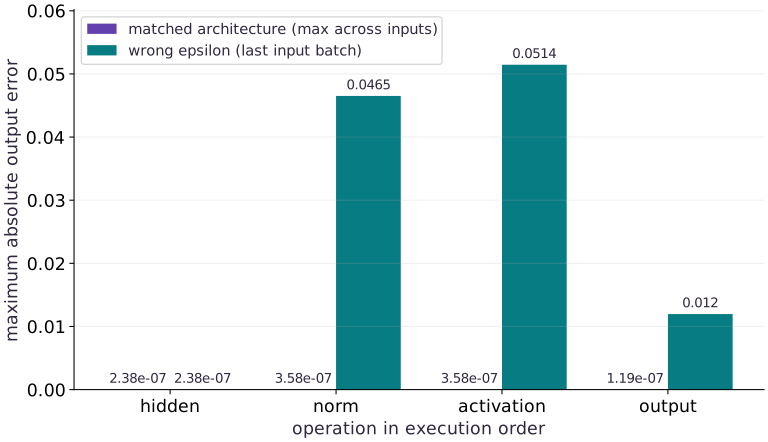
In the matched fixture, maximum absolute errors stay between and across hidden, normalization, activation and output. With only epsilon changed, hidden error remains , then normalization jumps to 0.0465; activation reaches 0.0514 and output later falls to 0.0120. The first bad layer identifies the likely cause more reliably than the largest final error.
Small errors need a scale-aware budget
Predict: Why can a larger absolute difference pass at a larger reference value?
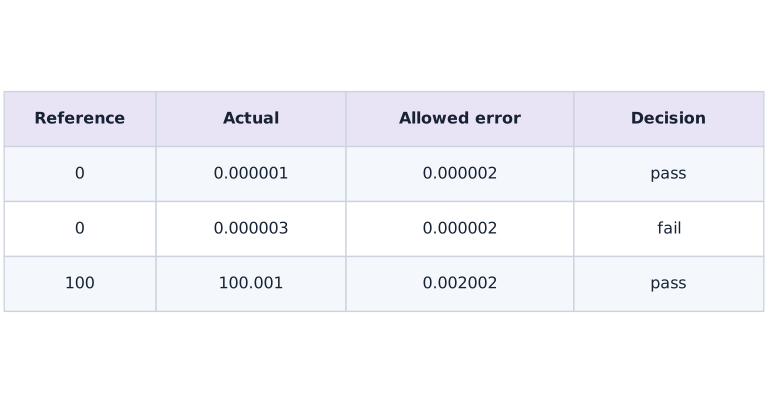
Each table row is one elementwise tolerance check: allowed difference is . Near zero, a difference of passes and fails; at reference 100, the budget is 0.002002, so 0.001 passes. These are hand-worked tolerance examples. The executed plot separately shows the epsilon fault’s first mismatch at normalization.
Write the architecture contract before mapping weights
Our input has shape , the hidden width is , and the output width is . PyTorch Linear stores output-by-input weights, while Flax Linear uses input-by-output kernels, so transpose those two arrays. LayerNorm scale and bias stay one-dimensional and do not transpose. Require every expected key exactly once; ignoring unknown or missing parameters can silently leave random weights in the target.
Match operations, not just tensors
Use the same LayerNorm epsilon, feature axes, variance convention and affine parameters. Select exact GELU in both frameworks instead of mixing exact and tanh approximations. Disable training-only behavior and match preprocessing, padding, positions and output labels before claiming parity. The Flax implementation disables the fast variance formula to make the comparison boundary explicit; float32 execution can still differ slightly across kernels.
Use an error budget that works near zero
For each element, require the absolute difference to fit an absolute tolerance plus a relative tolerance times the reference magnitude. Absolute tolerance handles near-zero references; relative tolerance scales with large values. Report maximum absolute error and relative L2 error, but retain the elementwise decision so a small aggregate cannot hide a bad element. Set tolerances before inspecting the candidate, record dtype/backend, and never turn NaN into a passing comparison.
Find the first mismatch
Capture hidden linear output, normalized values, activation and final logits for the same inputs. A wrong LayerNorm epsilon leaves the hidden linear output correct but changes the normalized output first. Later mismatches may be consequences rather than separate bugs. Use several batch sizes and amplitudes: one large random batch can miss epsilon-sensitive or near-zero behavior.
Validate the derivative and the saved artifact
For a scalar sum of outputs, compare gradients with respect to the input in both frameworks. Then save the Flax arrays with architecture metadata and reload them before inference. The project also starts a fresh process for this step. Only load trusted checkpoint sources; weights_only loading limits the PyTorch loading path but is separate from authenticity or universal safety.
Extend the mapping deliberately
Convolution kernels may require OIHW to HWIO permutations, not a dense transpose. Attention may fuse query/key/value tensors or arrange heads differently. Tied embeddings, normalization order, rotary positions and vocabulary row order can all change behavior despite matching shapes. Add these operations one at a time with golden inputs and intermediate comparisons. This lesson validates its named MLP only; those additional architectures need their own executed mappings.
Read an error budget one element at a time
A relative error alone behaves badly near a zero reference. Use an absolute allowance near zero and a relative allowance for larger values. For a reference and converted value , the allowed difference is . The reference is deliberately the source value; exchanging the two arguments changes the budget slightly.
With and , a reference of zero allows absolute error. An error of passes even though dividing by the reference is undefined. At reference , the budget is , so an error of passes. These tolerances are declared checks for this FP32 fixture. Derive and test a different budget for a different computation or precision policy.
Probe more than the sum of the outputs
The companion compares the input gradient of the sum of outputs. That is one projection of the Jacobian: it weights every output equally. Opposing errors can cancel in that projection. Use a nonuniform output sensitivity, called a cotangent, to ask how a different weighted combination changes with the input.
Keep the source in evaluation mode, use the same input and cotangent, and reset the PyTorch input gradient before comparing. Inspect the first failing forward boundary before studying derivative differences. Matching this additional probe strengthens the test; it still does not prove equality of the entire Jacobian for every input.
Convert one bounded decoder checkpoint
The optional companion labs/transformer_bridge.py creates and saves a tiny local PyTorch decoder state_dict, reloads it, converts it into Flax NNX, and checks each intermediate in execution order. Its architecture matches the course block: pre-normalized causal self-attention, residual addition, pre-normalized GELU MLP, second residual, and tied token/output embeddings. The fixture uses width 8, two heads, MLP width 16, one block, and a seven-token vocabulary. The fixture is generated locally; no production checkpoint is downloaded.
The source key qkv.weight has shape [3D,D], with contiguous [Q_all,K_all,V_all] rows. The NNX qkv.kernel has shape [D,3D], so conversion transposes once; the reshape then interprets [B,T,3,H,D/H]. The other Linear weights map [out,in] to [in,out]; biases and embedding tables keep their axes. The output projection reads the exact token embedding table, so it is tied rather than copied into a second parameter. The fixture records a processor identity that binds the token-to-ID vocabulary.
Inputs use asymmetric token rows, nonsequential position_ids, and a padding key. The mask contract is True means this key is valid, combined with a lower-triangular causal mask. The companion prints absolute and relative-L2 errors per boundary. It checks the elementwise budget 3e-6 + 3e-5*abs(reference): float32 CPU kernels differ by a few ULPs, while a meaningful layout or semantic error is orders of magnitude larger. A nonuniform mixed-sign cotangent checks an input VJP. Same-shape QKV/head reinterpretation and inverted mask faults must fail. Finally, a separate Python process reloads the converted artifact and reproduces logits. This supports only the declared fixture contract, not arbitrary PyTorch or Hugging Face checkpoint families.
Run instructions: Optional framework environment — macOS/Linux, workspace root
python3 -m venv .venv-transformer-parity
.venv-transformer-parity/bin/python -m pip install "jax==0.9.2" "flax==0.12.6" "torch==2.11.0" "numpy==2.4.4"
Expected:
An isolated CPU-capable environment for the optional PyTorch/NNX fixture. The lesson core remains usable without installing these frameworks.
Run instructions: Optional saved Transformer fixture — workspace root after activating the environment
JAX_PLATFORMS=cpu .venv-transformer-parity/bin/python phases/15-deployment/08-pytorch-to-flax-numerical-parity/labs/transformer_bridge.pyExpected:
PASS for ordered activations, nonuniform VJP, deliberate same-shape QKV/head and mask faults, tied embeddings, processor identity, and fresh-process save/reload. The fixture is generated locally; no model download is required.
Locate the first divergent layer
Predict before looking: Which bar should remain near zero when only LayerNorm epsilon is wrong?
Read the figure
The x-axis follows hidden linear, normalization, activation and output; the y-axis is maximum absolute output error in each layer’s units. Matched mapping errors remain at roughly –. Wrong epsilon leaves hidden error at , then raises normalization to 0.0465, activation to 0.0514, and output to 0.0120. The earliest jump points to normalization; do not debug the later output projection first.
Connect it to the computation
All weights are held fixed, so the wrong-epsilon bars isolate an operation mismatch. The hidden layer still matches within rounding error, while normalization is the first large error (0.0465); later activation grows it to 0.0514 and output reduces it to 0.0120. The per-element budget and nonuniform-cotangent gradient check are separate evidence. Next inspect epsilon and axes, then rerun varied inputs.
Figure data and execution details
Open full-size figureDownload data and provenance
The notebook contains the data experiment, plotting code, and recorded figure output. Rerun it to test your changes.
Your build: Create a separate main.py in your practice folder. Append each block in order and run python main.py in the lesson environment. The downloaded script is the complete reference, so keep it separate from your attempt.
1 Make the source boundaries inspectable
Create main.py in your lesson workspace and run it with the active course Python environment. Define the source model so every named operation returns its intermediate result.
# Step 1: Make the source boundaries inspectable
"""Explicit CPU PyTorch -> Flax NNX mapping; no generic architecture converter."""
import numpy as np
import jax
import jax.numpy as jnp
import torch
from flax import nnx

# Define `TorchModel` module / container with explicit state and forward pass:
class TorchModel(torch.nn.Module):
    def __init__(self, eps=1e-5):
        super().__init__()
        self.hidden=torch.nn.Linear(3,5)
        self.norm=torch.nn.LayerNorm(5,eps=eps)
        self.out=torch.nn.Linear(5,2)
    def forward(self,x):
        h=self.hidden(x)
        n=self.norm(h)
        a=torch.nn.functional.gelu(n,approximate='none')
        return {'hidden':h,'norm':n,'activation':a,'output':self.out(a)}

assert TorchModel().eval()(torch.zeros((2,3)))['output'].shape == (2,2)
The probe has two observations and returns an output of shape . It also exposes hidden, normalization and activation tensors for diagnosis.
2 Write the same operations in Flax
Append this block to the same main.py and rerun the whole file. Match dimensions, normalization epsilon, variance calculation and exact GELU.
# Step 2 — Write the same operations in Flax: The probe again returns shape (2,2).
# Define `FlaxModel` module / container with explicit state and forward pass:
class FlaxModel(nnx.Module):
    def __init__(self,eps=1e-5):
        self.hidden=nnx.Linear(3,5,rngs=nnx.Rngs(0))
        self.norm=nnx.LayerNorm(5,epsilon=eps,use_fast_variance=False,rngs=nnx.Rngs(1))
        self.out=nnx.Linear(5,2,rngs=nnx.Rngs(2))
    def __call__(self,x):
        h=self.hidden(x)
        n=self.norm(h)
        a=jax.nn.gelu(n,approximate=False)
        return {'hidden':h,'norm':n,'activation':a,'output':self.out(a)}

assert FlaxModel()(jnp.zeros((2,3)))['output'].shape == (2,2)
The probe again returns shape . At this point random parameters differ; matching shapes does not mean matching predictions.
Explain the APIs in this step
nnx.Linear(in_features, out_features, ...): Creates a learned affine layer in Flax NNX.nnx.Rngs(seed): Provides named random streams used to initialize and operate on NNX modules.jnp.zeros(shape, dtype=...): Creates a JAX array of the requested shape filled with zeros.
3 Map each parameter and declare tolerances
Append this block to the same main.py and rerun the whole file. Copy checked source arrays into named destination parameters. Compare a hidden output with an independent matrix calculation.
# Step 3 — Map each parameter and declare tolerances: The hidden-layer check passes after transposing the source kernel.
def convert(state,eps=1e-5):
    shapes={'hidden.weight':(5,3),'hidden.bias':(5,),'norm.weight':(5,),'norm.bias':(5,),'out.weight':(2,5),'out.bias':(2,)}
    if set(state)!=set(shapes):raise ValueError('missing or unexpected state key')
    arrays={}
    for name,shape in shapes.items():
        value=state[name].detach().cpu().numpy()
        if value.shape!=shape or value.dtype!=np.float32 or not np.isfinite(value).all():
            raise ValueError('unexpected shape, dtype or nonfinite tensor: '+name)
        arrays[name]=value.copy()
    target=FlaxModel(eps)
    target.hidden.kernel[...]=jnp.asarray(arrays['hidden.weight'].T)
    target.hidden.bias[...]=jnp.asarray(arrays['hidden.bias'])
    target.norm.scale[...]=jnp.asarray(arrays['norm.weight'])
    target.norm.bias[...]=jnp.asarray(arrays['norm.bias'])
    target.out.kernel[...]=jnp.asarray(arrays['out.weight'].T)
    target.out.bias[...]=jnp.asarray(arrays['out.bias'])
    return target

def error_report(reference,actual,atol=2e-6,rtol=2e-5):
    # Transfer the device result to the host for an independent NumPy comparison.
    # Transfer the device result to the host for an independent NumPy comparison.
    reference=np.asarray(reference,dtype=np.float64)
    actual=np.asarray(actual,dtype=np.float64)
    if reference.shape!=actual.shape or not np.isfinite(reference).all() or not np.isfinite(actual).all():
        raise ValueError('shape or finite-value mismatch')
    if min(atol,rtol)<0 or not np.isfinite([atol,rtol]).all():raise ValueError('invalid tolerances')
    absolute=np.abs(actual-reference)
    budget=atol+rtol*np.abs(reference)
    return {'max_abs':float(absolute.max()),'relative_l2':float(np.linalg.norm(actual-reference)/max(np.linalg.norm(reference),1e-12)),
            'passed':bool(np.all(absolute<=budget))}

step_source = TorchModel().eval()
step_target = convert(step_source.state_dict())
step_input = np.array([[1., -2., .5]], np.float32)
step_expected = step_input @ step_source.hidden.weight.detach().numpy().T + step_source.hidden.bias.detach().numpy()
np.testing.assert_allclose(step_target(jnp.asarray(step_input))['hidden'], step_expected, rtol=2e-5, atol=2e-6)
The hidden-layer check passes after transposing the source kernel. A missing key or wrong source shape should fail before inference.
Explain the APIs in this step
np.isfinite(x): Returns a NumPy boolean array marking elements that are neitherNaNnor infinite.np.testing.assert_allclose(actual, desired, rtol=..., atol=...): Checks a host-side numerical expectation and raisesAssertionErrorwhen values differ beyond tolerance.
4 Save and reload the converted state
Append this block to the same main.py and rerun the whole file. Store architecture metadata with the arrays and rebuild the target from that archive.
# Step 4 — Save and reload the converted state: The temporary round trip preserves a probe output.
def save_flax(model,path):
    # Transfer the device result to the host for an independent NumPy comparison.
    np.savez(path,hidden_kernel=np.asarray(model.hidden.kernel[...]),hidden_bias=np.asarray(model.hidden.bias[...]),
             norm_scale=np.asarray(model.norm.scale[...]),norm_bias=np.asarray(model.norm.bias[...]),
             out_kernel=np.asarray(model.out.kernel[...]),out_bias=np.asarray(model.out.bias[...]),
             epsilon=np.array(model.norm.epsilon),schema=np.array(1))

def load_flax(path):
    shapes={'hidden_kernel':(3,5),'hidden_bias':(5,),'norm_scale':(5,),'norm_bias':(5,),'out_kernel':(5,2),'out_bias':(2,)}
    with np.load(path,allow_pickle=False) as archive:
        if set(archive.files)!=set(shapes)|{'epsilon','schema'}:raise ValueError('unexpected archive schema')
        if archive['schema'].shape!=() or int(archive['schema'])!=1:raise ValueError('unknown schema')
        if archive['epsilon'].shape!=():raise ValueError('epsilon must be scalar')
        eps=float(archive['epsilon'])
        if not np.isfinite(eps) or eps<=0:raise ValueError('invalid epsilon')
        arrays={}
        for key,shape in shapes.items():
            value=archive[key]
            if value.shape!=shape or value.dtype!=np.float32 or not np.isfinite(value).all():raise ValueError('invalid array '+key)
            arrays[key]=value.copy()
    model=FlaxModel(eps)
    for module,name,key in [(model.hidden,'kernel','hidden_kernel'),(model.hidden,'bias','hidden_bias'),(model.norm,'scale','norm_scale'),(model.norm,'bias','norm_bias'),(model.out,'kernel','out_kernel'),(model.out,'bias','out_bias')]:
        getattr(module,name)[...]=jnp.asarray(arrays[key])
    return model

import tempfile
from pathlib import Path
# Keep this run’s database and artifacts in a scratch directory removed on exit.
with tempfile.TemporaryDirectory() as step_folder:
    step_path = Path(step_folder) / 'roundtrip.npz'
    save_flax(step_target, step_path)
    step_reloaded = load_flax(step_path)
    np.testing.assert_allclose(step_reloaded(jnp.asarray(step_input))['output'], step_target(jnp.asarray(step_input))['output'], rtol=2e-5, atol=2e-6)
The temporary round trip preserves a probe output. The loader validates the array set, dtype, shape and epsilon; a filename alone establishes none of these properties.
Explain the APIs in this step
np.isfinite(x): Returns a NumPy boolean array marking elements that are neitherNaNnor infinite.np.testing.assert_allclose(actual, desired, rtol=..., atol=...): Checks a host-side numerical expectation and raisesAssertionErrorwhen values differ beyond tolerance.
5 Compare input regimes and reproduce a mismatch
Append this block to the same main.py and rerun the whole file. Run the fixed-seed source, layerwise comparison, derivative checks and wrong-epsilon intervention.
# Step 5 — Compare input regimes and reproduce a mismatch: The original epsilon passes all declared gates.
import tempfile
from pathlib import Path
torch.set_num_threads(1)
torch.manual_seed(9)
source=TorchModel().eval()
# A real local state_dict file, loaded using the tensor-only loading option.
with tempfile.TemporaryDirectory() as folder:
    checkpoint=Path(folder)/'weights.pt'
    torch.save(source.state_dict(),checkpoint)
    state=torch.load(checkpoint,map_location='cpu',weights_only=True)
    target=convert(state)
    # Save the converted weights independently of the live PyTorch object.
    converted=Path(folder)/'flax-weights.npz'
    save_flax(target,converted)
    target=load_flax(converted)
    errors={name:[] for name in ['hidden','norm','activation','output']}
    for batch,scale in [(1,1.),(7,1e-3),(5,4.)]:
        inputs=np.random.default_rng(batch).normal(size=(batch,3)).astype(np.float32)*scale
        tx=torch.tensor(inputs,requires_grad=True)
        torch_values=source(tx)
        flax_values=target(jnp.asarray(inputs))
        for name in errors:
            report=error_report(torch_values[name].detach().numpy(),flax_values[name])
            assert report['passed'],(name,report)
            errors[name].append(report['max_abs'])
        torch_values['output'].sum().backward()
        input_gradient=jax.grad(lambda z:jnp.sum(target(z)['output']))(jnp.asarray(inputs))
        assert error_report(tx.grad.numpy(),input_gradient,atol=5e-6,rtol=5e-5)['passed']
    wrong=convert(state,eps=.1)
    reference={k:v.detach().numpy() for k,v in source(torch.tensor(inputs)).items()}
    wrong_reports={k:error_report(reference[k],v) for k,v in wrong(jnp.asarray(inputs)).items()}
    assert wrong_reports['hidden']['passed'] and not wrong_reports['norm']['passed']
    for bad in [dict(state,unexpected=torch.zeros(1)),{k:v for k,v in state.items() if k!='norm.bias'}]:
        try:convert(bad)
        except ValueError:pass
        else:raise AssertionError('incomplete mapping accepted')
print('Maximum absolute error per layer:',{k:max(v) for k,v in errors.items()})
print('Wrong epsilon: first mismatch is norm; intermediate outputs and input gradients verified on CPU.')
The original epsilon passes all declared gates. Changing only epsilon leaves the hidden layer unchanged and first fails normalization. Use that first mismatch to choose a repair.
Explain the APIs in this step
array.sum(axis=...): Adds values along the selected axis; that axis is removed unlesskeepdims=True.jax.grad(loss_fn)(params, ...): Transforms a scalar-output function into one returning the gradient PyTree with the same structure asparams.jnp.sum(x, axis=...): Adds JAX array values along the selected axis.
View the cumulative build in main.py
These blocks append in order to your separate practice file.
# Step 1: Make the source boundaries inspectable
"""Explicit CPU PyTorch -> Flax NNX mapping; no generic architecture converter."""
import numpy as np
import jax
import jax.numpy as jnp
import torch
from flax import nnx

# Define `TorchModel` module / container with explicit state and forward pass:
class TorchModel(torch.nn.Module):
    def __init__(self, eps=1e-5):
        super().__init__()
        self.hidden=torch.nn.Linear(3,5)
        self.norm=torch.nn.LayerNorm(5,eps=eps)
        self.out=torch.nn.Linear(5,2)
    def forward(self,x):
        h=self.hidden(x)
        n=self.norm(h)
        a=torch.nn.functional.gelu(n,approximate='none')
        return {'hidden':h,'norm':n,'activation':a,'output':self.out(a)}

assert TorchModel().eval()(torch.zeros((2,3)))['output'].shape == (2,2)

# Step 2 — Write the same operations in Flax: The probe again returns shape (2,2).
# Define `FlaxModel` module / container with explicit state and forward pass:
class FlaxModel(nnx.Module):
    def __init__(self,eps=1e-5):
        self.hidden=nnx.Linear(3,5,rngs=nnx.Rngs(0))
        self.norm=nnx.LayerNorm(5,epsilon=eps,use_fast_variance=False,rngs=nnx.Rngs(1))
        self.out=nnx.Linear(5,2,rngs=nnx.Rngs(2))
    def __call__(self,x):
        h=self.hidden(x)
        n=self.norm(h)
        a=jax.nn.gelu(n,approximate=False)
        return {'hidden':h,'norm':n,'activation':a,'output':self.out(a)}

assert FlaxModel()(jnp.zeros((2,3)))['output'].shape == (2,2)

# Step 3 — Map each parameter and declare tolerances: The hidden-layer check passes after transposing the source kernel.
def convert(state,eps=1e-5):
    shapes={'hidden.weight':(5,3),'hidden.bias':(5,),'norm.weight':(5,),'norm.bias':(5,),'out.weight':(2,5),'out.bias':(2,)}
    if set(state)!=set(shapes):raise ValueError('missing or unexpected state key')
    arrays={}
    for name,shape in shapes.items():
        value=state[name].detach().cpu().numpy()
        if value.shape!=shape or value.dtype!=np.float32 or not np.isfinite(value).all():
            raise ValueError('unexpected shape, dtype or nonfinite tensor: '+name)
        arrays[name]=value.copy()
    target=FlaxModel(eps)
    target.hidden.kernel[...]=jnp.asarray(arrays['hidden.weight'].T)
    target.hidden.bias[...]=jnp.asarray(arrays['hidden.bias'])
    target.norm.scale[...]=jnp.asarray(arrays['norm.weight'])
    target.norm.bias[...]=jnp.asarray(arrays['norm.bias'])
    target.out.kernel[...]=jnp.asarray(arrays['out.weight'].T)
    target.out.bias[...]=jnp.asarray(arrays['out.bias'])
    return target

def error_report(reference,actual,atol=2e-6,rtol=2e-5):
    # Transfer the device result to the host for an independent NumPy comparison.
    # Transfer the device result to the host for an independent NumPy comparison.
    reference=np.asarray(reference,dtype=np.float64)
    actual=np.asarray(actual,dtype=np.float64)
    if reference.shape!=actual.shape or not np.isfinite(reference).all() or not np.isfinite(actual).all():
        raise ValueError('shape or finite-value mismatch')
    if min(atol,rtol)<0 or not np.isfinite([atol,rtol]).all():raise ValueError('invalid tolerances')
    absolute=np.abs(actual-reference)
    budget=atol+rtol*np.abs(reference)
    return {'max_abs':float(absolute.max()),'relative_l2':float(np.linalg.norm(actual-reference)/max(np.linalg.norm(reference),1e-12)),
            'passed':bool(np.all(absolute<=budget))}

step_source = TorchModel().eval()
step_target = convert(step_source.state_dict())
step_input = np.array([[1., -2., .5]], np.float32)
step_expected = step_input @ step_source.hidden.weight.detach().numpy().T + step_source.hidden.bias.detach().numpy()
np.testing.assert_allclose(step_target(jnp.asarray(step_input))['hidden'], step_expected, rtol=2e-5, atol=2e-6)

# Step 4 — Save and reload the converted state: The temporary round trip preserves a probe output.
def save_flax(model,path):
    # Transfer the device result to the host for an independent NumPy comparison.
    np.savez(path,hidden_kernel=np.asarray(model.hidden.kernel[...]),hidden_bias=np.asarray(model.hidden.bias[...]),
             norm_scale=np.asarray(model.norm.scale[...]),norm_bias=np.asarray(model.norm.bias[...]),
             out_kernel=np.asarray(model.out.kernel[...]),out_bias=np.asarray(model.out.bias[...]),
             epsilon=np.array(model.norm.epsilon),schema=np.array(1))

def load_flax(path):
    shapes={'hidden_kernel':(3,5),'hidden_bias':(5,),'norm_scale':(5,),'norm_bias':(5,),'out_kernel':(5,2),'out_bias':(2,)}
    with np.load(path,allow_pickle=False) as archive:
        if set(archive.files)!=set(shapes)|{'epsilon','schema'}:raise ValueError('unexpected archive schema')
        if archive['schema'].shape!=() or int(archive['schema'])!=1:raise ValueError('unknown schema')
        if archive['epsilon'].shape!=():raise ValueError('epsilon must be scalar')
        eps=float(archive['epsilon'])
        if not np.isfinite(eps) or eps<=0:raise ValueError('invalid epsilon')
        arrays={}
        for key,shape in shapes.items():
            value=archive[key]
            if value.shape!=shape or value.dtype!=np.float32 or not np.isfinite(value).all():raise ValueError('invalid array '+key)
            arrays[key]=value.copy()
    model=FlaxModel(eps)
    for module,name,key in [(model.hidden,'kernel','hidden_kernel'),(model.hidden,'bias','hidden_bias'),(model.norm,'scale','norm_scale'),(model.norm,'bias','norm_bias'),(model.out,'kernel','out_kernel'),(model.out,'bias','out_bias')]:
        getattr(module,name)[...]=jnp.asarray(arrays[key])
    return model

import tempfile
from pathlib import Path
# Keep this run’s database and artifacts in a scratch directory removed on exit.
with tempfile.TemporaryDirectory() as step_folder:
    step_path = Path(step_folder) / 'roundtrip.npz'
    save_flax(step_target, step_path)
    step_reloaded = load_flax(step_path)
    np.testing.assert_allclose(step_reloaded(jnp.asarray(step_input))['output'], step_target(jnp.asarray(step_input))['output'], rtol=2e-5, atol=2e-6)

# Step 5 — Compare input regimes and reproduce a mismatch: The original epsilon passes all declared gates.
import tempfile
from pathlib import Path
torch.set_num_threads(1)
torch.manual_seed(9)
source=TorchModel().eval()
# A real local state_dict file, loaded using the tensor-only loading option.
with tempfile.TemporaryDirectory() as folder:
    checkpoint=Path(folder)/'weights.pt'
    torch.save(source.state_dict(),checkpoint)
    state=torch.load(checkpoint,map_location='cpu',weights_only=True)
    target=convert(state)
    # Save the converted weights independently of the live PyTorch object.
    converted=Path(folder)/'flax-weights.npz'
    save_flax(target,converted)
    target=load_flax(converted)
    errors={name:[] for name in ['hidden','norm','activation','output']}
    for batch,scale in [(1,1.),(7,1e-3),(5,4.)]:
        inputs=np.random.default_rng(batch).normal(size=(batch,3)).astype(np.float32)*scale
        tx=torch.tensor(inputs,requires_grad=True)
        torch_values=source(tx)
        flax_values=target(jnp.asarray(inputs))
        for name in errors:
            report=error_report(torch_values[name].detach().numpy(),flax_values[name])
            assert report['passed'],(name,report)
            errors[name].append(report['max_abs'])
        torch_values['output'].sum().backward()
        input_gradient=jax.grad(lambda z:jnp.sum(target(z)['output']))(jnp.asarray(inputs))
        assert error_report(tx.grad.numpy(),input_gradient,atol=5e-6,rtol=5e-5)['passed']
    wrong=convert(state,eps=.1)
    reference={k:v.detach().numpy() for k,v in source(torch.tensor(inputs)).items()}
    wrong_reports={k:error_report(reference[k],v) for k,v in wrong(jnp.asarray(inputs)).items()}
    assert wrong_reports['hidden']['passed'] and not wrong_reports['norm']['passed']
    for bad in [dict(state,unexpected=torch.zeros(1)),{k:v for k,v in state.items() if k!='norm.bias'}]:
        try:convert(bad)
        except ValueError:pass
        else:raise AssertionError('incomplete mapping accepted')
print('Maximum absolute error per layer:',{k:max(v) for k,v in errors.items()})
print('Wrong epsilon: first mismatch is norm; intermediate outputs and input gradients verified on CPU.')
Run the example
python3 phases/15-deployment/08-pytorch-to-flax-numerical-parity/code/main.pyAbout this command
This shortcut uses an activated macOS/Linux course environment in the repository folder. For Windows, use the explicit interpreter command in “Setup help” above. The script includes worked examples and reference solutions.
Inspect the complete assembled example
# Complete runnable example (deployment-08)
"""Explicit CPU PyTorch -> Flax NNX mapping; no generic architecture converter."""
import numpy as np
import jax
import jax.numpy as jnp
import torch
from flax import nnx

# Define `TorchModel` module / container with explicit state and forward pass:
class TorchModel(torch.nn.Module):
    def __init__(self, eps=1e-5):
        super().__init__()
        self.hidden=torch.nn.Linear(3,5)
        self.norm=torch.nn.LayerNorm(5,eps=eps)
        self.out=torch.nn.Linear(5,2)
    def forward(self,x):
        h=self.hidden(x)
        n=self.norm(h)
        a=torch.nn.functional.gelu(n,approximate='none')
        return {'hidden':h,'norm':n,'activation':a,'output':self.out(a)}

# Define `FlaxModel` module / container with explicit state and forward pass:
class FlaxModel(nnx.Module):
    def __init__(self,eps=1e-5):
        self.hidden=nnx.Linear(3,5,rngs=nnx.Rngs(0))
        self.norm=nnx.LayerNorm(5,epsilon=eps,use_fast_variance=False,rngs=nnx.Rngs(1))
        self.out=nnx.Linear(5,2,rngs=nnx.Rngs(2))
    def __call__(self,x):
        h=self.hidden(x)
        n=self.norm(h)
        a=jax.nn.gelu(n,approximate=False)
        return {'hidden':h,'norm':n,'activation':a,'output':self.out(a)}

def convert(state,eps=1e-5):
    shapes={'hidden.weight':(5,3),'hidden.bias':(5,),'norm.weight':(5,),'norm.bias':(5,),'out.weight':(2,5),'out.bias':(2,)}
    if set(state)!=set(shapes):raise ValueError('missing or unexpected state key')
    arrays={}
    for name,shape in shapes.items():
        value=state[name].detach().cpu().numpy()
        if value.shape!=shape or value.dtype!=np.float32 or not np.isfinite(value).all():
            raise ValueError('unexpected shape, dtype or nonfinite tensor: '+name)
        arrays[name]=value.copy()
    target=FlaxModel(eps)
    target.hidden.kernel[...]=jnp.asarray(arrays['hidden.weight'].T)
    target.hidden.bias[...]=jnp.asarray(arrays['hidden.bias'])
    target.norm.scale[...]=jnp.asarray(arrays['norm.weight'])
    target.norm.bias[...]=jnp.asarray(arrays['norm.bias'])
    target.out.kernel[...]=jnp.asarray(arrays['out.weight'].T)
    target.out.bias[...]=jnp.asarray(arrays['out.bias'])
    return target

def error_report(reference,actual,atol=2e-6,rtol=2e-5):
    # Transfer the device result to the host for an independent NumPy comparison.
    # Transfer the device result to the host for an independent NumPy comparison.
    reference=np.asarray(reference,dtype=np.float64)
    actual=np.asarray(actual,dtype=np.float64)
    if reference.shape!=actual.shape or not np.isfinite(reference).all() or not np.isfinite(actual).all():
        raise ValueError('shape or finite-value mismatch')
    if min(atol,rtol)<0 or not np.isfinite([atol,rtol]).all():raise ValueError('invalid tolerances')
    absolute=np.abs(actual-reference)
    budget=atol+rtol*np.abs(reference)
    return {'max_abs':float(absolute.max()),'relative_l2':float(np.linalg.norm(actual-reference)/max(np.linalg.norm(reference),1e-12)),
            'passed':bool(np.all(absolute<=budget))}

def save_flax(model,path):
    # Transfer the device result to the host for an independent NumPy comparison.
    np.savez(path,hidden_kernel=np.asarray(model.hidden.kernel[...]),hidden_bias=np.asarray(model.hidden.bias[...]),
             norm_scale=np.asarray(model.norm.scale[...]),norm_bias=np.asarray(model.norm.bias[...]),
             out_kernel=np.asarray(model.out.kernel[...]),out_bias=np.asarray(model.out.bias[...]),
             epsilon=np.array(model.norm.epsilon),schema=np.array(1))

def load_flax(path):
    shapes={'hidden_kernel':(3,5),'hidden_bias':(5,),'norm_scale':(5,),'norm_bias':(5,),'out_kernel':(5,2),'out_bias':(2,)}
    with np.load(path,allow_pickle=False) as archive:
        if set(archive.files)!=set(shapes)|{'epsilon','schema'}:raise ValueError('unexpected archive schema')
        if archive['schema'].shape!=() or int(archive['schema'])!=1:raise ValueError('unknown schema')
        if archive['epsilon'].shape!=():raise ValueError('epsilon must be scalar')
        eps=float(archive['epsilon'])
        if not np.isfinite(eps) or eps<=0:raise ValueError('invalid epsilon')
        arrays={}
        for key,shape in shapes.items():
            value=archive[key]
            if value.shape!=shape or value.dtype!=np.float32 or not np.isfinite(value).all():raise ValueError('invalid array '+key)
            arrays[key]=value.copy()
    model=FlaxModel(eps)
    for module,name,key in [(model.hidden,'kernel','hidden_kernel'),(model.hidden,'bias','hidden_bias'),(model.norm,'scale','norm_scale'),(model.norm,'bias','norm_bias'),(model.out,'kernel','out_kernel'),(model.out,'bias','out_bias')]:
        getattr(module,name)[...]=jnp.asarray(arrays[key])
    return model

import tempfile
from pathlib import Path
torch.set_num_threads(1)
torch.manual_seed(9)
source=TorchModel().eval()
# A real local state_dict file, loaded using the tensor-only loading option.
with tempfile.TemporaryDirectory() as folder:
    checkpoint=Path(folder)/'weights.pt'
    torch.save(source.state_dict(),checkpoint)
    state=torch.load(checkpoint,map_location='cpu',weights_only=True)
    target=convert(state)
    # Save the converted weights independently of the live PyTorch object.
    converted=Path(folder)/'flax-weights.npz'
    save_flax(target,converted)
    target=load_flax(converted)
    errors={name:[] for name in ['hidden','norm','activation','output']}
    for batch,scale in [(1,1.),(7,1e-3),(5,4.)]:
        inputs=np.random.default_rng(batch).normal(size=(batch,3)).astype(np.float32)*scale
        tx=torch.tensor(inputs,requires_grad=True)
        torch_values=source(tx)
        flax_values=target(jnp.asarray(inputs))
        for name in errors:
            report=error_report(torch_values[name].detach().numpy(),flax_values[name])
            assert report['passed'],(name,report)
            errors[name].append(report['max_abs'])
        torch_values['output'].sum().backward()
        input_gradient=jax.grad(lambda z:jnp.sum(target(z)['output']))(jnp.asarray(inputs))
        assert error_report(tx.grad.numpy(),input_gradient,atol=5e-6,rtol=5e-5)['passed']
    wrong=convert(state,eps=.1)
    reference={k:v.detach().numpy() for k,v in source(torch.tensor(inputs)).items()}
    wrong_reports={k:error_report(reference[k],v) for k,v in wrong(jnp.asarray(inputs)).items()}
    assert wrong_reports['hidden']['passed'] and not wrong_reports['norm']['passed']
    for bad in [dict(state,unexpected=torch.zeros(1)),{k:v for k,v in state.items() if k!='norm.bias'}]:
        try:convert(bad)
        except ValueError:pass
        else:raise AssertionError('incomplete mapping accepted')
print('Maximum absolute error per layer:',{k:max(v) for k,v in errors.items()})
print('Wrong epsilon: first mismatch is norm; intermediate outputs and input gradients verified on CPU.')
Expected result: Correct FP32 conversion passes layerwise and input-gradient tolerances on three input regimes. A changed LayerNorm epsilon first fails at norm; missing and unexpected keys are rejected.
Recorded output and runtime details
Reference output captured from executing the complete lesson script (code/main.py) and its assertions in the course CPU environment.
Maximum absolute error per layer: {'hidden': 2.384185791015625e-07, 'norm': 3.5762786865234375e-07, 'activation': 3.5762786865234375e-07, 'output': 1.1920928955078125e-07}
Wrong epsilon: first mismatch is norm; intermediate outputs and input gradients verified on CPU.
Maximum absolute error per layer: {'hidden': 2.384185791015625e-07, 'norm': 3.5762786865234375e-07, 'activation': 3.5762786865234375e-07, 'output': 1.1920928955078125e-07}
Wrong epsilon: first mismatch is norm; intermediate outputs and input gradients verified on CPU.
Per-layer wrong-epsilon report: {'hidden': {'max_abs': 2.384185791015625e-07, 'relative_l2': 3.5662515782829134e-08, 'passed': True}, 'norm': {'max_abs': 0.046508073806762695, 'relative_l2': 0.018277932316979384, 'passed': False}, 'activation': {'max_abs': 0.05144989490509033, 'relative_l2': 0.022399576976497533, 'passed': False}, 'output': {'max_abs': 0.011958837509155273, 'relative_l2': 0.013684121610437203, 'passed': False}}
Near-zero, excessive near-zero, large-value: True False True
Near-zero acceptance and rejection verified.
Wrong source layout rejected
Nonuniform cotangent input-gradient parity: {'max_abs': 2.086162567138672e-07, 'relative_l2': 4.910744924550249e-07, 'passed': True}
PASS: deployment-08
Download execution record · The notebook includes executed cells and figure outputs. Compare your run with these values; timings depend on the machine.
Inspect the wrong-epsilon signature
# Experiment — Inspect the wrong-epsilon signature
assert wrong_reports['hidden']['passed']
assert not wrong_reports['norm']['passed']
print('Per-layer wrong-epsilon report:',wrong_reports)
Expected: The first dense layer passes; normalization fails first.
Localize the first divergent operation before remapping unrelated weights. The plot records downstream effects as well as the first failure.
Test the tolerance rule near zero
# Experiment — Test the tolerance rule near zero: The gate checks each element against a reference-dependent budget.
near_zero = error_report([0.], [1e-6])
near_zero_fail = error_report([0.], [3e-6])
large_value = error_report([100.], [100.001])
assert near_zero['passed'] and not near_zero_fail['passed'] and large_value['passed']
print('Near-zero, excessive near-zero, large-value:', near_zero['passed'], near_zero_fail['passed'], large_value['passed'])
Expected: The three decisions are pass, fail, pass.
The gate checks each element against a reference-dependent budget. A single relative-error percentage is not a substitute.
Make it yours
Where to put your code: Modify your own main.py, or use the Make it yours cell in your downloaded notebook. Run your attempt in the declared environment and verify your prediction before opening the reference solution.
Compare a near-zero reference against two candidate errors. Verify that the absolute tolerance accepts rounding noise but rejects a meaningful discrepancy.
Show a writing guide and starter scaffold
How to write this exercise code
Learner-only inputs, outputs, checks and hints
Inputs
- A near-zero reference value, the two candidate values, and the declared absolute/relative tolerances.
Outputs
- Whether rounding noise is accepted and whether the meaningful discrepancy is rejected.
Invariants to check
- The absolute tolerance handles the near-zero rounding case; the larger discrepancy remains outside tolerance.
Hints
- Evaluate each candidate against the same near-zero reference.
- Include the absolute and relative tolerance terms in the comparison rule.
import numpy as np

def check_near_zero_tolerance(reference, candidates, atol, rtol):
    # TODO: Apply the declared tolerance to both candidate errors and report each acceptance result.
    raise NotImplementedError
Reveal the reference solution
# Exercise solution: Compare a near-zero reference against two candidate errors.
assert error_report([0.,1.],[1e-7,1.000001])['passed']
assert not error_report([0.,1.],[1e-3,1.])['passed']
print('Near-zero acceptance and rejection verified.')
Reject a plausible but wrong tensor layout
Transfer
Transpose the first PyTorch weight before conversion and prove the boundary rejects it instead of transposing it a second time.
Show a writing guide and starter scaffold
How to write this practice solution
Learner-only inputs, outputs, checks and hints
Inputs
- Transpose the first PyTorch weight before conversion and prove the boundary rejects it instead of transposing it a second time.
Outputs
- A rejection for the transposed source tensor and parity for the correct mapping.
Invariants to check
- The converter performs one documented layout transform.
Hints
- The first weight is rectangular, so validate its source shape before applying the mapping.
- Compare asymmetric matrix dimensions so a mistaken second transpose is visible.
import numpy as np
import jax
import jax.numpy as jnp
import torch
from flax import nnx

def practice_reject_a_plausible_but_wrong_tensor_layout(source_weight, converted_weight, tolerance):
    """Complete the reject a plausible but wrong tensor layout check."""
    # TODO: ('Transpose the source first-layer weight before mapping and check that the parity boundary rejects it without a second transpose.', 'A failed wrong-layout parity check and an accepted correctly mapped matrix.', 'Each framework layout conversion is applied exactly once.')
    raise NotImplementedError
Show a hint
The first weight is rectangular, so validate its source shape before applying the mapping.
Reveal reference solution and reasoning
# Reject a plausible but wrong tensor layout (Transfer)
bad_state=dict(state)
bad_state['hidden.weight']=state['hidden.weight'].T
try:convert(bad_state)
except ValueError:print('Wrong source layout rejected')
else:raise AssertionError('layout mismatch accepted')
Asymmetric dimensions expose orientation errors that square test matrices can hide. Shape checks complement numerical checks rather than replacing them.
Check a nonuniform output sensitivity
Transfer / diagnosis
Compare the source and converted input gradients for an output cotangent that contains unequal positive and negative entries. Explain what this tests beyond summing the outputs.
Show a writing guide and starter scaffold
How to write this practice solution
Learner-only inputs, outputs, checks and hints
Inputs
- Compare the source and converted input gradients for an output cotangent that contains unequal positive and negative entries. Explain what this tests beyond summing the outputs.
Outputs
- Source and converted input-gradient vectors.
Invariants to check
- Both paths receive the same mixed-sign output cotangent.
Hints
- Form the same scalar weighted output in each framework. Create a fresh PyTorch input so earlier gradients do not accumulate.
- Compare gradient entries with declared numerical tolerances.
import numpy as np
import jax
import jax.numpy as jnp
import torch
from flax import nnx

def practice_check_a_nonuniform_output_sensitivity(source_fn, converted_fn, inputs, cotangent):
    """Complete the check a nonuniform output sensitivity check."""
    # TODO: ('Use a mixed-sign output cotangent to compare source and converted input gradients.', 'Two input-gradient vectors with tolerance-based parity.', 'The same nonuniform cotangent is applied to both implementations.')
    raise NotImplementedError
Show a hint
Form the same scalar weighted output in each framework. Create a fresh PyTorch input so earlier gradients do not accumulate.
Reveal reference solution and reasoning
# Check a nonuniform output sensitivity (Transfer / diagnosis): This checks J^{\mathsf T}v for a second, nonuniform direction.
probe_inputs = np.array([[.2, -.7, 1.1], [1., .4, -.5]], np.float32)
cotangent = np.array([[1., -.5], [2., .25]], np.float32)
probe_torch = torch.tensor(probe_inputs, requires_grad=True)
weighted_source = (source(probe_torch)['output'] * torch.tensor(cotangent)).sum()
weighted_source.backward()
weighted_target = jax.grad(lambda z: jnp.sum(target(z)['output'] * jnp.asarray(cotangent)))(jnp.asarray(probe_inputs))
vjp_report = error_report(probe_torch.grad.numpy(), weighted_target, atol=5e-6, rtol=5e-5)
assert vjp_report['passed'], vjp_report
print('Nonuniform cotangent input-gradient parity:', vjp_report)
This checks for a second, nonuniform direction. It can reveal errors hidden by an all-ones sensitivity. The same activation, normalization and parameter mapping must support both forward and derivative agreement.
Diagnose the result
Reject missing, extra, malformed or nonfinite weights before assignment. If the first linear output differs, inspect orientation and bias. If normalization first differs, inspect its contract. If forward outputs agree but gradients differ, inspect operation approximations and differentiability; retain both results.
Keep your evidence
Keep MLP normalization/activation parity, first-divergence evidence, the optional QKV/head layout and mask canaries, nonuniform VJP, processor/position identity and fresh-process reload results.
Save your modified code, its output, and an explanation of your prediction. Checkpoint answers and exercise evidence are tracked separately.
Saved in this browser. Export or back up your portfolio anytime in My learning.
Reference execution: CPU validation only. This worked reference is validated on CPU. Accelerator compatibility requires a separate source review and target execution receipt. Use the execution matrix to review device selection and data ownership before adapting a separate target program. Execution matrix and target qualification.